
What to Do When You Have a Clogged Toilet
A clogged toilet is one of the most common plumbing emergencies homeowners face — and one of the most stressful. The good news? Most clogs can be cleared at home in minutes.
Here’s how to unclog a toilet fast:
- Stop the overflow — turn off the water supply valve behind the toilet
- Use a flange plunger — cover the drain and pump firmly 10–20 times
- Try dish soap + hot water — pour soap in, follow with hot (not boiling) water
- Use baking soda + vinegar — pour 1 cup baking soda, then 1 cup vinegar; wait 20 minutes
- Use a toilet auger — for stubborn clogs that a plunger can’t reach
Plunging alone resolves about 80% of clogs when done correctly. If none of these steps work, it’s time to call a plumber.
Still with us? Good. Whether this is your first clog or your fifth this month, this guide walks you through every step — from stopping an overflow to knowing when a professional needs to step in.
Toilet clogs are frustrating, but ignoring them can make things much worse. A simple blockage left untreated can turn into a sewage backup, water damage, or a sign of a deeper problem in your main sewer line. The average emergency plumbing call runs $200–$400 — a cost that’s often avoidable with fast, informed action.
I’m Hugh Hodur, President of VanDerBosch Plumbing, and over the years I’ve seen how a clogged toilet can quickly escalate from a minor inconvenience into a costly plumbing emergency when not handled correctly. Let’s make sure that doesn’t happen to you.
What Causes a Clogged Toilet?
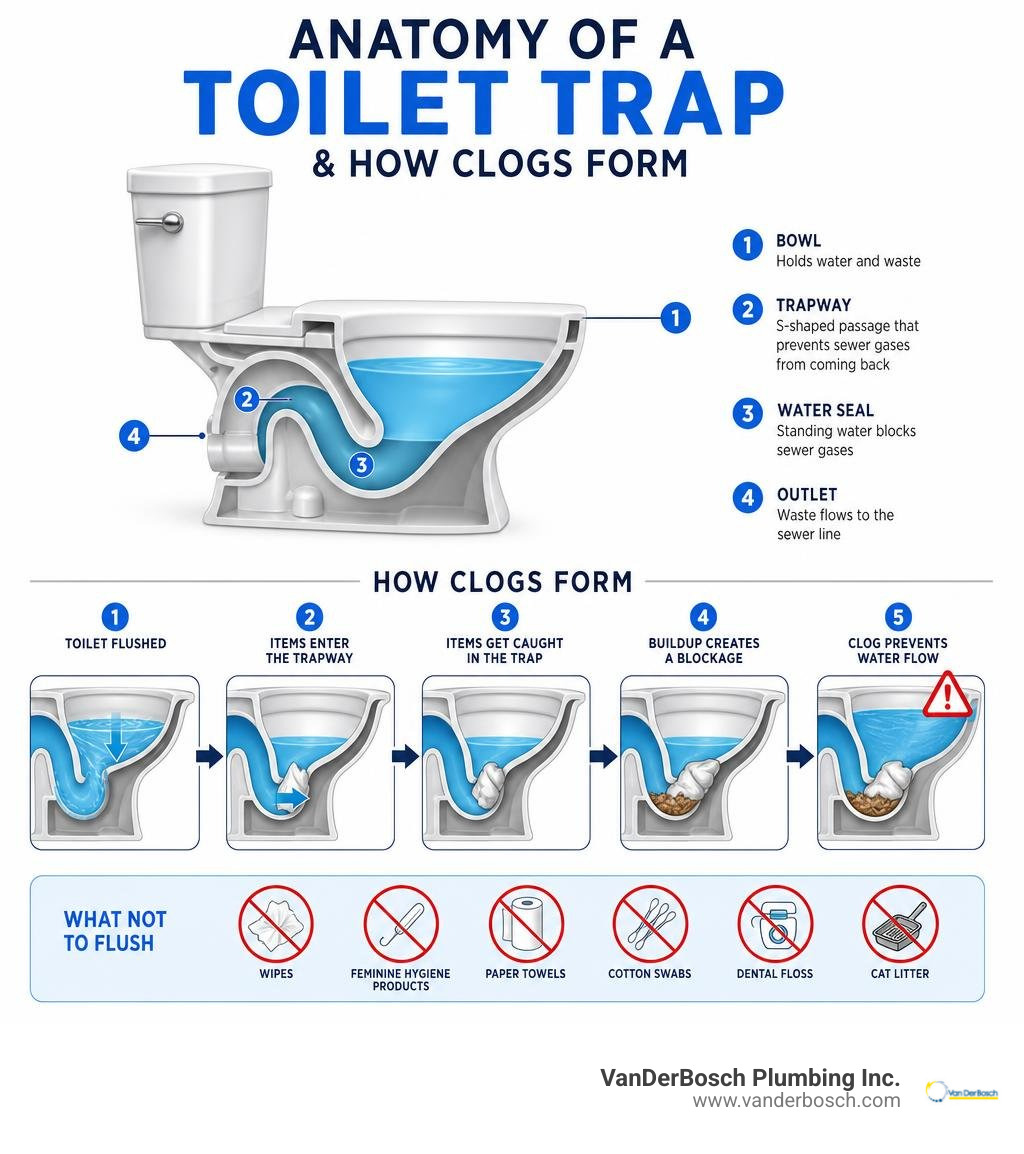
Before you grab your plunger and prepare for battle, it helps to understand what you are actually fighting. Toilets are beautifully simple machines designed to handle only two things: human waste and toilet paper. When anything else enters the mix, the delicate balance of your home’s wastewater system is thrown off.
In fact, over 50% of toilet clogs are caused by flushing non-flushable items. When these items meet the narrow, twisting passages of your toilet’s internal plumbing, they get stuck. Over time, even minor waste can build up behind these obstructions, sealing off the pipe entirely.
If you are constantly dealing with a toilet that refuses to cooperate, it is usually due to a combination of improper flushing habits, outdated fixture designs, or hard water. You can Learn more about preventing clogs to protect your pipes over the long term.
Household Habits and Non-Flushable Items
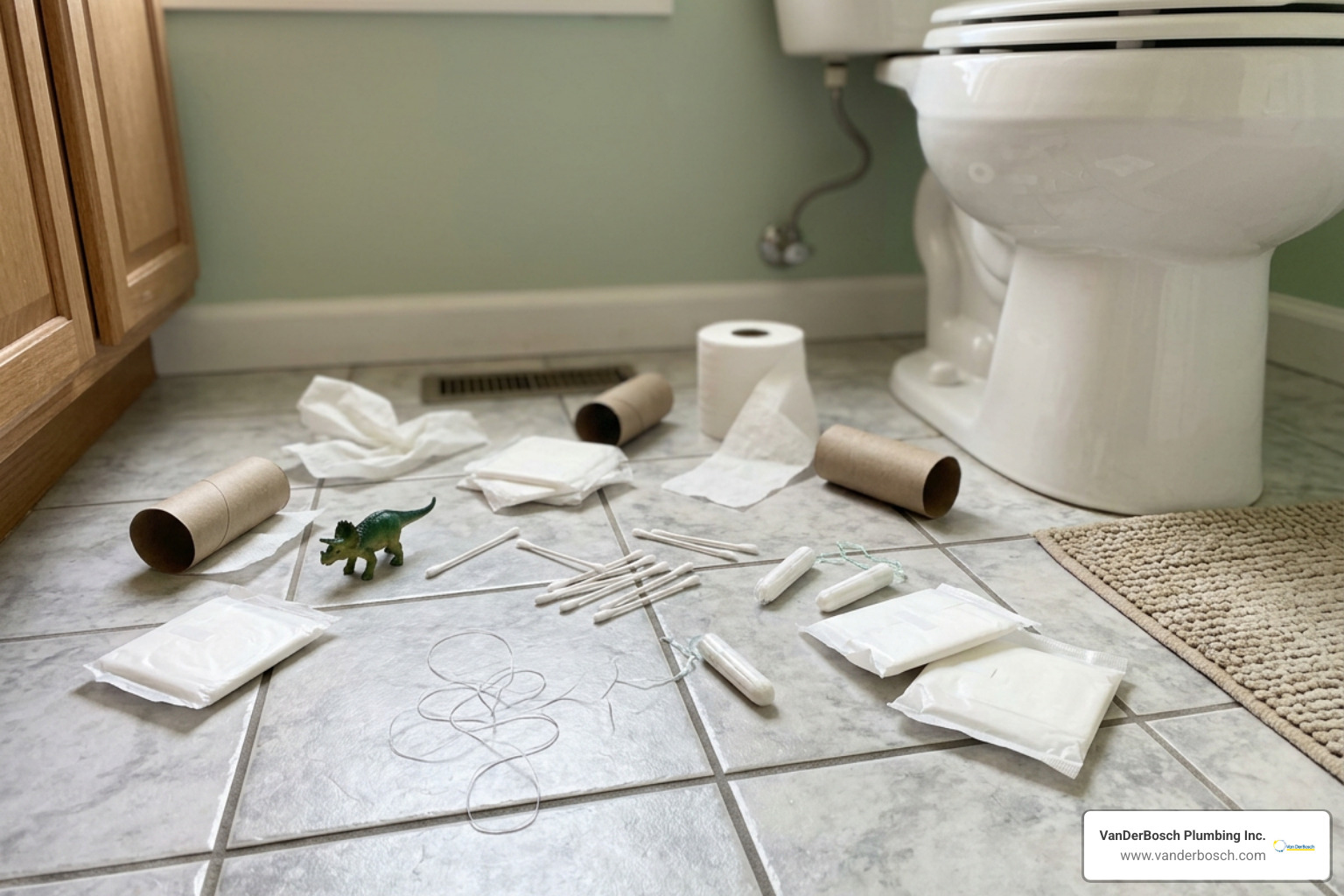
The modern bathroom is full of products that claim to be “convenient,” but are actually a nightmare for your plumbing. Chief among these are baby wipes and so-called “flushable” wipes. Despite what the packaging claims, flushable wipes do not disintegrate in water the way toilet paper does. Instead, they remain fully intact, floating down your pipes until they catch on a rough edge or a bend.
Other common offenders include paper towels, facial tissues, cotton swabs, dental floss, hair, and feminine products. Dental floss and hair are particularly insidious; they act like tiny nets, catching other debris and binding them together into solid, indestructible blockages. Even cooking grease poured down a nearby sink can find its way into your main line, cooling and solidifying into a sticky trap that catches toilet waste.
To keep your plumbing flowing smoothly, it is vital to understand how different materials behave once they leave the bowl:
| Material Type | Dissolves in Water? | Safe to Flush? | Impact on Home Plumbing |
|---|---|---|---|
| Standard Toilet Paper | Yes (breaks down in seconds) | Yes | Minimal; designed specifically for home waste systems. |
| “Flushable” Wipes | No (remains intact for hours/days) | No | High risk; catches on pipe joints and causes severe blockages. |
| Paper Towels & Tissues | No (designed to absorb and stay strong) | No | High risk; expands in water and immediately wedges in the trap. |
| Feminine Hygiene Products | No (designed to expand) | No | Extremely high risk; causes immediate mechanical blockages. |
| Dental Floss & Hair | No (extremely strong tensile strength) | No | Moderate to high risk; tangles and binds other waste together. |
Toilet Design and Mechanical Issues
Sometimes, the culprit isn’t what you are flushing, but the toilet itself. Every toilet is built with a curved internal channel called the toilet trap or S-bend. This trap is designed to hold a small pool of standing water, which acts as a physical barrier to block sewer gases from rising into your bathroom. However, because this channel is narrow and curves sharply upward before heading down, it is the most common spot for a clogged toilet to occur.
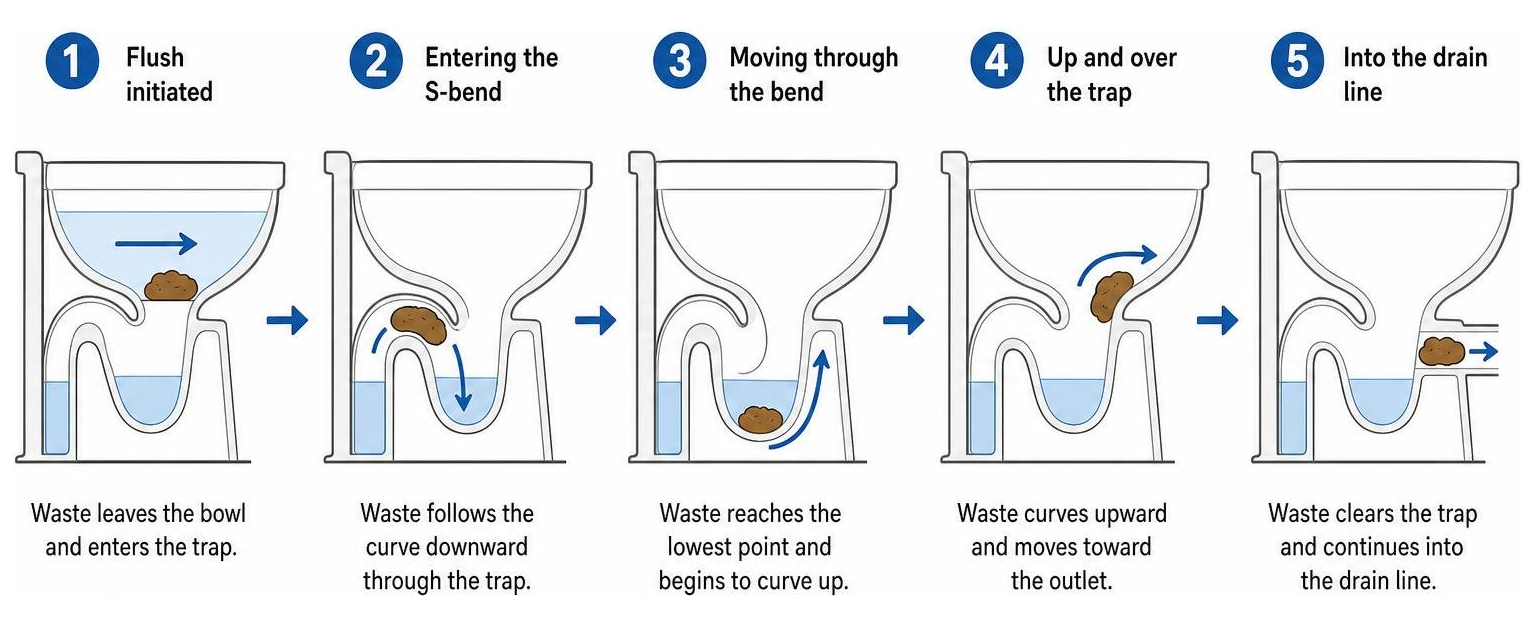
Older low-flow toilets — particularly early models manufactured between 1994 and 2005 — are notorious for clogging. Engineered to use only 1.6 gallons per flush (GPF) or less compared to the 3.5 to 5 gallons used by older models, these early designs often lacked the velocity and siphon power needed to push waste completely through the trap. Statistics show that these older low-flow models are 2 to 3 times more likely to clog than modern high-efficiency toilets.
Additionally, if you live in Chicagoland areas like Niles, Winnetka, or Elmhurst, you may have hard water. Over time, hard water minerals (like calcium and magnesium) build up inside the toilet’s rim jets and siphon jet. When these jets are restricted by mineral scale, the flush loses its force, resulting in a weak, lazy flush that cannot clear the bowl. If you are experiencing slow drains elsewhere in your home alongside toilet issues, check out our guide on How to fix other household drains to rule out localized pipe issues.
The 5-Step Guide to Clearing a Toilet Blockage
When you are facing a backed-up toilet, time is of the essence. Fortunately, you do not need a truck full of professional gear to resolve most minor blockages. A few basic household items and the right technique can get your bathroom back in working order.
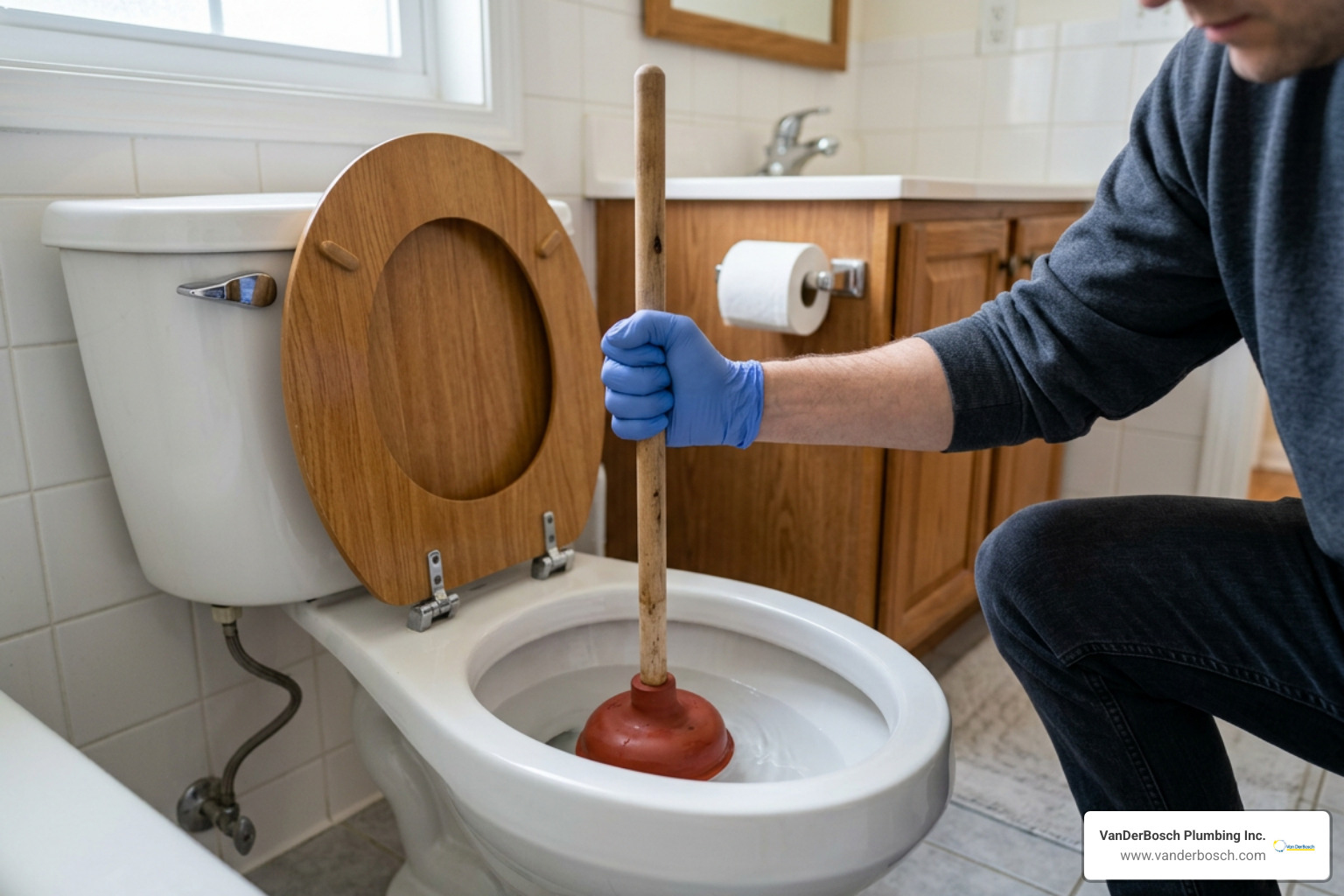
Before you begin, make sure you have the right safety gear. We highly recommend wearing long rubber gloves and eye protection to protect yourself from splashing water. Open a window or turn on the bathroom fan for ventilation, and lay down old towels or newspaper around the base of the toilet to catch any spills.
For a complete breakdown of tools and safety prep, you can also consult this Step-by-step guide to unclogging.
Step 1: Stop the Overflow and Prep the Area
Nothing causes instant panic quite like flushing a toilet and watching the water rise toward the rim. If this happens, do not flush again. Flushing a second time will guarantee an overflow.
Instead, act quickly to stop the water flow:
- Reach behind the toilet tank and locate the metal shutoff valve connected to the wall. Twist this valve clockwise until it is tight to shut off the water supply.
- If the valve is stuck or rusted, quickly remove the lid of the toilet tank. Locate the rubber flapper at the bottom of the tank and push it down manually to seal the drain.
- Alternatively, lift the float cup or ball float upward; this tricks the fill valve into thinking the tank is already full, immediately stopping more water from entering the bowl.
Once the water is stable, prep your work area by laying down towels around the base of the toilet. If the bowl is filled to the very brim, use a small disposable cup to scoop out some of the excess water into a bucket, leaving enough water to submerge the head of your plunger.
Step 2: Apply the Flange Plunger Correctly
Not all plungers are created equal. For a toilet, you should never use a flat, cup-shaped sink plunger. You need a flange plunger (also known as a toilet plunger), which features an extended rubber sleeve or “collar” at the bottom designed to fit snugly inside the toilet’s round drain hole.
To plunge effectively:
- Lower the plunger into the bowl at an angle so the bell fills with water rather than trapping air. Trapped air compresses and absorbs the force of your plunge, reducing its effectiveness.
- Insert the extended flange directly into the drain opening, ensuring a tight, secure seal against the porcelain.
- Push down gently at first to expel any remaining air, then pull back up.
- Begin plunging with firm, rapid up-and-down motions. The pull-back motion is just as important as the push. The suction created by pulling up loosens the clog, while the push drives it forward.
- Maintain the seal and repeat this push-pull action 15 to 20 times.
If the water suddenly drains with a gurgling sound, you’ve successfully cleared the blockage!
Step 3: Use the Hot Water and Dish Soap Hack
If plunging doesn’t work, or if you don’t have a plunger on hand, the hot water and dish soap method is an incredibly effective alternative for organic waste or toilet paper clogs. This technique relies on lubrication, heat, and gravity to break down the blockage.
- Squirt about a quarter-cup of liquid dish soap (like Dawn) directly into the toilet bowl. The soap is dense and will sink to the bottom, coating the trap and the clog to help lubricate the passage. Let it sit for 10 to 15 minutes.
- While the soap is working, heat a gallon of water on the stove. Crucial Safety Warning: Do not use boiling water. Boiling water can crack the cold porcelain of your toilet bowl, turning a simple clog into a costly replacement job. The water should be hot, like a very warm cup of tea (around 120°F to 140°F).
- Pour the hot water directly into the drain from waist height. The physical weight and pressure of the falling water, combined with the heat and lubricating soap, will often dissolve and push the clog through the S-bend.
- Let the mixture sit for 20 to 30 minutes. If the water level begins to drop, the trick is working.
Step 4: Try a Natural Baking Soda and Vinegar Mixture
For slow-draining toilets or minor organic blockages, a classic baking soda and vinegar chemical reaction can do wonders without damaging your pipes.
- Ensure the toilet bowl is only half-full of water. If it is too full, the fizzing reaction will cause an overflow.
- Pour 1 cup of baking soda directly into the toilet bowl.
- Slowly pour 1 cup of white vinegar into the bowl.
- The mixture will immediately begin to fizz and bubble as the acid and base react, creating carbon dioxide gas. This bubbling action helps to physically break up compressed toilet paper and organic matter.
- Allow the mixture to sit and work its magic for at least 30 minutes, or overnight if possible.
- Follow up by pouring a bucket of hot water into the bowl to flush away any loosened debris.
Step 5: Deploy a Toilet Auger for Stubborn Blockages
When a plunger can’t reach the blockage, it’s time to upgrade to a toilet auger (also known as a closet auger). This specialized tool consists of a long metal shaft with a flexible cable inside, tipped with a corkscrew hook. Importantly, a toilet auger features a protective rubber or plastic sleeve at the bend to prevent the metal cable from scratching the visible porcelain of your toilet bowl.
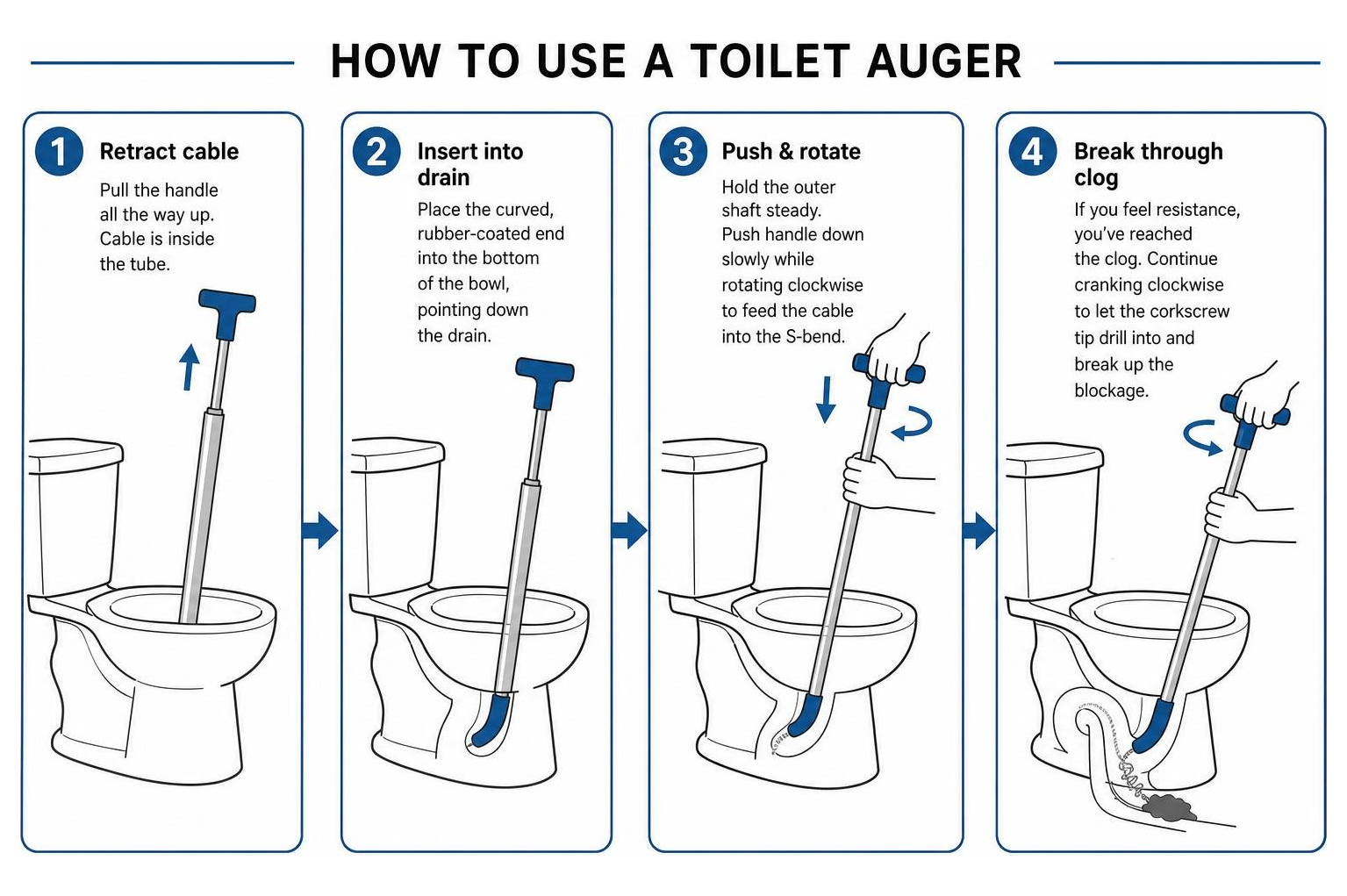
To use a toilet auger:
- Pull the auger handle all the way up so the cable is retracted inside the metal tube.
- Place the curved, rubber-coated end of the auger into the bottom of the toilet bowl, pointing directly down the drain.
- Hold the outer shaft steady with one hand while slowly pushing the handle down and rotating it clockwise with your other hand. This guides the flexible cable deep into the S-bend.
- If you feel resistance, you have reached the clog. Do not try to force it. Instead, continue cranking the handle clockwise to let the corkscrew tip drill into the obstruction.
- Once the auger has snagged the clog, gently pull the cable back up. This will either break up the blockage so it can flush away or retrieve the foreign object (like a child’s toy or washcloth) so you can dispose of it in the trash.
If you’ve tried these methods and your toilet still refuses to budge, you can read more about Why your toilet won’t flush to identify deeper underlying issues.
When to Stop DIY and Call a Professional Plumber
While DIY methods can resolve about 80% of minor household clogs, there are times when continuing to plunge or snake can cause serious damage to your plumbing fixtures or pipes. If you push too hard with an auger, you risk cracking the porcelain bowl or damaging the wax ring seal at the base of the toilet, leading to hidden leaks under your floorboards.
You should stop DIY attempts immediately and call a professional if:
- The clog is completely solid: If you know a rigid object (like a cell phone, toy, or large plastic cap) was flushed, plunging will only wedge it deeper into the trap.
- You experience multiple slow drains: If your kitchen sink, shower, and washing machine drains are all backing up or draining slowly at the same time, the issue is not localized to your toilet.
- Sewage is backing up: If flushing the toilet causes water to rise in your shower drain, or if sewage is pooling in your basement floor drains, you have a major blockage down the line.
- You smell foul sewer odors: Persistent sewer gas odors indicate a broken seal, a blocked vent stack, or a backed-up lateral line.
Recognizing these warnings early can save you thousands of dollars in water damage restoration. Learn more about the Signs your sewer line needs repair to protect your home.
Professional Tools and Techniques for Severe Clogs
When our licensed technicians at VanDerBosch Plumbing arrive at your home, we bring advanced diagnostic and clearing tools that are far more powerful than retail equipment.
First, we utilize state-of-the-art sewer cameras. By inserting a waterproof, high-resolution camera down your toilet or sewer cleanout, we can see exactly what is causing the blockage in real time. This allows us to pinpoint the precise location and nature of the clog — whether it is a mass of flushable wipes, a collapsed pipe, or tree root intrusion. If you have questions about how this works, read our Sewer video inspection FAQs.
For clearing stubborn clogs, we use two primary professional methods:
- Motorized Drain Snakes: These heavy-duty, commercial-grade machines use powerful electric motors to spin a thick steel cable deep into your sewer lines, easily cutting through thick tree roots, grease buildup, and solid obstructions.
- Hydro Jetting: This highly effective, eco-friendly technique blasts high-pressure water (up to 4,000 PSI) through your pipes. Hydro jetting doesn’t just poke a hole in a clog; it thoroughly scrubs the interior walls of your pipes, removing years of grease, mineral scale, and debris, restoring them to like-new condition without the use of harsh chemicals.
Frequently Asked Questions About Clogged Toilets
Why does my clogged toilet keep happening?
If your toilet seems to clog every single week, it is usually a sign of an underlying systemic issue. In older homes across Cook County — from Hyde Park to Sauganash — aging cast-iron or clay sewer pipes can corrode internally, creating a rough surface that catches toilet paper and waste.
Additionally, mature trees on your property can send roots seeking moisture directly into tiny cracks in your sewer lateral, creating a physical root barrier that catches solid waste. If you are tired of dealing with constant backups, you can learn How to avoid sewer line issues to keep your system running smoothly.
Are chemical drain cleaners safe for a clogged toilet?
No, you should never use chemical liquid drain cleaners (like Drano or Liquid-Plumr) in a toilet. These products rely on strong chemical reactions to generate heat and dissolve blockages. However, because a toilet trap holds standing water, the chemicals become diluted and cannot reach the actual clog effectively.
Instead, the caustic chemicals sit in your toilet bowl, generating intense heat that can crack the cold porcelain or eat away at the delicate wax ring seal beneath the toilet, leading to leaks. Furthermore, if the chemical fails to clear the clog, you are left with a bowl full of toxic, caustic water that makes it highly dangerous for a plumber to work on.
How do I know if the blockage is in the main sewer line?
The easiest way to tell the difference between a simple toilet clog and a main sewer line blockage is to observe how other fixtures in your home behave. If the clog is only in the toilet trap, flushing it will not affect your sinks, showers, or other bathrooms.
However, if your main sewer line is blocked, wastewater has nowhere to go and will back up into the lowest drains in your home (typically basement floor drains or shower stalls). You may also hear a distinct gurgling sound coming from your bathroom sink or shower when you flush the toilet, or see water rise in the toilet bowl when your washing machine drains. To understand how your home’s wastewater system is structured, check out our guide where the Main sewer line is explained.
Conclusion
Dealing with a clogged toilet is never a fun way to spend your day, but with a flange plunger, some hot water, dish soap, or a closet auger, you can easily resolve most minor blockages on your own. Just remember to always prioritize safety, avoid harsh chemical cleaners, and stop immediately if you suspect a deeper main sewer line issue.
At VanDerBosch Plumbing Inc., we have been serving homeowners and businesses throughout Chicago and the surrounding suburbs — including Roselle, Niles, Winnetka, Melrose Park, Oakbrook Terrace, and Mount Prospect — for decades. We pride ourselves on providing licensed, background-checked technicians, transparent pricing with absolutely no hidden service charges, and 24/7 availability for those stressful late-night emergencies.
We back all of our work with a 100% satisfaction guarantee. If your DIY efforts aren’t getting the job done, don’t risk damaging your home’s plumbing. Give us a call or Schedule professional clogged toilet repair online today, and we’ll have your bathroom back to normal in no time!