

Table of Contents
- Plumbing Warranty vs. Home Warranty vs. Insurance: What’s the Difference?
- What a Plumbing Warranty Typically Covers
- What Plumbing Warranties Usually Exclude
- Manufacturer Warranty for Water Heaters: Parts vs. Labor
- Plumber Labor Warranty: What It Covers and Why It Matters
- How to File a Plumbing Warranty Claim (and Why Claims Get Denied)
- Frequently Asked Questions
Last Updated: September 26, 2026
Plumbing Warranty vs. Home Warranty vs. Insurance: What’s the Difference?
A plumbing warranty is a written promise that a specific product or a specific repair will be free from defects for a set period. It is not the same as a home warranty or a homeowners insurance policy, and mixing them up is one of the most common reasons a claim gets denied.
Here is the difference in plain terms:
- Manufacturer warranty: Covers the part itself, usually a water heater tank or a fixture.
- Plumber labor warranty: Covers the workmanship on a repair the plumber performed.
- Home warranty (service contract): A paid service plan that covers repairs to systems in the home, with a service fee per visit.
- Homeowners insurance: Covers sudden accidental damage, like a burst pipe soaking a ceiling (Water Damage: What’s Covered, What’s Not). It does not cover the pipe itself.
How Each Type of Coverage Responds to a Plumbing Failure
Picture a water heater tank that splits and floods a basement. Three different coverages may respond, and each one handles a different slice of the problem.
What a Plumbing Warranty Typically Covers
Coverage depends on who issued the warranty. A manufacturer warranty protects the product. A labor warranty protects the work.
Most manufacturer warranties cover:
- Plumbing fixtures: faucets, toilets, sinks, and shower valves, usually against defects in materials
- Water heater tanks: the tank and internal parts, often for several years
- Parts: cartridges, valves, thermostats, and heating elements
What Plumbing Warranties Usually Exclude
Exclusions are where most claims die. A warranty is a contract with a defined boundary, and the boundary is usually drawn around anything that looks like neglect, misuse, or work the issuer did not control. Read this list before you assume you are covered.
- Normal wear and tear: a faucet that drips after a decade of use is worn out, not defective. Warranties cover defects in materials and workmanship, not the predictable end of a component’s service life.
- Pre-existing conditions: a problem that existed before the policy or install date. See the section below on how this is actually determined.
- Code violations and unpermitted work: if a repair or installation was never inspected or does not meet the code in force at the time, the issuer can deny the claim and require the work to be brought up to standard before paying anything.
- Improper installation: work done by an unlicensed or DIY installer. This is the single most common reason a manufacturer warranty is voided on a fixture or water heater.
- Unauthorized repairs: if you or another party opened the equipment, replaced a part with a non-approved component, or altered the installation after the fact, the warranty on that equipment is typically void.
- Root intrusion and blockages: tree roots in a sewer line are a maintenance issue, not a defect.
- Corrosion from neglect: pipe corrosion that built up over years of ignored leaks.
- Improper maintenance: skipped flushing, skipped anode rod service, or a boiler that was never serviced.
- Acts outside the home: freezing, power surges, water quality, and pressure spikes from the municipal supply are usually excluded.
How Unauthorized DIY Repairs Void a Warranty
This is the exclusion homeowners underestimate most. A manufacturer warranty is conditioned on the product being installed and serviced according to the manufacturer’s instructions, by a qualified installer. Once someone else opens the unit, the issuer has no way to know whether the failure was caused by the part or by the work, and most manufacturers resolve that ambiguity by denying the claim.
The pattern shows up in predictable places:
- A homeowner replaces a water heater thermocouple or heating element themselves. The tank later fails. The manufacturer points to the unauthorized repair as the cause.
- A fixture cartridge is swapped with a generic part instead of the manufacturer’s replacement. The finish or valve body fails later, and the claim is denied because a non-approved component was installed.
- A gas appliance is reconnected after a DIY move or remodel. The gas connection is now unpermitted work, and any warranty tied to that appliance is at risk.
How Pre-Existing Condition Clauses Are Actually Determined
Common evidence used to date a problem:
- The home inspection report. If a home warranty plan was sold to you after an inspection flagged a plumbing issue, that issue is almost certainly excluded. The report is the paper trail.
- Prior service records. A plumber who noted a slow drain, a corroded fitting, or a water heater at end of life created a dated record. That record can be used against a later claim.
- Corrosion and mineral patterns. A failed fitting that shows years of buildup is hard to attribute to a recent defect.
- Permit and inspection history. Unpermitted work is often discovered only when a claim is filed and the issuer pulls the record.
If you need a repair done in a way that keeps your manufacturer or labor warranty intact, contact VanDerBosch Plumbing Inc. to schedule a licensed technician.
Manufacturer Warranty for Water Heaters: Parts vs. Labor
The manufacturer warranty for water heaters almost always covers parts only. Labor is on you.
Here is the split you should expect:
|
Warranty Type |
Covers |
Typically Does Not Cover |
|---|---|---|
|
Manufacturer (tank) |
Tank, internal parts |
Labor, haul-away, permits |
|
Manufacturer (parts) |
Valves, elements, controls |
Labor, diagnosis |
|
Plumber labor |
Workmanship on the repair |
The part itself |
|
Home warranty |
Repair or replacement, minus service fee |
Pre-existing issues, code upgrades |
Plumber Labor Warranty: What It Covers and Why It Matters
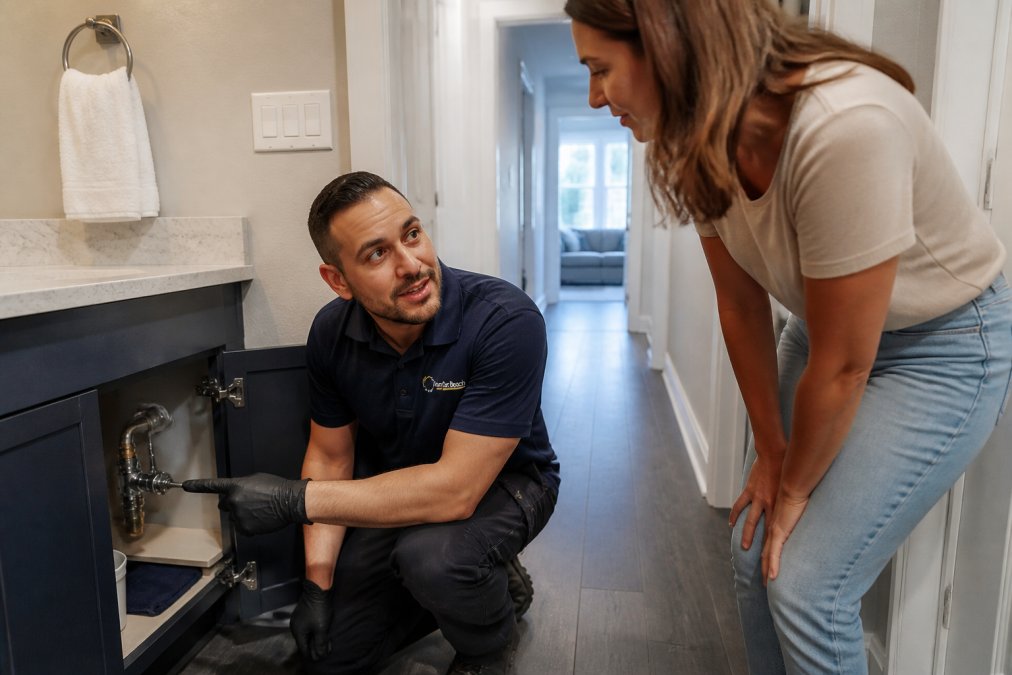
A plumber labor warranty covers the workmanship on a repair, not the part. If a connection fails because of how it was installed, the labor to correct it should be covered.
Ask two questions before you hire anyone:
- How long does the labor warranty run?
- Does it cover a return visit, or just the original repair?
How to File a Plumbing Warranty Claim (and Why Claims Get Denied)
The claim process is simple on paper. In practice, most denials come down to documentation and timing, not to whether the failure was real.
Here is what a typical claim looks like:
- Find the original receipt, model number, and install date.
- Confirm the failure falls inside the warranty window and is not on the exclusion list.
- Call the warranty provider before you authorize any repair. Work done before approval is often not reimbursed.
- Get the diagnosis in writing from a licensed plumber, including the cause of failure.
- Submit the claim with photos, the service record, and the plumber’s written diagnosis.
- Wait for approval before work begins, unless the provider authorizes emergency service in writing.
Claim Denial Checklist: The Reasons Claims Actually Get Rejected
Run through this list before you file. Each item is a documented denial trigger, and each one is fixable in advance.
- No maintenance records. The issuer asks for proof the system was maintained. You have none.
- No receipt or model number. Without proof of purchase and install date, the issuer cannot confirm the warranty is active.
- Work done by an unlicensed installer. The install itself is the denial reason, regardless of the failure.
- Unauthorized repair before approval. You called a plumber, paid, and then filed. The provider denies reimbursement because prior authorization was required.
- Pre-existing condition. The inspection report or a prior service note dates the problem before coverage started.
- Code violation or unpermitted work. The repair cannot be approved until the work is brought up to code, and the upgrade is not covered.
- Normal wear and tear. The component reached end of life. That is not a defect.
- Missed filing window. Most warranties require the claim within a set number of days of discovery. Late claims are denied.
- Failure to mitigate. If a leak was left running and caused secondary damage, the issuer can deny the portion of the claim tied to the neglect.
- Excluded system. The item is simply not on the covered list. Read the covered-items schedule before you file.
The Maintenance Record Is Your Best Defense
A maintenance record is the single most effective way to protect a future claim. It converts a he-said-she-said dispute about whether a problem was pre-existing into a dated, third-party record of the system’s condition.
What a useful record includes:
- Date of service and the plumber or company that performed it
- What was inspected, cleaned, or replaced
- Any noted condition, even if no repair was made
- Photos where the condition is visible
What to Do If Your Claim Is Denied
A denial is not always final. Ask the provider for the specific exclusion or condition cited in writing. If the denial is based on a pre-existing condition, request the evidence they used to date the problem. If it is based on an unauthorized repair, confirm whether the repair was actually performed by a licensed professional and documented.
Frequently Asked Questions
What does a home warranty cover for plumbing?
A home warranty is a service contract, not insurance. It typically covers repair or replacement of plumbing systems and appliances that fail from normal wear and tear, such as a water heater tank, clogged main drain, or leaking supply line. Most policies require a service fee per visit and exclude pre-existing conditions, code upgrades, and damage caused by neglect. Read the policy exclusions carefully before filing a claim.
Do plumbers warranty their work?
Most licensed plumbers provide a labor warranty on their workmanship, separate from any manufacturer warranty on parts. A plumber labor warranty generally covers defects in the installation or repair itself, such as a leak at a joint that was just replaced. It usually does not cover unrelated failures or damage caused by the homeowner. Ask for the warranty terms in writing before work begins.
Are water leaks and pipe bursts covered under a plumbing warranty?
It depends on the cause. A plumber labor warranty may cover a leak at a fitting the plumber just installed. A manufacturer warranty may cover a defective part, like a failed water heater tank. Neither typically covers pipes that burst from freezing, corrosion, or age. Homeowners insurance may cover resulting water damage, but usually not the pipe repair itself.
How long does a standard plumbing repair warranty last?
Labor warranty periods vary by provider and by the type of work performed. Some plumbers offer a short window on repairs, while others extend coverage on new equipment installations. Manufacturer warranties on water heaters and fixtures often run longer on parts than on labor. Always confirm the specific warranty length in writing, since it is not standardized across the industry.