
Table of Contents
- Water Heater Repair or Replace: How to Decide
- Quick Comparison: Repair vs. Replace at a Glance
- Water Heater Lifespan: How Long Tanks and Tankless Units Last
- Common Water Heater Problems and What They Usually Mean
- The 50% Repair-Cost Rule and What Drives the Numbers
- Tankless vs Tank Water Heater: Which Replacement Makes Sense
- Safety First: Gas, Leaks, and When to Shut It Down
- Permits, Code, and What Replacement Involves
- Frequently Asked Questions
Last Updated: October 8, 2026
Water Heater Repair or Replace: How to Decide
At VanDerBosch Plumbing Inc., we’ve walked Chicago-area homeowners through this exact call for decades, and the pattern rarely changes. Age plus leak location tells most of the story before a wrench ever comes out.
Below, we’ll show you how to weigh repair against replacement using a simple rule of thumb, a symptom-to-part map, and the factors that actually drive the numbers.
Quick Comparison: Repair vs. Replace at a Glance
Repair makes sense when the problem is a single, accessible component and the tank itself is sound. Replacement makes sense when the tank, the surrounding plumbing, or the unit’s age points to more failures ahead.
|
Factor |
Favor Repair |
Favor Replace |
|---|---|---|
|
Age of unit |
Under 6 years |
Over 10 years |
|
Leak location |
Fittings, valve, element |
Tank body or base |
|
Repair cost vs. age |
Well under half of replacement |
Half or more of replacement |
|
Repair history |
First issue |
Third or fourth issue |
|
Water quality |
Clear, no rust |
Rusty or metallic-tasting |
Use this as a starting filter, not a verdict. A licensed plumber still needs to confirm what’s actually failing.
Water Heater Lifespan: How Long Tanks and Tankless Units Last
A traditional tank water heater typically lasts about 8 to 12 years, while a tankless unit often runs 20 years or longer with regular maintenance. That gap matters when you’re weighing a repair bill against the years you’d get from a new unit.
Does Age Alone Decide It?
No. Age is one factor, not the whole case. A 12-year-old tank with a failed heating element may still have usable life left, while a 7-year-old tank with a corroded base is on borrowed time.
Here’s how we think about it:
- Under 6 years: repair is usually the clear choice
- 6 to 10 years: weigh the repair cost against remaining useful life
- Over 10 years: replacement starts to make more sense, especially with a second or third failure
Sediment buildup is the quiet killer in older tanks. It forces the burner or element to work harder, shortens the unit’s life, and shows up as rumbling or popping noises.
Common Water Heater Problems and What They Usually Mean
Most water heater complaints fall into a handful of categories: no hot water, reduced hot water, inconsistent temperature, strange noises, or a leak. Each points to a different part, and each has a different repair outlook.
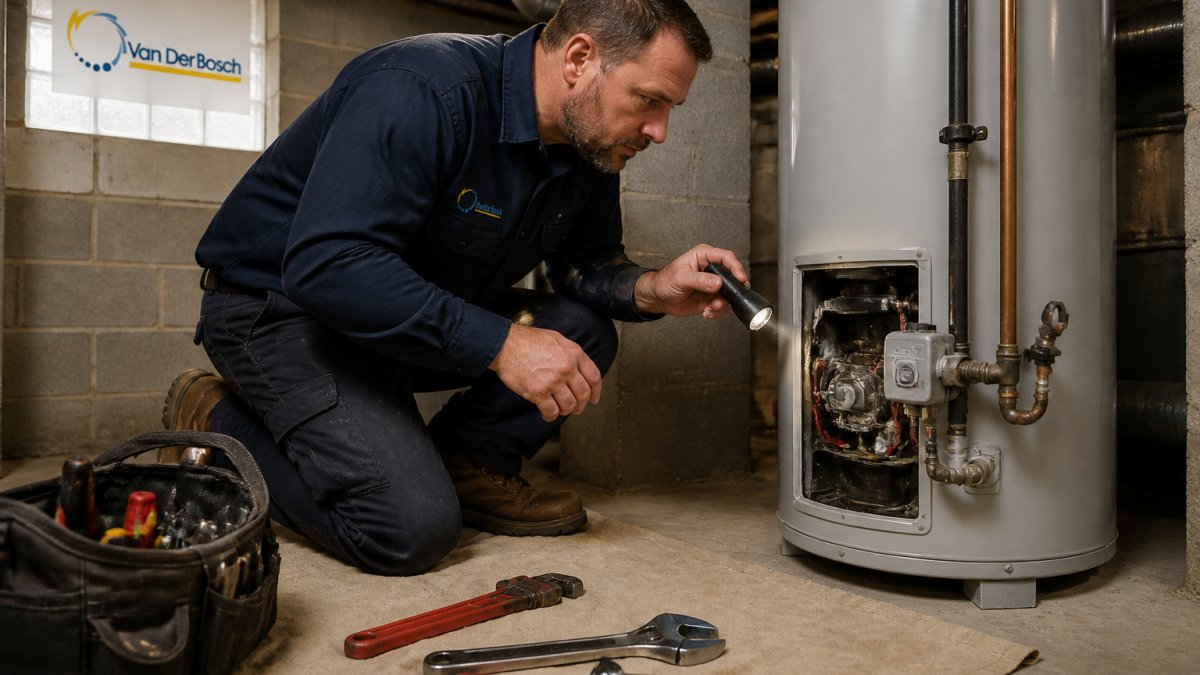
Repairable by Component: A Symptom-to-Part Map
- No hot water (gas): pilot light, thermocouple, or gas control valve
- No hot water (electric): heating element or upper thermostat
- Reduced hot water: sediment buildup or a failing lower element
The last one is the fork in the road. If the tank shell is cracked, no repair fixes it.
Repair or Replace by Symptom
A failed element or thermostat is a straightforward repair. A leaking tank is not. That’s the line most homeowners need help finding, and it’s the reason a professional diagnosis matters more than a guess.
The 50% Repair-Cost Rule and What Drives the Numbers
The 50% rule is a starting filter: if a repair costs half or more of what a comparable new unit would cost, replacement usually deserves serious consideration. It is a guideline, not a verdict. A repair that costs 40% of replacement on a two-year-old tank is a very different decision than the same ratio on a twelve-year-old tank.
Factors That Affect Water Heater Repair Cost
What we can tell you is what moves the number up or down:
- Type and location of the problem, an accessible heating element is a different job than a fitting buried behind the tank
- Accessibility, basement, closet, attic, or a tight mechanical room changes labor and time
- Materials and parts required for the fix
Two identical symptoms can produce very different bills. That is why a real diagnosis comes before any number.
Total Cost of Ownership: The Math Most Guides Skip
Upfront repair cost is only one line in the ledger. A more useful comparison looks at what you will spend over the next several years, not just this month.
If you repair:
- You pay the repair bill now.
- You keep the existing efficiency rating, which on an older tank is lower than a new unit’s.
- You accept the risk of another failure, often a related component, within the remaining service life.
If you replace:
- You pay more upfront.
- You reset the clock on the unit’s expected service life.
- You gain the efficiency of a current model, which can lower monthly gas or electric use.
A common pattern: a repair on a unit with several years of life left pays for itself quickly, while a repair on a unit near the end of its service life rarely does.
When the Rule of Thumb Breaks Down
Three situations override the 50% math:
- Tank shell leak. No repair fixes a cracked or corroded tank. Replacement is the only option regardless of cost ratio.
- Safety issues. A failed pressure relief valve, scorched wiring, or a gas control problem that cannot be corrected safely points to replacement.
- Code or venting problems. If the existing install no longer meets current code, a repair may not be permitted without bringing the rest of the system up to standard, which changes the math entirely.
Use the 50% rule as a first pass, then compare total cost of ownership over the next several years. The cheapest repair today is not always the cheapest decision.
Tankless vs Tank Water Heater: Which Replacement Makes Sense
If replacement is the call, the next question is what to replace it with. Three options dominate the residential market: traditional tank, tankless, and heat pump. Each has a different footprint, fuel requirement, and cost profile.
Traditional Tank Water Heaters
A tank unit stores a set volume of hot water and reheats as it is used. It is the most common type in older housing stock because it fits existing gas, venting, and electrical setups with minimal modification.
- Strengths: lower upfront cost, simple installation, steady stored supply, works with standard venting
- Tradeoffs: shorter service life than tankless, standby heat loss, larger physical footprint
- Best fit: rental properties, tight budgets, homes where the existing venting and gas supply are already sized for a tank
Tankless Water Heaters
Tankless units heat water on demand and do not store it. They take up far less space and typically last longer than tanks with regular maintenance.
- Strengths: long service life, endless hot water within capacity, small footprint, no standby loss
- Tradeoffs: higher upfront cost, requires adequate gas supply and proper venting, may need electrical upgrades for the ignition and controls, flow rate limits how many fixtures can run at once
- Best fit: households with steady demand and limited mechanical space, or owners planning to stay long enough to benefit from the longer service life
Tankless is not a drop-in swap. Gas line sizing, venting material and routing, condensate management on condensing models, and sometimes electrical capacity all have to be evaluated before installation. A unit that is undersized for the home’s demand will disappoint, and one that is oversized wastes money.
Heat Pump Water Heaters
Heat pump (hybrid) water heaters pull heat from the surrounding air to warm the water instead of generating heat directly (Heat Pump Water Heaters Achieve Significant Peak Reduction and Energy Savings). They use noticeably less electricity than a standard electric resistance tank.
- Strengths: lower operating cost than a standard electric tank, qualifies for some utility and federal efficiency incentives, uses the same tank-style footprint
- Tradeoffs: needs a large, unconditioned space with adequate airflow, typically a basement or garage, produces cooler air and some condensate, recovery is slower than a gas tank, and the compressor adds noise
- Best fit: homes with an electric setup, a suitable basement or garage, and enough space around the unit for airflow
Heat pump units are a poor fit for a closet or a finished living space. They also are not a match for every household’s hot water demand pattern.
How to Choose
The right replacement depends on more than preference:
- Fuel available: gas, electric, or both at the install location
- Venting: existing flue type and whether it can be reused or must be modified
- Space and airflow: closet, basement, garage, or utility room
Our team installs tank, tankless, and heat pump units and can walk you through tankless options if you want to compare. The right answer is the one that fits your fuel, space, and demand, not the one with the best marketing.
Before committing to any new unit, ask about the condition of the surrounding plumbing. A new water heater tied to a failing shutoff valve or corroded fittings just moves the next problem a few months down the road.
Safety First: Gas, Leaks, and When to Shut It Down
Any gas smell, scorched wiring, or active leak around a water heater is a stop-and-call situation. Your first move is to shut off the gas or power and the water supply, then get a licensed professional on site.
What to do right now:
- Smell gas? Leave the area, don’t touch switches, and call your gas utility or a licensed plumber from outside
- Active water leak? Shut off the water supply and, if safe, the power or gas to the unit
- Scorched or burnt smell? Cut power at the breaker and keep clear of the unit
Do not attempt to repair gas lines, burners, or electrical components yourself. If a leak has already spread to the piping around the unit, that’s a separate repair, our burst pipe repair team handles damaged supply lines, and gas work around the heater falls under gas line repair and installation.
Permits, Code, and What Replacement Involves
A water heater replacement typically requires a permit and an inspection in most jurisdictions, and the work has to meet current plumbing and gas codes.
Skipping the permit can create real problems later: failed home inspections, insurance questions after a leak, and code violations you inherit at resale.
If you’re weighing repair against replacement, the water heater service team at VanDerBosch Plumbing Inc. can diagnose the unit, explain your options in plain terms, and handle the permit and install if replacement is the answer.
When a water heater fails, the pressure to decide fast can push you toward the wrong call. VanDerBosch Plumbing Inc. takes the guesswork out of it: licensed and insured technicians, honest and fair pricing, a 100% satisfaction guarantee, and availability seven days a week. Whether you need a repair or a full replacement, get started with VanDerBosch Plumbing Inc. and get your hot water back the right way.
Frequently Asked Questions
Is it worth it to repair a hot water heater?
It depends on the unit’s age and the repair involved. If the tank is still within its expected lifespan and the problem is a single component like a heating element, thermostat, or pilot assembly, repair is often the cost-effective choice. If the tank itself is leaking, corroded, or the unit is near the end of its water heater lifespan, replacement usually makes more sense because tank leaks cannot be repaired.
What is the average lifespan of a hot water heater?
Tank water heaters generally last about 8 to 12 years, while tankless units often run 15 to 20 years with regular maintenance. Actual water heater lifespan depends on water quality, sediment buildup, how hard the unit works, and whether it has been serviced. In areas with hard water, tanks can fail sooner because sediment collects on the bottom and overheats the steel.
Is it cheaper to repair or replace a water heater?
A single repair is almost always cheaper upfront than a full replacement. The useful comparison is the 50% repair-cost rule: if the repair costs more than half the price of a new unit and the heater is already past middle age, replacement is usually the better long-term value. Pricing depends on the unit type, the failed part, accessibility, and local code requirements.
How can I tell if my water heater needs to be replaced?
The clearest replacement signals are a leaking tank, a leak around the base, rust-colored water, corrosion on the tank fittings, or repeated repairs on a unit that is already 10 years or older. Erratic operation, reduced hot water, and strange noises point to repairable problems like sediment buildup or a failing heating element. A licensed plumber can diagnose the unit and confirm whether repair is still reasonable.