
Last Updated: October 29, 2026
Quick Summary
Replace a water heater when it is near or past its expected life, is leaking from the tank itself, or has several problems at once, such as rusty water, short hot water supply, temperature swings, and loud noises. Repairs on a young unit with one isolated fault are often worth it. Shut off the power or gas and call a licensed plumber if you see active leaks or suspect gas.
- Check the manufacture date on the tank or serial number to see how old the water heater is.
- Water pooling under the tank usually means the tank itself is leaking, which is a strong sign to replace.
- Rumbling or popping noises can come from sediment settling at the bottom of the tank.
- Two or more repairs in a short window usually signals a unit failing in several places at once.
- Shut off the gas or power and the cold water supply, then call a licensed plumber for any leak.
Table of Contents
- How Long a Water Heater Usually Lasts
- Sign 1 and 2: Age and Leaks Around the Base
- Signs 3 Through 6: Rusty Water, Short Hot Water Supply, Temperature Swings, and Noises
- Signs 7 Through 10: Rising Energy Bills, Frequent Repairs, Visible Rust, and Sediment
- Water Heater Repair or Replacement: How to Decide
- Tank vs. Tankless: What Changes When You Replace
- Water Heater Maintenance That Delays Replacement
- Scheduling a Water Heater Evaluation With VanDerBosch
- Frequently Asked Questions
Your water heater is supposed to be the quiet workhorse of the house. When it starts giving you trouble, the question is rarely whether something is wrong, it’s whether the unit can still be fixed or whether it’s time to replace it.
Tank water heaters do not last forever. Age is one of the first things to check, and a water heater nearing the end of its life often shows several symptoms at once, so look at the whole picture rather than one problem alone.
How Long a Water Heater Usually Lasts
Tank water heaters are built to run for a limited number of years, and actual lifespan depends on water quality, maintenance, and how hard the unit works.
Check the label on the tank or the serial number, which often shows the manufacture date. If the unit is older than its expected lifespan, plan for replacement even if the symptoms seem minor.
Here is what to watch for as the unit ages:
- Slower hot water recovery after showers or laundry
- More frequent rumbling or popping sounds
- Small drips that come and go
Sign 1 and 2: Age and Leaks Around the Base
Sign 1: The unit is near or past its expected life. Age alone does not mean a heater has failed, but it changes the math. Our guide on when to replace a water heater walks through the signs that suggest it is time to break up with an aging unit.
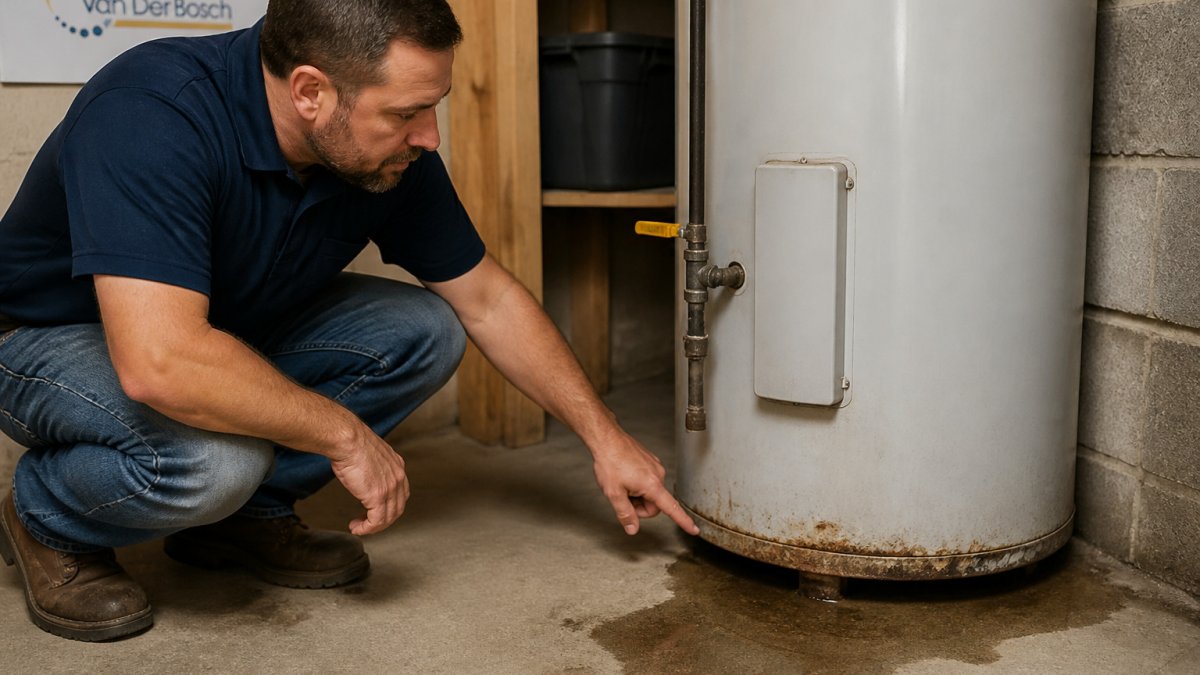
Sign 2: You see moisture or leaks around the base. Any water near the bottom of the tank is worth taking seriously. Small leaks can come from fittings, the drain valve, or the connections at the top.
If you see water and you are not sure where it is coming from, turn off the power or gas supply to the heater and shut off the cold water supply valve. Then call a licensed plumber.
Why Water Pooling Under the Tank Is a Serious Sign
Water collecting under the tank usually means the tank itself is leaking. Our page on why your water heater is leaking from the bottom explains the common causes and what to do next. Over time, corrosion weakens the steel inside, and once it cracks, the unit cannot be sealed.
Because a leaking heater can flood a basement or utility room, treat it as urgent. Move valuables away from the area and call for service promptly.
Signs 3 Through 6: Rusty Water, Short Hot Water Supply, Temperature Swings, and Noises
Sign 3: Rusty or discolored water. Rust-colored water can come from the heater, but it can also come from older pipes.
Sign 5: Inconsistent or fluctuating temperature. Water that jumps between hot and lukewarm often points to a failing thermostat, a worn valve, or sediment interfering with heating.
Sign 6: Popping, rumbling, or banging noises. Sediment settling at the bottom of the tank can cause loud popping as water boils beneath it.
Signs 7 Through 10: Rising Energy Bills, Frequent Repairs, Visible Rust, and Sediment
Sign 7: Your energy bills keep climbing. An aging heater loses efficiency.
Sign 8: You keep calling for repairs. One repair is normal.
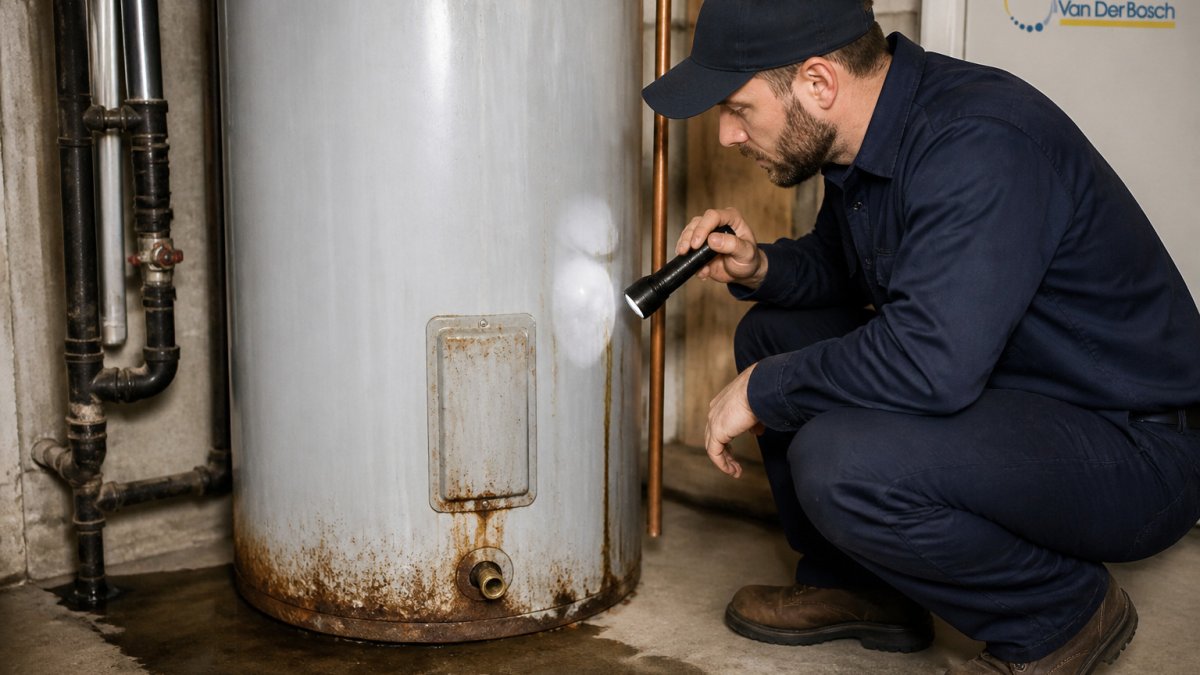
Sign 9: Visible rust on the tank. Rust on the outside of the tank, especially near seams or fittings, can signal corrosion inside.
Sign 10: Heavy sediment buildup. Minerals in the water settle at the bottom of the tank over time.
Water Heater Repair or Replacement: How to Decide
Most signs in this guide point to a decision rather than a verdict. Use this water heater repair or replace decision guide to weigh age, leaks, and repair history before you commit. A rumbling tank, a lukewarm shower, or a rising gas bill does not automatically mean replacement.
Use the framework below to sort a borderline case into one of three buckets: repair, replace now, or plan to replace soon.
Step 1: Rule out the cheap fixes first
Before you weigh replacement, confirm the problem is not something simple. A few issues look like failure but are not:
- No hot water at all on an electric unit. Check the circuit breaker at the panel. A tripped breaker is a common cause and costs nothing to reset.
- No hot water on a gas unit. Confirm the pilot is lit or the electronic ignition has power, and check that the gas supply valve at the unit is open. If you smell gas, stop and follow the safety steps below.
- Lukewarm water with a correct thermostat setting. On a tank unit, a failed heating element or a bad thermostat can mimic end-of-life symptoms. Both are repairable on a tank that is otherwise sound.
If a simple check resolves the problem, you may not have a replacement decision at all. If the symptom returns or worsens, move to Step 2.
Step 2: Score the unit on four factors
A repair-versus-replace decision gets clearer when you look at four factors together instead of one at a time.
- Age versus expected life. A tank heater well into its expected service life is a weaker candidate for an expensive repair, because the next failure is usually not far behind. A younger unit with one isolated problem is usually worth fixing.
- Repair cost versus replacement cost. Ask for the repair estimate and a replacement estimate side by side. A common rule of thumb among plumbers is that a repair costing a large share of a new unit’s installed price, on an aging tank, tilts toward replacement.
- Severity and location of the failure. A leaking fitting, a bad element, a thermostat, or a failed thermocouple is a component repair. A leaking tank body, a cracked inner liner, or corrosion spreading across the shell is a structural failure that cannot be reliably sealed.
Step 3: Match the case to a likely outcome
| Situation | Likely direction |
|---|---|
| Young unit, single component failure, no tank leak | Repair |
| Older unit, tank body leaking or corroded | Replace |
| Older unit, repair cost approaching a large share of replacement | Replace |
| Mid-life unit, one repair, otherwise healthy | Repair and monitor |
| Multiple repairs in a short period, rising bills | Plan replacement soon |
| Active leak flooding the area | Shut off and call for urgent service |
Treat the table as a starting point, not a diagnosis. A technician on site can confirm whether a tank leak is from the shell or a fitting, which changes the answer.
Step 4: Weigh what a replacement buys you
Replacement resets the clock on the unit’s service life, may improve efficiency compared with an older model, and can reduce the odds of an emergency failure at an inconvenient time.
If the unit is mid-life and the repair is reasonable, repairing now and budgeting for replacement later is a legitimate path. You do not have to replace a working heater just because it showed one warning sign.
If you smell gas, see scorching or melted wiring at the unit, or have an active leak you cannot stop at the supply valve, treat it as an emergency. Shut off the gas or power at the source if you can do so safely, keep people away from the area, and call a licensed plumber or your gas utility. Do not attempt to repair gas, electrical, or pressurized components yourself.
A licensed plumber can inspect the unit, confirm whether the leak is from the tank or a fitting, and lay out repair and replacement options so you can compare them directly.
Tank vs. Tankless: What Changes When You Replace
Most water heater articles describe one kind of unit: the conventional tank. That leaves out a lot of households, because the symptoms, lifespan, and replacement math differ by system type.
Conventional tank heaters
A tank heater stores a ready supply of hot water and reheats it as it is used. It is the most common type in older homes and the simplest to replace like-for-like. Its typical failure points are the tank shell (corrosion and leaks), sediment buildup on the bottom, heating elements or burners, thermostats, and the temperature and pressure relief valve.
Tankless heaters
A tankless unit heats water on demand and does not store a supply. It generally has a longer expected service life than a tank, but it is not maintenance-free. The most common issues are mineral scale buildup in the heat exchanger, which reduces output and efficiency, and ignition or sensor faults. A tankless unit also has different installation requirements, including gas supply capacity, venting, and electrical service, so a switch from tank to tankless is a project rather than a swap.
Heat pump water heaters
A heat pump water heater moves heat from the surrounding air into the tank instead of generating it directly with a burner or element. It is more efficient to run than a standard electric tank, but it needs adequate space and airflow around the unit and produces cooler air and some condensate. Its failure symptoms can include the backup heating element not keeping up during heavy demand, fan or compressor problems, and condensate drainage issues.
What changes when you replace
- Like-for-like replacement is the simplest path and usually involves the fewest changes to gas, venting, and electrical connections.
- Switching from tank to tankless can free up floor space and may last longer, but it often requires upgrades to gas lines, venting, or electrical service, and the installed cost is typically higher than a like-for-like tank replacement.
- Switching to a heat pump unit can lower operating costs, but it depends on space, climate, and how the unit is integrated with the home’s electrical capacity.
Before you commit to a type, ask your plumber to confirm what your home’s gas line, venting, and electrical service can support. The right unit is the one that fits the existing infrastructure without expensive surprises.
If you are unsure which type you have or what a switch would involve, a water heater evaluation can answer those questions before you decide. Households considering a switch can also review tankless water heater options to see what installation involves.
Water Heater Maintenance That Delays Replacement
Regular maintenance can extend the life of a tank heater and reduce the chance of a surprise failure. Common steps include:
- Flushing the tank once or twice a year to remove sediment
- Checking the temperature and pressure relief valve
- Inspecting fittings and the area around the base for early leaks
Some of these tasks involve gas or electrical connections. If you are not comfortable with them, leave the work to a licensed professional.
Scheduling a Water Heater Evaluation With VanDerBosch
If you recognize two or more of these signs, schedule an evaluation soon. Learn what to expect from professional water heater installation services and how licensed technicians handle a replacement. VanDerBosch Plumbing Inc. offers water heater repair and installation for Chicagoland homes, including tankless water heater installation for households considering a switch. If you suspect a leak, a burst pipe and water leak service can help locate the source quickly.
Call us today to talk through what you are seeing and get your water heater checked before a small problem becomes an emergency.
Frequently Asked Questions
How long does a water heater usually last?
Conventional tank water heaters and tankless water heaters both have limited service lives, and actual lifespan depends on water quality, maintenance, and how hard the unit works, including regular descaling and proper installation for tankless units. Age alone does not mean a unit has failed, but a heater approaching the end of its typical range should be evaluated closely, especially if it shows leaks, rust, or declining performance. Checking the manufacturer’s label for the install date helps you know where your unit stands.
Can a leaking water heater be repaired?
Some leaks can be repaired, but the location matters. A leak at a fitting, drain valve, or pressure relief valve may be fixable. A leak coming from the bottom or side of the tank usually means the steel tank itself has corroded or cracked, and that is generally not repairable. Because a leaking tank can release water quickly and damage flooring or ceilings below, shut off the water supply and power or gas to the unit and call a licensed plumber promptly to determine the source.
Should I flush my water heater if it is 10 years old?
Flushing a tank water heater removes sediment that settles at the bottom, which can reduce efficiency, cause rumbling noises, and accelerate wear on the tank. Flushing is worthwhile maintenance, but it will not reverse corrosion or restore a tank that is failing. If your 10-year-old heater has never been flushed and is still working well, flushing may help extend its service life. If it is already leaking, rusting, or running out of hot water, a professional evaluation is more important than flushing.
When should I call a plumber about a water heater problem?
Call a licensed plumber promptly if you see active water leaking from the tank, a strong smell of gas, scorched or burnt odors, or a pressure relief valve that is dripping or discharging water. Gas-fired units with a suspected gas leak should be treated as an emergency: leave the area and contact the gas utility or emergency services. For less urgent symptoms such as lukewarm water, rusty water, or unusual noises, schedule an evaluation soon so a plumber can diagnose the cause before it becomes a larger failure.
