
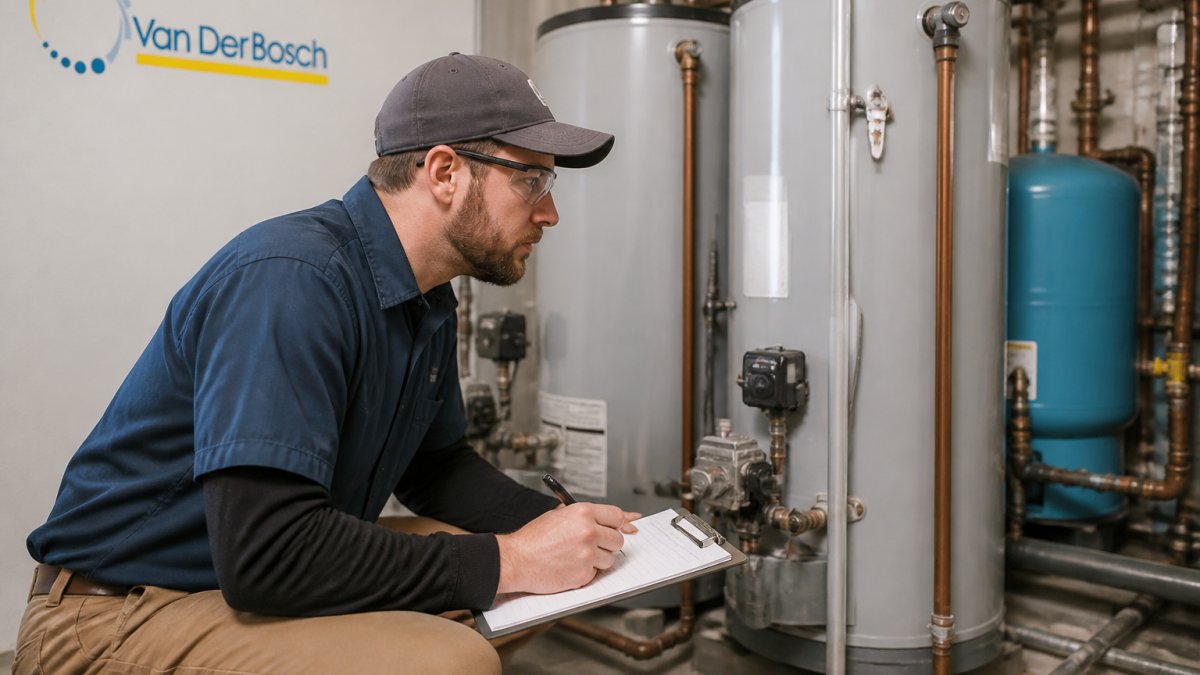
Table of Contents
- Why Commercial Water Heater Inspection Matters
- Safety Precautions Before You Begin
- Visual Inspection of Tank and Surroundings
- Commercial Water Heater Inspection Checklist
- Commercial Water Heater Maintenance Schedule
- Documenting Findings and When to Call a Professional
- Frequently Asked Questions
Last Updated: October 20, 2026
Why Commercial Water Heater Inspection Matters
Learning how to inspect commercial water heaters isn’t just maintenance, it’s a safety and compliance requirement.
How to inspect commercial water heaters means knowing what to look for and when professional diagnosis is needed.
Inspection also protects occupants. A malfunctioning relief valve won’t prevent dangerous pressure buildup, and inconsistent temperature control can create scalding hazards or allow bacterial growth.
Safety Precautions Before You Begin
Commercial water heaters operate under pressure and heat, so mistakes can cause injury or equipment damage.
Electrical and Gas Hazards
Electrical hazards include shock from live wiring, arc flash from energized components, and electrocution if water contacts electrical elements. Gas hazards include explosion or fire if gas accumulates, carbon monoxide exposure, and uncontrolled flame if ignition fails.
Pressurized System Risks
The tank holds water under pressure; if pressure builds too high and the relief valve fails, it can rupture.
If you smell gas, hear hissing, or see water spraying from the relief valve discharge, stop immediately, leave the area, and call a professional.
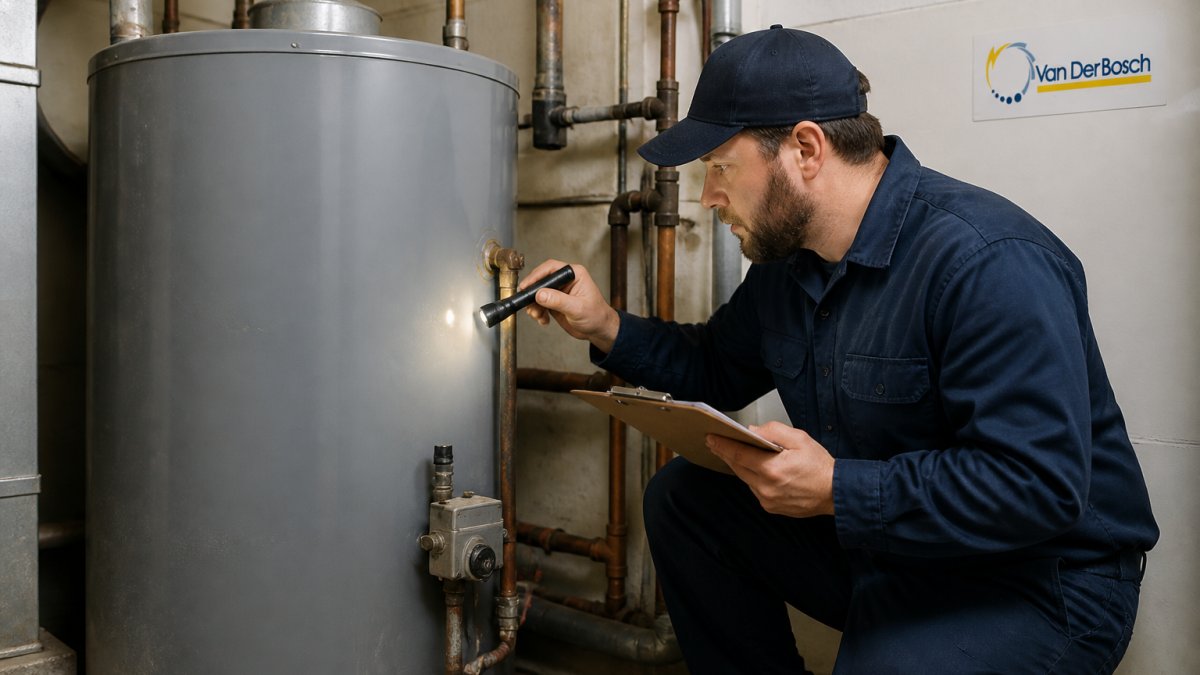
Visual Inspection of Tank and Surroundings
A visual inspection reveals corrosion, leaks, physical damage, and installation problems before they become emergencies.
Tank Condition and Corrosion
Rust and corrosion on the tank exterior indicate the protective coating is failing and the metal underneath is being attacked.
Check the tank’s support structure and straps. Rust on the base or legs means moisture is present and the foundation may be unstable; a corroded support can fail suddenly.
Leaks and Water Connections
Where to check for leaks: the base of the tank (most common failure point), connection points where pipes enter the tank, the relief valve discharge line, flanges and threaded connections, and welded seams. Small leaks can escalate into significant water damage, and persistent moisture around the heater may indicate a burst pipe or connection failure that requires prompt attention.
Commercial Water Heater Inspection Checklist
A structured checklist keeps inspections consistent. The items below separate observation-level checks staff can safely handle from work requiring a qualified technician: reading a gauge or looking at a flame is observation; testing a relief valve, opening a burner compartment, or probing electrical components is service work.
Do not open burner compartments, remove electrical covers, disconnect gas piping, or operate relief-valve test levers on a live commercial system unless you are trained and authorized to do so. Observation only for facility staff.
Temperature and Pressure Relief Valve
The temperature and pressure relief (TPR) valve is the primary safety device on any storage-type heater. It opens when internal pressure or temperature exceeds its rated setpoint, protecting the tank from rupture.
A valve that weeps continuously or won’t reseat after a test needs replacement. Do not plug, cap, or ‘fix’ it by tightening the bonnet; those shortcuts turn a nuisance leak into a pressure vessel hazard.
Temperature and Pressure Readings
Gauge readings are only useful if you know what normal looks like for that unit.
| Reading | What to record | Typical concern |
|---|---|---|
| Storage temperature | Thermostat setpoint and measured tank or outlet temperature | Large gap between setpoint and actual; wild swings |
| Delivered temperature | Temperature at the nearest fixture after a short flush | Below setpoint by a wide margin; above setpoint (scald risk) |
| System pressure | Gauge reading at rest and during a draw | Continuous climb; pressure that will not drop when water is drawn |
| Recovery time | Time to return to setpoint after a heavy draw | Lengthening recovery suggests sediment or a failing element/burner |
Acceptable ranges depend on the heater’s data plate, manufacturer’s instructions, and applicable code. Use those sources, not a generic number, to judge pass or fail; a stable reading outside the manufacturer’s range is still worth escalating.
Gas Supply and Burner Components
Gas-fired heaters add combustion and carbon monoxide risk. Staff can observe; only a qualified technician should adjust, disassemble, or test the gas train.
Technician-level checks: combustion analysis (carbon monoxide, oxygen, and stack temperature); gas pressure at the manifold and at the appliance inlet; burner cleaning, orifice inspection, and ignition system testing; venting verification against the manufacturer’s venting tables and applicable code.
A yellow or orange flame, lifting flame, burner rollout, or a carbon monoxide alarm is an immediate stop-and-call condition.
Electrical Components and Connections
Electric heaters carry line-voltage and, on larger units, three-phase power. Visual checks are appropriate for staff; opening a control panel or testing voltage is technician work.
Observation-level checks: junction box and control covers in place; no scorching, melted insulation, or burning smell near the electrical enclosure; conduit and fittings intact; no water pooling near electrical components.
Technician-level checks: element resistance and amperage draw; contactor and sequencer operation; high-limit and thermostat continuity; grounding and bonding verification.
Venting and Exhaust
Venting failures are a leading cause of carbon monoxide incidents in commercial mechanical rooms. Check the visible flue run for corrosion, sagging, separated joints, and proper slope, and confirm the vent terminates outdoors and isn’t blocked by snow, nests, or debris. On power-vented units, listen for the inducer before ignition; firing without it is a safety issue.
Sediment, Scale, and Flushing
Sediment accumulates at the bottom of any storage tank and insulates the heat source from the water, driving up recovery time and energy use; hard-water facilities accumulate it faster. Flushing is a technician task on commercial equipment because it involves isolating the unit, connecting to a drain, and managing scalding water.
Equipment-Type Variations
The checklist above is written for a gas-fired storage heater. Adjust emphasis for other configurations:
- Electric storage: weight the electrical section heavier; sediment and element scaling are the dominant failure modes.
- Gas storage: combustion, venting, and gas train checks are the priority.
- Tankless (gas or electric): scale buildup in the heat exchanger and inlet filter condition replace tank corrosion as the main concern; venting and condensate management are critical on condensing models. Tankless water heater installation and maintenance differ significantly from storage systems and should be handled by a technician familiar with the specific model.
What Staff Should Not Do
- Do not test the TPR valve on a live commercial system unless trained.
- Do not open burner or electrical compartments.
- Do not adjust gas pressure, thermostats, or high limits.
- Do not attempt to clear a sediment-bound tank by draining it without isolation and scald protection.
When in doubt, document the observation and escalate. A clear escalation boundary protects staff and keeps the inspection useful.
Commercial Water Heater Maintenance Schedule
Preventive maintenance extends equipment life and catches problems early. Establish a routine inspection schedule for your facility.
Monthly visual checks: look for new leaks or corrosion, confirm the relief valve discharge is clear, verify the thermostat holds set temperature, and listen for unusual sounds.
Facilities with high water demand or hard water should increase inspection frequency, as should systems in older buildings or those showing early corrosion.
Documenting Findings and When to Call a Professional
An inspection that isn’t documented is a conversation, not a record. For commercial properties, the log turns a checklist into a maintenance program: it shows whether a condition is stable, worsening, or resolved, supports budgeting and vendor conversations, and provides a defensible record if a failure later causes damage or injury.
A Simple Severity Framework
Assign every finding a severity so the next action is obvious without re-reading the whole report.
| Severity | Meaning | Response window |
|---|---|---|
| Critical | Immediate safety hazard: gas odor, CO alarm, active tank leak, continuous TPR discharge, scorched wiring | Stop use, isolate if safe, call a qualified technician or emergency service now |
| High | Condition likely to fail soon or cause damage: pitting corrosion, weeping TPR, yellow flame, rising pressure trend | Schedule service promptly; do not defer past the next operating cycle |
| Medium | Degrading condition with a known cause: sediment symptoms, worn insulation, minor connection corrosion | Schedule within the normal maintenance cycle |
| Low | Cosmetic or housekeeping: dust, labeling, minor rust staining without active leak | Note and address at next service |
Severity is a judgment call; the same reading can move up a level if the unit serves a critical process, a healthcare or food-service space, or a building with no backup capacity.
What Every Log Entry Should Contain
- Date, time, and name of the person inspecting
- Unit identifier (asset tag, location, model, serial, and data-plate ratings)
- Readings: setpoint, measured temperature, pressure at rest, pressure during draw, recovery time
- Observations by checklist section (tank, TPR, gas/burner, electrical, venting, sediment)
A photo taken at the same angle each visit shows progression a written note can miss.
Prioritizing Corrective Actions
When several findings compete for the same maintenance budget, rank them by:
- Safety first. Anything in the Critical or High tier outranks efficiency or cosmetic items, regardless of cost.
- Failure consequence. A unit serving a production line, a commercial kitchen, or a tenant-occupied building carries more risk than one with redundant capacity.
- Trend direction. A reading that has moved steadily over three inspections is more urgent than a stable reading at the same value.
- Repair vs. replace economics. Weigh equipment age, severity of damage, recurring problems, efficiency loss, repair history, accessibility, and the condition of surrounding piping and venting. Replacement is not automatically the answer; a repairable unit with good remaining life and a single fixable fault is often the better call.
When to Call a Professional Immediately
Treat the following as stop-and-call conditions. Isolate the unit only if safe, then contact a qualified technician or the appropriate emergency service.
- Gas odor, hissing at a gas connection, or a carbon monoxide alarm
- Active water leak from the tank shell, base, or a fitting that will not stop
- Continuous flow from the TPR discharge
- Pressure that climbs and will not relieve
For gas or carbon monoxide events, leave the area, avoid operating switches or phones near the source, and call from a safe location. Do not relight or adjust a unit that has tripped a safety control.
Turning the Log Into a Maintenance Plan
Review the log on a set cadence, not just when something breaks. A quarterly review of open High and Medium items, temperature and pressure trends, and each unit’s age surfaces replacement decisions before they become emergencies.
VanDerBosch Plumbing Inc. provides water heater repair and installation and commercial plumbing services to help you maintain reliable hot water systems.
Frequently Asked Questions
How often should commercial water heaters be inspected?
Commercial water heaters typically require inspection at least quarterly, with some facilities needing monthly checks depending on usage and local codes. Regular inspections catch corrosion, leaks, and pressure issues early, preventing downtime and extending equipment life. High-demand facilities should establish a maintenance schedule with a licensed professional to ensure consistent operation and compliance with safety standards.
What are the most common problems found during commercial water heater inspection?
Common issues include sediment buildup affecting heating performance, corrosion on tank walls and connections, faulty temperature and pressure relief valves, leaks at water connections, and problems with gas burners or combustion venting. Many problems start small but worsen quickly in commercial settings where demand is constant. Early detection through routine inspection prevents emergency shutdowns and costly repairs.
Can I inspect a commercial water heater myself, or do I need a professional?
While basic visual checks for obvious leaks or damage are safe, a thorough commercial water heater inspection requires licensed professional expertise. Pressure testing, burner evaluation, combustion analysis, and safety valve function testing demand specialized equipment and training. A professional inspection also ensures compliance with local codes and identifies risks that untrained eyes may miss.
What should I look for during a visual inspection of a commercial water heater?
Check for visible corrosion or rust on the tank exterior, water pooling or dripping at connections, proper clearance around the unit, secure gas and electrical connections, and signs of damage. Inspect the relief valve discharge line for leaks or blockages, and verify that the storage room or mechanical room is properly ventilated. Document any concerns and contact a professional if you spot rust, active leaks, or unusual odors.
Regular inspection of your commercial water heater isn’t optional, it’s essential for safety, compliance, and reliable operation. If you’re unsure about the condition of your system or need professional testing of pressure, temperature, and relief valve function, contact VanDerBosch Plumbing Inc. today. We’ll conduct a thorough inspection, document findings, and recommend the right service to keep your facility running smoothly.