
What You Need to Know About Kitchen Plumbing
Kitchen plumbing is the network of water supply lines, drain pipes, and venting that keeps your sink, dishwasher, and garbage disposal running every day. Here’s a quick overview of what it includes:
- Water supply lines — bring hot and cold water to your faucet and appliances
- Drain-waste-vent (DWV) system — carries wastewater out and prevents sewer gases from entering your home
- P-trap — the curved pipe under your sink that blocks sewer gases
- Shut-off valves — let you cut water to the sink without shutting off the whole house
- Fixtures and appliances — sink, faucet, garbage disposal, and dishwasher all connect to this system
Most of the action happens under your sink — and while it looks like a tangle of pipes, the system follows a straightforward logic once you understand each part.
When something goes wrong — a slow drain, a leak under the sink, a backed-up garbage disposal — it can disrupt your whole kitchen. Small issues tend to get worse fast if ignored. A dripping faucet wastes hundreds of gallons a year. Grease poured down the drain builds up over months and can cause a full backup.
This guide covers everything: how the system works, how to fix common problems, when to DIY, and when to call a pro.
I’m Hugh Hodur, President of VanDerBosch Plumbing Inc., with extensive hands-on experience diagnosing and repairing kitchen plumbing systems across the Chicagoland area. Let’s break down exactly how your kitchen plumbing works — and how to keep it running without surprises.
Anatomy of a Standard Kitchen Plumbing System
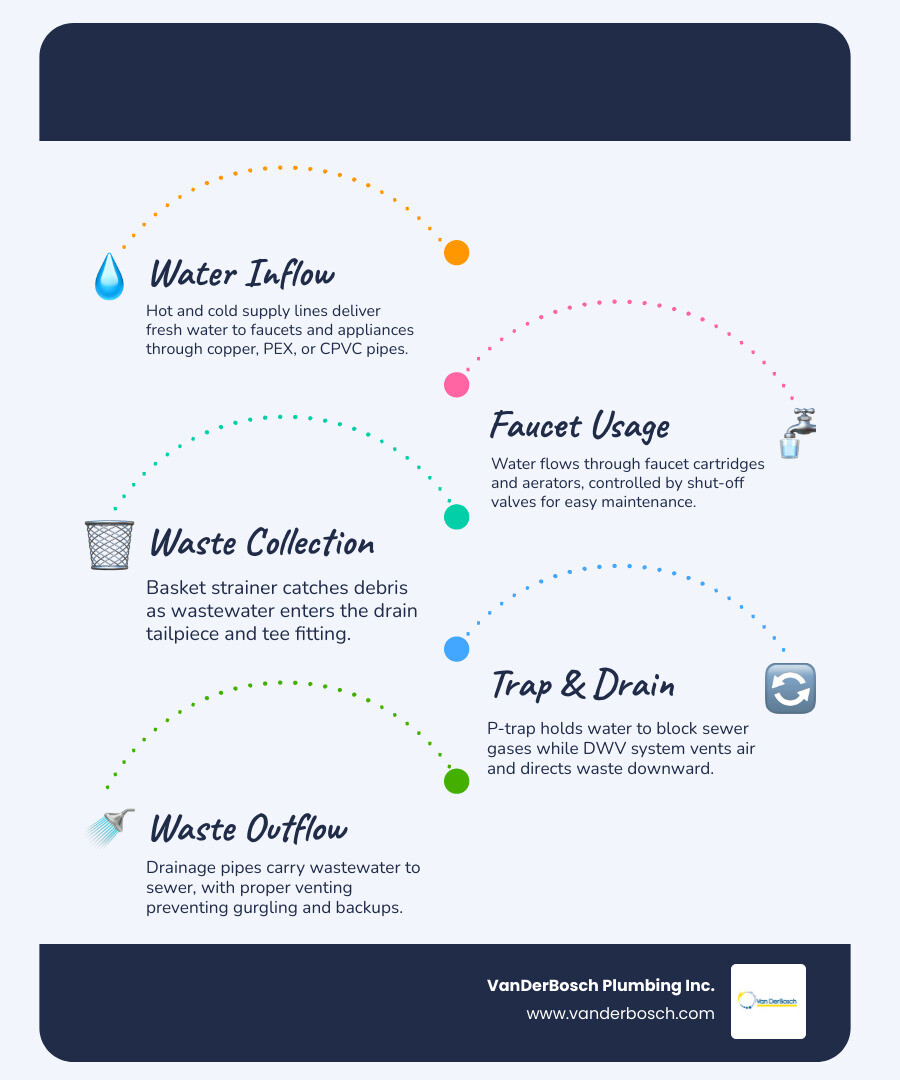
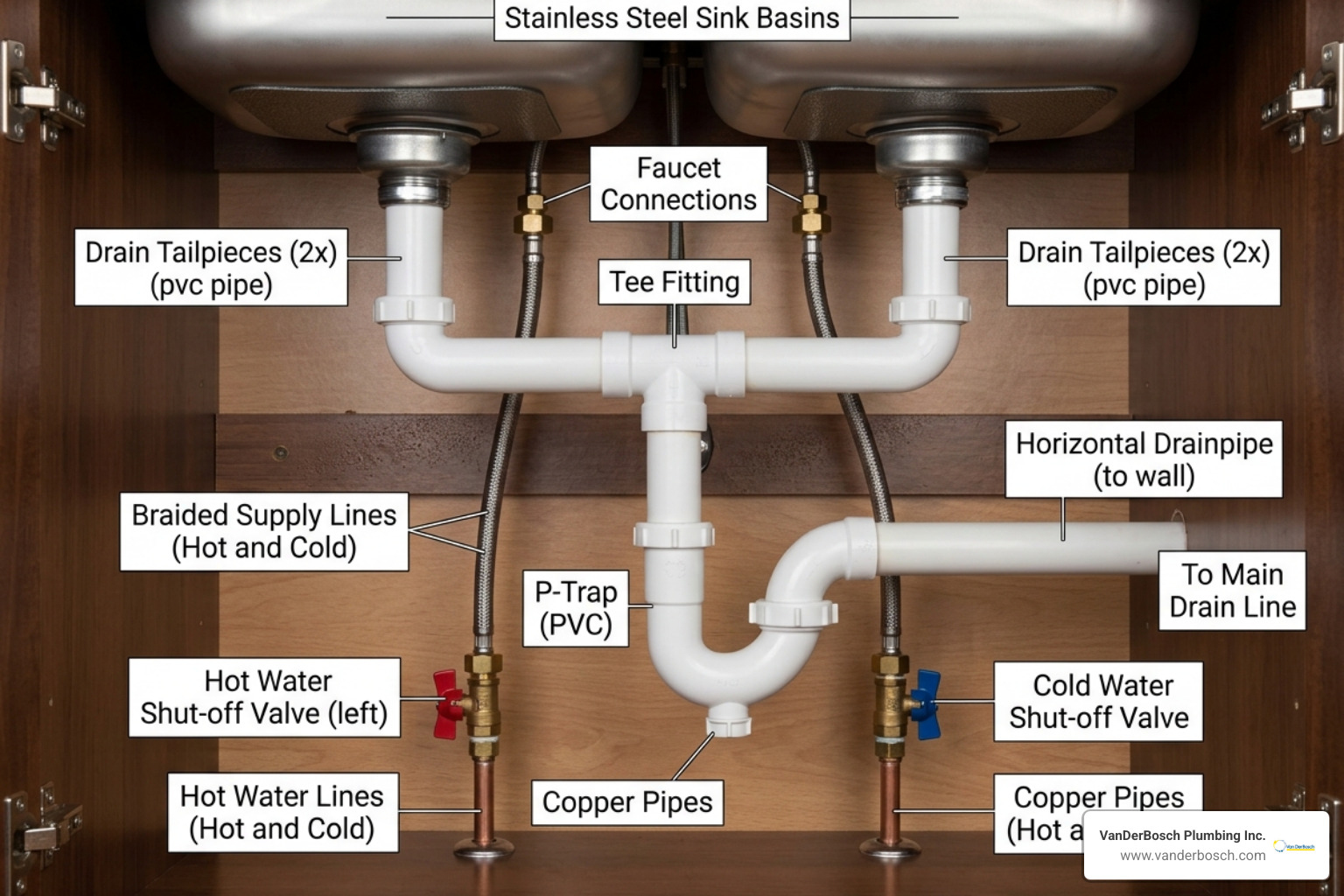
If you have ever peered into the dark cabinet under your sink, you might have felt like you were looking at a puzzle designed by a mad scientist. However, All the Parts of Kitchen Sink Plumbing You Need to Know usually boils down to a few key components that work in harmony to bring water in and whisk waste away.
At the very top, you have the basket strainer. This is the metal mesh or perforated piece in the sink drain that catches large debris. In April 2026, many homeowners are opting for high-rated options like the Glacier Bay Fixed Post Kitchen Sink Strainer, which maintains a solid 4.5/5 rating from over 2,100 reviews. Directly below this is the drain tailpiece, a straight section of pipe that connects the strainer to the rest of the drainage assembly.
If you have a double sink, you will see a tee fitting that joins the two drains into a single line. This line then leads into the most iconic part of the system: the P-trap. This U-shaped pipe is designed to hold a small amount of water at all times. This water seal acts as a barrier, preventing foul-smelling (and potentially dangerous) sewer gases from rising into your kitchen.
The water that supplies your faucet comes through the hot and cold supply lines. These are usually flexible braided stainless steel or plastic hoses connected to shut-off valves. These valves are your best friends during a plumbing emergency, allowing you to stop the water flow locally without affecting the rest of your home in Winnetka or Melrose Park.
Essential Components of Kitchen Plumbing
Beyond the basic pipes, several specialized parts keep your kitchen plumbing efficient and code-compliant.
- Air Gaps: Often required by local codes in Illinois, an air gap is a cylindrical fixture mounted on the sink or countertop. it prevents dishwasher wastewater from siphoning back into the dishwasher.
- Escutcheons: These are the decorative metal plates that cover the holes where pipes enter the wall, providing a finished look and protecting the wall from moisture.
- Aerators: These small screens at the tip of your faucet spout mix air into the water stream. This reduces water usage and prevents splashing while maintaining high pressure.
- Faucet Cartridges: The internal “engine” of your faucet. When your faucet drips, it’s usually because this cartridge has worn out.
For many modern kitchens, the garbage disposal is the workhorse of the sink. It sits between the sink drain and the P-trap, grinding food waste so it can flow through the pipes. If yours is humming but not grinding, or leaking from the bottom, you might need More info about garbage disposal kitchen services to get things moving again.
Water Supply and Shut-Off Valves
The water supply system in your kitchen is under constant pressure. To manage this safely, we use high-quality fittings and valves. Shut-off valves (also called stop valves) are typically quarter-turn valves or multi-turn valves. Quarter-turn ball valves are preferred in 2026 because they are less prone to leaking and easier to operate after years of sitting idle.
The pipes themselves are usually made from one of three materials:
- Copper Piping: The gold standard for durability, often lasting 50-100 years.
- PEX Tubing: Highly flexible and resistant to scale and chlorine. It’s much easier to install in tight spaces under a sink in Chicago’s older homes.
- CPVC: A budget-friendly plastic that offers excellent corrosion resistance.
When connecting these lines, compression fittings are common. These use a brass nut and a small ring (the ferrule) to create a watertight seal without the need for soldering or “sweating” pipes.
DIY Installation and Replacement Guide
Many kitchen plumbing tasks are well within the reach of a determined DIYer. To succeed, you need the right arsenal. Retailers like Home Depot and Lowe’s offer a staggering variety of parts—Home Depot alone lists over 2,016 results for kitchen sink plumbing parts!
Essential Plumbing Tools:
- Basin Wrench: Specifically designed to reach the nuts behind the sink basin that hold the faucet in place.
- Pipe Wrench and Slip-joint Pliers: For gripping and turning metal and plastic pipes.
- Plumber’s Putty: A clay-like substance used to create a watertight seal around the basket strainer.
- Teflon Tape (Thread Seal Tape): Used on threaded connections to prevent leaks.
- Hacksaw: For trimming plastic tailpieces or extension tubes to size.
- Safety Goggles: Always protect your eyes from falling debris or drips when working under the sink.
Installing Drains and Garbage Disposals
Replacing a drain or a garbage disposal is a common weekend project. To install a new basket strainer, apply a “rope” of plumber’s putty around the underside of the strainer flange, press it firmly into the sink opening, and tighten the mounting nut from below.
Installing a garbage disposal involves attaching a mounting ring to the sink’s flange. Most units, like those from popular brands found in Roselle or Niles, use a “twist-and-lock” mechanism. You must ensure the putty seals are tight to prevent leaks that can rot your kitchen cabinets.
When connecting the disposal, don’t forget the discharge tube that leads to the P-trap. If you are also connecting a dishwasher, you must knock out the plastic plug inside the disposal’s dishwasher inlet before attaching the hose. If you need professional help with the electrical or mounting aspects, we provide expert Garbage Disposal Kitchen services to ensure a leak-free setup.
Connecting Dishwashers and Tailpieces
The connection between your dishwasher and your sink drain is a frequent source of “mystery smells.” To prevent dirty sink water from flowing back into your clean dishwasher, you must use the high-loop method. This involves looping the drain hose up as high as possible under the countertop before it connects to the drain.
In many parts of Cook County, code requires an air gap installation instead of a high loop. This is a physical break in the line that makes backflow impossible. The hose is secured with drain hose clamps to either a Y-branch tailpiece (a drain pipe with a side inlet) or the garbage disposal.
Troubleshooting Common Kitchen Plumbing Problems
Even the best-maintained systems run into trouble. In Chicago, our harsh winters and aging infrastructure can lead to unique issues like pipes that expand and contract, causing small cracks.
| Problem | Potential Source | DIY Fix |
|---|---|---|
| Dripping Faucet | Worn O-ring or cartridge | Replace the faucet cartridge |
| Puddle Under Sink | Loose slip-joint nut | Tighten by hand or with pliers |
| Low Water Pressure | Clogged aerator | Soak aerator in vinegar to remove minerals |
| Slow Drain | Debris in P-trap | Remove and clean the P-trap |
| Gurgling Sounds | Poor venting | Check roof vent or install AAV |
Low water pressure is often caused by mineral buildup from hard water. Chicago’s water is known for its mineral content, which can narrow the passage in your faucet’s aerator or supply lines. Simply unscrewing the aerator and soaking it in white vinegar for an hour often restores full flow. If the problem persists, it may be time to learn How to fix a clogged sink or investigate deeper pipe blockages.
Preventing and Clearing Kitchen Plumbing Clogs
Clogs are the most common kitchen plumbing headache. Most kitchen clogs are caused by grease solidification. When you pour liquid grease down the drain, it looks harmless. But as it hits the cool pipes under your Chicago home, it hardens into a waxy sludge that acts like glue for food particles.
To keep your drains clear, follow these 5 reasons your drain is clogged and how to fix it:
- Never pour grease down the drain: Collect it in a jar and throw it in the trash.
- Use sink strainers: Catch food scraps before they enter the pipes.
- The Baking Soda Flush: Once a month, pour 1/2 cup of baking soda followed by 1/2 cup of vinegar down the drain. Let it fizz for 15 minutes, then flush with boiling water.
- Avoid Chemical Cleaners: Harsh chemicals can damage older metal pipes and are often ineffective against heavy grease.
- Enzyme Cleaners: Use biological cleaners that “eat” organic matter without harming your plumbing.
If a plunger won’t do the trick, you may need professional Drain cleaning services to clear the line without causing damage.
Code Requirements and Venting Standards
Plumbing isn’t just about water moving down; it’s about air moving in. Your DWV system needs proper venting to equalize pressure. Without air, a vacuum forms, causing drains to gurgle and move slowly.
Standard code requirements include:
- 3.5-inch Drain Standards: The universal size for kitchen sink drain openings.
- P-trap Depth: The water seal must be between 2 and 4 inches deep to effectively block gases.
- Island Venting: Sinks located in kitchen islands require special “loop vents” or Air Admittance Valves (AAVs) because there is no wall for a standard vent pipe.
- Mobile Home Variations: Plumbing in mobile homes often uses different pipe diameters and specialized plastic threaded fittings that aren’t compatible with standard residential parts.
Advanced Maintenance and Professional Solutions
For persistent clogs that a standard snake can’t reach, we recommend hydro jetting. This process uses high-pressure water (up to 4,000 PSI) to literally “scrub” the inside of your pipes. It’s the most effective way to remove years of grease buildup and tree roots. You can learn more about our Hydro jetting services and explore The benefits of hydro jetting for long-term pipe health.
In the Chicagoland area, hard water mitigation is another advanced consideration. Installing a water softener can extend the life of your kitchen fixtures by 15 years or more. Additionally, seasonal pipe insulation is vital for pipes running along exterior walls in places like Sauganash or Hyde Park to prevent catastrophic bursts during a deep freeze.
Frequently Asked Questions about Kitchen Plumbing
When should I call a professional plumber instead of attempting a DIY fix?
While we love an empowered homeowner, some situations require a licensed expert. You should call us if you experience:
- Persistent leaks that return after you’ve tightened the fittings.
- Sewage odors that linger even after cleaning the P-trap (this indicates a venting or main line issue).
- Low pressure across all fixtures, which could mean a problem with your main water line or pressure regulator.
- Gas line connections for a new stove; gas work should never be a DIY project due to the risk of fire or explosion.
- Water behind walls: If you see damp spots on the drywall, the leak is likely in the “rough-in” plumbing, which requires professional repair.
What are the differences between mobile home and standard kitchen plumbing?
Mobile home kitchen plumbing is a different beast. These systems often use plastic threaded fittings that are more fragile than standard brass or PVC. The venting layouts are often simplified, sometimes relying on small mechanical vents under the sink rather than pipes through the roof. Furthermore, supply line diameters in mobile homes can be non-standard, meaning a trip to a specialized retailer is often necessary to find the right replacement parts.
How can I extend the life of my kitchen plumbing fixtures?
Proactive care is the secret to a long-lasting system:
- Annual Inspections: Check under your sink once a month for any signs of moisture or corrosion.
- Aerator Descaling: Clean your faucet aerators every six months to prevent pressure-damaging clogs.
- Hot Water Flushes: Once a week, run the hot water for 2-3 minutes to help melt away any small amounts of grease that may have accumulated.
- Avoid Chemical Drain Cleaners: These are the leading cause of premature pipe failure in older Chicago homes. Stick to mechanical cleaning or enzyme-based products.
Conclusion
Your kitchen plumbing is the heart of your home’s daily operations. From the morning coffee to the evening dishes, you rely on a complex network of valves, traps, and supply lines to work perfectly. By understanding the anatomy of your system and performing regular maintenance, you can avoid the stress of sudden leaks and backups.
At VanDerBosch Plumbing Inc., we have spent years serving our neighbors in Ukrainian Village, Elmhurst, Mount Prospect, and across the entire Chicagoland area. We take pride in our 100% satisfaction guarantee, 24/7 emergency availability, and transparent pricing with no hidden service charges. Our technicians are not only experienced but also background-checked for your peace of mind.
Whether you need a simple faucet repair or specialized Garbage Disposal Kitchen Services, we are here to help. Don’t let a small drip turn into a major flood—keep your kitchen running smoothly with the pros who know Chicago plumbing best.