
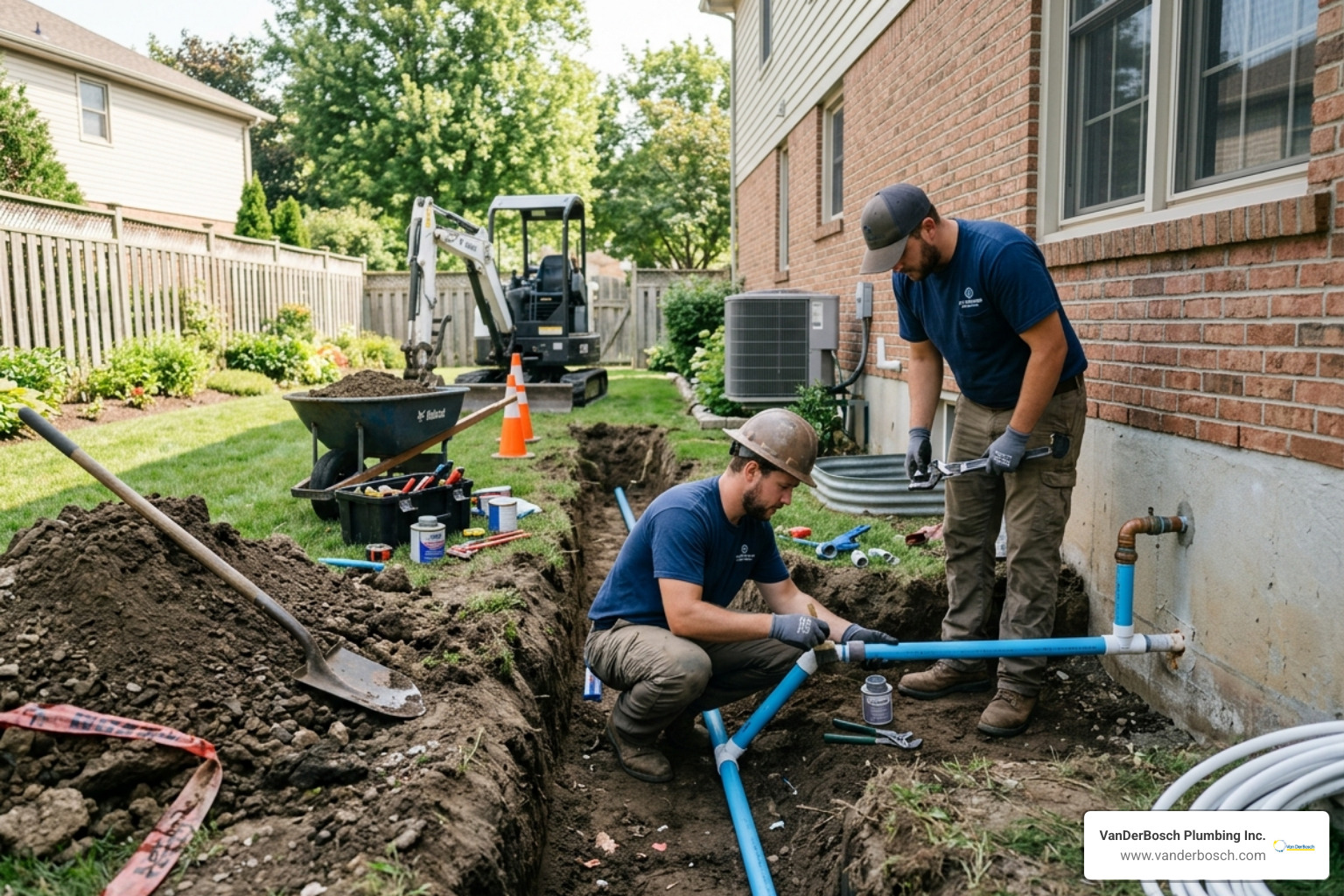
Why Water Line Services Matter for Every Chicagoland Homeowner
Water line services cover everything from leak detection and emergency repairs to full pipe replacement — and knowing what you need can save you thousands of dollars in water damage.
Here’s a quick overview of the most common water line services:
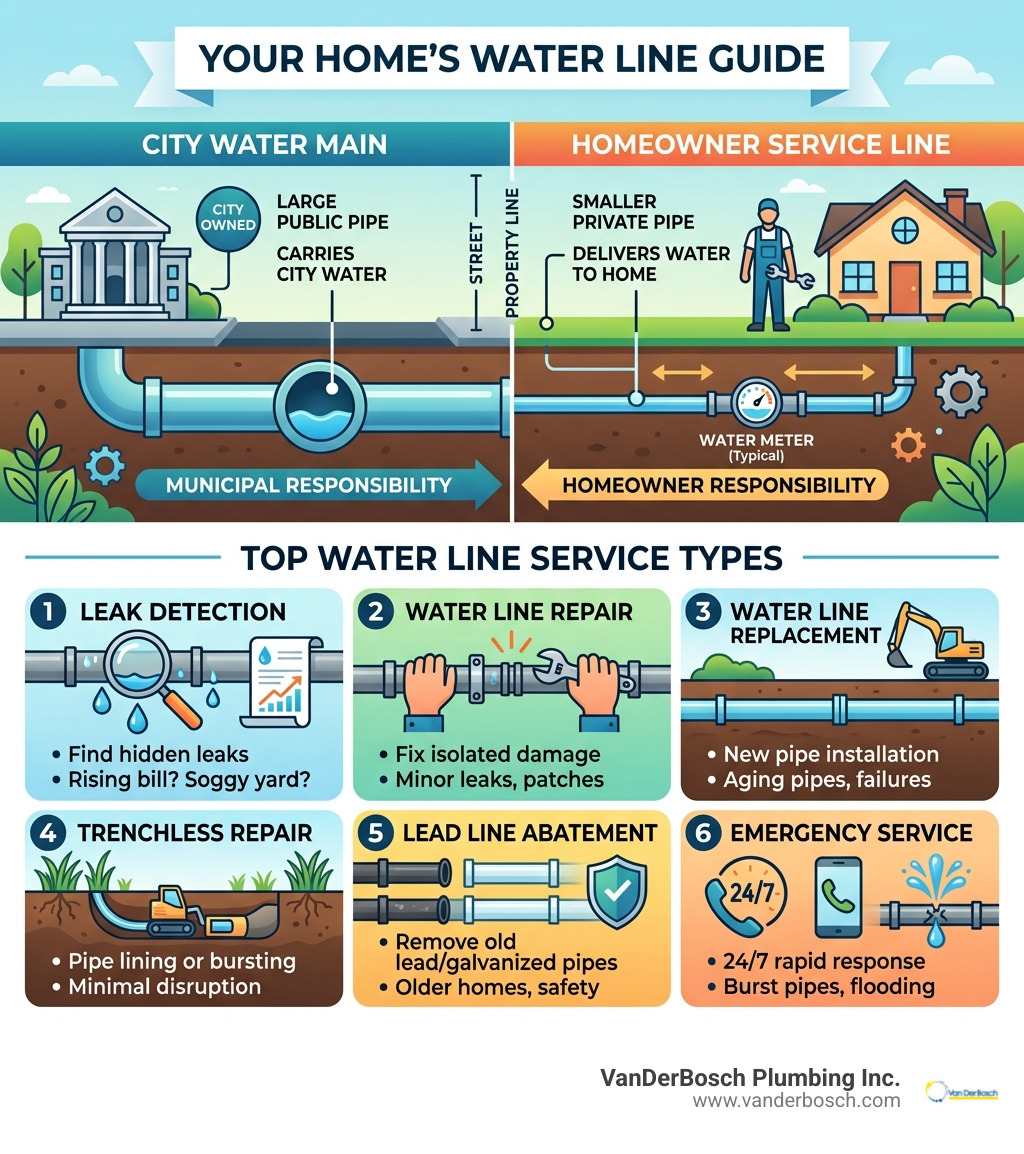
| Service | What It Covers | When You Need It |
|---|---|---|
| Leak Detection | Hidden leaks, meter testing, pressure checks | Rising water bill, soggy yard |
| Water Line Repair | Patching, clamp repairs, section fixes | Isolated damage, minor leaks |
| Water Line Replacement | Full or partial line swap | Aging pipes, frequent failures |
| Trenchless Repair | Pipe bursting or lining underground | Landscaped yards, minimal disruption |
| Lead Line Abatement | Removing old lead or galvanized pipes | Older homes, discolored water |
| Emergency Service | 24/7 burst pipe and shutoff response | Sudden water loss or flooding |
Your water line is the single pipe that carries clean water from the city main into your home. It runs underground, out of sight — which means problems can go unnoticed for months. By the time you see a wet spot in your yard or notice a spike in your water bill, the damage may already be significant.
The good news? Most water line problems are fixable — often the same day — when you catch them early and call the right professionals.
I’m Hugh Hodur, President of VanDerBosch Plumbing Inc., and I’ve overseen hundreds of water line services across the Chicagoland area, from emergency burst pipe repairs to full trenchless replacements. Let’s break down exactly what your options are and how to choose the right one for your situation.
Essential Water Line Services for Homeowners
Understanding your plumbing infrastructure is the first step toward maintaining a healthy home. Many homeowners use the terms “water main” and “water line” interchangeably, but they are quite different. The water main is the large pipe owned by the city or municipality (like the City of Chicago) that runs under the street. Your water line (or service line) is the pipe that branches off that main and brings water directly into your house.
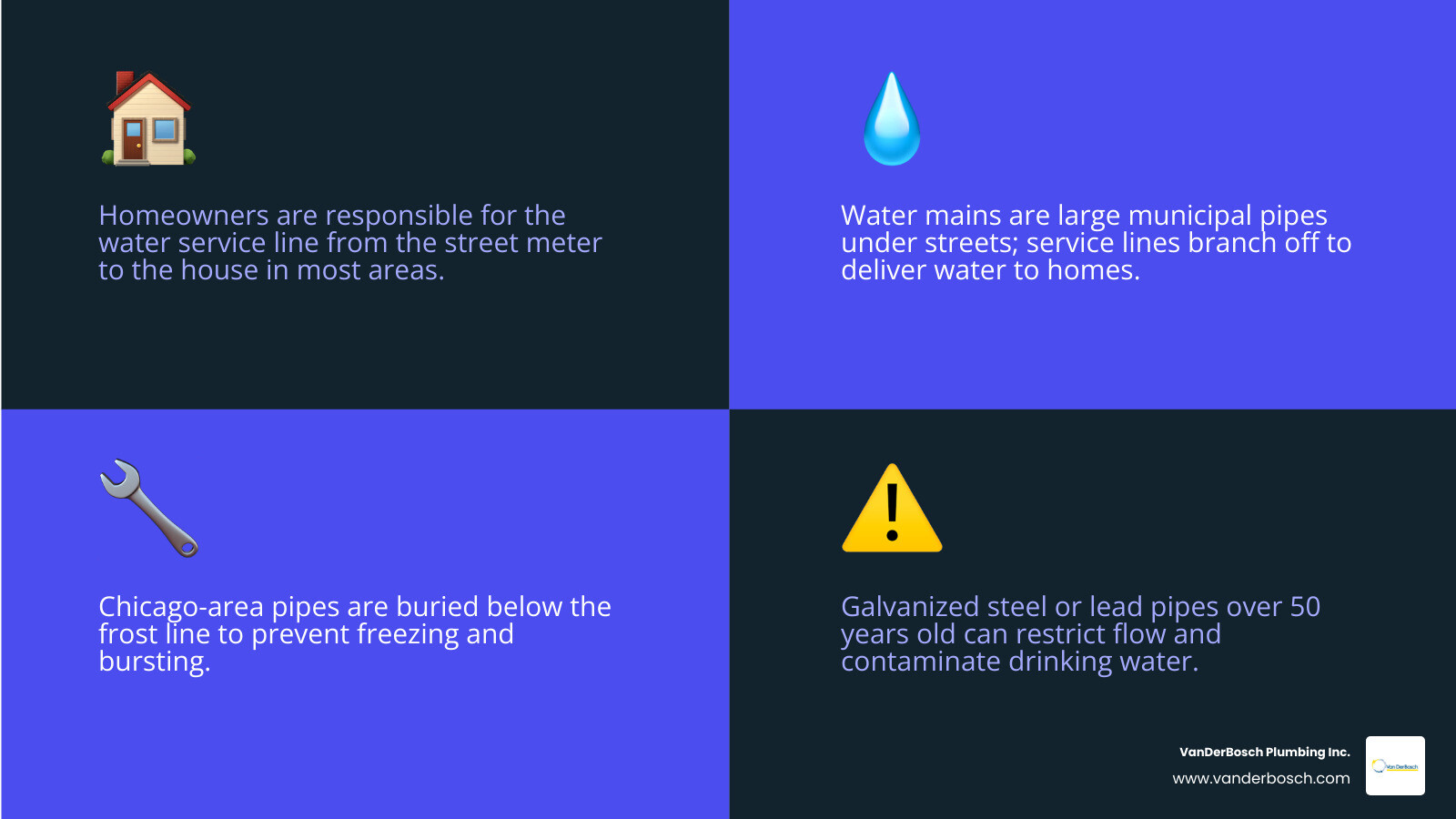
In Chicagoland, from the North Side to Roselle and down through Cook County, the homeowner is typically responsible for the maintenance and repair of the water service line from the street meter or the buffalo box (B-box) all the way into the home. Because these pipes are buried deep to avoid the Chicago frost line, issues often remain “out of sight, out of mind” until a disaster occurs.
As we move through April 2026, infrastructure standards have evolved. Whether you are in Winnetka or Melrose Park, modern Water Line Repair Services now prioritize longevity and water quality. If your home was built more than 50 years ago, you likely have outdated materials like galvanized steel or even lead, which deteriorate over time and can restrict flow or contaminate your drinking water.
Comparing Professional Water Line Services for Leak Detection
Not every leak announces itself with a geyser in the front yard. In fact, some of the most damaging leaks are “silent killers” of your monthly budget. Professional water line services utilize several methods to find these hidden issues:
- Water Meter Testing: This is the simplest check. If you turn off all fixtures in your home and the triangular “leak indicator” dial on your meter is still spinning, you have a leak.
- Electronic Sonar/Acoustic Detection: We use specialized microphones to “listen” for the sound of pressurized water escaping a pipe deep underground.
- Pressure Testing: By isolating sections of your plumbing, we can determine exactly which run of pipe is failing to hold pressure.
- Moisture Sensors: Advanced sensors can detect changes in soil saturation that indicate a slow, persistent leak.
Adhering to Chicago Water Management Standards ensures that these diagnostic methods are non-invasive, preventing unnecessary digging while we hunt for the source of the problem.
Emergency Water Line Services and Rapid Response
When a pipe bursts, time is your greatest enemy. A major line break can dump hundreds of gallons of water into your foundation or yard in a matter of minutes. This is why we provide 24/7 availability for emergency water line services.
Beyond property damage, a broken water line carries significant contamination risks. When a pipe loses pressure, groundwater and soil contaminants can actually be sucked into the line through the crack (a process called back-siphonage), potentially polluting your home’s drinking water. Rapid response includes immediate shut-off at the main valve and same-day repair to restore safe, pressurized water to your family.
5 Best Water Line Services for Modern Infrastructure
Choosing between a quick patch and a full replacement is a big decision. While a repair might cost less today, if your pipe is 60 years old and brittle, you’ll likely be calling us back in six months for the next leak.
Trenchless Pipe Replacement
For years, the only way to replace a water line was to dig a massive, ugly trench through your lawn, driveway, and sidewalk. In 2026, we prefer the “no-dig” approach. Trenchless technology, such as pipe bursting or pipe lining, allows us to replace your line by only digging two small access points.
This service is a lifesaver for homeowners in areas like Oakbrook Terrace or Elmhurst who have invested heavily in mature landscaping or expensive brick pavers. You can learn more about how this works on our Trenchless Technology Benefits page.
Lead Service Line Abatement
This is perhaps the most critical service for older Chicago homes. Lead service lines were the standard for decades, but we now know the severe health risks they pose, especially to children. You can identify a lead pipe by its dull matte gray color; if you gently scrape it with a screwdriver, the metal will look shiny and silver.
Since the 1986 federal ban on lead solder, the industry has shifted toward copper and PEX. Upgrading to copper not only removes the lead risk but often significantly improves your home’s water pressure, as old lead and galvanized pipes tend to “close up” with mineral scale over time.
Advanced Trenchless Technology and Diagnostic Methods

Modern water line services rely on high-tech equipment to ensure the job is done right the first time. One of our most effective tools is the High-Density Polyethylene (HDPE) pipe used in pipe bursting. This material is incredibly strong, flexible, and resistant to the root intrusion that plagues older clay or metal pipes.
Benefits of Trenchless Solutions
Why choose trenchless?
- Lower Labor Costs: Fewer hours spent operating heavy machinery means lower costs for the homeowner.
- Faster Completion: Most trenchless replacements are finished in a single day.
- Structural Integrity: The new seamless pipes have fewer joints, which are the most common points of failure.
- Root Resistance: Without joints for roots to “sniff out” water, your new line is virtually immune to tree damage.
For More info about water line repair, we always recommend starting with a professional assessment to see if your property is a candidate for these eco-friendly methods.
High-Definition Camera Inspections
We don’t guess; we see. By feeding a high-definition waterproof camera into your lines, we can identify exactly what is causing your trouble. Common culprits include:
- Root Intrusion: Tree roots from those beautiful Chicago maples can find even the tiniest crack in a pipe.
- Pipe Bellies: This happens when the soil shifts or settles, causing the pipe to sag and collect sediment.
- Mineral Buildup: Especially common in older galvanized pipes, which can eventually choke off water flow entirely.
Cost Analysis and Material Selection for 2026
When it comes to water line services, the “best” material depends on your specific needs and budget. In the Chicagoland area, we primarily work with three materials:
Comparing PEX, Copper, and HDPE
- Copper: The gold standard for durability and drinking water quality. It is naturally antimicrobial and can last 50 to 70 years. However, it is the most expensive option.
- PEX (Cross-linked Polyethylene): Highly flexible and resistant to the freeze-thaw cycles we experience in Niles and Mount Prospect. It is easier to install in tight spaces but isn’t always suitable for the main underground run from the street.
- HDPE: The go-to for trenchless replacements. It is incredibly tough and can be pulled through old pipes without breaking.
Budgeting for Repair vs. Replacement
Based on current data for the region, the majority of main water line projects fall into these ranges:
- Low: $3,000 (Minor repairs or short, shallow runs)
- Average: $5,000 (Standard replacement for a typical single-family home)
- High: $12,500 (Complex replacements involving deep excavation, long distances, or street-side obstacles)
While a $5,000 investment sounds steep, consider that a single major leak can cause $10,000+ in foundation damage and mold remediation. Furthermore, a new water line is a significant selling point that preserves your property value.
Frequently Asked Questions about Main Water Lines
Who is responsible for the water line between the street and my house?
In most of Chicagoland, including Cook County, the homeowner is responsible for the “service line” that runs from the shut-off valve near the street (the B-box) to the house. The city is responsible for the large main under the road. If the leak is on your property side of that valve, the repair bill is yours.
What are the most common signs of a water line leak?
Keep an eye out for these “Big Four” warning signs:
- Unexplained High Water Bills: If your usage hasn’t changed but your bill has doubled, water is going somewhere.
- Low Water Pressure: A sudden drop in pressure often means water is escaping before it reaches your faucets.
- Wet Spots in the Yard: If it hasn’t rained but you have a “marsh” in your front lawn, your water line is likely leaking.
- Discolored Water: Rusty or brown water often indicates that your old metal pipes are corroding from the inside out.
Is water line replacement covered by homeowners insurance?
Standard policies often do not cover the replacement of a line that failed due to age or wear and tear. However, they may cover the damage caused by the leak (like a flooded basement). Some homeowners opt for “service line coverage” as an add-on to their policy, which can be a lifesaver. It is always best to check your specific policy details before an emergency happens.
Conclusion
At VanDerBosch Plumbing Inc., we understand that dealing with underground plumbing is stressful. That’s why we’ve built our reputation on being the most reliable provider of water line services in the Chicago area. From the historic homes of Hyde Park and Ukrainian Village to the newer builds in Sauganash and West Ridge, we bring over 30 years of local expertise to every job.
We offer a 100% satisfaction guarantee, 24/7 emergency availability, and transparent pricing with absolutely no hidden service charges. Our technicians are fully licensed, insured, and background-checked, so you can feel safe inviting us into your home.
Whether you need a simple leak check or a full Water Line Repair using the latest trenchless technology, we are here to help. Don’t wait for a small leak to become a major flood. Give us a call today, and let’s keep your water flowing safely.