
Do You Need a Tankless Water Heater Expansion Tank?
A tankless water heater expansion tank is a small but important safety device — and whether you need one depends on your specific plumbing setup. Here’s the short answer:
Do tankless water heaters need an expansion tank?
- Usually no — tankless heaters heat water on demand and don’t store it, so pressure buildup is less of a concern
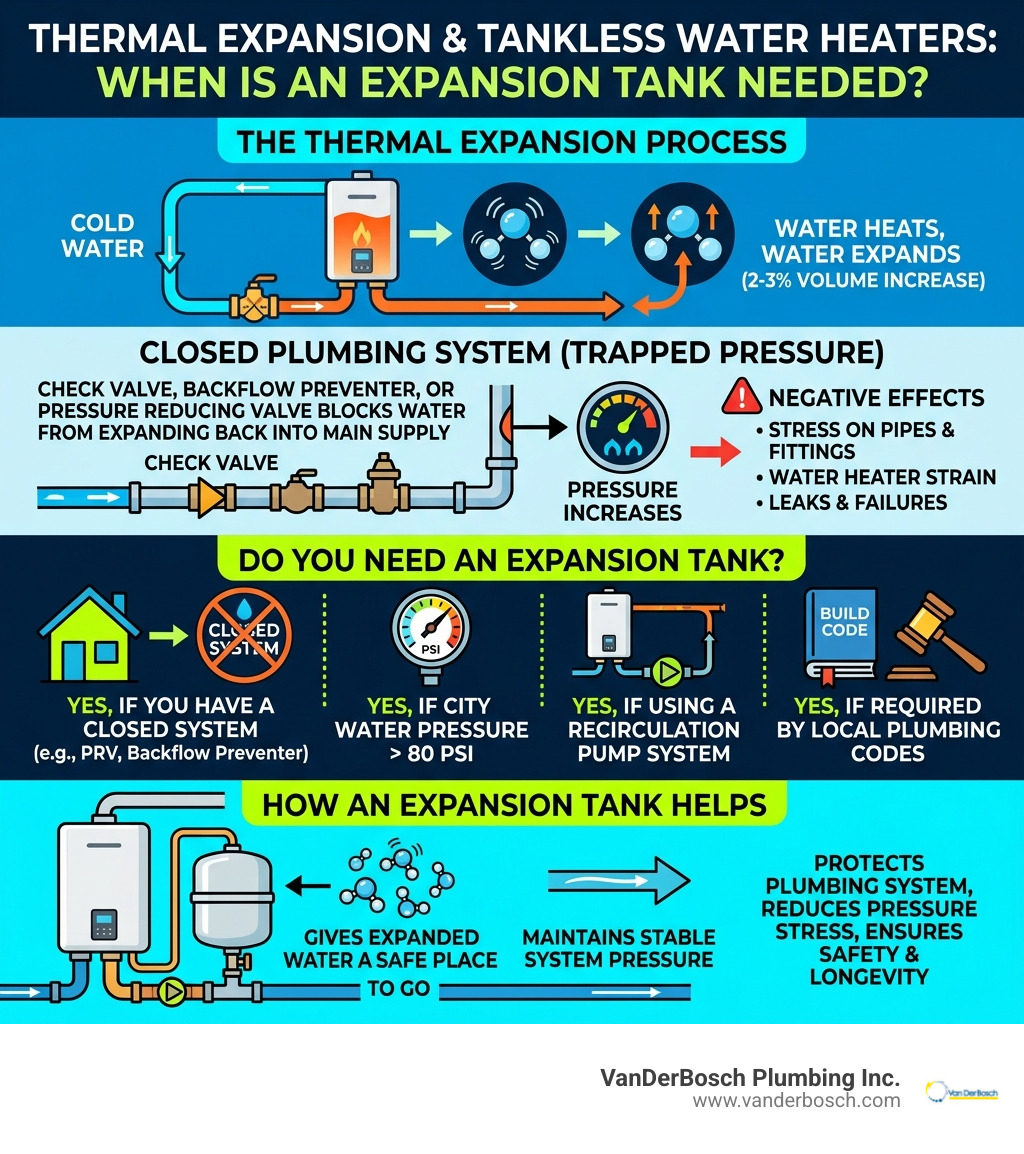
- Yes, if you have a closed plumbing system — caused by a pressure reducing valve (PRV), backflow preventer, or check valve
- Yes, if your city water pressure exceeds 80 PSI
- Yes, if you use a recirculation pump system
- Yes, if your local plumbing code requires it
If any of those conditions apply to your home, skipping the expansion tank can lead to serious — and expensive — problems.
When water heats up, it expands. In an open system, that extra volume flows back into the municipal supply. But most homes in the Chicagoland area operate on closed plumbing systems, where that expanded water has nowhere to go. Pressure can spike from a normal 60 PSI to over 120 PSI in a single heating cycle. That’s a lot of stress on your pipes, fittings, and water heater.
An expansion tank gives that pressure somewhere safe to go — protecting your entire system.
I’m Hugh Hodur, President of VanDerBosch Plumbing Inc., and I’ve overseen countless tankless water heater installations and repairs across the Chicagoland area, including diagnosing pressure-related failures that a properly sized tankless water heater expansion tank could have prevented. Let’s walk through everything you need to know to protect your system and stay code-compliant.
Understanding Thermal Expansion in Tankless Systems
To understand why a tankless water heater expansion tank might be necessary, we first have to look at a universal law of science: thermal expansion. When water is heated, it increases in volume by approximately 2% to 3%. In plumbing, that small percentage can cause a massive headache.
In a traditional tank-style heater, you have 40 or 50 gallons of water being heated and stored, which creates a significant amount of expansion. While tankless units don’t store water, they still heat it rapidly. If your home has a “closed system”—meaning there is a backflow preventer or a pressure-reducing valve (PRV) blocking water from flowing back into the city mains—that expanded water is trapped.
Without an expansion tank to act as a “cushion,” the water pressure in your pipes can spike from a standard 60 PSI to over 120 PSI during a single heating cycle. This is where the Tankless Water Heaters 101 fundamentals come into play: managing that pressure is key to equipment longevity.
How the Internal Diaphragm Works
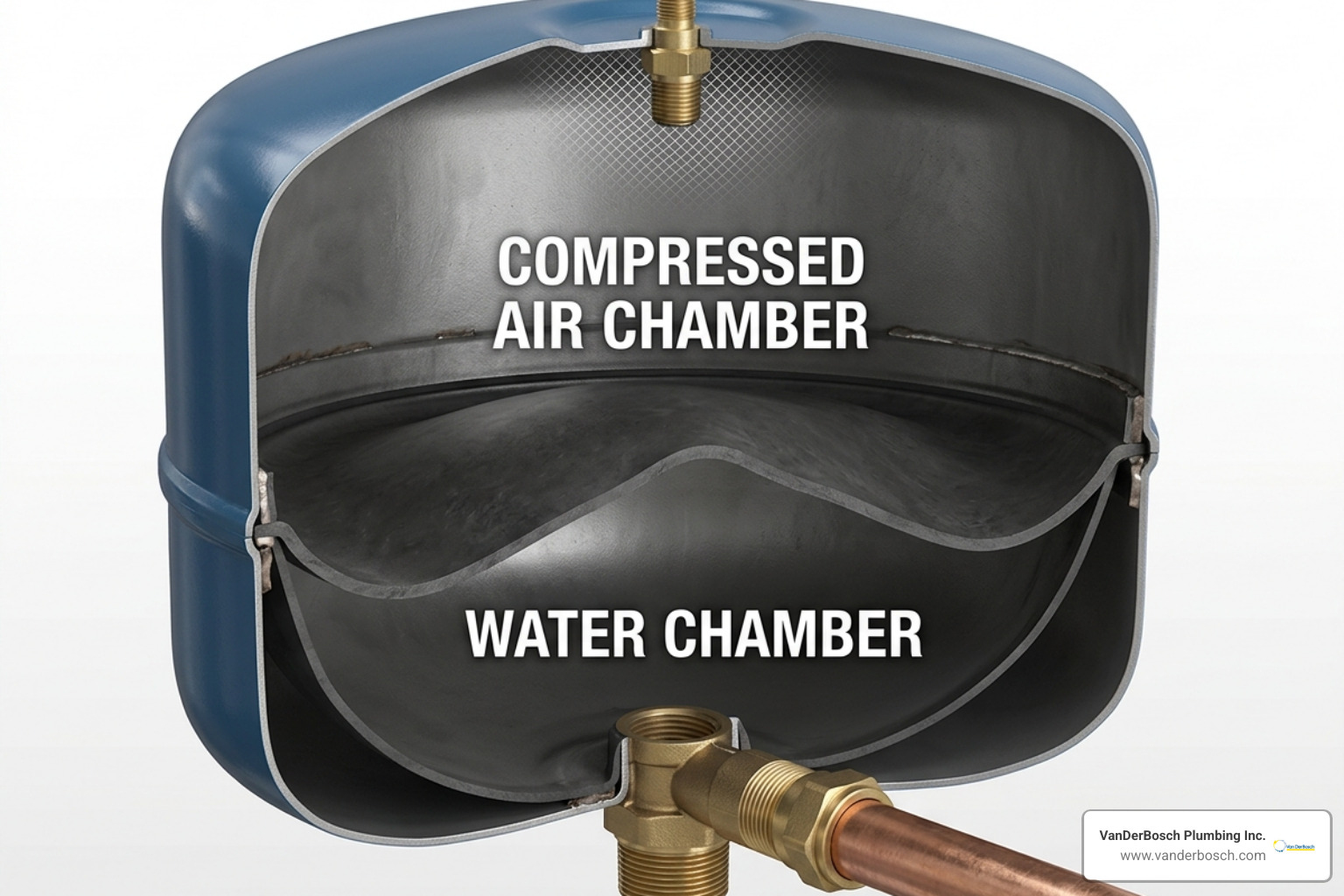
Inside a thermal expansion tank, there is a heavy-duty butyl rubber bladder or diaphragm. This bladder divides the tank into two chambers: one side stays dry and is filled with compressed air, while the other side connects to your plumbing system.
According to Thermal Expansion – Moen Solutions, as the water heats up and expands, it pushes against the bladder, compressing the air on the other side. This “absorbs” the pressure spike, preventing it from rattling your pipes or damaging your heater’s sensitive internal components.
Managing Pressure in a Tankless Water Heater Expansion Tank
For the tank to work correctly, it must be properly calibrated. This is known as “pre-charging.” The air pressure inside the tank should match your home’s static water pressure—typically between 50 and 60 PSI.
If the pre-charge is too low, the tank fills with water and loses its ability to cushion expansion. If it’s too high, the water can’t enter the tank at all. Most high-quality units, like the Thermal Expansion Tank models we often see in Chicagoland homes, are designed to handle a maximum pressure of 150 PSI, providing a substantial safety margin for your system.
When is a Tankless Water Heater Expansion Tank Required?
Not every home in Cook County needs one, but many do. The deciding factor is usually whether your plumbing is an “open” or “closed” system.
| Feature | Open Plumbing System | Closed Plumbing System |
|---|---|---|
| Backflow Preventer | No | Yes |
| Pressure Reducing Valve | No | Yes |
| Pressure Destination | Pushed back to city main | Trapped in home pipes |
| Expansion Tank Need | Generally Low | High / Mandatory |
The “Closed System” Problem
Most modern homes in areas like Winnetka, Niles, and Sauganash are now closed systems. Municipalities install check valves and backflow preventers to protect the public water supply from contamination. While this is great for public health, it creates a “dead end” for your home’s plumbing.
If you have a PRV or a backflow preventer, a tankless water heater expansion tank is essentially a requirement to prevent system failure. Furthermore, if your incoming city water pressure is over 80 PSI, an expansion tank is highly recommended to protect your fixtures.
Recirculation Pumps and Hybrid Systems
If your tankless unit includes a recirculation pump—which keeps hot water moving through the pipes so you don’t have to wait at the faucet—an expansion tank is almost always necessary. These systems often utilize a small internal buffer tank or keep the entire loop pressurized, increasing the risk of thermal expansion stress.
Our team at VanDerBosch Plumbing provides specialized Services/Tankless Water Heater support to help homeowners determine if their specific model requires this added protection.
Local Plumbing Codes and Future Mandates
Plumbing codes are constantly evolving to keep up with safety standards. For example, What Is a Thermal Expansion Tank? NJ 2026 Requirements highlights that some states are making these tanks mandatory for all water heater installations by 2026. While Illinois codes vary by municipality (from Chicago to Roselle), many local inspectors now look for expansion tanks during routine permit inspections for tankless upgrades.
Benefits and Risks of Pressure Management
Installing a tankless water heater expansion tank is an investment in the “health” of your home’s infrastructure.
The Benefits
- Heat Exchanger Protection: The heat exchanger is the most expensive part of a tankless unit. Constant pressure fluctuations can cause the metal to fatigue and eventually crack.
- Extended Lifespan: By minimizing stress on seals and valves, you can help your unit reach its full 20-year potential.
- Quiet Operation: Expansion tanks help mitigate “water hammer,” the loud banging noise you hear when a faucet is turned off suddenly.
- Warranty Compliance: Many manufacturers will void your warranty if they find the unit failed due to excessive thermal expansion in a closed system.
The Risks of Skipping It
If you need an expansion tank but don’t have one, the consequences can be catastrophic. Chronic high pressure leads to:
- Pipe Bursts: Especially at weak joints or older fittings.
- Structural Damage and Mold: Small, hidden leaks behind walls can go undetected for months, rotting wood and encouraging toxic mold growth.
- Dripping T&P Valves: Your Temperature and Pressure relief valve is a safety device, not a faucet. If it’s constantly dripping, it’s a sign your system is over-pressurized.
If you are currently seeing moisture around your unit, check out our guide on Why Is My Water Heater Leaking to see if pressure is the culprit. When Choosing The Right Type Of Water Heater For Installation, we always factor in the cost of the expansion tank to ensure a “done-right-the-first-time” setup.
Proper Placement for a Tankless Water Heater Expansion Tank
Location matters. The expansion tank should always be installed on the cold water supply line. Specifically, it belongs between the water heater inlet and the shut-off valve.
We recommend a vertical orientation whenever possible, as this reduces stress on the fittings and prevents sediment from settling on the diaphragm. If you notice your heater acting up, it might be due to poor placement or a failing tank; see our list of Signs Your Water Heater May Need Repair Or Replacement for more details.
Maintenance and Troubleshooting Guidelines
Thermal expansion tanks are “set it and forget it” devices, but they don’t last forever. Most tanks have a lifespan of 5 to 10 years.
How to Tell if the Tank has Failed
The most common failure is a ruptured internal bladder. When this happens, the tank fills completely with water and loses its ability to compress air. You can test this yourself with the “Tap Test”:
- Hollow Sound: Tap the top of the tank (the air side). It should sound hollow.
- Solid Thud: Tap the bottom (the water side). It should sound solid.
- The Fail Sign: If the whole tank sounds like a solid thud, the bladder has likely failed, and the tank is “waterlogged.”
Professional Pressure Checks
During an annual inspection — like the ones we perform for our Tankless Water Heater services for Roselle clients — we use a tire pressure gauge on the air valve at the top of the tank. If water squirts out of the air valve when we press the pin, the bladder is definitely broken.
Another indicator of failure is the bladder pressure reading; if it’s above 75 PSI while the system is under load, or if it won’t hold a charge, it’s time for a replacement.
Frequently Asked Questions about Tankless Expansion Tanks
Do tankless water heaters always need an expansion tank?
No, they do not always need one. If you have an “open” plumbing system where pressure can bleed back into the city lines, you can often skip the tank. However, if you have a closed system (PRV or backflow preventer), a recirculation loop, or local codes require it, then yes, it is mandatory for safety.
Are there alternatives to expansion tanks for managing pressure?
There are a few alternatives, though they are often less effective:
- Thermal Expansion Relief Valves: These are specialized valves that bleed off a tiny bit of water when pressure gets too high. However, they require a drain line and can become clogged with scale.
- Water Hammer Arrestors: These help with sudden “shocks” from faucets closing but don’t handle the slow, steady pressure build-up of heating water.
- Pressure-Only Relief Valves: These are safety backups, but they shouldn’t be used as a primary way to manage expansion.
How can I tell if my expansion tank has failed?
The biggest red flag is a dripping T&P valve on your water heater. You might also hear “water hammer” noises that weren’t there before. Visually, look for rust at the connection point or use the “tap test” mentioned above. If you press the air schrader valve and water comes out, the tank is finished.
Conclusion
A tankless water heater expansion tank might be small, but it plays a massive role in keeping your Chicagoland home safe and dry. Whether you’re in Ukrainian Village, Elmhurst, or Mount Prospect, understanding your home’s plumbing “type” is the first step in protecting your investment.
At VanDerBosch Plumbing Inc., we take the guesswork out of water heater maintenance. We’ve served the Chicago area for decades with a focus on transparent pricing, 24/7 availability, and a 100% satisfaction guarantee. Our background-checked, licensed technicians are experts in sizing and installing the right expansion solutions for every type of tankless system.
Don’t wait for a dripping valve or a burst pipe to tell you there’s a problem. If you’re planning an upgrade or need a system checkup, reach out to the pros.