
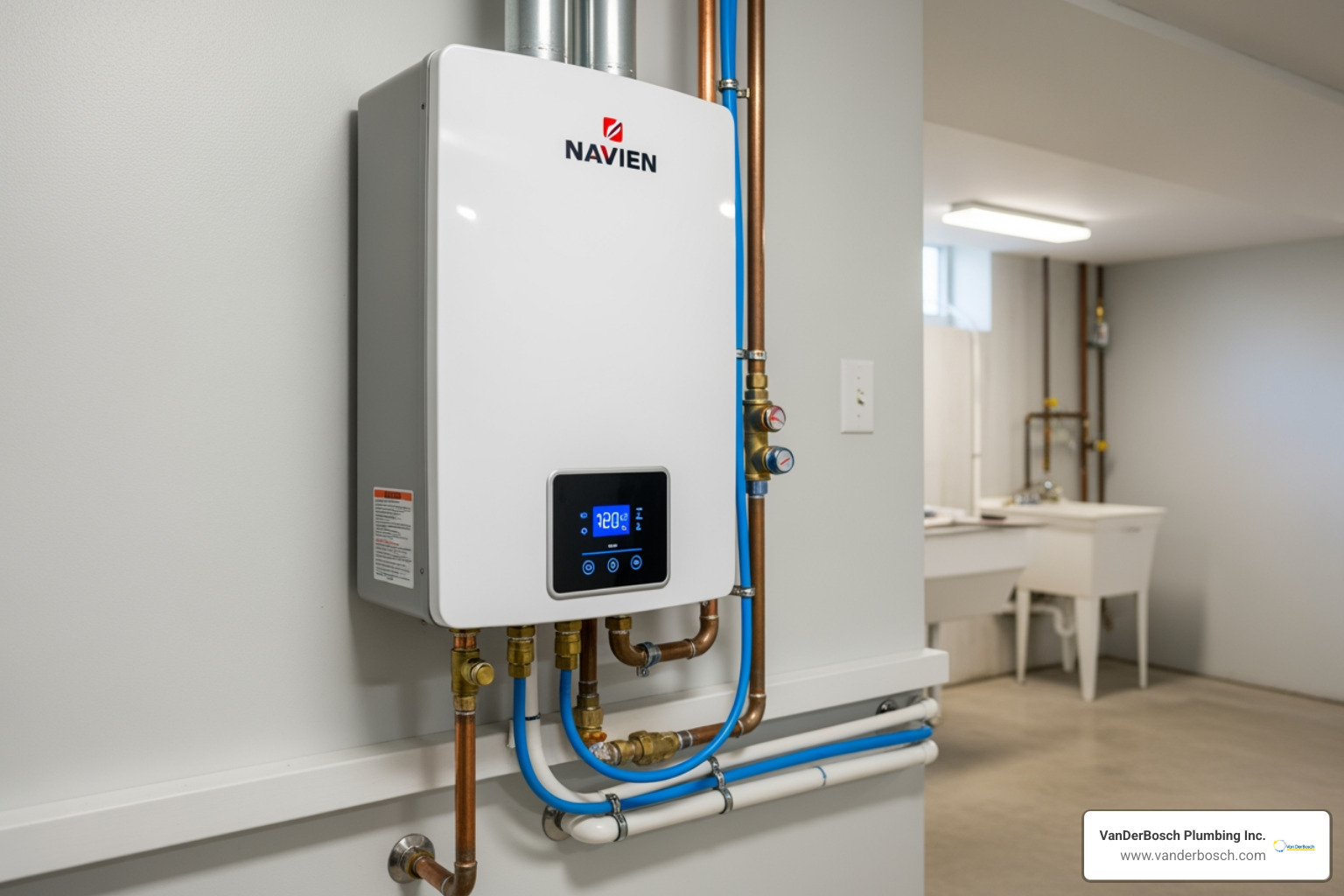
Why Navien Water Heater Maintenance Keeps Your Home Running Smoothly
Navien water heater maintenance is something every Chicagoland homeowner with a tankless unit needs to stay on top of — and here’s what that looks like in practice:
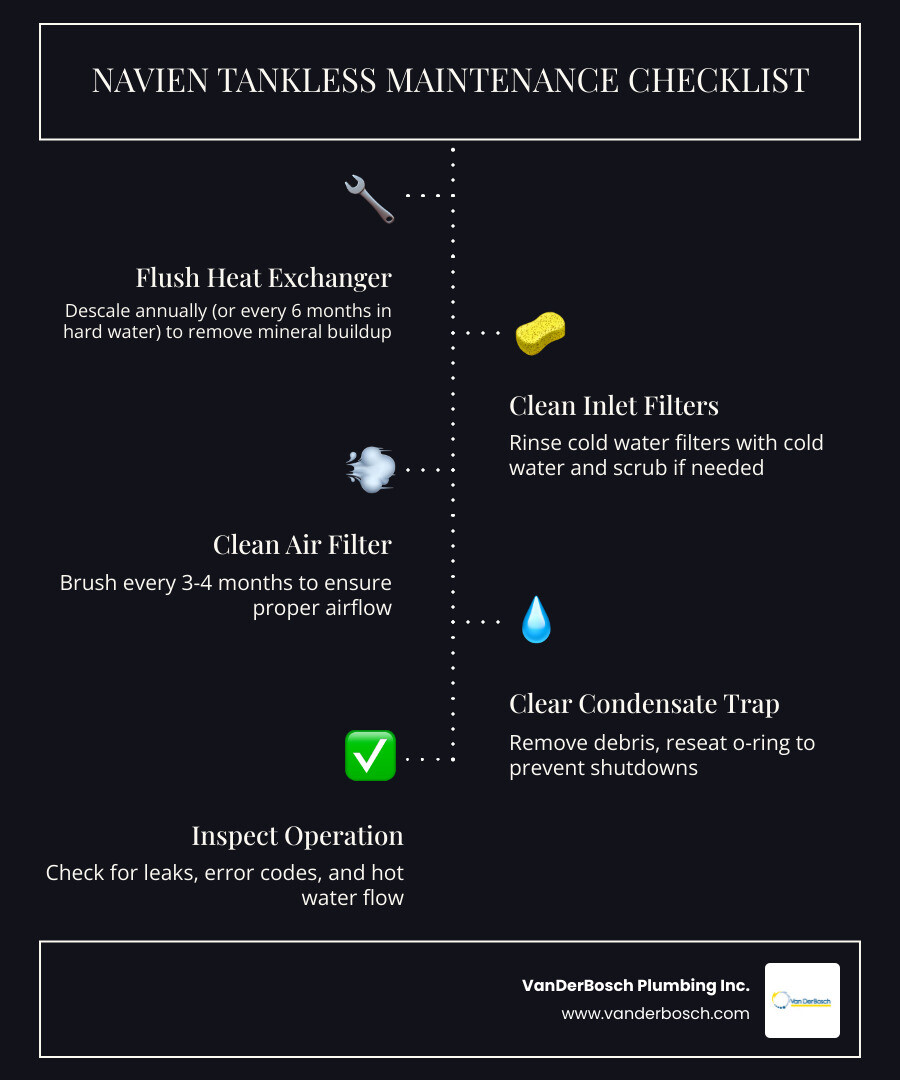
Core maintenance tasks for a Navien tankless water heater:
- Flush/descale the heat exchanger — at least once a year (more often with hard water)
- Clean the cold water inlet filter(s) — rinse with cold water, scrub if needed
- Clean the air intake filter — every 3-4 months using a toothbrush and cold water
- Clean the condensate trap — remove, clear, and reseat the o-ring
- Inspect and verify operation — check for leaks, error codes, and proper flow
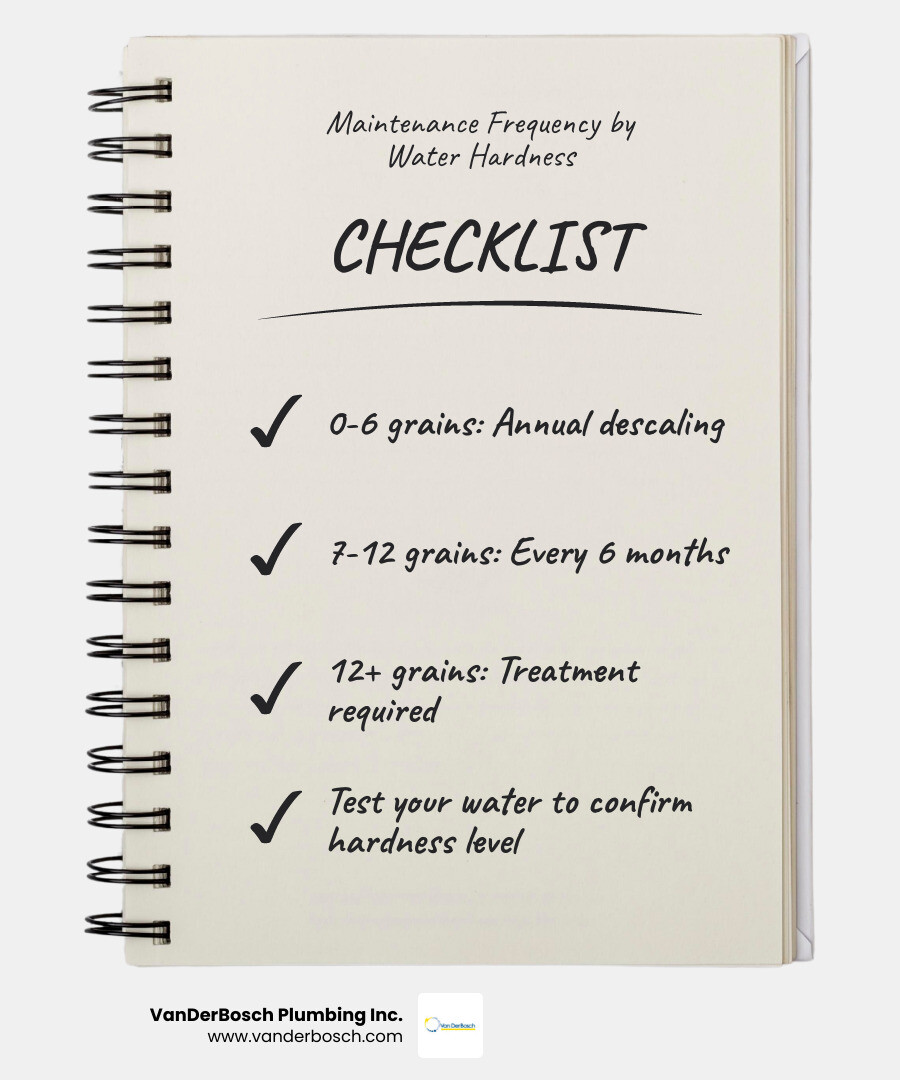
Quick answer: Annual servicing is the baseline. If your Chicago-area water is hard (7+ grains per gallon), increase descaling to every 6 months.
Navien tankless units are built to last 15-20 years — far longer than a conventional tank water heater. But that lifespan depends almost entirely on how well the unit is maintained. Skip the annual flush, and mineral scale quietly builds up inside the heat exchanger, choking efficiency and cutting years off your unit’s life.
This guide walks you through exactly what to do, how often, and when to call in a pro.
I’m Hugh Hodur, President of VanDerBosch Plumbing Inc., with hands-on experience overseeing tankless water heater installation, repair, and service across the Chicagoland area — including Navien water heater maintenance for both residential and commercial customers. In the sections below, I’ll break down everything you need to service your unit with confidence.
The Importance of Routine Navien Water Heater Maintenance
Think of your Navien unit like a high-performance sports car. It’s incredibly efficient and provides “endless” hot water, but you wouldn’t dream of driving a Porsche for 50,000 miles without an oil change. In tankless technology, “oil changes” come in the form of descaling and filter cleaning.
The primary enemy of your Navien unit is calcium and magnesium—the minerals that make water “hard.” As water is heated, these minerals solidify and create a rock-hard layer known as scale. This scale acts like an insulator on your heat exchanger. Instead of the burner heating the water directly, it has to heat through a layer of “stone” first. This causes a massive loss in energy efficiency, making your monthly bills climb while your water temperature drops.
If you’ve ever asked yourself, Why Is My Water Heater Leaking?, the answer often traces back to neglected maintenance. Scale buildup doesn’t just sit there; it erodes the metal walls of the heat exchanger over time. Eventually, the metal thins and cracks, leading to internal leaks that can destroy the electronics of the unit. Furthermore, as scale narrows the passages inside the unit, you’ll notice a significant reduction in water flow. Your high-pressure shower will slowly turn into a sad, lukewarm drizzle.
Consequences of Neglecting Service
If you decide to play “maintenance roulette” and skip your annual service, the house usually wins. One of the first things you’ll notice is that your unit starts making strange noises. It might sound like a tea kettle whistling or stones rattling around inside. This is often the sound of water boiling underneath layers of sediment—a phenomenon that leads to localized overheating.
When the unit overheats, the internal sensors will often trigger a system shutdown to prevent a fire or explosion. You’ll be left with an error code on your digital display and a very cold shower. Navien provides a guide on how to descale your tankless water heater because they know that neglecting this task leads to premature failure. Once the heat exchanger is compromised by scale, it’s often more cost-effective to replace the entire unit than to repair it. Regular maintenance isn’t just a suggestion; it’s an insurance policy against a $3,000+ replacement bill.
The Essential Maintenance Schedule and Water Quality Factors
In the Chicagoland area, our water quality varies significantly. While Lake Michigan water is relatively soft compared to well water in the outer suburbs, it still contains enough minerals to require an annual flushing. Navien units are smart—they actually feature a limescale detection alarm that can be set to a 12-month interval via internal DIP switches. If you see a maintenance code, the unit is literally telling you it’s time for a bath.
The “Magic Number” for water hardness is 12 grains per gallon (or 200 mg/L). If your water tests at or above this level, Navien considers it “hard water.” In these conditions, you should be descaling every 6 months rather than 12.
Preventing Scale Buildup
You don’t have to just sit back and let the scale take over. There are several ways to fight back and extend the time between manual flushes:
- Navien PeakFlow System: This is a chemical-free scale prevention system that Navien highly recommends. It transforms minerals into harmless crystals that flow right through the unit instead of sticking to the walls.
- Water Softeners: A whole-home water softener is the gold standard for protecting all your plumbing fixtures, including your tankless unit.
- Temperature Settings: Higher temperatures accelerate scale formation. Navien units come factory-set at 120°F (49°C). We recommend keeping it at this level. Not only does it reduce scale, but it also prevents scalding—water at 130°F can cause a severe burn in just seconds.
If you’re unsure about your local water quality, our tankless water heater services include water testing to help you establish the perfect maintenance rhythm for your specific home.
Step-by-Step Guide to Servicing Your Navien Unit
Ready to get your hands dirty? Performing Navien water heater maintenance is a multi-step process that involves more than just flushing the heat exchanger. You also need to tend to the filters and traps that keep the unit breathing and draining properly.
Preparing for DIY Navien water heater maintenance
Before you start, you’ll need a “Flush Kit.” You can buy these pre-assembled or build your own. You will need:
- A 5-gallon bucket.
- A small submersible pump (capable of moving 3-5 gallons per minute).
- Two heavy-duty garden hoses.
- 4 gallons of food-grade white vinegar (or a manufacturer-approved descaling solution). Never use harsh chemicals or pool acid.
- Pliers and a screwdriver.
Safety First: Always turn off the electric power supply and the gas valve before you begin. Wait for the unit to cool down completely; the water inside can be scalding hot.
Cleaning Internal Components
While the unit is draining, you should clean the mechanical filters:
- Cold Water Inlet Filter: Located at the bottom of the unit. Unscrew the cap, pull out the cylindrical screen, and rinse it under cold water. If it’s clogged with grit, use a toothbrush to gently scrub it clean.
- Air Intake Filter: This is located inside the cabinet, usually near the top where the air intake collar is. If this filter is dusty, your unit will struggle to “breathe,” leading to inefficient combustion. Wash it with soap and water, let it dry completely, and pop it back in.
- Condensate Trap: This is a small cup at the bottom of the unit that collects moisture from the exhaust. Remove the metal wire clip, pull the cup down, and clear out any debris. CRITICAL: Ensure the rubber o-ring is seated correctly when you put it back, or you’ll have a nasty leak on your hands.
- Recirculation Screen: If you have an NPE-Advanced model, there is a second screen on the recirculation inlet that needs the same cleaning treatment as the cold water inlet.
The Flushing Procedure
Once the filters are clean, it’s time for the main event:
- Close the isolation valves (the red and blue handles) to “lock” the unit away from the rest of your house’s plumbing.
- Connect your hoses to the service ports on these valves.
- Place the pump in the bucket filled with vinegar. Connect the pump to the “Cold” service port.
- Run the other hose from the “Hot” service port back into the bucket.
- Turn on the pump and let the vinegar circulate through the unit for at least 45 minutes.
- Once finished, flush the unit with fresh water for 10 minutes to remove all traces of vinegar before turning the gas and power back on.
Professional vs. DIY: Protecting Your Investment
While many homeowners in places like Roselle or Elmhurst are quite handy, there is a strong argument for calling in the pros. A Navien unit is a complex piece of machinery involving high-voltage electricity, combustible gas, and pressurized water.
A professional service technician doesn’t just “flush and go.” We perform a comprehensive safety check that includes:
- Gas Pressure Verification: We use a manometer to ensure your gas pressure is within the required 3.5″ to 10.5″ WC for natural gas. Incorrect pressure can lead to “sooting” and carbon monoxide risks.
- Venting Inspection: We check for obstructions (like bird nests) in the intake and exhaust pipes.
- Component Testing: We test the pressure relief valve and the flame rod to ensure they are functioning within factory specs.
Navien provides a tool for finding authorized installers and service providers, and we are proud to be a trusted name for these services in the Chicago area.
Professional Navien water heater maintenance and Warranty Protection
Here is the “fine print” that catches many people off guard: Your warranty may depend on your maintenance records. Navien’s limited warranty specifically excludes damage caused by scale buildup or lack of maintenance. If your heat exchanger fails and you can’t prove the unit was flushed annually by a licensed professional, you might be stuck paying the full price for a replacement.
Furthermore, if you accidentally damage a component—like stripping a thread on a filter or improperly seating an o-ring—while performing DIY maintenance, that damage is not covered by the manufacturer. By hiring a licensed service provider like VanDerBosch Plumbing Inc., you ensure that the work is performed to manufacturer standards and that your warranty remains ironclad. If you ever find yourself asking Why Is My Water Heater Leaking?, having a professional record of service makes the warranty claim process much smoother.
Frequently Asked Questions and Conclusion
How often should I descale my Navien tankless water heater?
For most Chicagoland homes using municipal water, once every 12 months is sufficient. However, if you have a private well or live in an area with very hard water (over 12 grains per gallon), you should descale every 6 months.
Can I use regular vinegar for descaling?
Yes, food-grade white vinegar is the most common DIY solution. It is acidic enough to dissolve calcium but gentle enough not to damage the stainless steel heat exchanger. Avoid using “cleaning vinegar” with high acidity (above 5-6%) unless specified by a pro, and never use industrial acids.
Will DIY maintenance void my Navien warranty?
Not necessarily, but it’s risky. If the unit fails due to a mistake you made during the DIY process, that repair will not be covered. Additionally, if the unit fails due to scale, you must be able to provide documentation that the unit was properly maintained. A receipt from a licensed plumber is the best proof you can have.
Conclusion
Maintaining your Navien unit doesn’t have to be a headache. Whether you choose the DIY route for basic filter cleaning or call us for a comprehensive annual flush, the key is consistency. A well-maintained unit will reward you with lower energy bills, higher water pressure, and nearly two decades of reliable service.
At VanDerBosch Plumbing Inc., we’ve built our reputation on being there when our neighbors need us. We offer licensed residential plumbing across Chicago, Niles, Winnetka, and beyond. With our 100% satisfaction guarantee, 24/7 availability, and transparent pricing with no service charges, we make Navien water heater maintenance easy.
Ready to protect your investment? Explore our Roselle Tankless Water Heater Services or give us a call today to schedule your annual service. We’ll help you keep your cool—and your hot water—for years to come.