
Table of Contents
- Warning Signs of Sewer Line Failure Every Homeowner Should Know
- Slow-Flowing Drains and Gurgling Noises
- Foul Sewer Odors and Wastewater Backups
- Recurring Drain Backups: A Red Flag for Main Line Blockage
- Outdoor Clues: Soggy Spots, Lush Patches, and Pest Problems
- How Sewer Video Inspection Confirms a Failure
- DIY vs. Professional Diagnostic Tools: What You Can Safely Check
- Age-Related Pipe Materials and Trenchless Repair Options
- Immediate Mitigation Steps and Insurance Coverage
- Frequently Asked Questions
Last Updated: September 25, 2026
Warning Signs of Sewer Line Failure Every Homeowner Should Know
A sewer line failure rarely announces itself with a single dramatic event. It usually starts small: one slow drain, one gurgle, one damp spot in the yard. By the time sewage backs up into a basement, the problem has often been developing for months.
Slow-Flowing Drains and Gurgling Noises
One slow drain usually means a local clog. Several slow at once points to the main line.
Watch for these patterns:
- Multiple sinks and tubs draining slowly at the same time
- A toilet that gurgles when you run the washing machine
- Water backing up in a shower when you flush
- Bubbling sounds from drains after normal use
If you see standing water in more than one fixture at the same time, stop using water in the house. Every flush pushes more wastewater into a line that’s already blocked, and that pressure has to go somewhere, usually your basement floor drain.
Foul Sewer Odors and Wastewater Backups
Sewer gas smells like rotten eggs and should never be noticeable indoors. Odor near a floor drain, basement sink, or laundry tub means wastewater isn’t moving properly, often a dry or failed plumbing vent, a crack in the sewer lateral, or a blockage letting waste sit and decompose.
Recurring Drain Backups: A Red Flag for Main Line Blockage
One clog is an inconvenience. The same clog returning every few months means the underlying problem was never fixed. That cycle usually points to tree roots that regrow, corrosion narrowing the pipe, a belly or sag where waste collects, or scale and grease a cable scrapes but doesn’t remove. Cabling clears a path through the blockage; it doesn’t restore the pipe.
Keep a simple log of every backup: the date, which fixtures were affected, and what was done. That history helps a plumber spot a repeat pattern fast, and it’s useful if you file an insurance claim later.
Outdoor Clues: Soggy Spots, Lush Patches, and Pest Problems
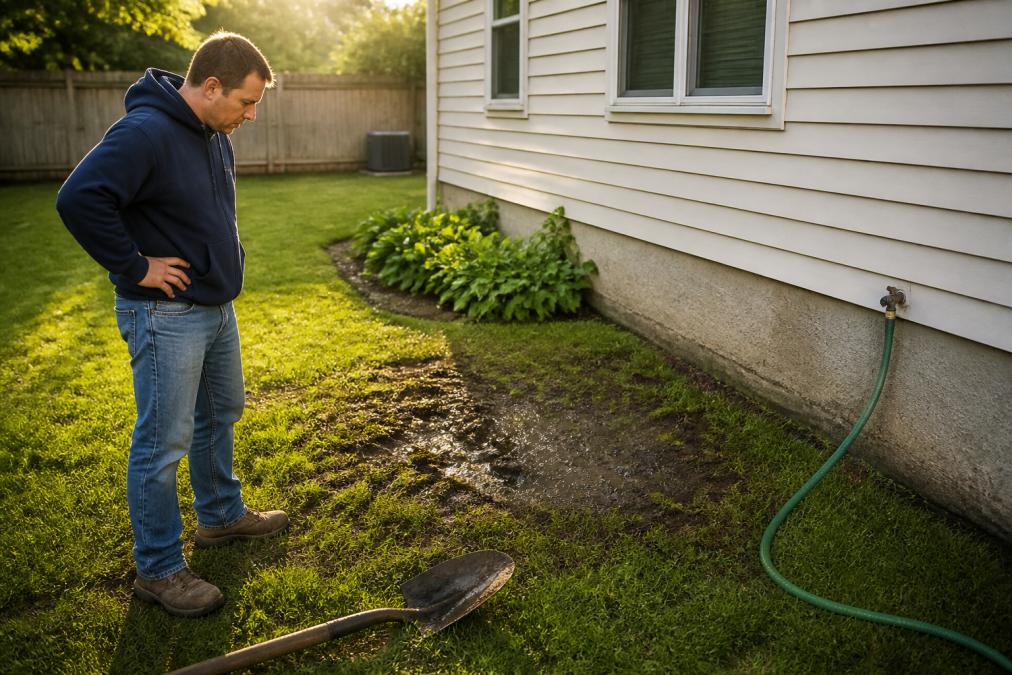
Look for:
- A strip of unusually green, fast-growing grass along the sewer path
- Soggy ground that stays wet when everything else is dry
- A sunken or dipped area in the lawn
- Rodents or insects gathering near a specific outdoor spot
Ground Saturation and Foundation Damage
Ground saturation is more than a wet lawn. A continuously leaking sewer line keeps soil around your foundation soaked, which can shift soil, crack a basement floor, and let water seep into the lowest level of the home.
How Sewer Video Inspection Confirms a Failure
A sewer video inspection is the only way to know for certain what’s happening inside the pipe. A small camera travels the line and sends back live footage of the interior.
DIY vs. Professional Diagnostic Tools: What You Can Safely Check
You can check a few things yourself without touching the plumbing. You cannot diagnose a sewer line from above ground.
Safe homeowner checks:
- Confirm which fixtures are affected and when
- Note the timing of backups relative to laundry, showers, or dishwasher use
- Look for outdoor signs like wet spots and green patches
- Check that floor drains have water in the trap
What you should not do:
- Pour chemical drain cleaners into a main line
- Open a cleanout and reach or snake blindly into the pipe
- Dig up the yard to find the line
- Attempt repairs on a pressurized or buried sewer line
The single most useful thing you can do is document the pattern. When the problem started, which fixtures are involved, and whether it’s getting worse. A plumber can work with that.
Age-Related Pipe Materials and Trenchless Repair Options
The more useful question is what the pipe is made of, because material determines how a line fails and which repair method works. In older neighborhoods with pre-war housing stock, the sewer lateral under the yard is often the original pipe installed when the home was built.
How Each Material Fails
Clay tile. Common on older laterals. Clay is rigid and brittle, installed in short sections with joints every few feet, those joints are the weak points. Ground movement opens them, roots find the gap, and once a root hair enters, it grows into a mat that catches paper, grease, and debris. On camera, clay failure looks like open joints, root masses at the seams, and hairline cracks that widen over time.
Why Material Matters for the Repair Decision
Age alone doesn’t mean a line has failed. A 70-year-old clay lateral with tight joints and no root intrusion may still have years of service left. But age raises the odds, and material tells you what kind of failure to expect:
- A clay line with root intrusion at joints is often a candidate for clearing followed by lining.
- A cast iron line with heavy scale and channeling is usually past the point where cleaning restores capacity.
- Deformed Orangeburg is a replacement, not a repair.
- A plastic line with a single offset joint may only need a localized repair.
Trenchless Options and When They Fit
When a line is damaged but the pipe still has structural shape, trenchless methods can often restore it without digging a long trench across the yard, driveway, or landscaping:
- Pipe lining (CIPP). A resin-saturated liner is inserted into the existing pipe and cured in place, creating a new pipe inside the old one. Best for cracked, root-damaged, or scaled lines where the original pipe still holds its shape.
- Pipe bursting. A bursting head pulls a new pipe through the old one, breaking the old pipe outward into the surrounding soil. Useful when the existing pipe is too deformed for lining but the path is still usable.
- Hydro-jetting. High-pressure water scours grease, scale, and roots from the pipe wall. This is a cleaning method, not a repair, but it’s often the first step before a camera inspection or lining.
| Situation | Likely Approach | Why |
|---|---|---|
| Roots at joints, pipe shape intact | Hydro-jetting, then lining | Clears roots, seals the line |
| Cast iron with heavy scale and channeling | Lining or replacement | Capacity is compromised |
| Deformed or crushed Orangeburg | Pipe bursting or excavation | Structure is gone |
| Offset joint in plastic pipe | Localized repair | Damage is isolated |
| Recurring clogs, no damage found | Drain cleaning and monitoring | Blockage, not failure |
Immediate Mitigation Steps and Insurance Coverage
When you suspect a sewer line failure, the first hour matters. Wastewater backing into a basement or crawlspace creates a health hazard, and every fixture you use adds more water to a line that can’t move it.
What to Do Right Now
- Stop using water in the home. No flushing, showers, laundry, or dishwasher. Every gallon you send down the drain has to go somewhere, and if the line is blocked, that somewhere is your lowest floor drain.
- Keep people and pets out of any backed-up water. Sewage carries bacteria and pathogens. If the water is in a basement, close the door and don’t walk through it.
- Shut off water to affected fixtures if you can do so safely. A fixture shutoff valve under a sink or behind a toilet is fine to close. Do not open cleanouts, remove caps, or attempt to snake or rod the line yourself.
- Photograph and document everything. Wide shots of the affected area, close-ups of the water line on walls or flooring, and any damaged belongings. This is the evidence your insurance adjuster will ask for.
- Call a licensed plumber for diagnosis. A camera inspection confirms what’s actually happening in the line, the information both you and your insurer need.
If sewage is backing up and you cannot stop water use, or if the backup is affecting a finished living space, treat it as an emergency. Do not attempt to clear a main sewer line yourself. The hazards, bacteria, gas, and the risk of releasing a larger volume of waste, are not worth the risk.
What Homeowner’s Insurance Typically Covers, and What It Usually Doesn’t
Standard homeowner’s policies generally treat the sewer line and the damage it causes as two separate things:
- The buried pipe itself is usually excluded. Most standard policies consider the lateral, the pipe running from your home to the municipal main, the homeowner’s responsibility and outside general coverage. Some policies offer an endorsement or rider that adds sewer line coverage, but you have to ask for it and often pay extra.
- Sudden damage from a backup is more often covered. If sewage backs up and ruins flooring, drywall, or belongings, that damage may fall under the policy’s water backup or sewer backup provision, but only if you have that coverage. Many standard policies exclude sewer backup entirely unless you’ve added the endorsement.
- Gradual damage is usually excluded. If a slow leak has been saturating your yard or foundation for months, insurers often treat it as a maintenance issue rather than a sudden loss.
- Mold remediation is frequently a separate coverage question. Some policies cap or exclude mold coverage unless it resulted from a covered peril. If mold develops after a backup, document it and ask your adjuster directly.
Documentation That Makes a Claim Easier
A claim goes smoother when you can show the timeline. Keep:
- A log of every backup: date, which fixtures were affected, and what was done
- Photos of the affected area before cleanup begins
- The plumber’s camera inspection findings and written report
- Receipts for any emergency cleanup or water extraction
What Happens Next
Once the line is diagnosed, the repair path depends on what the camera found. A blockage that can be cleared is a drain cleaning or hydro-jetting job. A damaged pipe may be a candidate for trenchless repair or may need excavation. VanDerBosch handles drain cleaning and hydro-jetting for lines that can be cleared, and we diagnose the rest with sewer line camera inspection before recommending anything.
The two things you control in the first hour are water use and documentation. Stop the water, photograph everything, and get a camera inspection on record. Those three steps protect your home and your claim.
Frequently Asked Questions
What are the early warning signs of a sewer line collapse?
Early signs include slow drains throughout the house, gurgling toilets, and foul odors from drains. You might also notice unusually green grass patches or soggy spots in the yard. If multiple fixtures back up at once, that points to a main line blockage. A sewer camera inspection can confirm whether the pipe is cracked, collapsed, or blocked by tree roots.
Can a sewer line failure cause foundation damage?
Yes. A leaking or collapsed sewer line can saturate the soil around your foundation, leading to shifting, cracks, and structural damage. Wastewater leaking underground can also create voids that weaken support. If you see foundation cracks along with sewer symptoms, it’s important to have both the plumbing and foundation evaluated promptly.
How do I know if my sewer line is blocked or broken?
A blockage often causes slow drains and recurring backups that may clear temporarily with plunging or drain cleaning. A broken line may lead to constant backups, foul odors, and ground saturation even when no fixtures are in use. A sewer video inspection is the only way to tell the difference and locate the exact problem.
Are sewer line repairs covered by homeowners insurance?
Coverage varies by policy. Many standard homeowners insurance policies exclude sewer line repairs unless the damage is caused by a covered peril like a sudden break. Some insurers offer optional sewer backup endorsements. Check your policy or ask your agent. Home warranties may cover repairs but often have limitations. Knowing your coverage before a failure helps you plan.