
Table of Contents
- What to Do First When a Pipe Bursts in Winter
- How to Shut Off the Main Water Valve in Your Home
- Can You Fix a Burst Pipe Yourself?
- Frozen Pipe Prevention Tips for Cold Months
- How Winter Cold Causes Pipes to Burst
- What Affects the Cost of Burst Pipe Repair
- Frequently Asked Questions
Last Updated: September 21, 2026
What to Do First When a Pipe Bursts in Winter
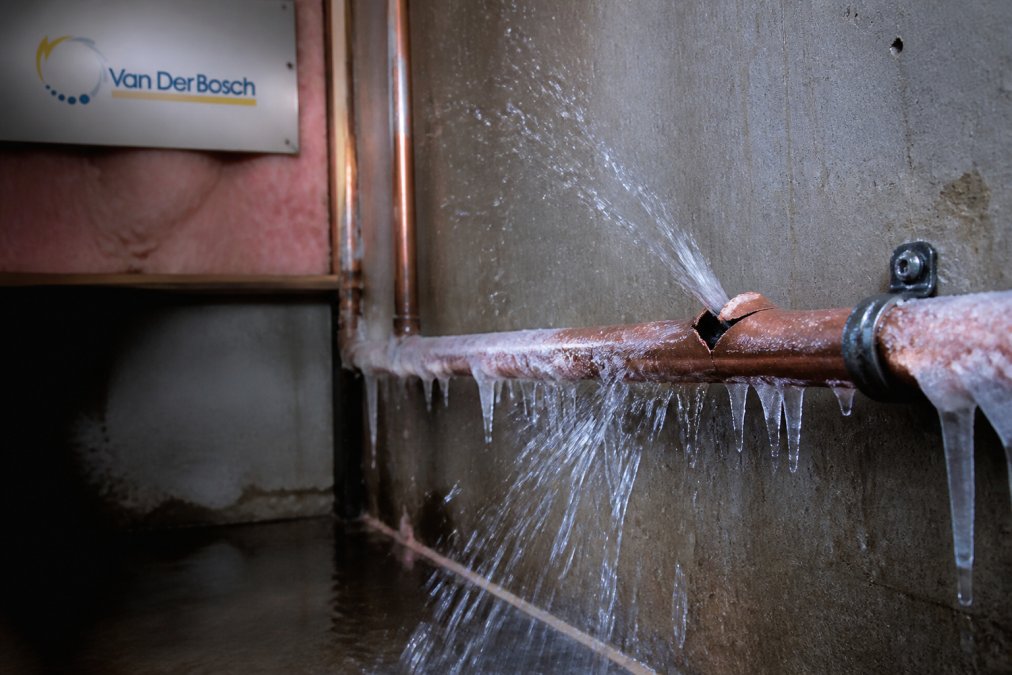
A burst pipe can release several gallons of water per minute, so the first five minutes matter most. This guide walks through the emergency steps that limit damage before a plumber arrives.
Here’s the order that matters most:
- Shut off the water supply
- Cut power to flooded areas
- Drain the remaining water
- Document everything for your insurance claim
Shut Off the Water and Cut the Power
Find your main shutoff valve and close it. If you can’t find it, call your water utility for an emergency shutoff.
Drain the Lines and Document the Damage
Open every faucet in the house, hot and cold, and flush toilets to drain trapped water and reduce pressure on the break.
How to Shut Off the Main Water Valve in Your Home
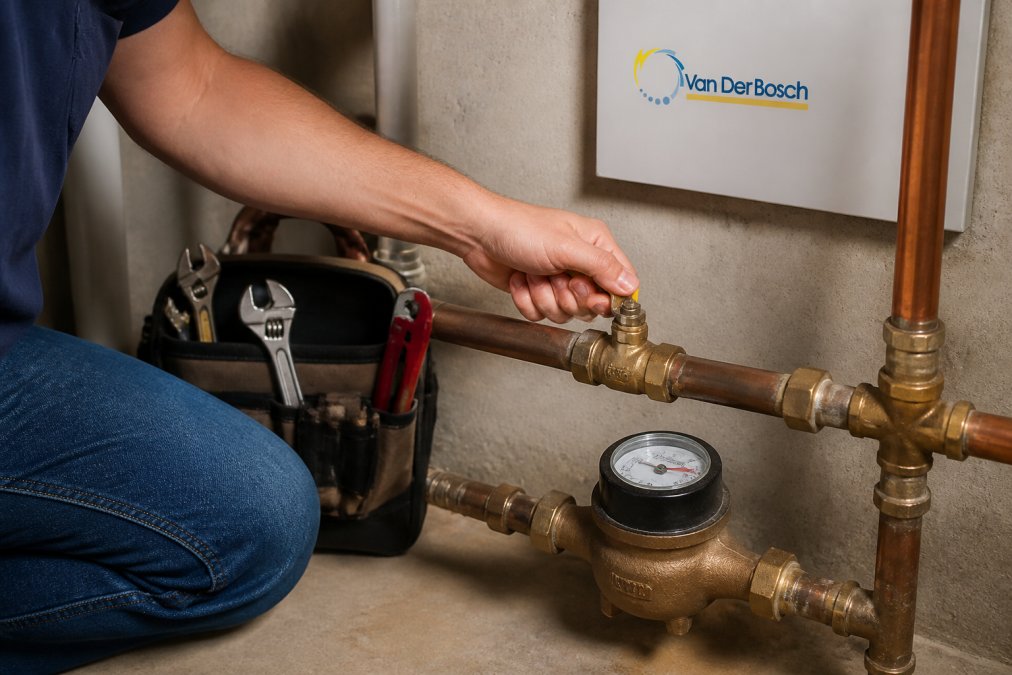
The main water valve is usually in the basement, near the water meter, or along the front wall facing the street. Knowing how to shut off main water valve hardware before an emergency saves critical minutes.
Gate Valves, Ball Valves, and Older Fixtures
Older homes often have gate valves, a round handle you turn clockwise until it stops. They can seize if untouched for years, so test yours before winter. Newer homes usually have ball valves, where a quarter turn of the lever shuts the water off completely.
Can You Fix a Burst Pipe Yourself?
A burst pipe is different from a leak. A pinhole drip is contained; a burst pipe means the pipe wall has failed under household pressure. You can slow a small leak long enough to protect your floors, but you cannot restore a split pipe to service with tape and a clamp. Treat any DIY step as a holding action measured in hours, not a fix.
Here is the honest split:
- Pinhole leak or weeping joint: A pipe clamp, self-fusing silicone tape, or a rubber patch with a hose clamp may hold until a plumber arrives.
- Split, ruptured, or separated pipe: Shut the water off, leave it off, and call a licensed plumber.
- Frozen section that has not split: Thaw it slowly and watch for a leak once flow returns.
- Pipe on a boiler, steam system, or gas line: Do not touch it. These are pressurized or hazardous systems and belong to a licensed technician.
Temporary Fixes for Small Leaks
For a pinhole leak, shut the water off, dry the pipe, wrap self-fusing silicone tape around the leak, and finish with a hose clamp. Open the main valve slowly and watch the patch; if it weeps, close the valve and stop. A sleeve clamp, a rubber pad backed by a metal plate, works better on a straight run of copper or galvanized pipe than tape alone.
Repair or Replace the Failed Section?
This decision determines whether you are back on the same call next winter. A plumber evaluating a burst section looks at several factors:
- Age and material of the pipe. Galvanized steel that has already failed once is usually near the end of its service life. Copper and PEX behave differently.
- Extent of the failure. One clean split in a straight run is a candidate for a sectional repair. Multiple weak spots, pitting, or a long corroded stretch point toward replacement of the run.
- Condition of surrounding pipe. If the metal on either side of the break is thin or discolored, patching the break just moves the next failure a few feet down the line.
- Accessibility. A pipe in an open basement is straightforward to replace. A pipe inside a finished wall or under a slab changes the labor and the decision.
- Recurring history. A line that has frozen or leaked more than once is telling you something about how it was installed or insulated.
Material Compatibility Matters
Connecting new pipe to old is not one-size-fits-all. Copper, PEX, galvanized steel, and cast iron each require different transition fittings, and mismatched connections are a common source of future leaks and corrosion. A dielectric union, for example, is used where copper meets galvanized steel to prevent galvanic corrosion. If a repair ties new material into an older system, that transition is part of the work.
When to Stop and Call a Licensed Plumber
Call a plumber right away if:
- Water is still spraying after your patch
- The break is behind a wall, under a slab, or in a ceiling cavity
- You see rust, corrosion, green staining, or multiple weak spots along the pipe
- The pipe is part of your boiler, steam system, or gas line
- The same line has frozen or leaked before
- You cannot find or fully close the main shutoff valve
Pressurized systems, gas lines, and boiler components are not DIY territory. A frozen pipe repair or burst pipe repair from a licensed technician protects your home, your safety, and your ability to file a clean insurance claim.
Never use a torch or open flame to thaw a pipe. It can ignite nearby wood framing and cause a house fire. Use a hair dryer, heat lamp, or portable heater instead, and never leave a heat source unattended.
The Insurance Angle Most Guides Skip
A burst pipe claim can go sideways for reasons unrelated to the water. Insurers look at whether the home was maintained, whether the loss was sudden or the result of long-term neglect, and whether the repair was done by a qualified professional. A DIY patch that fails weeks later and causes a second loss can complicate the claim.
Frozen Pipe Prevention Tips for Cold Months
Frozen pipe prevention comes down to three things: keep pipes warm, keep water moving, and know your weak spots. Fall prep beats an emergency call in January.
Start with these steps:
- Insulate pipes in basements, crawl spaces, and attics
- Seal gaps around exterior walls where cold air enters
- Disconnect garden hoses and shut off outdoor spigots
- Keep cabinet doors open under sinks on exterior walls
- Let faucets drip during hard freezes
Insulation, Heat Tape, and Drip Strategy
Foam pipe insulation is easy to install, wrap it around any pipe running through an unheated space. Heat tape adds protection for pipes that freeze every year; plug it in before the first hard freeze. The drip strategy works because moving water freezes slower than still water, so a slow trickle overnight keeps the line clear.
Focus your insulation budget on pipes along exterior walls and in unheated crawl spaces. Those freeze first, and they’re the hardest to reach once they burst.
How Winter Cold Causes Pipes to Burst
Water expands when it freezes, creating enormous pressure inside a sealed pipe (Essential Tasks After it Warms Up). The pipe doesn’t always split where the ice forms, pressure pushes downstream, so the break often shows up somewhere else. Older homes with galvanized steel pipes and cast iron drainage are especially vulnerable, since these materials weaken with age and lead solder joints can fail under stress.
What Affects the Cost of Burst Pipe Repair
There is no flat rate for a burst pipe, and any quote given before someone sees the break is a guess. A plumber can explain the factors that drive the number so you understand why two similar-sounding jobs can land in very different places.
The main factors:
- Location of the break. A pipe in an open, unfinished basement is fast to reach. A pipe inside a finished wall, above a ceiling, or under a slab takes more labor to expose and more work to close back up.
- Accessibility and restoration. Cutting into drywall, tile, or a ceiling adds scope. The plumbing repair and the drywall or finish repair are usually separate line items.
- Pipe material. Copper, PEX, galvanized steel, and cast iron each require different fittings, tools, and techniques. Transitioning between old and new material adds a step.
- Extent of damage. A single split section is a smaller job than a failed run with multiple weak points. If the plumber finds corrosion along the line, the scope changes.
- Diagnostic work. Finding the break is not always obvious. Water travels along framing and can surface far from the actual failure, so leak detection may be part of the job.
- Related components. If the burst pipe affected a water heater, boiler, or sump pump, those systems may need inspection or service as part of the same visit.
- Time and conditions. After-hours and emergency calls, and work in a flooded or frozen space, affect how long the job takes.
Repair vs. Replace: The Cost Logic
This decision most affects what you ultimately spend, and it is where a cheap repair can become an expensive one.
- The pipe has failed more than once
- The material is galvanized steel or another aging system near the end of its life
- Corrosion or pitting extends beyond the visible break
- The line is already open and accessible, so the labor is largely paid for
- You plan to stay in the home long enough to benefit from the reliability
What a Fair Quote Looks Like
A written estimate should separate the plumbing repair from restoration work, list materials, and describe the scope, what is being repaired or replaced and why. Ask whether the quote covers just the visible break or the full failed section, and what happens if additional weak spots are found once the pipe is exposed. Be cautious of any quote given without an inspection; a phone estimate for a burst pipe is a placeholder, not a price.
Get an inspection before you agree to a repair. A licensed plumber can tell you whether a section needs a patch or a full replacement, and that decision changes the scope of the work, and the cost, far more than any other factor.
Why the Cheapest Patch Is Not Always the Cheapest Outcome
A patch that fails in February means a second emergency call, a second round of water damage, and possibly a second insurance claim. Compare the total cost of getting through the winter reliably, not just the cost of stopping the leak today. For older homes with aging pipe, that comparison often favors doing the job once, correctly, while the line is already open.
Frequently Asked Questions
What is the first thing to do when a pipe bursts?
Shut off your home’s main water valve immediately to stop water from feeding the break. If the leak is near electrical outlets, wiring, or a breaker panel, turn off the power to that area at the breaker box before you touch anything wet. Then open the lowest faucet in the house to drain remaining water and reduce pressure. If you cannot reach the valve or the leak is spraying near live wiring, leave the area and call a licensed plumber.
Can I fix a burst pipe myself or do I need a plumber?
You can slow a small, accessible leak with a pipe clamp or silicone tape, but those are short-term measures, not repairs. A burst pipe usually means the pipe wall has split from ice expansion or corrosion, and the surrounding section is often weakened too. A licensed plumber can cut out the damaged section, check for additional freeze damage, and restore the line safely. If the pipe is behind a wall, in a crawlspace, or part of a pressurized system, leave it to a professional.
Why do pipes burst during cold weather?
Water expands as it freezes, and that expansion puts pressure on the pipe walls. The burst often happens not where the ice forms but downstream, where pressure builds between the ice blockage and a closed faucet. Pipes in unheated basements, crawlspaces, exterior walls, and garages are the most vulnerable. Older homes with galvanized steel or aging copper lines are at higher risk because the metal has already thinned from corrosion.
How much does burst pipe repair cost?
Pricing depends on several factors: where the pipe is located, how accessible it is, what material it is made of, how much of the line needs replacing, and whether water damage affected other areas. A pipe in an open basement is a different job than one inside a finished wall. Pricing depends on several factors: where the pipe is located, how accessible it is, what material it is made of, how much of the line needs replacing, and whether water damage affected other areas. A pipe in an open basement is a different job than one inside a finished wall. Visit the website to review current pricing or request a quote.