
Table of Contents
- Questions to Ask About Credentials and Licensing
- Plumber Estimate Questions and Pricing Factors
- Experience and References: The Right Questions to Ask
- What to Expect During a Plumbing Service Call
- Questions to Ask Before Replacing a Water Heater
- Red Flags and Warranty Protection
- Conclusion
- Frequently Asked Questions
Last Updated: October 5, 2026
Questions to Ask About Credentials and Licensing
The most important questions to ask plumber should start with verifying credentials and licensing first.
Ask directly: “Are you licensed to perform plumbing work in this area?” A licensed plumber has passed exams on plumbing codes, safety, and best practices.
Insurance matters too. Ask: “Do you carry liability insurance and workers’ compensation?” Liability insurance protects you if something goes wrong; workers’ comp covers the plumber if injured on your property.
How to Verify a Plumber’s License and Insurance
Don’t just take the plumber’s word for it.
For insurance, ask for a certificate of insurance and call the insurer to confirm the policy is active.
Finally, ask: “Have you had any complaints filed against you?” You can also check the Better Business Bureau or local consumer protection agencies.
Plumber Estimate Questions and Pricing Factors
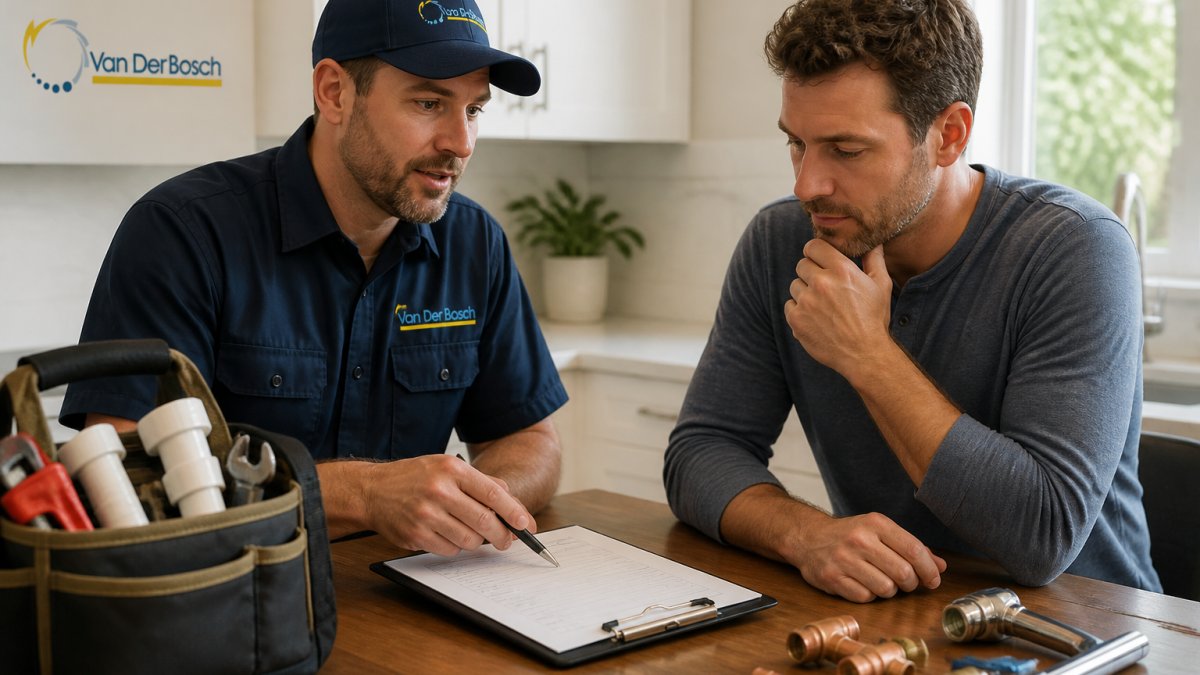
When you call for an estimate, the goal is to understand what the job costs and why, so you can compare quotes fairly.
Ask how labor is calculated, hourly or flat rate, and whether there’s a service call fee just to diagnose.
Ask what’s included: materials, permits, cleanup, disposal, travel time?
What Should Be Included in a Written Estimate
A good written estimate is specific. It should list:
- The exact work to be performed (not vague language like “fix plumbing”)
- Materials needed and their cost
- Labor hours or flat rate
- Any service call or diagnostic fees
- Permits or inspections required
The estimate should also specify what happens if additional problems are found.
Ask about warranties on the work and any equipment installed. VanDerBosch Plumbing Inc. offers a 90-day warranty on new equipment.
Compare estimates from at least two plumbers. Don’t automatically choose the cheapest, a much lower estimate might mean cut corners or an underestimated scope.
Ask if the estimate includes a timeline. When can work start, and how long will it take?
Experience and References: The Right Questions to Ask
Experience is easy to claim and harder to verify. The right questions to ask plumber force a specific answer you can check.
Questions That Reveal Real Experience
- “How many jobs like mine have you completed in the past year?”, A plumber who does sewer line work weekly will answer quickly. A generalist will hedge.
- “What’s the most common failure point you see on systems like mine?”, For a steam boiler, a knowledgeable answer might mention low-water cutoff issues, faulty pressuretrols, or radiator vents. For a tankless water heater, scale buildup or undersized gas supply. Vague answers signal inexperience.
- “Who on your team will actually be doing the work?”, Some companies send a licensed master to sell the job and an apprentice to do it. Not automatically a problem, but you should know who is on site.
- “Do you handle permits yourself, or do I need to pull them?”, In most jurisdictions, the licensed contractor pulls the permit. If a plumber asks you to pull it as the homeowner, that’s a warning sign.
How to Check References Without Wasting Time
Ask for the right references.
- Request two or three references from jobs completed in the last six months, not years ago. Recent references reflect current staff and standards.
- Ask for at least one reference matching your job type, a water heater replacement, sewer repair, or boiler service. A faucet swap reference tells you little about a repiping job.
- When you call, ask: Did the plumber show up when scheduled? Did the final bill match the estimate? Was the work area left clean? Would you hire them again?
Reading Reviews the Right Way
Read reviews as a pattern, not a verdict.
- One bad review is noise. Three describing the same problem, missed appointments, surprise charges, no callbacks, is a pattern.
- Look at how the company responds to negative reviews. A business that replies professionally and offers to make it right signals something different from one that argues or ignores.
- Check the Better Business Bureau for complaint history and whether complaints were resolved. Your state or local consumer protection agency is a second source.
Matching Experience to Your Job
Different problems require different skill sets. A plumber excellent at drain cleaning may not be right for a boiler replacement, and vice versa.
- Drain and sewer work: Ask whether they use sewer video inspection to confirm the cause before recommending repair, and whether they offer hydro jetting for grease or root intrusion versus snaking for simple clogs.
- Water heaters: Ask whether they install both tank and tankless units, and whether they handle venting and gas line sizing for a tankless conversion.
- Boilers: Ask specifically about steam versus hot-water systems. These are different systems with different controls, and not every plumber services both.
- Gas lines: Ask whether they perform gas leak detection and gas line installation, and confirm they hold the credentials required for gas work in your area.
If a plumber can’t explain their diagnostic approach for your problem, that’s your answer. A qualified plumber describes how they’d confirm the cause before quoting, not guess over the phone.
Before you call, write down three details: when the problem started, what you’ve already tried, and any recent work on the system. Plumbers who ask follow-up questions about those details are usually the ones who diagnose carefully.
For recurring drain backups, a sewer video inspection can confirm whether the issue is root intrusion, a bellied line, or a collapsed section, three different problems with three different repairs. For water heater or boiler questions, the right first step is often a service call to diagnose rather than a phone quote.
What to Expect During a Plumbing Service Call
Knowing what happens during the service call helps you prepare.
The plumber should explain the problem, why it happened, and outline repair options in plain terms.
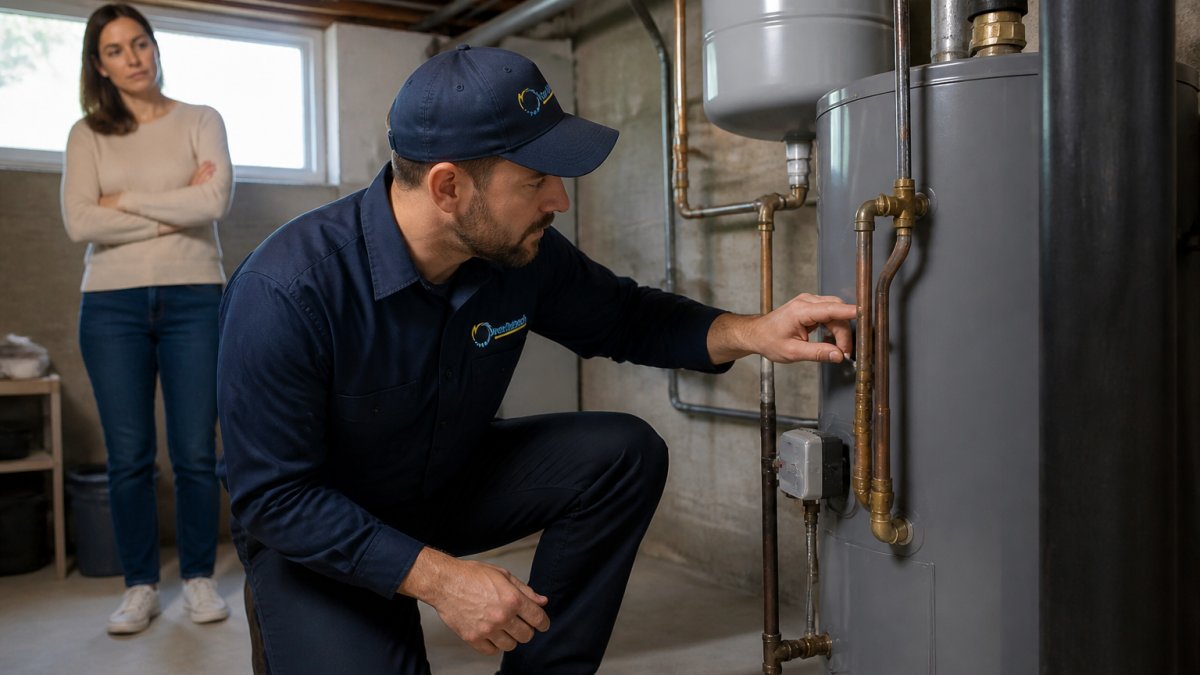
For water heater repair or replacement, ask about the process.
Ask about cleanup: “Will you clean up debris and dispose of old materials?” This matters for jobs like drain cleaning or pipe replacement.
During the work, the plumber should keep you informed.
Questions to Ask Before Replacing a Water Heater
Water heater replacement is a major decision. Ask the right questions to choose the best option.
Ask about tank versus tankless.
Ask about energy efficiency.
Ask about warranty coverage. How long is it? What does it cover, labor or just parts?
Ask about installation requirements. Will the new unit fit where the old one was?
Ask about maintenance. Tank systems typically need annual flushing; tankless systems need descaling.
Red Flags and Warranty Protection
Most plumbing companies are legitimate. The ones that aren’t follow recognizable patterns, and knowing them ahead of time is the best protection.
Red Flags That Should End the Conversation
- Large upfront cash payment required. A deposit for materials is normal on larger jobs. Demanding most or all payment before work begins is not. Never pay in full before the work is done and inspected.
- No written estimate, or a verbal-only quote. If a plumber won’t put scope and terms in writing, you have no way to hold them to it.
- Pressure to decide immediately. “This price is only good today” or “we have a crew in the area right now” are sales tactics, not scheduling realities. Legitimate plumbers schedule work without a countdown clock.
- Recommendation to replace without diagnosis. If a plumber recommends replacing a water heater or boiler without checking obvious failure points first, thermocouple, heating element, pressuretrol, expansion tank, ask why. Sometimes replacement is correct; sometimes it’s the faster sale.
- No physical business address or verifiable license number. A plumber who won’t provide a license number you can look up is a risk you don’t need.
Contract and Scope Red Flags
Read the estimate or contract before you sign. Watch for:
- Vague scope language like “repair plumbing as needed” instead of a specific description.
- No stated process for change orders, what happens if the plumber finds something unexpected after opening a wall or floor.
- No completion timeline or start date.
- No mention of who pulls permits and who pays for inspections.
- Blank spaces in the contract that could be filled in later.
A legitimate estimate describes the work, lists materials, notes permits required, and explains how additional findings will be handled. If the plumber finds a corroded pipe behind a wall that wasn’t in the original scope, they should stop, explain, and get your approval before proceeding, not add it to the bill afterward.
Warranty Questions to Ask Before You Sign
Warranty terms vary widely, and the differences matter when something fails.
- What does the workmanship warranty cover, and for how long? Workmanship coverage applies to the installation itself, a leak at a fitting, a poorly soldered joint, a water heater installed with the wrong venting. This is separate from the manufacturer’s warranty on the equipment.
- What does the manufacturer’s warranty cover? Most water heater and boiler manufacturers cover parts for a set period. Labor is often not included. Ask who handles labor if a covered part fails.
- Does the warranty transfer if you sell the home? Some do, some don’t. If you might sell within the warranty period, this matters.
- What’s the process for a callback? If something fails a week after the job, who do you call, and how quickly will they respond? Get this in writing.
- Are there conditions that void the warranty? Some warranties require annual maintenance or prohibit homeowner repairs. Know the rules before you need them.
If you smell gas, hear hissing near a gas line, or see a boiler leaking water or showing error codes, don’t wait to compare quotes. Leave the area if you suspect a gas leak, avoid operating switches or open flames, and call your gas utility’s emergency line or 911 from a safe location. Gas and boiler issues are not DIY territory.
How to Compare Two Estimates Fairly
Once you have written estimates from two or more plumbers, compare line by line:
- Are they quoting the same scope, or is one excluding something the other includes?
- Are materials specified by brand and model, or left generic?
- Are permits and inspections included?
- Is the warranty stated in writing?
- Does the timeline match your needs?
If you’re ready to move forward, VanDerBosch Plumbing Inc. can walk you through the scope, timeline, and warranty terms for your job before any work begins.
Conclusion
Asking the right questions before hiring a plumber puts you in control. Verify credentials and licensing, get a detailed written estimate, check references and experience, and understand what happens during the service call and what warranties cover.
When you’re ready to hire, VanDerBosch Plumbing Inc. is here to help. Our licensed and insured technicians have over 30 years of experience with residential and light commercial plumbing.
Frequently Asked Questions
What should I ask a plumber before hiring them?
Ask about their license, insurance, and experience with your specific problem. Request a written estimate that includes labor, materials, and any additional fees. Inquire about their response time, availability, and warranty on their work. Ask for references from recent jobs and find out whether they charge a service call fee just to diagnose the problem. These questions help you understand what you’re paying for and whether they’re qualified to handle your plumbing issue.
How can I verify that a plumber is licensed and insured?
Request their license number and insurance documentation before work begins. You can verify licensing through your state’s licensing board or contractor database. Ask to see proof of general liability insurance and workers’ compensation coverage. A legitimate plumber should provide this information without hesitation. Licensed and insured plumbers protect both you and themselves, if something goes wrong, you’re covered.
What should a plumbing estimate include?
A clear estimate should list the specific work to be performed, labor costs, materials needed, any diagnostic or permit fees, and travel charges if applicable. It should specify the scope of work so you understand exactly what’s included and what’s not. Ask whether the estimate is binding or if additional charges might appear once work begins. Request the estimate in writing so you have documentation for comparison and reference.
What questions should I ask before replacing a water heater?
Ask about the age of your current unit and whether repair or replacement makes more sense. Inquire about efficiency ratings and long-term cost savings of different models. Ask about installation timeline, whether permits are required, and what warranty comes with the new unit. Discuss whether you want a traditional tank water heater or a tankless system, as each has different benefits and costs. Understanding these factors helps you make the right choice for your home and budget.