
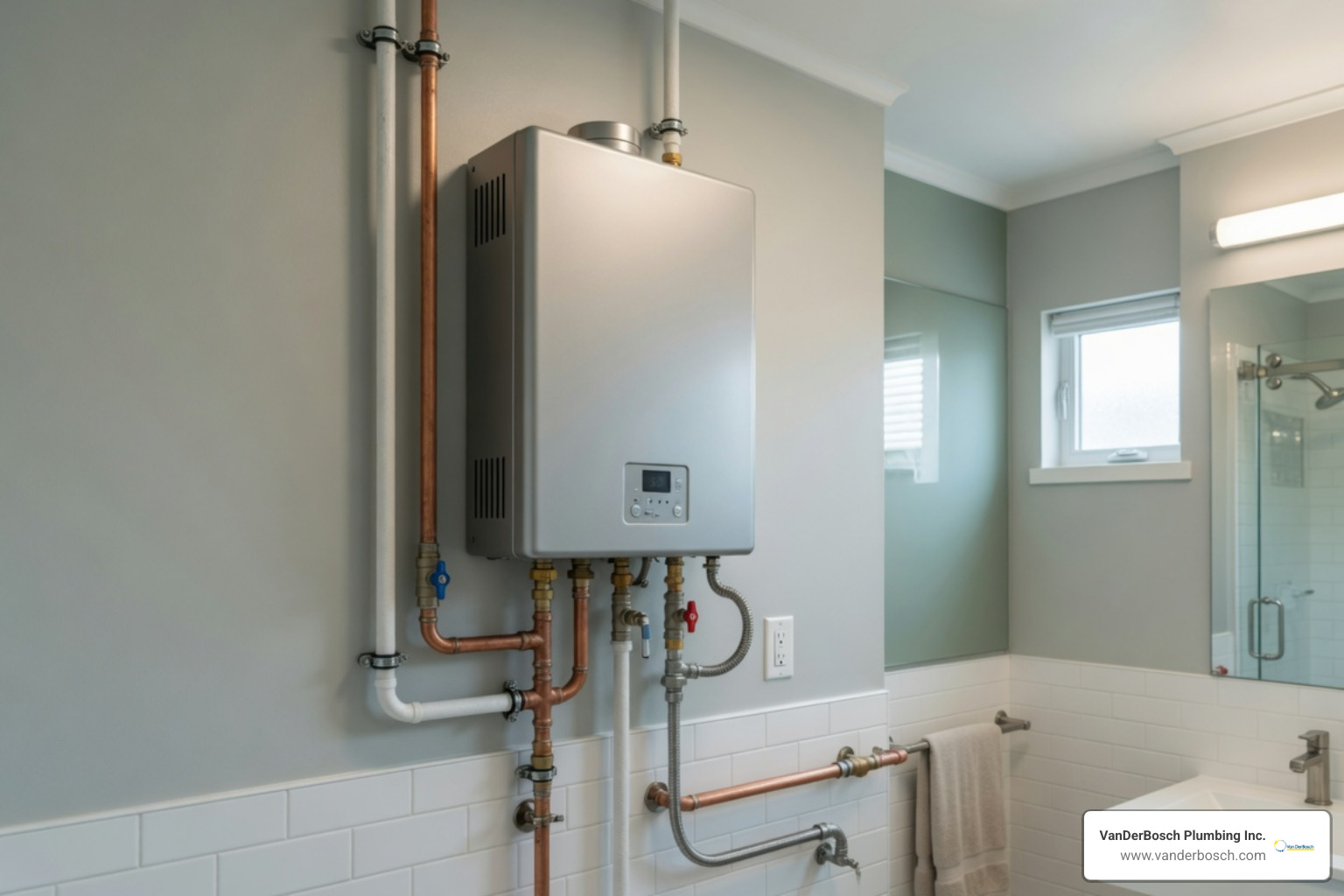
Why Tankless Water Heaters Are Taking Over Chicagoland Homes
Tankless water heaters heat water instantly on demand — no storage tank, no standby energy waste, no running out mid-shower.
Here’s a quick overview of what you need to know:
| Topic | Quick Answer |
|---|---|
| How they work | Cold water flows through a heat exchanger and is heated instantly by a gas burner or electric element |
| Energy savings | 24%–34% more efficient than tank models for average households |
| Lifespan | 20+ years vs. 10–15 years for traditional tank heaters |
| Flow rate | 2–5 gallons per minute (gas models typically higher) |
| Best for | Homes wanting endless hot water, lower bills, and more space |
| Key drawback | Higher upfront cost; flow rate limits under heavy simultaneous use |
If your water heater just failed — or you’re tired of cold showers and high energy bills — you’re in the right place. This guide covers everything Chicagoland homeowners need to know before making the switch.
Running out of hot water is more than an inconvenience. For a busy household juggling morning showers, laundry, and the dishwasher all at once, a traditional tank heater simply can’t keep up. Tankless systems solve that problem by heating water only when you need it — which also means you stop paying to keep 40–50 gallons hot around the clock.
I’m Hugh Hodur, President of VanDerBosch Plumbing Inc., and I’ve overseen hundreds of tankless water heater installations across the Chicagoland area for both residential and commercial customers. In this guide, I’ll walk you through everything — from how these systems work to what they cost and how to keep them running for 20+ years.
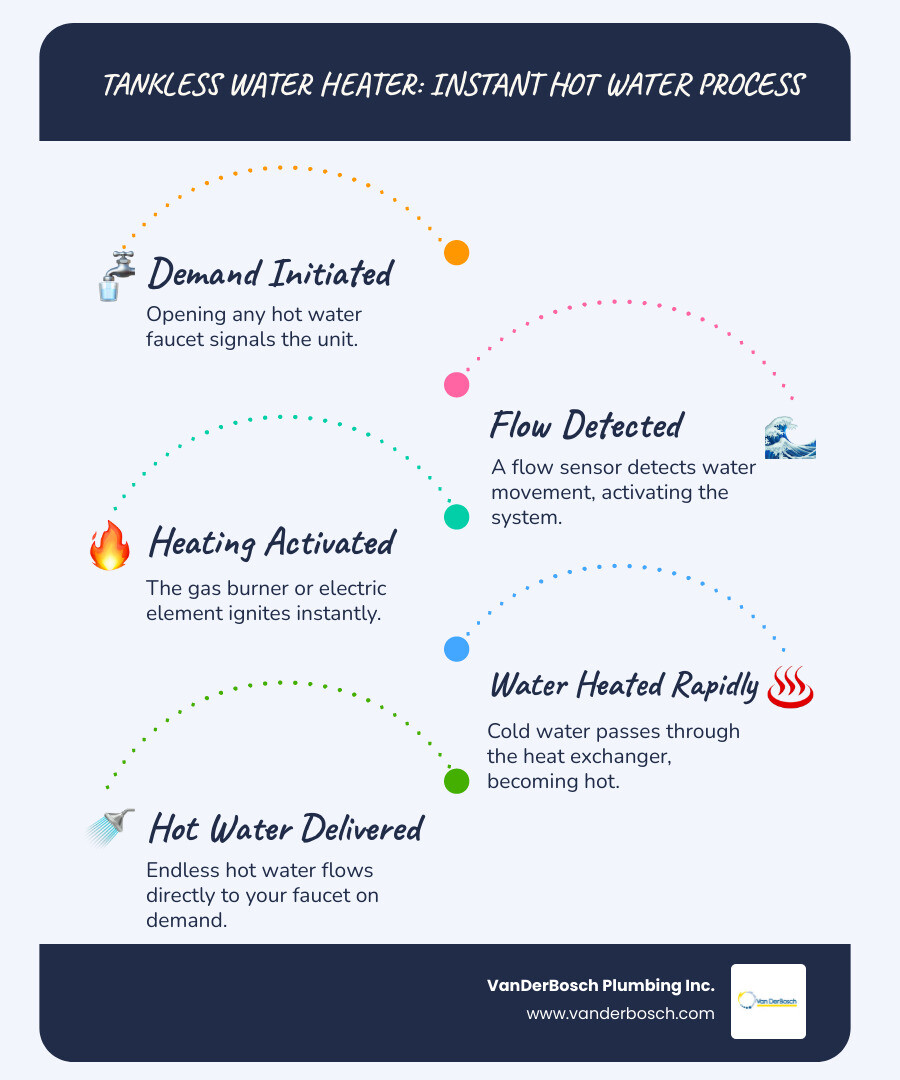
Understanding Tankless Water Heaters: How They Work
To understand why tankless water heaters are such a game-changer, we have to look under the hood. Unlike a traditional tank that sits in your basement like a giant, simmering tea kettle, a tankless unit stays dormant until you actually turn on a tap.
When you flip that hot water handle in your kitchen in Winnetka or your bathroom in Hyde Park, a series of high-tech events happens in seconds:
- Flow Detection: A flow sensor detects that water is moving into the unit.
- The Brain Activates: The unit’s computer (the control board) starts the ignition process.
- Heating Begins: A gas burner ignites or an electric element reaches temperature.
- Heat Exchange: Cold water circulates through a copper heat exchanger. This is a series of pipes designed to maximize surface area contact with the heat source.
- Negative Feedback Loop: The unit uses sensors to monitor the outgoing water temperature. If it’s too cold, it ramps up the heat; if it’s getting too hot, it scales back. This “negative feedback loop” ensures you don’t get a face full of steam or a sudden icy blast.
According to Tankless 101 | Rinnai, this process provides a continuous stream of hot water at a rate of roughly 2 to 5 gallons per minute. Because there is no tank to empty, the hot water literally never runs out as long as the unit has power and fuel. For more details on the specific models we install, check out our tankless water heater services.
Instantaneous vs. Storage Heating
The biggest difference between these two technologies is something called “standby loss.” Traditional tanks lose heat through the walls of the tank 24 hours a day. Even if you go on vacation to the North Shore for a week, that tank is firing up periodically to keep 50 gallons of water hot. It’s like leaving your car idling in the driveway just in case you decide to go to the grocery store later.
Tankless water heaters eliminate this waste. According to the Department of Energy, for homes using 41 gallons or less of hot water daily, demand water heaters can be 24%–34% more energy efficient than conventional storage tank water heaters. Even for high-usage homes (around 86 gallons per day), they remain 8%–14% more efficient.
The Role of Modulating Burners
Not all “on-demand” heat is created equal. Modern tankless water heaters use modulating burners. Think of this like the gas pedal in your car. A traditional water heater is either “on” (full blast) or “off.” A modulating burner can adjust the size of its flame based on how much water you’re asking for.
If you’re just washing your hands, the burner stays low. If you turn on two showers at once, the burner kicks into high gear to maintain that steady temperature. This precision is what prevents the “cold water sandwich” effect and keeps your BTU input exactly where it needs to be for maximum efficiency. You can learn more about this in our Tankless Water Heaters 101 guide.
Pros and Cons of Switching to On-Demand Hot Water
Switching to a tankless system is a big decision. While we love the technology, we always want our neighbors in Elmhurst and Mount Prospect to have the full picture.
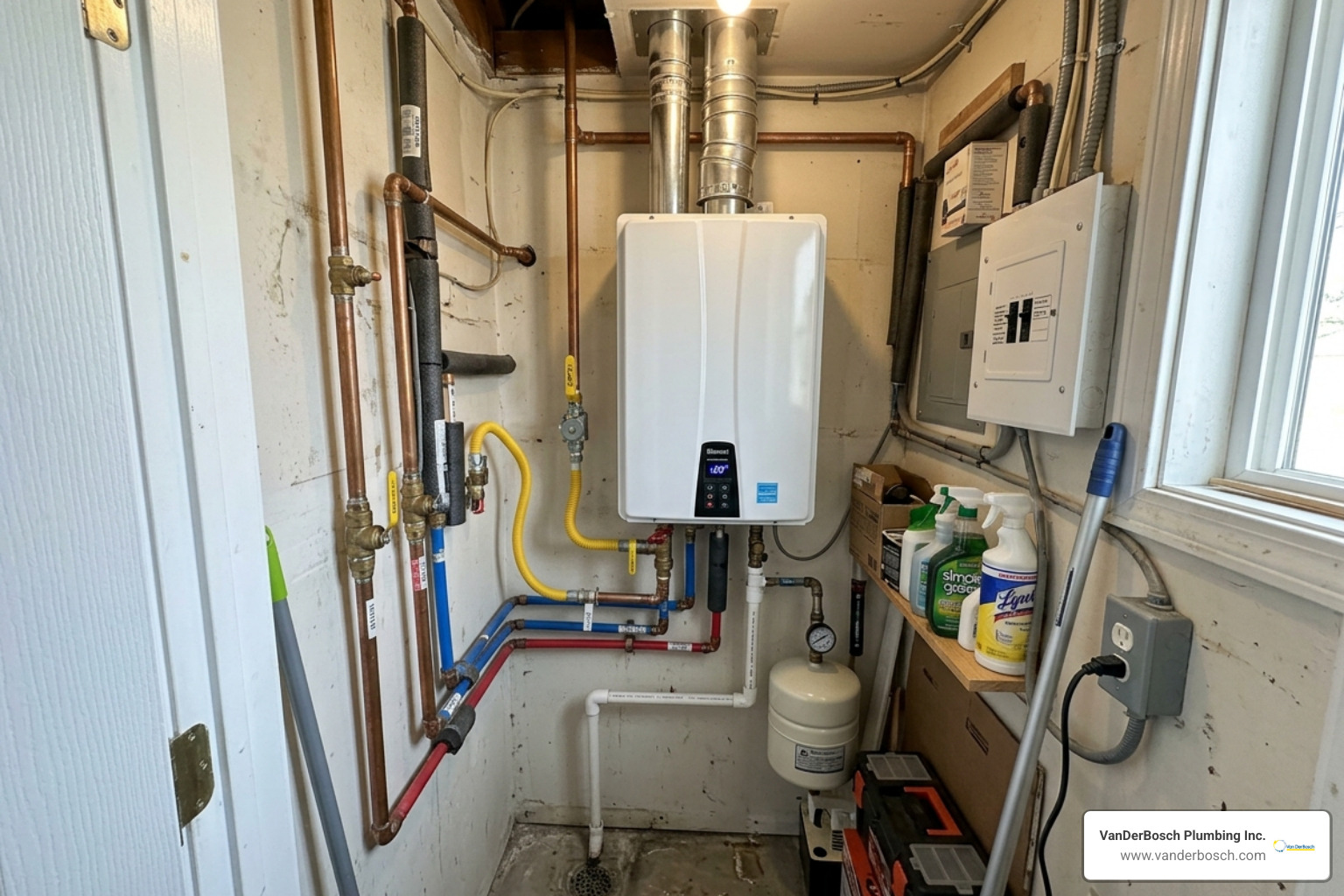
Key Advantages for Homeowners
- Endless Hot Water: This is the headline feature. If you have a large family in a home in Sauganash, you know the pain of being the fourth person in line for the shower. With tankless, the hot water lasts as long as the tap is open.
- Space Savings: A traditional tank takes up about 10 to 15 square feet of floor space. A tankless unit is roughly the size of a carry-on suitcase and mounts to the wall. In tight Chicago basements or Ukrainian Village condos, that extra space is gold.
- Longevity: Most tankless water heaters have a life expectancy of more than 20 years. Compare that to the 10–15 years you get from a storage tank, and the long-term value becomes clear.
- Water Quality: Storage tanks eventually rust and collect sediment at the bottom. Since tankless units don’t store water, you aren’t bathing in “tank tea” made of old minerals and rust. If you’re noticing rust in your water, it might be one of the signs your water heater needs replacement.
Potential Drawbacks to Consider
- Upfront Cost: There’s no sugar-coating it—the initial purchase and installation cost for a tankless unit is higher than a standard tank. This is due to the complexity of the unit and the potential need for gas line or venting upgrades.
- Flow Limits: While the water is endless, it isn’t infinite in volume. If you try to run three showers, the dishwasher, and the washing machine at the same time, the unit might struggle to keep up with the flow rate.
- The “Cold-Water Sandwich”: In older or lower-end models, if you turn the water off and then right back on, there might be a small pocket of cold water left in the pipes that reaches you before the heater re-activates. Modern units with “buffer tanks” or “recirculation pumps” have largely solved this.
- Installation Requirements: You can’t just “swap” a tank for a tankless unit. It requires specialized venting and often a larger gas line to handle the high BTU demand when it first fires up. This is why we recommend choosing the right type of water heater based on your existing home infrastructure.
Selecting the Best Tankless Water Heaters for Your Household
Choosing the right unit involves more than just picking a brand. You have to consider fuel type, efficiency ratings, and your household’s peak demand.
Sizing Your Tankless Water Heaters
Sizing a tankless unit isn’t about how many gallons it holds (since it holds zero); it’s about Gallons Per Minute (GPM) and Temperature Rise.
- Calculate Peak Demand: Add up the GPM of every fixture you might use at the same time.
- Shower: 2.5 GPM
- Kitchen Sink: 1.5 GPM
- Dishwasher: 1.0 GPM
- Total: 5.0 GPM
- Determine Temperature Rise: This is the difference between the cold water coming into your house and the temperature you want at the tap. In Chicagoland, our groundwater can get as cold as 35°F or 40°F in the winter. To get to 120°F, your heater needs to provide an 80°F to 85°F “rise.”
Gas units typically perform better in our cold climate because they can produce more heat quickly than most electric models. If you’re unsure what size you need, our team can help you evaluate your water heater needs.
Condensing vs. Non-Condensing Technology
When browsing models from brands like Navien or Rinnai, you’ll see “Condensing” and “Non-Condensing” options.
- Non-Condensing: These are the traditional style. They are cheaper upfront but less efficient (around 80%-82% UEF). They require expensive stainless steel venting because the exhaust is incredibly hot.
- Condensing: These units use a secondary heat exchanger to capture extra heat from the exhaust gases. This boosts efficiency to 90%–98%. Because the exhaust is cooler, we can often use inexpensive PVC pipe for venting. For our customers in Roselle, we often recommend condensing units for the long-term energy savings. Check out our Roselle tankless services for more local info.
| Feature | Gas Tankless | Electric Tankless |
|---|---|---|
| Energy Factor (UEF) | 0.81 – 0.98 | 0.96 – 0.99 |
| Typical Flow Rate | High (5.0 – 11.0 GPM) | Lower (2.0 – 5.0 GPM) |
| Installation Cost | Higher (Venting/Gas) | Lower (Wiring) |
| Operating Cost | Lower (Natural Gas is cheap) | Higher (Electricity rates) |
| Best For | Whole-home use in Chicago | Point-of-use or small apartments |
For the highest efficiency, always look for the ENERGY STAR certification.
Installation, Maintenance, and Longevity
Installing tankless water heaters is not a DIY project for a Sunday afternoon. Because these units pull a lot of gas or electricity at once, they require precise calibration.
Maintaining Your Tankless Water Heaters
Chicagoland is known for many things: deep-dish pizza, the lakefront, and unfortunately, hard water. Hard water contains minerals like calcium and magnesium that love to “bake” onto the inside of your heat exchanger.
To keep your unit running for 20+ years, you must perform regular maintenance:
- Descaling/Flushing: At least once a year, the unit should be flushed with a food-grade descaling solution (like white vinegar) to remove mineral buildup. If you have a water softener, you might be able to go longer between flushes.
- Filter Cleaning: Most units have an in-line screen filter that catches sediment from the city water lines. This should be checked and rinsed periodically.
- Venting Inspection: We check to ensure no birds or debris have blocked the intake or exhaust pipes.
Neglecting this can lead to efficiency loss or even a cracked heat exchanger. You can read more about the technical side of tankless water heating on Wikipedia, but the takeaway is simple: clean it, and it will last.
Professional Installation Requirements
When we install a unit in Melrose Park or Oakbrook Terrace, we aren’t just hooking up pipes. We are ensuring the system meets strict local building codes:
- Gas Line Sizing: A tankless unit might need 199,000 BTUs instantly. If your gas pipe is too small, the unit will “starve,” leading to error codes or poor performance.
- Combustion Air: Gas units need oxygen to burn. Proper venting ensures they aren’t pulling air from living spaces.
- Condensate Drains: High-efficiency units produce a small amount of acidic water (condensate) that must be safely drained or neutralized.
- Permits: Most municipalities in Cook County require a permit for water heater replacement to ensure safety.
If you’re worried about the state of your current system, look into why your water heater might be leaking and whether a tankless upgrade is the right move. Our Roselle water heater services cover these professional requirements in detail.
Cost, Efficiency, and Financial Incentives
The “sticker shock” of a tankless unit is often offset by long-term savings and incentives. While a Senville 13KW Electric unit might be priced as low as $299.99 for point-of-use, whole-home gas units like the Rheem Performance Platinum or Rinnai SENSEI series are more substantial investments.
How you save money:
- Lower Utility Bills: By eliminating standby loss, most homeowners see a 10% to 20% drop in the water-heating portion of their gas bill.
- Federal Tax Credits: Under the Inflation Reduction Act, many homeowners can claim a tax credit (often up to 30% of the project cost, capped at specific amounts) for installing high-efficiency water heaters.
- Utility Rebates: Companies like Peoples Gas or Nicor Gas often offer rebates for switching to high-efficiency (UEF 0.87 or higher) tankless models.
- Avoided Replacements: Since a tankless unit lasts twice as long as a tank, you’re essentially skipping an entire replacement cycle over 20 years.
Check out the Takagi product catalog for examples of high-efficiency models that qualify for these incentives.
Frequently Asked Questions
Can a tankless unit handle multiple showers at once?
Yes, provided it is sized correctly. A unit with a flow rate of 9.0 GPM or higher can typically handle two or three showers simultaneously in a Chicago home, even with our cold winter groundwater. If you have a massive home with five bathrooms, we sometimes install two units in parallel to handle the massive demand.
How much can I save on my energy bills?
For an average household, you can expect to save about $100 to $150 per year on energy costs compared to a standard gas tank. Over the 20-year lifespan of the unit, that’s $2,000 to $3,000 in savings — which often covers the price difference of the unit itself!
How long do these units typically last?
With proper maintenance (especially annual descaling), tankless water heaters typically last 20 years or more. One of the best features is that almost every part inside the unit—the burner, the heat exchanger, the sensors—is replaceable. When a traditional tank leaks, it’s garbage. When a tankless unit has an issue, it’s usually repairable.
Conclusion
Switching to a tankless system is one of the best upgrades you can make for your home’s comfort and efficiency. No more “first come, first served” showers, no more bulky tanks eating up your basement space, and no more wasting money heating water you aren’t using.
At VanDerBosch Plumbing Inc., we believe in doing things the right way. That’s why we offer a 100% satisfaction guarantee and 24/7 availability for our neighbors across Chicagoland—from Niles to Winnetka and Elmhurst to the South Side. Our pricing is completely transparent with no service charges, and every one of our technicians is experienced and background-checked for your peace of mind.
If you’re still wondering when homeowners should break up with their water heaters, or if you’re ready to make the switch to endless hot water, we’re here to help.
Schedule your professional tankless water heater installation today and join the thousands of Chicago families who have already made the upgrade to modern, on-demand hot water.