
When Your Yard Turns Into a Swamp: What Sewer Line Damage Is Telling You
Sewer line damage is one of the most disruptive — and expensive — problems a homeowner can face. One day your drains are fine. The next, you’ve got sewage backing up into your basement, soggy patches spreading across your lawn, and no idea what’s going on underground.
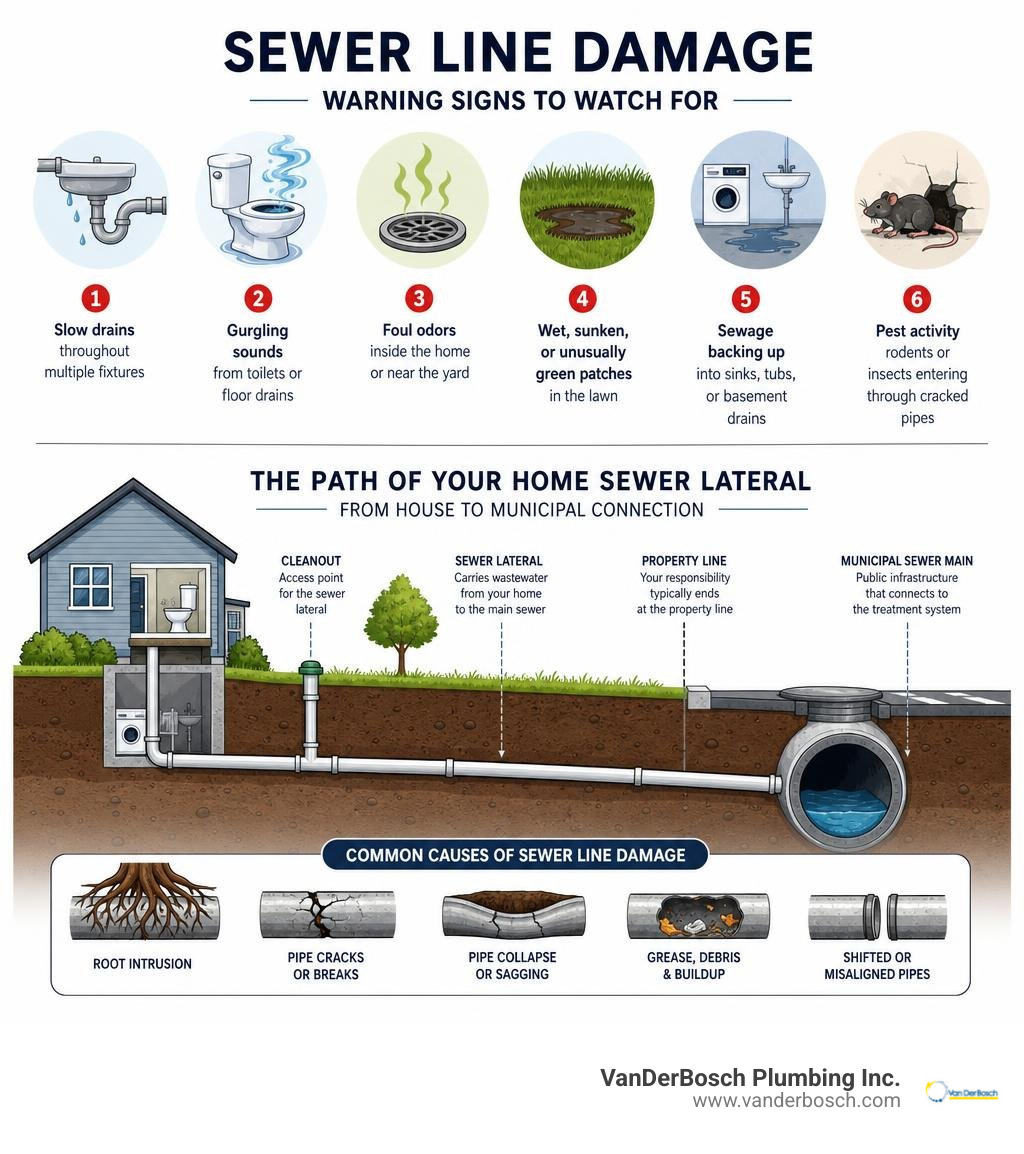
Here’s a quick look at the most common signs you may have a sewer line problem:
- Slow drains throughout multiple fixtures at once
- Gurgling sounds from toilets or floor drains
- Foul odors inside the home or near the yard
- Wet, sunken, or unusually green patches in the lawn
- Sewage backing up into sinks, tubs, or basement drains
- Pest activity — rodents or insects entering through cracked pipes
If you’re seeing two or more of these at the same time, it’s very likely a main sewer line issue — not just a simple clog.
The bad news: sewer repairs can run anywhere from $1,000 to $20,000 depending on the damage, depth, and repair method. The good news: catching it early almost always means a smaller repair bill.
I’m Hugh Hodur, President of VanDerBosch Plumbing Inc., and I’ve overseen hundreds of sewer line damage cases across the Chicagoland area — from root intrusions in aging clay pipes to full lateral collapses. In this guide, I’ll walk you through exactly how to identify the problem, understand your options, and protect your home.
Simple guide to Sewer line damage:
What is a Sewer Line and Who is Responsible?
Before we dive into the symptoms of sewer line damage, let’s clarify what this pipe actually does and where your legal responsibility begins.
Your home’s waste system relies on a sewer lateral. This is the underground pipe connecting your household plumbing to the municipal sewer main under the street. When you flush a toilet, run the washing machine, or empty a sink in Sauganash or Hyde Park, that wastewater travels through your sewer lateral to exit your property.
A common point of confusion for homeowners is who owns this underground pipe. Many assume that because the pipe runs under public sidewalks or streets, the local municipality is responsible for its upkeep. However, standard property laws across Cook County dictate that the property owner is responsible for the entire sewer lateral from the house to the connection point at the municipal main.
Depending on your specific location, this responsibility can even extend under the public right-of-way:
- In Chicago, qualifying homeowners may find relief through the city’s Private Drain Program, which can save homeowners between $5,000 and $15,000 if a sewer lateral break occurs specifically within the “public way” (under the street or public sidewalk).
- In suburban areas like Niles, the village maintains the main sanitary sewer system, but the lateral remains the homeowner’s duty, as outlined on the Niles, IL Sewers page.
- Similarly, residents in Roselle must coordinate repairs according to local guidelines, which you can read about on the Roselle Sanitary Sewer Problems page.
- For broader local support, you can also check the Cook County Leak Repair service to see if you qualify for county-level assistance programs.
To put this in perspective, municipal guides from other parts of the country, such as the Portland.gov guide on broken sewer and drain lines, highlight a similar rule: property owners are responsible for their sewer lines, and failing to address leaks within a set timeframe (often 30 days of municipal notification) can result in heavy fines or property liens. Understanding your local responsibilities before an emergency strikes is essential.
Warning Signs and Common Causes of Sewer Line Damage
Because sewer lines are buried deep underground, identifying sewer line damage requires playing detective. You have to look for subtle clues inside your home and out in your yard.
One of the most classic outdoor indicators is an unusually lush, vibrant, green patch of grass. While a beautiful lawn is usually a source of pride, a single strip of grass that is noticeably greener and faster-growing than the rest of your yard is a major red flag. Sewage acts as a natural fertilizer. If your main line is cracked, the escaping moisture and nutrients will feed the grass above it, often leaving a soggy, sunken patch of turf directly over the pipe.
Other warning signs to watch out for include:
- Multiple slow-draining fixtures: If only your kitchen sink is draining slowly, it’s likely a localized clog. But if your kitchen sink, basement shower, and laundry drain are all sluggish, the blockage or break is in your main line.
- Gurgling toilets: When waste cannot flow freely down the main lateral, air gets trapped in the system. This air bubbles back up through your toilet bowls, creating a distinct gurgling sound.
- Foul sewage odors: A cracked sewer line allows sewer gas to escape. If you smell rotten eggs or raw sewage in your basement, yard, or near your drains, the line is compromised.
- Pest infestations: Cracked clay or cast-iron pipes create an open highway for pests. Rats, mice, and cockroaches can swim up through broken lines and enter your home through toilet drains.
For a deeper dive into these warning signs, you can read our comprehensive article on signs of sewer line damage.
Tree Root Intrusion and Sewer Line Damage
Tree roots are the single greatest threat to residential sewer lines, especially in older, tree-lined neighborhoods like Winnetka, Melrose Park, and Ukrainian Village.
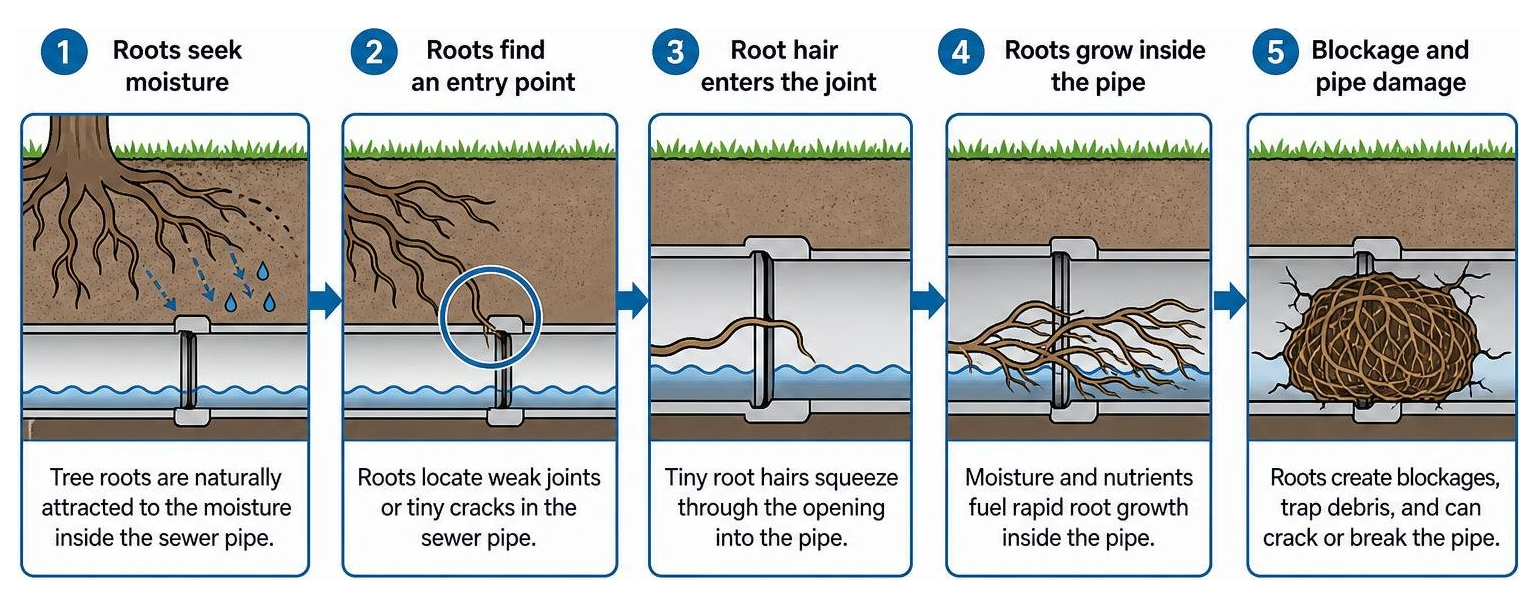
Tree roots are biologically programmed to seek out moisture and nutrients. Your sewer lateral is filled with warm, nutrient-rich water. If your sewer line is made of clay or cast iron, it has joints every few feet. Over time, these joints can weaken or develop microscopic cracks.
Once a tiny root hair finds a crack, it squeezes inside. Fed by the wastewater, the roots grow rapidly into massive “root balls” inside the pipe. This creates a catch-all net for toilet paper, grease, and debris, leading to frequent backups. Eventually, the expanding root mass will shatter the pipe entirely. For tips on how to prevent this, check out our guide on how to avoid and catch sewer line issues.
Aging Pipes and Gradual Sewer Line Damage
Like any other utility in your home, sewer pipes have a finite lifespan. The material your sewer line is made of determines how vulnerable it is to gradual sewer line damage:
- Clay Tile: Common in homes built before 1980. Clay is highly susceptible to root intrusion because the joints between pipe sections degrade over time. Shifting soil can easily misalign or crack clay pipes.
- Cast Iron: Widely used in mid-century homes. Cast iron is durable but prone to internal corrosion. Over decades, rust builds up on the pipe walls, catching debris and narrowing the pipe until it cracks or collapses.
- Orangeburg Pipe: Made of wood pulp fibers bound with coal tar pitch, this material was used from the 1940s through the 1970s as a cheap alternative. Today, Orangeburg pipes are reaching the end of their lifespans, softening, flattening, and completely collapsing under the weight of the soil.
In the Chicagoland area, our harsh winters add another layer of stress. Extreme freeze-thaw cycles cause the ground to shift and expand, placing immense physical pressure on these weakened, aging pipes.
Does Homeowners Insurance Cover Sewer Line Repairs?
When faced with the prospect of a major sewer repair, every homeowner’s first question is: Will my insurance cover this?
The short answer is: usually not under a standard policy.
A standard homeowners insurance policy (often called an HO-3 policy) is designed to cover sudden and accidental damage. It does not cover gradual damage, wear and tear, or maintenance issues. Because most sewer line damage is caused by tree root intrusion, pipe corrosion, or age, insurance companies consider these to be maintenance responsibilities and will deny the claim.
However, there are exceptions. Your standard policy may cover the repair if the damage was caused by a “covered peril,” such as:
- Vandalism
- An explosion
- Damage caused by heavy vehicles or aircraft crossing your property
- Tree damage, if a falling tree physically tears up the line (though this is rare)
To understand how devastating a sudden main line failure can be, consider the Spokane County sewer line rupture case, where a massive rupture flooded municipal streets and residential basements. While municipal failures are handled differently, a sudden break on your own property can cause thousands of dollars in interior water damage.
To protect yourself from paying for these repairs completely out of pocket, you should look into two optional insurance add-ons:
- Service Line Endorsement: This is a relatively inexpensive add-on (often costing $30 to $50 per year) that specifically covers the repair or replacement of buried utility lines, including your sewer lateral. These endorsements typically provide $10,000 to $20,000 in coverage for repairs necessitated by wear and tear, rust, or root damage.
- Water Backup Endorsement: It is vital to note that a service line endorsement covers the pipe, while a water backup endorsement covers the damage inside your home if sewage backs up through your drains. You need both for complete protection.
Repair Methods, Costs, and Prevention
If you are dealing with sewer line damage, you have two main options for fixing the pipe: traditional excavation or modern trenchless technology.
| Feature | Traditional Excavation | Trenchless Pipe Repair |
|---|---|---|
| Excavation Level | High (trench dug through yard/driveway) | Minimal (one or two small access pits) |
| Average Timeline | 3 to 5 days | 1 to 2 days |
| Landscaping Impact | Severe (requires reseeding, concrete repair) | Near zero |
| Lifespan | 50 to 100 years (with PVC) | 50+ years (with epoxy liner) |
| Overall Cost | High (when factoring in yard restoration) | 30% to 50% lower overall |
Traditional excavation involves bringing heavy machinery onto your property to dig a trench along the entire path of your sewer lateral. This method is highly disruptive, tearing up lawns, gardens, driveways, and sidewalks.
Trenchless repair, on the other hand, is a “no-dig” solution. The most common method is Cured-in-Place Pipe (CIPP) lining. We insert a flexible, epoxy-saturated liner into the damaged pipe through a single access point. Once inflated, the epoxy cures, creating a brand-new, seamless, root-proof pipe inside your old one.
For a detailed analysis of these methods, check out our articles on the trenchless vs traditional cost breakdown and is trenchless sewer repair worth the cost.
When planning for sewer line repairs in the Chicagoland area, local factors such as soil composition, depth of the municipal connection, and local permitting fees in municipalities like Winnetka, Melrose Park, or Chicago will influence the final cost. While traditional excavation might seem straightforward, the added expenses of restoring damaged landscaping, driveways, and sidewalks often make trenchless options far more economical in the long run.
Steps to Take If You Suspect Sewer Line Damage
If you suspect your sewer line is damaged, acting quickly can prevent a minor leak from turning into a catastrophic basement flood.
- Stop Using Water: Immediately minimize your water usage. Do not run the dishwasher, washing machine, or take showers. Any water you send down the drain will only worsen the backup.
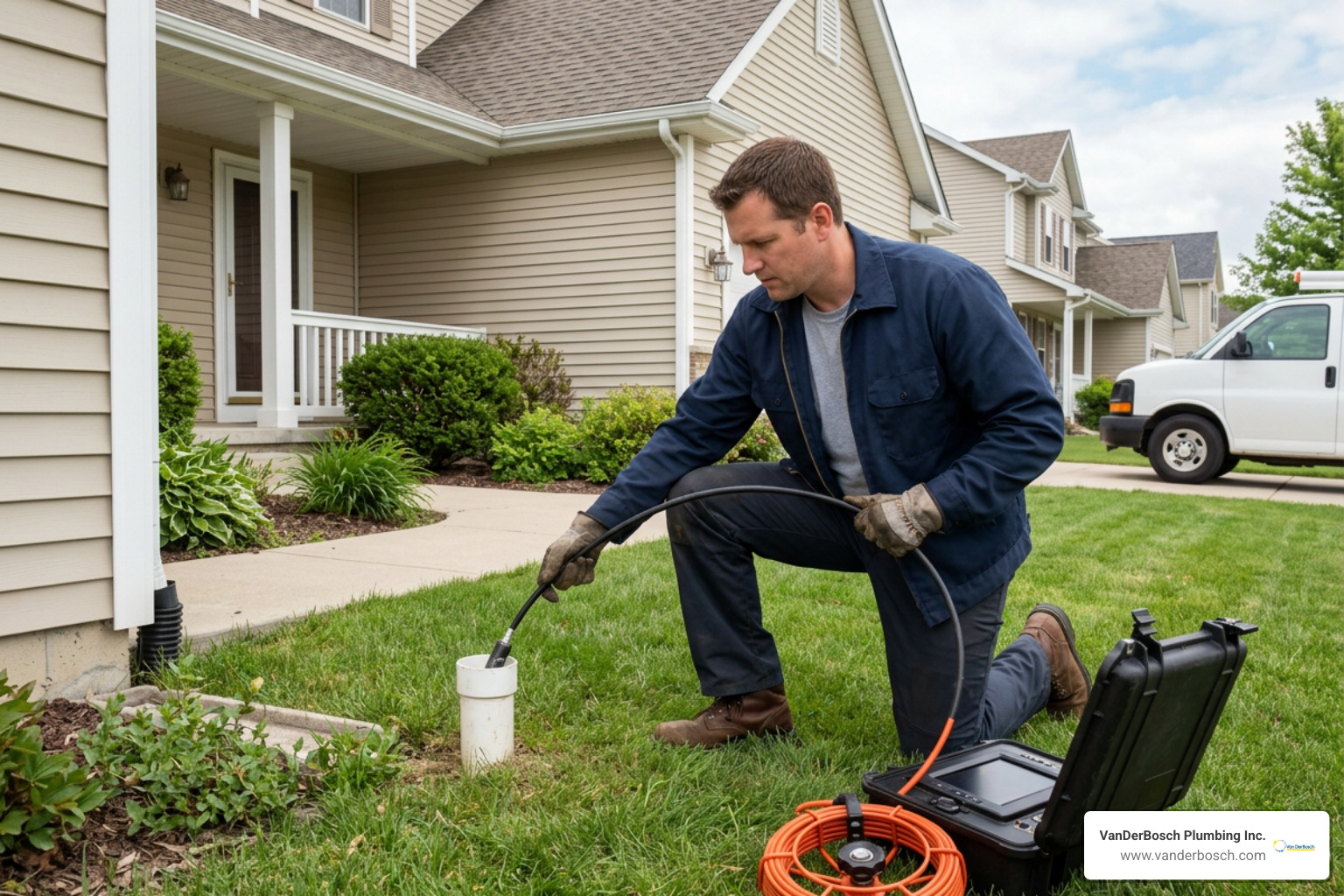
- Locate Your Cleanout: Your sewer cleanout is a capped pipe (usually made of PVC or cast iron) sticking out of the ground near your foundation or in your basement. Providing clear access to this point saves valuable time.
- Call a Professional for a Camera Inspection: Do not attempt to clear a suspected main line break with chemical drain cleaners, as these can corrode your pipes further. A professional plumber must run a waterproof, high-definition camera down the line to see exactly what is causing the issue.
- Document Everything: If you plan to file an insurance claim, take photos of any interior water damage, soggy yard patches, and keep a copy of the camera inspection footage.
To schedule a diagnostic check, you can visit our sewer video inspection services page.
Frequently Asked Questions about Sewer Line Damage
How much does it cost to replace a sewer line?
The cost to replace a sewer line typically ranges from $1,000 to $20,000, with most standard residential repairs landing between $3,000 and $8,000. The final price depends on the depth of the pipe, its accessibility, local permit fees, and the repair method used. While trenchless pipe lining may have a higher upfront cost than basic spot-repair digging, it often saves homeowners 30% to 50% overall by eliminating the need to rebuild porches, repave driveways, or re-landscape the yard. Read more about planning your budget in our guide on budgeting for trenchless sewer replacement.
Can tree roots grow back after sewer line cleaning?
Yes. Mechanical snaking or hydro-jetting clears the immediate blockage and cuts away the existing roots, but it does not seal the entry points. Because the roots are drawn to the moisture inside the pipe, they will grow back thicker and faster than before — often within 6 to 12 months. The only way to permanently stop root intrusion is to structurally seal the pipe using methods explained in our sewer pipe lining guide.
How do professionals diagnose a broken sewer line?
We diagnose sewer line damage using a high-definition, waterproof video camera attached to a flexible cable. We feed this camera through your cleanout, allowing us to view the interior of your sewer lateral in real-time. To pinpoint the exact location of a crack or collapse under your yard, we use an attached transmitter called a sonde. A locator device above ground detects the sonde’s signal, telling us exactly where and how deep we need to work. Learn more about how this works by reading the basics of sewer video inspection explained or our Sewer Video Inspection FAQ.
Conclusion
A swampy yard or a backed-up drain is a stressful experience, but you don’t have to navigate it alone. Understanding the early warning signs of sewer line damage and knowing your repair options is the best way to protect your property and your wallet.
At VanDerBosch Plumbing Inc., we have spent decades helping homeowners across Chicagoland — from Elmhurst and Mount Prospect to Melrose Park and West Ridge — resolve their toughest main line sewer issues. We back our work with a 100% satisfaction guarantee, offer 24/7 emergency service, and provide transparent pricing with no hidden service charges. Our experienced, background-checked technicians are equipped with the latest diagnostic cameras and trenchless repair tools to fix your pipes with minimal disruption to your home.
If you suspect a problem with your main line, don’t wait for a costly backup. Contact us today to schedule a professional diagnostic check, or explore our specialized trenchless pipe repair services to see how we can restore your sewer system without tearing up your beautiful yard. For suburban residents, we also offer dedicated support through our Roselle Sewer Line Repair page and our general Sewer Line Repair services page.