
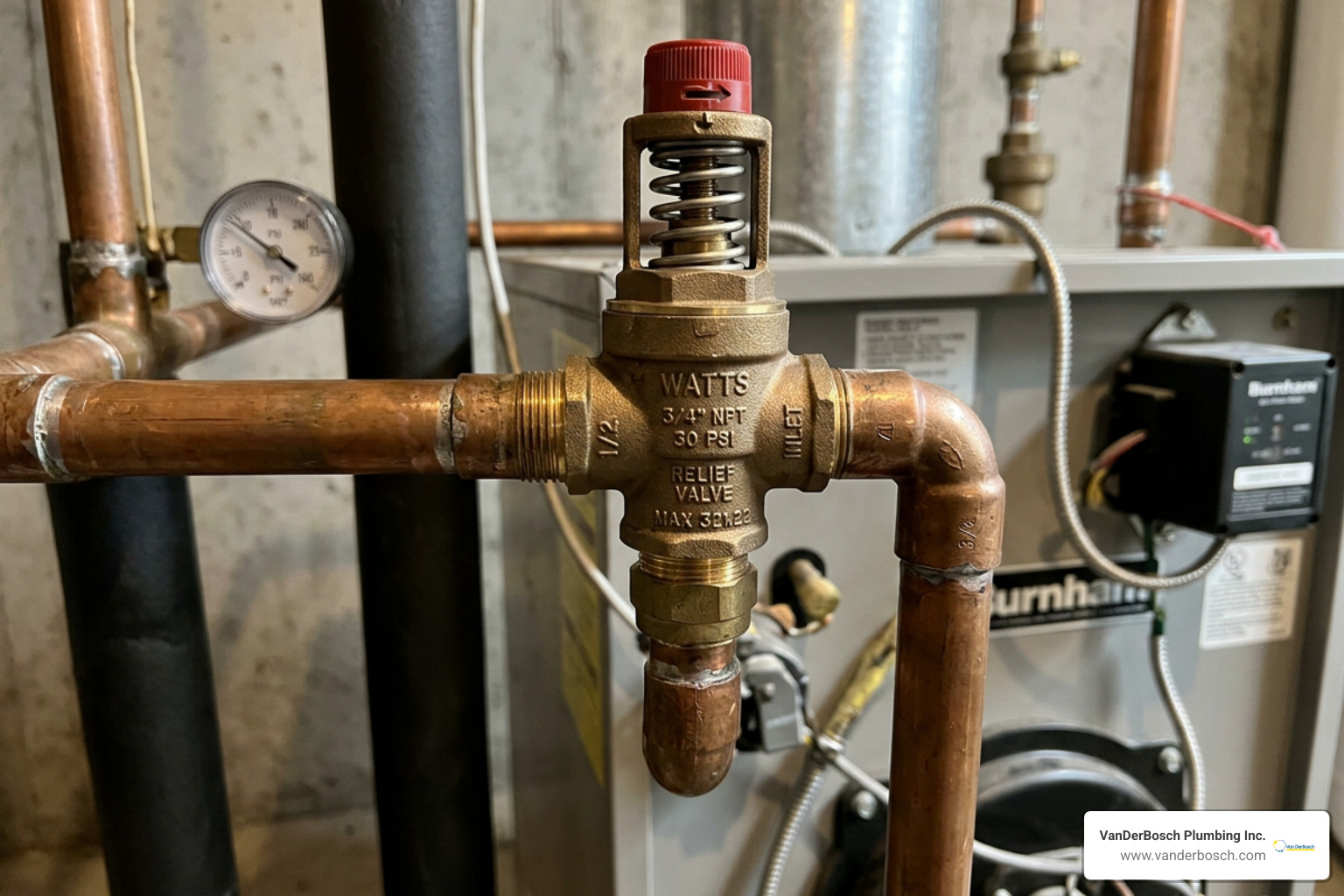
Your Boiler Relief Valve Could Be the Only Thing Standing Between You and a Disaster
Quick answer: The best boiler relief valves to replace your faulty unit are:
| Valve Type | Best For | Typical Set Pressure |
|---|---|---|
| Spring-loaded PRV | Most residential boilers | 30 PSI / ~2 bar |
| Pilot-operated PRV | High-pressure commercial systems | Varies by system |
| Bellows-type PRV | Systems with backpressure issues | Varies by system |
Before buying a replacement boiler relief valve, check:
- Your boiler’s maximum allowable working pressure (MAWP)
- The correct inlet/outlet size for your system
- ASME certification on the valve label
- Whether your normal operating pressure is in the 1–2 bar range
A boiler relief valve is one of the most important safety components in your entire heating system — and most homeowners never think about it until something goes wrong.
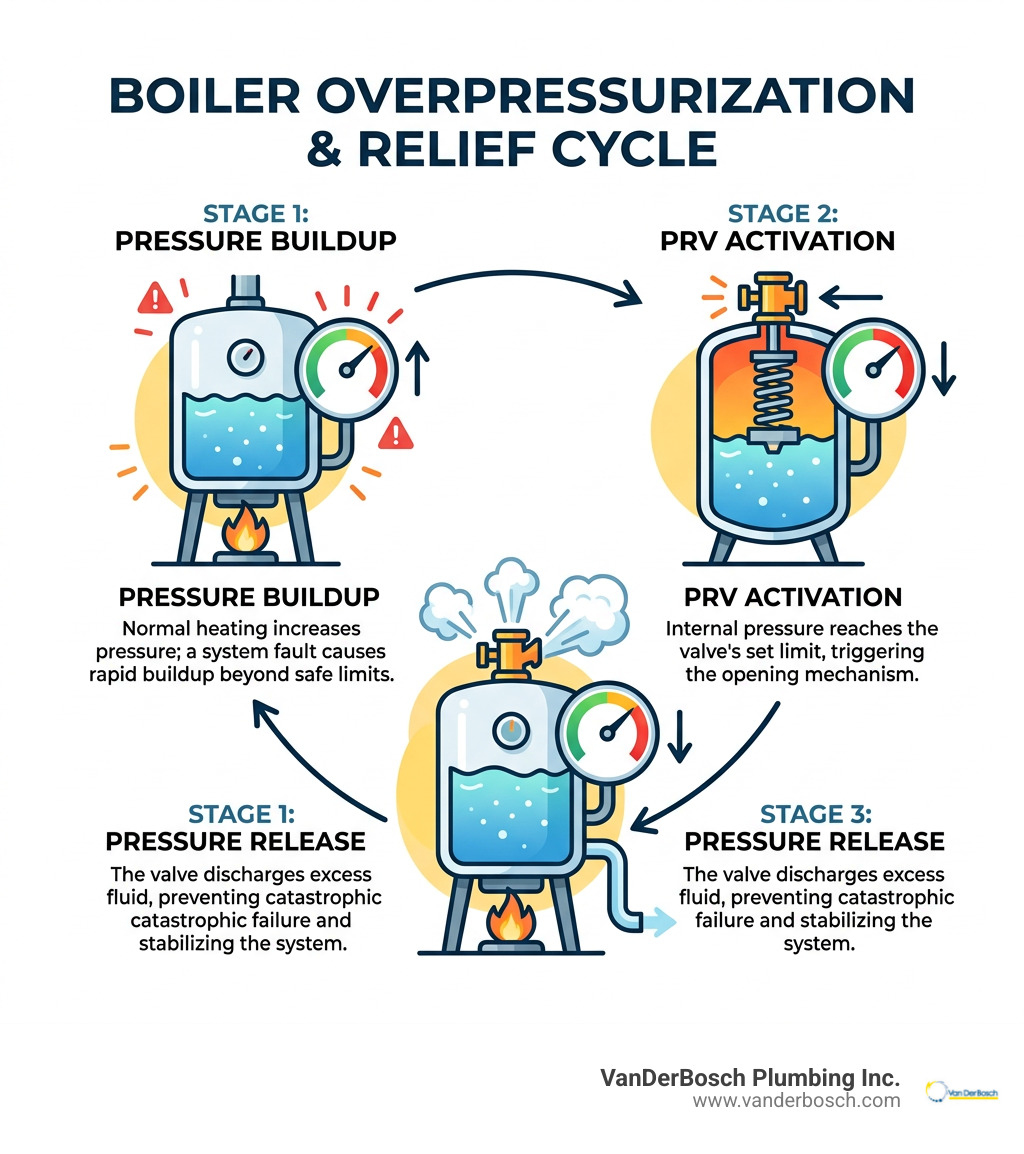
Here’s the thing: boilers build pressure naturally as they heat water. Under normal conditions, that pressure stays in a safe range. But if something fails — a faulty thermostat, a blocked pipe, or a malfunctioning burner — pressure can climb fast. Without a working relief valve, that buildup has nowhere to go.
The consequences can range from a system lockout to, in extreme cases, catastrophic equipment failure. Early steam boilers operating without safety valves were notoriously prone to explosion. Today’s boiler relief valves exist precisely to make sure that never happens in your home or building.
If your valve is dripping, corroded, or hasn’t been replaced in four to five years, it’s time to act.
I’m Hugh Hodur, President of VanDerBosch Plumbing Inc., and I’ve overseen boiler repair and water heater services across the Chicagoland area for years — including countless boiler relief valve inspections and replacements. In this guide, I’ll walk you through everything you need to know to choose the right replacement valve and keep your system running safely.
What is a Boiler Relief Valve and Why is it Critical?
At its core, a boiler relief valve (often abbreviated as PRV) is a fail-safe device. Its primary mission is to protect life and property by venting fluid—either steam or hot water—from a boiler when the internal pressure exceeds safe limits. Think of it as the “emergency exit” for your heating system.
Every boiler has a Maximum Allowable Working Pressure (MAWP). This is the highest pressure the vessel is designed to handle safely. If the pressure climbs beyond this point, the structural integrity of the metal can be compromised. To prevent this, the American Society of Mechanical Engineers (ASME) has established strict codes.
For instance, ASME Section I (Power Boilers) requires that a single valve installation limits the maximum pressure accumulation to no more than 3% above the MAWP. If you have multiple valves on a fired vessel, that limit is 6%. For non-fire scenarios under ASME Section VIII, you might see an allowable accumulation of up to 10%. These aren’t just suggestions; they are legal and safety requirements that ensure your home in Hyde Park or Sauganash stays safe.

Without this valve, a boiler could become a “ticking time bomb.” History tells us that early industrial-era boilers often exploded because they lacked reliable relief mechanisms. Today, while modern boilers usually “lock out” (shut down) before things get explosive, the PRV remains the final line of defense. Proper Steam Relief Valve Testing is essential to ensure these safety margins are maintained. If you suspect your system is struggling with pressure, you can find More info about Chicago boiler repair to see how we handle these critical components.
How a Boiler Relief Valve Works
The magic of the boiler relief valve lies in a principle called “force balance.” Inside the valve, there is a disc (or poppet) held against a seat by a heavy-duty set spring.
- Normal Conditions: The force of the spring pushing down is much stronger than the pressure of the water or steam pushing up. The valve remains tightly closed.
- Pressure Increase: As the boiler heats up, the internal pressure rises. This pressure pushes against the bottom of the valve disc.
- Approaching Set Pressure: When the system pressure matches the “set pressure” of the spring, the forces become equal.
- Opening Sequence: If the pressure rises just a tiny bit more, it overcomes the spring force. The valve “pops” or lifts open.
- Pressure Relief: Excess water or steam escapes through the discharge pipe, immediately lowering the internal pressure of the boiler.
- Re-seating: Once the pressure drops back to a safe level (known as the “blowdown” point), the spring pushes the disc back onto the seat, sealing the system again.
Selecting the Right Boiler Relief Valve
Choosing a replacement isn’t as simple as grabbing the first valve you see on the shelf. In the Chicagoland area, where we deal with everything from historic homes in Winnetka to modern condos in the Ukrainian Village, sizing is everything.
- Orifice Sizing: The internal opening (orifice) must be large enough to vent the boiler’s entire BTU output. If the valve is too small, it won’t release pressure fast enough. If it’s too large, it can “chatter”—opening and closing rapidly—which damages the valve.
- Capacity Certification: Look for the ASME “V” or “HV” stamp. This means the valve’s rated capacity is certified at 90% of its actual tested flow, providing a safety buffer.
- Set Pressure Tolerance: High-quality valves have strict tolerances. For a standard 70 psi valve, the tolerance is ±2 psi.
- Material Compatibility: Most residential valves are bronze or brass, but certain industrial applications require stainless steel to resist corrosion.
Types of Boiler Pressure Relief Valves for Your System
Not all valves are created equal. Depending on whether you have a steam boiler in an old Melrose Park factory or a modern combi boiler in a West Ridge bungalow, the type of valve matters.
| Feature | Relief Valve | Safety Valve |
|---|---|---|
| Opening Style | Gradual (Modulating) | Instantaneous (Pop action) |
| Best For | Liquids (Water) | Gases/Steam |
| Application | Hot water boilers | Steam boilers |
- Safety Valves: These are designed for steam. They open fully and instantly once the set pressure is reached.
- Relief Valves: These are typically used for hot water (liquid) systems. They open gradually in proportion to the increase in pressure.
- Pilot-Operated Valves: These use a smaller “pilot” valve to control the main valve. They are incredibly precise and used in high-pressure commercial systems where the operating pressure is very close to the set pressure.
- Bellows-Type Valves: These include a flexible metal bellows that protects the spring from the effects of backpressure in the discharge line.
For a deeper technical dive into the standards governing these parts, the Steam Safety Relief Valves Technical Bulletin provides exhaustive engineering data.
Signs of a Faulty or Leaking Boiler Relief Valve
How do you know if your boiler relief valve is waving a white flag? In our experience serving Cook County, there are several red flags homeowners should watch for.
- Constant Dripping: If you see water constantly dripping from the end of the discharge pipe, the valve may be “weeping.” This often happens because limescale or debris has become trapped between the disc and the seat, preventing a tight seal.
- Corrosion and Limescale: Look for white, crusty deposits or green “rust” around the valve body. This indicates a slow, long-term leak that can eventually seize the valve shut—a very dangerous condition.
- System Lockout: If your boiler keeps shutting down and displaying an overpressure error code, the PRV might be activating frequently because of a larger system issue, like a failed expansion tank.
- Strange Noises: A whistling or “chattering” sound when the boiler is running can indicate that the valve is struggling to stay closed or is improperly sized.
- Pressure Fluctuations: If your gauge is swinging wildly outside the normal 1–2 bar range, your valve is being put under immense stress.
If you notice any of these, don’t wait. Check out the Top signs you need boiler repair in Chicago to see if your valve issues are part of a bigger problem.
Maintenance, Safety Codes, and Replacement Costs
Maintenance is the key to longevity. We recommend a visual inspection of your boiler relief valve every few months and a professional test annually.
- The 1–2 Bar Rule: For most residential hot water boilers, the normal operating pressure should be between 1 and 2 bar (roughly 14.5 to 30 psi). If it hits 3 bar, the PRV should activate.
- Blowdown Limits: ASME codes specify that once a valve opens, it should close (reseat) after the pressure drops by about 4% (or 4 psi for low-pressure systems). This prevents the boiler from losing too much water.
- Discharge Pipe Routing: Safety codes require the discharge pipe to be made of a material that can handle high heat (like copper or CPVC—never standard PVC) and it must terminate near the floor or a drain to prevent scalding anyone nearby.
Replacement Costs: In the Chicagoland area, replacing a boiler relief valve is a relatively affordable repair compared to the cost of a full boiler replacement. While the part itself might only cost between $30 and $100 for a standard residential unit, the labor involves draining the system, installing the new valve, and refilling/bleeding the radiators. You can expect to pay for a few hours of expert labor. For those in the suburbs, you can find More info about Roselle boiler services for local pricing and availability.
Frequently Asked Questions about Boiler Relief Valves
Where is the pressure relief valve located on a boiler?
The location depends on your boiler type. On a modern combi boiler, the boiler relief valve is usually tucked inside the main casing, often near the bottom. On older, standing-cast-iron boilers, it’s typically located on the top or side, connected to a vertical pipe. In some Chicago homes, you might even find it located in a nearby airing cupboard or even the loft if the system was modified during a renovation. Always look for a brass valve with a small silver or red lifting lever and a pipe that leads toward the floor or outside.
What should I do if water is dripping from the discharge pipe?
First, check your pressure gauge. If the pressure is above 2.5 bar, the valve is just doing its job! You might need to bleed your radiators or check if your filling loop was left slightly open. However, if the pressure is normal (1–2 bar) and it’s still dripping, the valve is likely faulty due to limescale or a weakened spring. In this case, the valve needs to be replaced by a professional. You can read more about this in What does a pressure relief valve do?
How often should a boiler relief valve be replaced?
While there is no “expiration date” stamped on the metal, the industry consensus is that a boiler relief valve should be replaced every 4 to 5 years. Over time, the internal spring can lose its tension, and the rubber seals can harden or crack. Regular testing (manually lifting the lever to ensure water flows and then stops) can help, but for a critical safety component, proactive replacement is the smartest move.
Conclusion
Your boiler relief valve might be small, but it carries a massive responsibility. It is the silent guardian of your home’s comfort and safety. From ensuring your system complies with ASME codes to preventing the nightmare of an overpressurized tank, a healthy PRV is non-negotiable.
At VanDerBosch Plumbing Inc., we’ve been the trusted choice for Chicagoland homeowners from Mount Prospect to Oakbrook Terrace for decades. We pride ourselves on our 100% satisfaction guarantee, our transparent pricing with no hidden service charges, and our team of background-checked, expert technicians who are available 24/7.
Don’t wait for a small drip to turn into a major flood or a system failure. Whether you’re in Niles, Elmhurst, or right here in the heart of Chicago, we’re ready to help. Schedule your professional boiler service today and let us ensure your heating system is safe, efficient, and ready for the winter.