
Recognizing When Your Water Heater Needs Urgent Service
When comparing DIY upkeep with a professional water heater maintenance service, homeowners can safely perform basic visual inspections, clear clutter around the unit, insulate exposed pipes, and adjust the thermostat to 120°F. However, complex and hazardous procedures—such as pressurized hydro-flushing, sacrificial anode rod replacement, gas burner servicing, electrical heating element testing, and tankless descaling—require a licensed plumber to avoid gas leaks, 240-volt shock risks, water damage, or voided warranties.
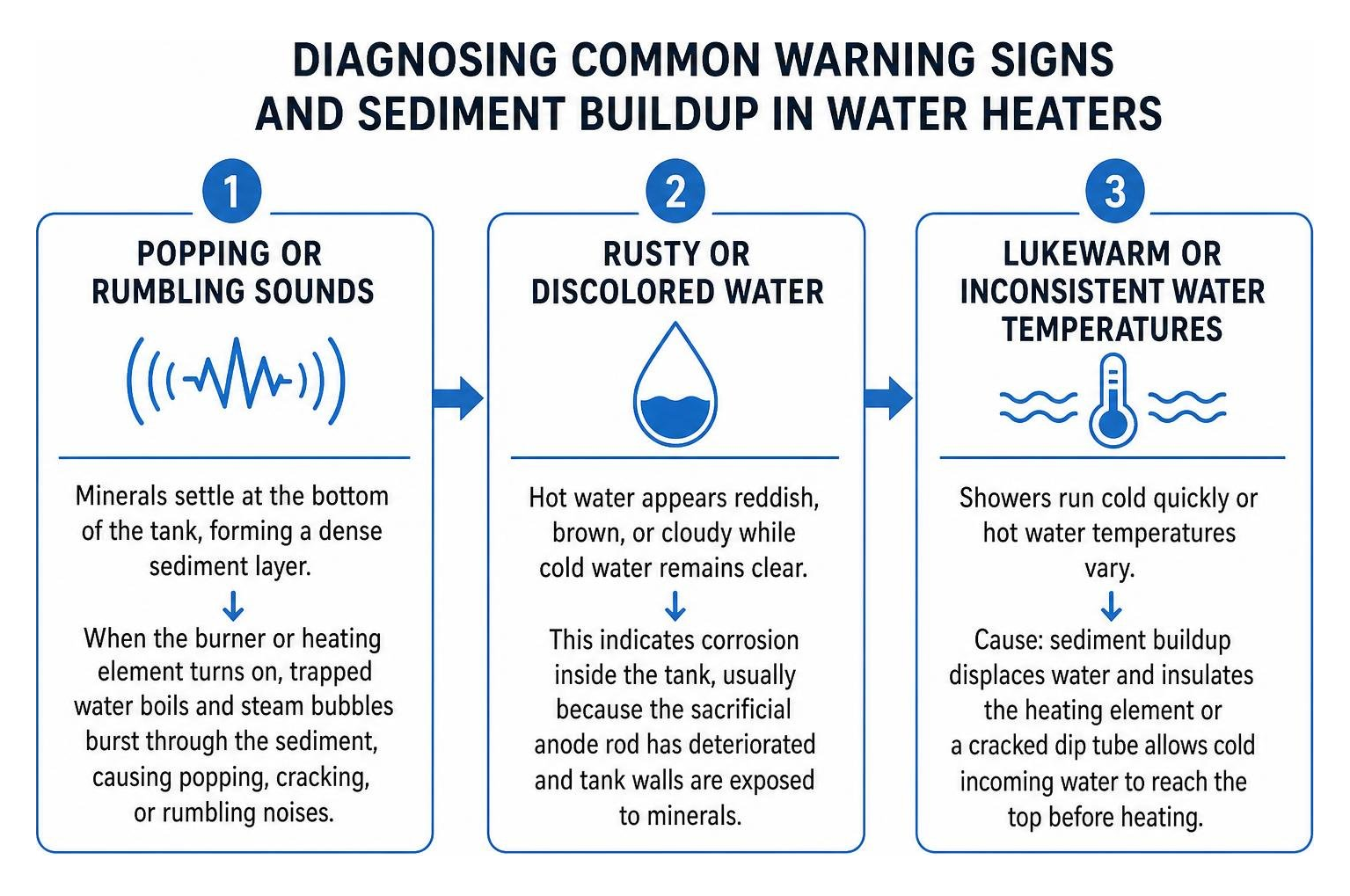
Knowing how to spot the early warning signs of trouble will help you schedule service before a minor component failure turns into thousands of dollars in water damage.
- Popping or Rumbling Sounds: As municipal water enters your water heater, naturally occurring minerals—primarily calcium and magnesium—settle to the bottom of the tank. Over time, this creates a dense sediment blanket. When the gas burner or electric heating element turns on, water gets trapped underneath this mineral layer. As that trapped water boils, steam bubbles burst violently through the sediment crust, producing distinct popping, cracking, or rumbling noises.
- Rusty or Discolored Water: If hot water coming from your faucets appears reddish, brown, or cloudy—while cold water remains crystal clear—corrosion is taking place inside your heating system. This usually indicates that the sacrificial anode rod has completely deteriorated, leaving the bare steel walls of your tank exposed to aggressive minerals.
- Lukewarm or Inconsistent Water Temperatures: If you notice that your morning shower runs cold after just five or ten minutes, mineral sediment has likely displaced valuable water capacity and insulated the lower heating element. In other cases, a cracked dip tube may be dumping cold incoming water straight to the top outlet pipe before the tank has a chance to heat it.
- Moisture or Puddling Around the Base: Any pooling water around the base of a storage tank requires immediate professional attention. While leaks from a fitting or valve can often be repaired, water seeping through the external jacket of the tank usually means the inner steel vessel has corroded through—a permanent failure requiring total replacement.
- Unexplained Spikes in Utility Bills: When hard water scale forms an insulating barrier over heating surfaces, your unit has to run significantly longer to achieve the set temperature. If your natural gas or electric bills have climbed without a change in household usage habits, your water heater is working overtime against heavy mineral scale.
Recognizing these key signs your water heater may need repair helps prevent minor sediment buildup from escalating into catastrophic tank ruptures or complete burner burnout.
Professional Water Heater Maintenance Service vs. Homeowner DIY Tasks
Many homeowners wonder where the boundary lies between simple weekend maintenance and tasks that demand a licensed professional. While taking an active role in maintaining your home is commendable, water heaters are complex appliances that combine high household water pressure, high-voltage electrical circuits (up to 240 volts), and combustible natural gas lines.
| Maintenance Task | Homeowner DIY | Professional Plumber | Reason & Safety Factor |
|---|---|---|---|
| Visual Leak & Corrosion Check | Yes | Yes | Safe, non-invasive visual check around fittings and valves. |
| Combustion Clearance Inspection | Yes | Yes | Simple safety practice to keep combustible items clear of the unit. |
| Thermostat Temperature Calibration | Yes | Yes | Adjusting the exterior dial to 120°F prevents scalding and saves energy. |
| Full Pressurized Hydro-Flush | Caution | Yes | DIY draining often clogs old drain valves; pros use pressurized flushing. |
| Anode Rod Inspection & Replacement | No | Yes | Requires high-torque tools; risks stripping tank threads or cracking fittings. |
| T&P Safety Relief Valve Testing | Limited | Yes | Old valves may fail to re-seat, causing persistent high-pressure leaks. |
| Burner & Thermocouple Servicing | No | Yes | Involves gas line seals, millivolt diagnostics, and combustion chamber safety. |
| Tankless Descaling & Pump Flush | Caution | Yes | Requires isolation valves, submersible pumps, and precise acid circulation. |
Safe DIY Maintenance Tasks for Homeowners
There are several straightforward, risk-free tasks you can perform every few months to keep your equipment running smoothly:
- Maintain Clear Surroundings: Keep at least two to three feet of open clearance around your water heater. Remove paint cans, cleaning solvents, cardboard boxes, and laundry piles to ensure the burner has an adequate supply of combustion air and to eliminate fire hazards.
- Perform Monthly Visual Inspections: Check all visible pipe connections, shut-off valves, and the floor around the base of the tank for signs of moisture, green corrosion (oxidation on copper), or rust streaks.
- Set the Thermostat to 120°F: Most manufacturer dials come preset to 140°F, which poses a scalding risk and accelerates scale buildup. Dialing back to 120°F reduces your energy consumption and protects young children and elderly family members from accidental burns.
- Insulate Exposed Hot Water Lines: Adding foam pipe insulation to the first six feet of exposed hot water pipe leaving your heater helps reduce standby heat loss as water travels to your fixtures.
What Is Included in a Water Heater Maintenance Service Checklist
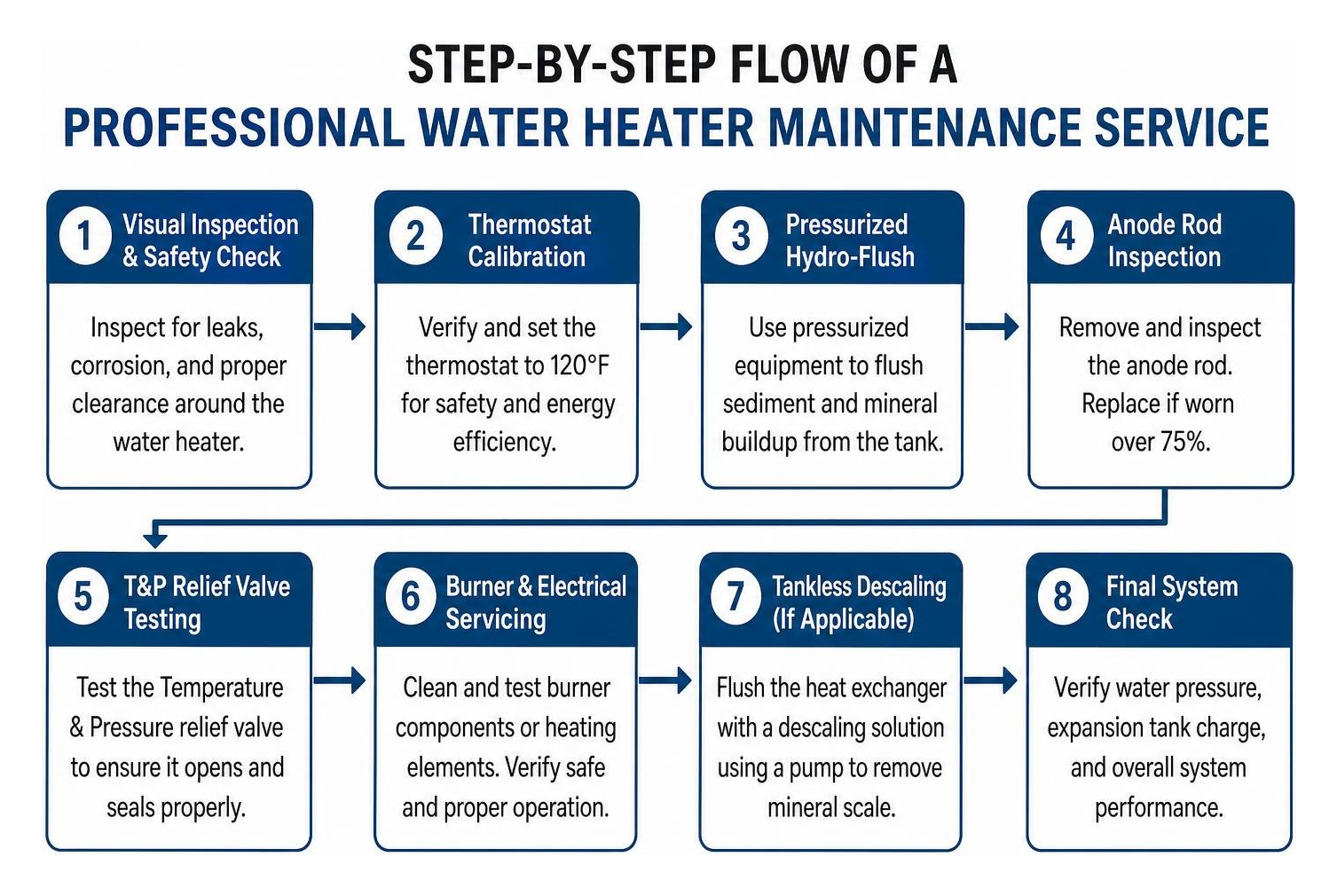
When our licensed plumbing technicians arrive for a comprehensive maintenance service, we execute a rigorous multi-point inspection and tune-up designed to restore your system to factory specifications:
- Deep Pressurized Hydro-Flush: Rather than simply opening a drain valve and allowing gravity to trickle out clean water, we hook up specialized equipment to dislodge, break up, and flush out calcified mineral chunks packed at the bottom of the tank.
- Sacrificial Anode Rod Assessment: We remove the anode rod to evaluate its degradation. If the magnesium or aluminum core has worn down past 75% of its original volume, we replace it to ensure your tank remains shielded from rust.
- T&P Relief Valve Diagnostic: We test the Temperature and Pressure relief valve to confirm it opens smoothly and seals tightly without dripping. If mineral deposits have frozen the valve shut, we guide homeowners on how to stop your water heater pressure relief valve from leaking by replacing the faulty mechanism immediately.
- Combustion & Electrical Audit: For gas units, we clean the pilot assembly, clean the flame arrestor screen, test the thermocouple millivolt output (target: 20–30 mV), and ensure compliance with manufacturer safety standards for gas systems. For electric models, we test upper and lower heating elements with a multimeter for correct electrical resistance and continuity.
- Thermal Expansion & Pressure Verification: We check the incoming municipal water pressure to ensure it does not exceed the safe threshold of 80 psi. We also check the air pre-charge on your thermal expansion tank so excessive expansion pressure doesn’t stress your home’s pipes.
Tank vs. Tankless Water Heater Maintenance Service Protocols
Maintaining a traditional storage tank is fundamentally different from servicing a modern on-demand tankless unit. Storage tanks focus primarily on sediment purge and internal cathodic protection, while tankless units require chemical descaling to protect ultra-compact heat exchangers.
If you operate a high-efficiency on-demand system, learning how to properly flush a tankless water heater prevents narrow copper heat exchanger pathways from clogging, which otherwise causes system lockouts and error codes.
Long-Term Benefits of Routine Maintenance and Membership Plans
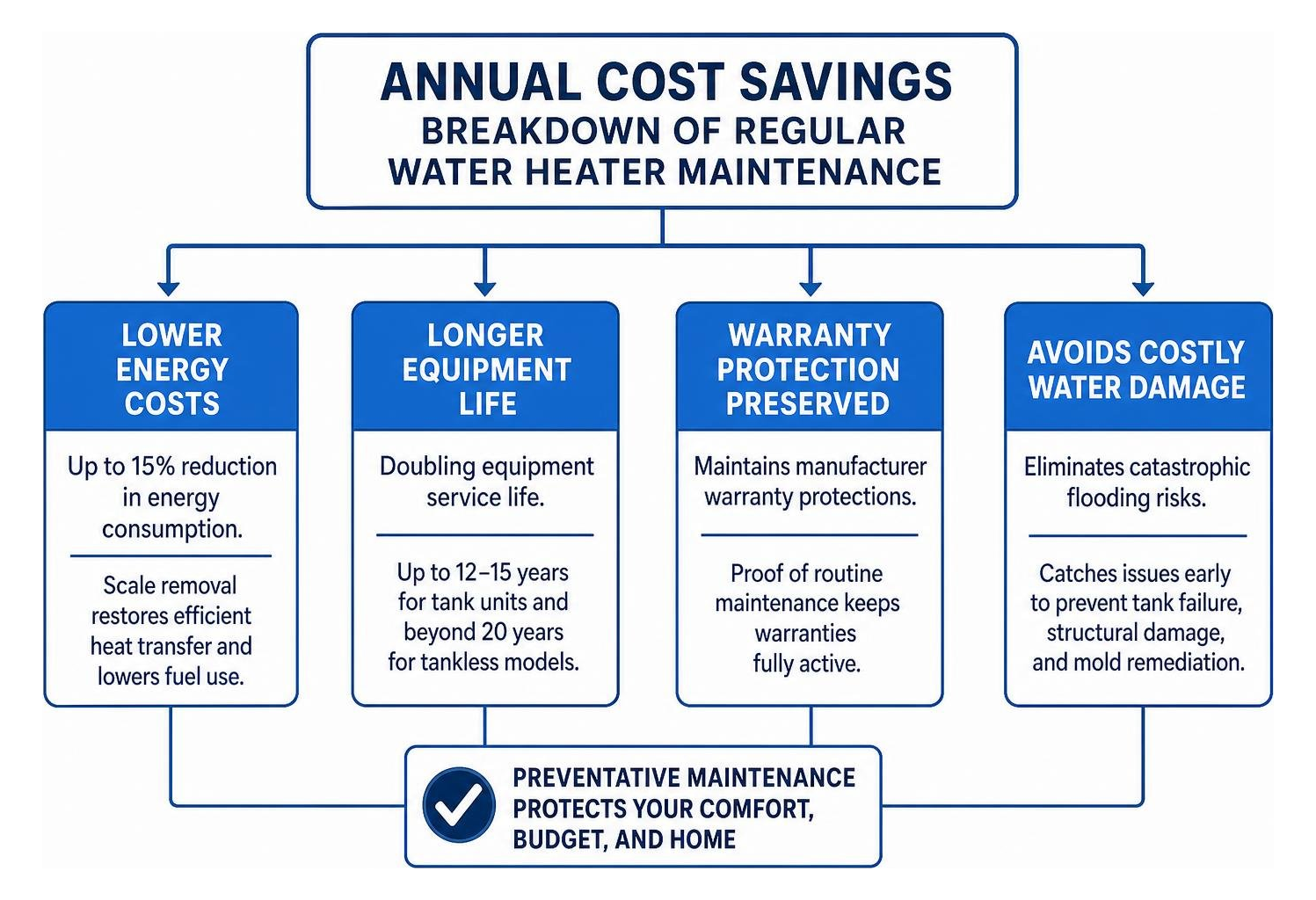
Water heaters are among the most heavily utilized mechanical systems in any building, operating 24 hours a day, 365 days a year. Investing in regular maintenance yields immediate and tangible dividends for your home budget and safety:
- Up to 15% Reduction in Energy Consumption: A 1/4-inch layer of mineral sediment at the bottom of a water heater acts as an insulating barrier, forcing a gas burner or electric element to heat the sediment before heating the water. Eliminating this scale restores rapid heat transfer and immediately lowers fuel consumption.
- Doubling Equipment Service Life: The average lifespan of an unmaintained storage tank water heater is just 8 to 10 years. Annual maintenance extends that lifespan up to 12 to 15 years for tank units and beyond 20 years for tankless models, effectively doubling the return on your initial equipment investment.
- Preserving Manufacturer Warranty Protections: Virtually all major equipment manufacturers require proof of routine maintenance in their warranty fine print. If your tank ruptures or a heat exchanger cracks due to unaddressed scale accumulation, claims can be denied without documented service records.
- Eliminating Catastrophic Flooding Risks: Water heaters hold anywhere from 30 to 80 gallons of water under continuous pressure. Routine maintenance catches micro-fissures, failing valves, and severe corrosion before they rupture, saving you from expensive structural repairs and mold remediation.
To make preventative care hassle-free, many homeowners enroll in professional service agreements such as annual home water heater maintenance programs. These memberships typically include automatic annual tune-up scheduling, priority emergency dispatch, discounted repair pricing, and documented service histories that keep equipment warranties fully active.
Understanding Service Frequency and Expected Maintenance Costs
How frequently your system needs maintenance depends largely on your local water supply and household hot water demand. In areas with elevated mineral content, dissolved calcium and magnesium rapidly crystallize onto heating elements.
- Standard Water Hardness: In areas with moderate water mineral levels, scheduling a professional maintenance service once every 12 months is sufficient to keep your unit operating smoothly.
- High Hardness / Heavy Use: If your home handles high hot water demands or operates without a whole-home water softening system, professional flushing may be beneficial every 6 to 9 months to stay ahead of severe scaling.
- Homes with Water Softeners: While water softeners remove scale-forming minerals, the sodium ions exchanged during the softening process increase water conductivity, accelerating the consumption rate of your sacrificial anode rod. If you use a softener, inspect your anode rod every 2 years, even if tank flushing is only required every 24 months.
Understanding the transparent costs of maintenance helps put preventative care into perspective against unexpected repairs:
- Standard Storage Tank Hydro-Flush & Safety Inspection: $99 – $150
- Tankless Chemical Descaling & Filter Servicing: $149 – $220
- Anode Rod Replacement (Labor & High-Grade Rod Included): $220 – $350
- Emergency Water Heater Replacement: $1,200 – $2,500+
Comparing a minor annual tune-up investment against the high water heater repair costs of sudden failures makes proactive servicing an easy choice. Whenever your system needs diagnostic evaluations, component repairs, or major updates, understanding why you need a licensed plumber ensures that every gas connection, electrical circuit, and safety valve meets strict local municipal plumbing and building codes.
Frequently Asked Questions About Water Heater Maintenance
How often should a water heater be professionally flushed?
Under normal conditions, water heaters should be professionally flushed once every 12 months. If your plumbing system receives hard water, annual servicing is critical to prevent calcium and magnesium sediment from solidifying into an immovable crust at the base of the tank. For homes using a tankless water heater, an annual descaling flush with virgin food-grade white vinegar is required to keep internal heat exchanger coils clear of restrictive scale.
Can I replace the sacrificial anode rod myself?
While replacing an anode rod is technically possible for an experienced DIYer, it is often challenging. Factory-installed anode rods are torqued into place with heavy machinery and secured with industrial sealants, frequently requiring an impact wrench or extended breaker bar with high leverage to break loose.
If the water heater is installed in a tight utility closet or basement with low ceiling clearance, a standard rigid replacement rod will not fit, requiring a specialized multi-segment flexible rod. Furthermore, using the wrong thread sealant—such as thick layers of standard plumber’s tape—can create an electrical barrier between the rod threads and the tank fitting, preventing the rod from grounding and rendering its sacrificial protection useless. A licensed plumber can handle this safely without damaging tank fittings or voiding your equipment warranty.
What causes rumbling and popping noises in my water heater?
Rumbling and popping noises are caused by steam bubbles forcing their way through a dense layer of mineral sediment at the bottom of the storage tank. When the gas burner or lower electric element heats up, the water trapped underneath the mineral blanket reaches boiling temperatures before the rest of the tank.
As that trapped water vaporizes, the resulting steam bubbles pop through the sediment crust, shaking the tank and producing a distinct popping or kettle-like rumbling sound. Left unaddressed, this condition acts as a thermal blanket that overheats the tank bottom, leading to metal fatigue, premature element burnout, and eventual tank rupture.
Protect Your Investment with Reliable Plumbing Experts
Maintaining your water heater shouldn’t be an afterthought left until your shower turns freezing cold or your basement floor is covered in standing water. Routine, proactive maintenance eliminates hazardous scale buildup, keeps your safety valves operating smoothly, and reduces your monthly energy bills.
At VanDerBosch Plumbing Inc., our licensed, background-checked technicians take pride in providing comprehensive water heater maintenance service with transparent pricing, zero hidden service fees, and a 100% satisfaction guarantee. Whether you need an annual safety check, a tankless descaling flush, or an emergency diagnostic evaluation, we are here 24/7 to keep your home’s hot water flowing reliably.