
Your Boiler Is Losing Pressure — Here’s What’s Happening
Boiler losing pressure is one of the most common heating problems homeowners face — and it almost always has a fixable cause.
Quick answer: Why is your boiler losing pressure?
| Cause | How Common? |
|---|---|
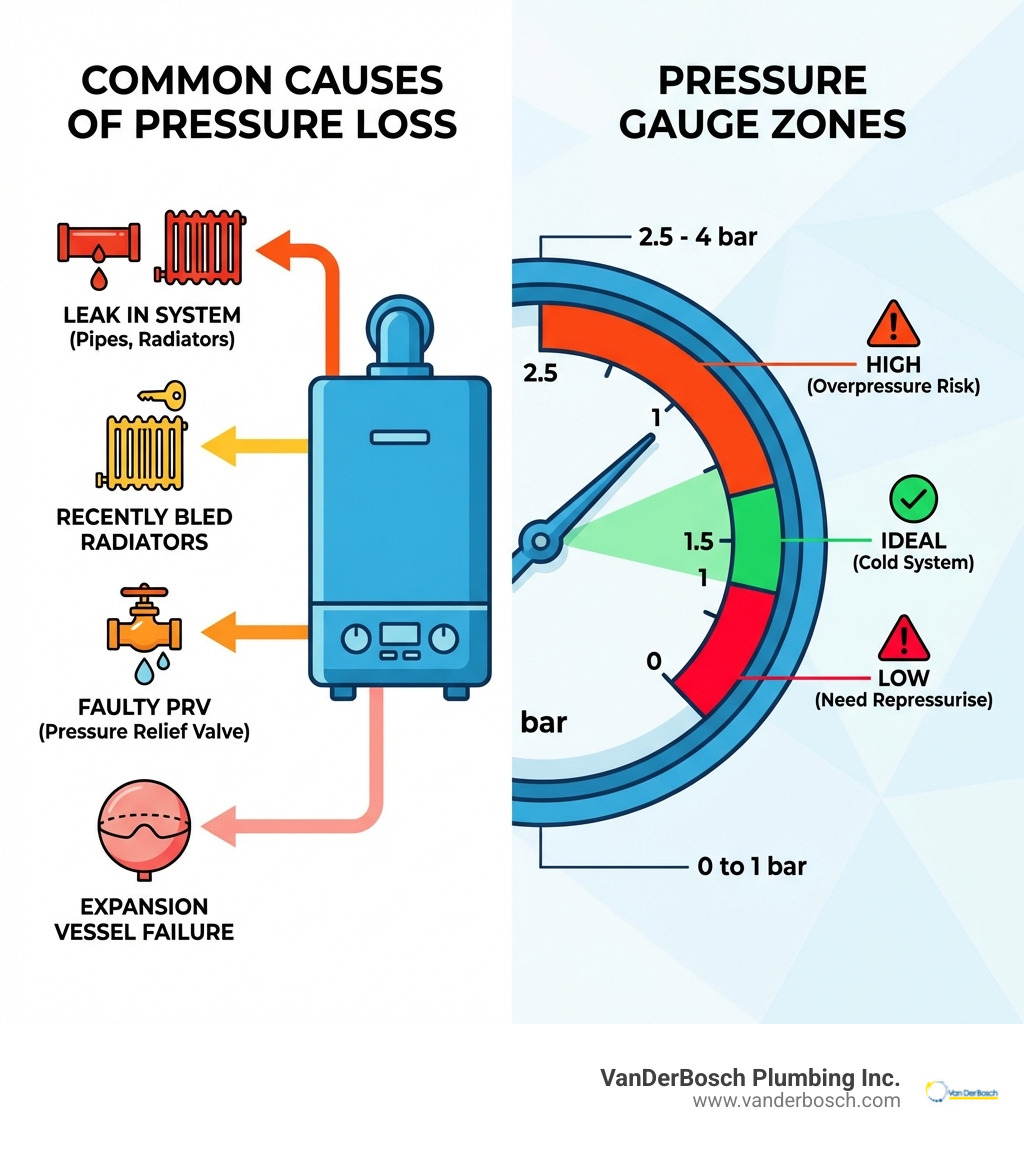
| Leak in pipes, radiators, or valves | Very common |
| Recently bled radiators | Very common |
| Faulty pressure relief valve (PRV) | Common |
| Expansion vessel failure | Common |
| Internal boiler fault (heat exchanger, pump) | Less common |
What to do right now:
- Check the pressure gauge — it should read 1 to 1.5 bar when the system is cold
- Look for visible damp patches near radiators, pipes, or the boiler itself
- If the pressure is below 1 bar, you may need to re-pressurise using the filling loop
- If pressure keeps dropping after topping up, call a professional
Most modern boilers will automatically shut down when pressure drops too low — a built-in safety feature that protects the system. So if your boiler has stopped working, low pressure is often the first thing to check.
I’m Hugh Hodur, President of VanDerBosch Plumbing Inc., and I’ve overseen countless boiler repairs and pressure diagnostics across the Chicagoland area. Diagnosing a boiler losing pressure is something our team handles regularly, and in this guide I’ll walk you through exactly how to find and fix the problem.
Understanding Boiler Pressure and the Ideal Range
Before we can solve the mystery of the vanishing PSI, we need to understand what “pressure” actually means in a boiler system. Think of your heating system as a closed loop. Water is heated by the boiler and pumped through your pipes and radiators. For this water to move effectively and reach every corner of your home—from the basement in Hyde Park to the second floor in Winnetka—it needs to be under a specific amount of pressure.
Most modern boilers are “sealed systems.” Unlike older gravity-fed systems that used a tank in the attic, sealed systems use an expansion vessel to manage the way water expands as it gets hot.
Reading the Gauge: Cold vs. Hot
It is perfectly normal for your boiler’s pressure to fluctuate based on whether the heat is running. However, these fluctuations should stay within a specific “safe zone.”
| System State | Ideal Pressure Range |
|---|---|
| Cold (System Off) | 1.0 – 1.5 bar |
| Hot (Heating Running) | 1.5 – 2.0 bar |
| Danger Zone (Low) | Below 0.5 bar (leads to lockout) |
| Danger Zone (High) | Above 2.75 – 3.0 bar (triggers PRV) |
If you look at the front of your unit, you’ll likely see a circular dial (a pressure gauge) or a digital display. Most manufacturers mark the “healthy” range in green. If the needle is resting in the red section below 1 bar, your boiler losing pressure has officially become a problem that needs addressing.
If you find yourself constantly squinting at that dial, you might benefit from a professional Chicago boiler repair to ensure your sensors and gauges are calibrated correctly.
Why Is My Boiler Losing Pressure? Common Culprits
When we get calls about a boiler losing pressure in places like Elmhurst or Melrose Park, we usually start our investigation with the “usual suspects.” Because the system is sealed, water shouldn’t just disappear. If the pressure is dropping, the water is going somewhere it shouldn’t.

1. The Classic Leak
The most frequent cause is a physical leak. This doesn’t always mean a massive puddle in the middle of your living room. Even a tiny, persistent drip from a radiator valve or a pinhole leak in a pipe hidden behind a baseboard can cause the PSI to plummet over a few days.
Common leak locations include:
- Radiator Valves: The “gland” nut on the valve can loosen over time.
- Pipe Joints: Soldered joints can fail due to age or “water hammer” (that banging sound you hear when valves close).
- The Boiler Itself: Internal components can develop leaks that drip into the internal tray.
2. Recently Bled Radiators
Did you recently use a key to release air from your radiators? While this is great for getting rid of cold spots, it also releases pressure from the system. Every bit of air (and the squirt of water that follows) that leaves the radiator reduces the overall pressure in the loop. If you bleed your radiators, you must top up the pressure afterward.
3. A Faulty Pressure Relief Valve (PRV)
The PRV is a safety device designed to release water if the pressure gets too high (usually over 3 bar). If this valve is faulty or “passing,” it might be letting water out even when the pressure is normal. Check the small copper pipe that leads outside your home; if it’s dripping, your PRV likely needs replacement.
4. Expansion Vessel Issues
This is the “lungs” of your boiler. It contains a rubber diaphragm with air on one side and water on the other. If the air side loses its charge or the diaphragm ruptures, there is nowhere for the expanding hot water to go. This causes the pressure to spike rapidly when the heat is on, which then triggers the PRV to dump water, leaving you with low pressure once the system cools down.
Can a boiler lose pressure without a visible leak?
Yes, and this is where the mystery gets interesting. We often see cases in Sauganash or Ukrainian Village where homeowners swear there isn’t a drop of water to be found, yet the boiler losing pressure continues.
- Internal Heat Exchanger Leak: If the heat exchanger has a microscopic crack, water can leak into the combustion chamber and simply vanish as steam out of the flue. You won’t see a puddle because the water evaporates instantly.
- Auto Air Vents: These small valves inside the boiler are meant to let air out. If they fail, they can let tiny amounts of water escape as vapor.
- Underfloor Leaks: In many Chicago homes, pipes run under floorboards or inside concrete slabs. A leak here can saturate the ground or insulation without ever showing a damp spot on your ceiling.
If you suspect an invisible issue, it’s best to review the top signs you need boiler repair before winter to catch these “ghost leaks” before they cause structural damage.
Is it normal for a boiler to lose pressure overnight?
To a very small degree, yes. As water cools down, it contracts, which naturally lowers the pressure. If your system was at 1.5 bar while running in the evening, seeing it at 1.2 bar the next morning when it’s cold is normal.
However, if it drops from 1.5 bar to zero overnight, that isn’t physics—it’s a problem. This usually indicates a significant leak that only reveals itself when the metal pipes cool down and contract, opening up a gap in a joint or seal.
How to Diagnose and Check for Low Boiler Pressure
Before you call us out to your home in Mount Prospect or Niles, you can do a bit of detective work yourself.
The 24-Hour Isolation Test
This is a professional trick we use to determine if the leak is inside the boiler or out in the house’s pipework:
- Top the boiler up to 1.5 bar while it is cold.
- Turn the boiler off completely (electrically).
- Close the “flow” and “return” isolation valves underneath the boiler (these usually require a screwdriver or an Allen key).
- Leave it for 24 hours.
- The Result: If the pressure on the gauge has dropped while the boiler was isolated from the rest of the house, the leak is inside the boiler. If the pressure stayed the same but drops the moment you open the valves, the leak is somewhere in your radiators or floorboards.
Visual Inspection
Grab a dry paper towel and walk around your home. Wipe the undersides of every radiator valve and joint. Even if it looks dry, the paper towel will show the slightest bit of moisture. Look for:
- Bubbling Paint: A sign of moisture behind the wall.
- Stained Ceilings: Especially in rooms directly below bathrooms or radiator runs.
- Damp Smells: If a room suddenly smells like a locker room, there might be a slow leak under the floor.
Step-by-Step Guide to Safely Re-pressurising Your Boiler
If you’ve confirmed the pressure is low but can’t find a major leak, you can usually top it up yourself. This process is called “re-pressurising.”
Note: Always consult your manufacturer’s manual first. While most boilers follow this logic, some have internal filling keys.
- Switch Off and Cool Down: Never add cold water to a hot boiler. Turn the system off and wait at least 30–60 minutes.
- Locate the Filling Loop: This is usually a silver, flexible braided hose with a small valve at each end. It connects your main water supply to the heating return pipe.
- Attach the Hose: If the hose isn’t already attached, screw it onto the two valves. Make sure the connections are finger-tight.
- Open the Valves: You will usually see two handles. Turn them so they align with the pipe. You should hear the sound of water whistling into the system.
- Watch the Gauge: Keep a close eye on the pressure dial. You want the needle to climb steadily. Once it hits 1.5 bar, stop.
- Close the Valves: Turn both handles back to their original “closed” position (perpendicular to the pipe).
- Bleed the Radiators (Optional): If you heard a lot of gurgling, you might need to bleed the radiators again, then repeat the top-up process if the pressure drops.
If you are uncomfortable performing this, our boiler maintenance services include a full system check and pressure adjustment to give you peace of mind.
When to Call a Professional for Persistent Pressure Issues
While topping up the water is a DIY task, fixing the reason the water left is often a job for the pros. At VanDerBosch Plumbing Inc., we believe in safety first—especially when dealing with gas appliances and pressurized vessels.
You should call us if:
- The pressure drops again within days: This indicates a persistent leak or a failed expansion vessel.
- You see water dripping from the boiler casing: Internal leaks can short out expensive circuit boards.
- The pressure spikes into the red zone when the heat is on: This is a classic sign of a failed expansion vessel diaphragm.
- You’ve had to top up more than twice in a year: Frequent topping up introduces fresh, oxygenated water into your system. This causes “inhibitor dilution,” leading to internal rust, sludge, and eventually a very expensive repair bill.
For residents in Roselle, our Roselle boiler services are available 24/7 to handle these emergencies.
Frequently Asked Questions about Boiler Pressure
What role does the expansion vessel play in pressure loss?
The expansion vessel is essentially a tank split in two by a rubber membrane. One side is filled with pressurized air (like a car tire), and the other side is connected to your heating water. When water heats up, it expands. The air side of the vessel compresses to “soak up” that extra volume.
If the air leaks out or the rubber membrane tears, the water has nowhere to expand. The pressure will skyrocket the moment the boiler fires up, causing the safety valve to spit out water. Once the system cools down, you’re left with a boiler losing pressure because that water is now gone.
How can I prevent future boiler pressure drops?
- Annual Servicing: This is the big one. We check the “charge” in your expansion vessel and ensure all seals are tight.
- Corrosion Inhibitor: We add a special chemical to your system that prevents the internal metal from rusting. Rust creates gas, and gas causes pressure fluctuations.
- Magnetic Filters: Installing a filter can catch metallic debris before it damages your pump or valves.
Is it dangerous to run a boiler with low pressure?
It’s generally not “explosive” dangerous, but it is “expensive” dangerous. Most modern boilers have a “low pressure switch” that will lock the system out to prevent “dry firing”—which is when the boiler tries to heat up without enough water. This can crack the heat exchanger (the most expensive part of the boiler) or burn out the circulation pump.
Conclusion
A boiler losing pressure is your heating system’s way of asking for help. Whether it’s a simple case of needing a top-up after bleeding your radiators or a more complex issue with a hidden expansion vessel, ignoring the “vanishing PSI” will only lead to cold nights and higher repair costs down the road.
At VanDerBosch Plumbing Inc., we’ve been keeping Chicagoland warm for decades. From Melrose Park to Winnetka, our experienced, background-checked technicians are ready to solve your pressure mystery with transparent pricing and a 100% satisfaction guarantee.
Don’t wait for a total system lockout in the middle of a Chicago freeze. Schedule professional boiler services today and let us get your pressure back in the green zone.