
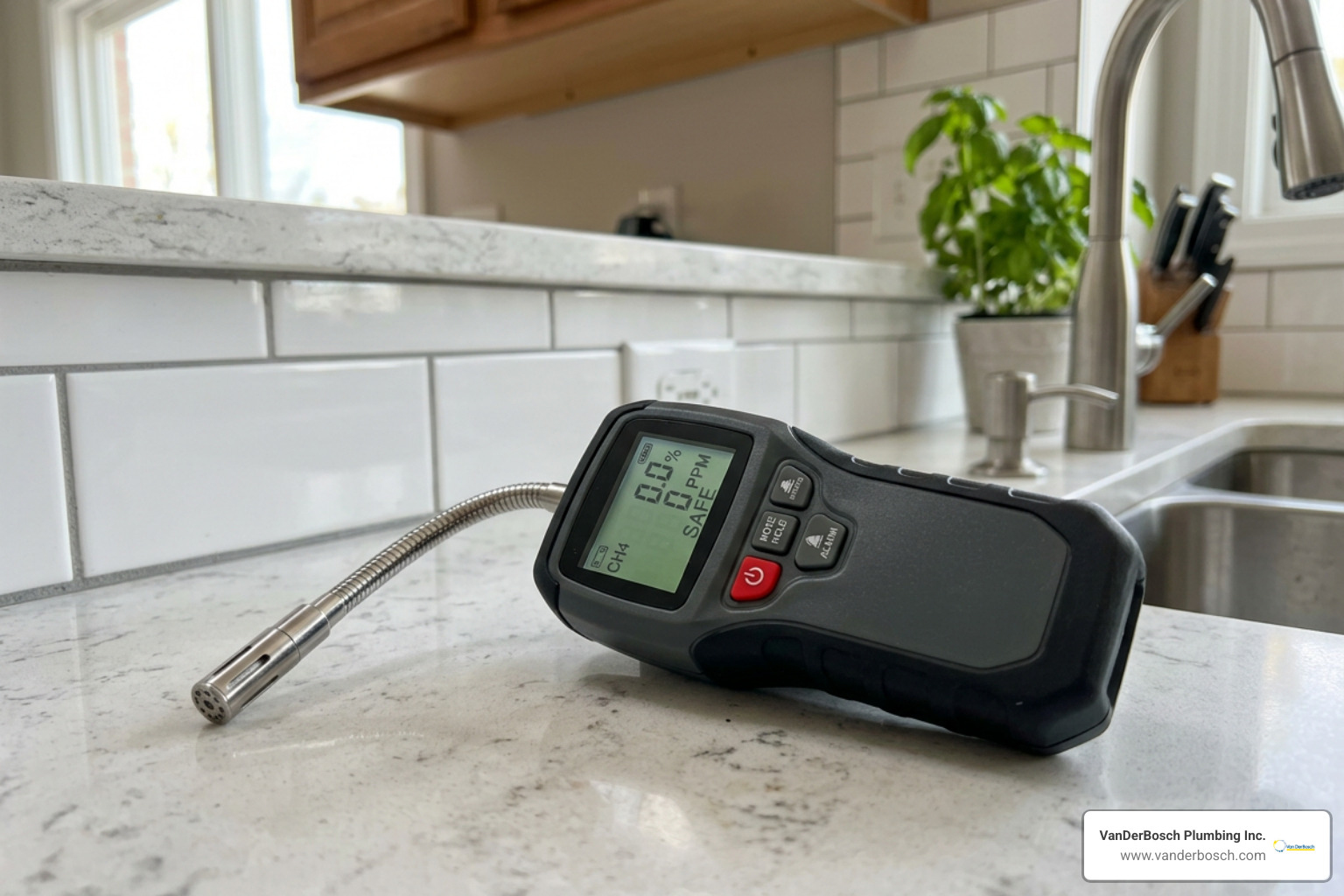
When You Can’t Smell Danger: What to Know About Digital Gas Leak Detectors
A digital gas leak detector is an electronic device that senses dangerous gas concentrations in the air and alerts you before levels become life-threatening. Here’s a quick breakdown:
- What it detects: Natural gas (methane), propane, butane, carbon monoxide, and other combustible gases
- How it alerts you: Audible alarm (typically 70–85 dB), LED visual indicators, and/or smartphone push notifications
- Where it’s used: Kitchens, boiler rooms, garages, RVs, and commercial spaces
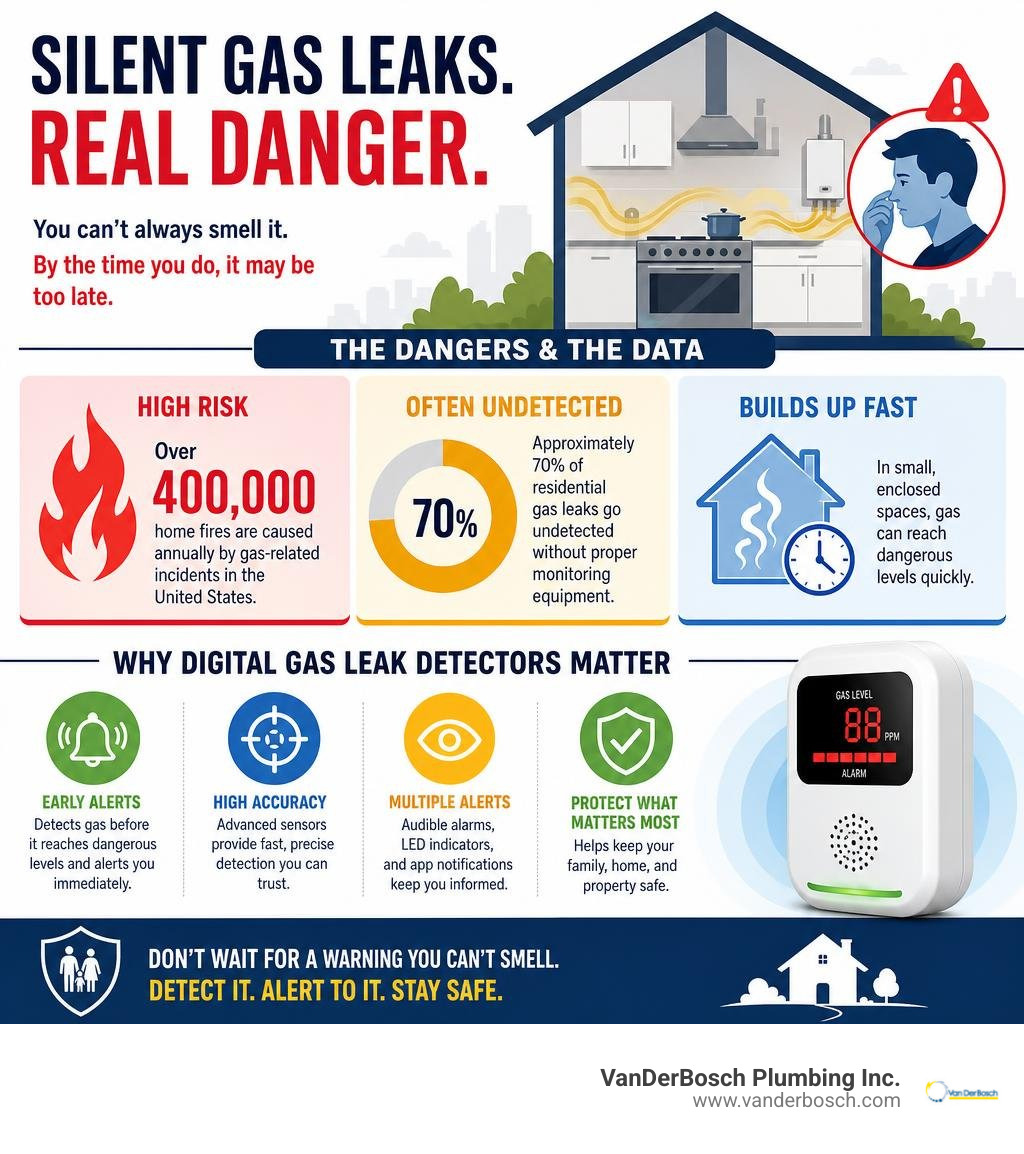
- Why it matters: Approximately 70% of residential gas leaks go undetected without proper monitoring equipment
Gas is one of the most common energy sources in Chicagoland homes — and one of the most quietly dangerous. Natural gas has no smell on its own. The rotten egg odor you associate with a leak? That’s mercaptan, an additive put in specifically so you can notice a problem. But by the time you smell it, concentrations may already be hazardous.
The numbers make this hard to ignore. Over 400,000 home fires are caused annually by gas-related incidents in the United States. And with modern homes sealed tight for energy efficiency — especially during Chicago winters — gas can accumulate fast with little warning.
That’s exactly why a digital gas leak detector isn’t just a “nice to have.” It’s a frontline safety tool.
I’m Hugh Hodur, President of VanDerBosch Plumbing Inc., and through years of overseeing residential and commercial plumbing services across the Chicagoland area — including gas leak detection and repair — I’ve seen how a digital gas leak detector can be the difference between a close call and a catastrophe. In this guide, I’ll walk you through everything you need to know to choose the right one for your home or business.
Digital gas leak detector:
What is a Digital Gas Leak Detector and How Does It Work?
To understand how a digital gas leak detector keeps your home safe, it helps to look under the hood. Unlike simple sensory detection (like your nose) or basic chemical test strips, these modern devices use advanced electronic sensors to continuously sample the air and translate chemical concentrations into digital data.

When we talk about how these devices work, we are looking at how they measure gas in two main ways: parts per million (PPM) or as a percentage of the Lower Explosive Limit (LEL). The LEL is the lowest concentration of a gas in the air that can produce a fire or explosion in the presence of an ignition source. For example, the LEL of natural gas (methane) is roughly 5% by volume in air. A high-quality digital detector will typically trigger its alarm long before you reach that point—often at just 5% to 10% of the LEL itself (which is roughly 0.25% to 0.5% gas in the air).
But how does the sensor actually “see” the gas? There are three primary sensor technologies used in digital detectors today:
- Metal-Oxide Semiconductor (MOS) Sensors: This is the most common technology found in residential digital gas leak detectors. The device contains a small ceramic heating element coated with a metal oxide (like tin dioxide). In clean air, the electrical conductivity of this oxide remains stable. However, when combustible gases like methane or propane make contact with the heated surface, they react with oxygen on the sensor, causing the electrical resistance to drop. The digital processor measures this change in resistance and converts it into a precise PPM or LEL reading.
- Catalytic Bead (Pellistor) Sensors: Frequently used in industrial and high-end portable detectors, these sensors use two small wire coils coated with a catalyst. When combustible gas is present, it burns catalytically on the active bead, raising its temperature and changing its electrical resistance. The second bead remains inactive as a reference to compensate for environmental temperature changes.
- Non-Dispersive Infrared (NDIR) Sensors: These are highly sophisticated sensors that use infrared light to detect gas molecules. Because different gases absorb specific wavelengths of infrared light, the sensor can identify exactly which gas is present by measuring how much light is absorbed as it passes through the sample chamber. NDIR sensors are incredibly accurate, long-lasting, and immune to sensor “poisoning” (where chemical exposure permanently damages other sensor types), though they are generally more expensive.
If you are interested in a deeper dive into how professional leak locating works, check out our guide on How to Detect Gas Leaks the Right Way.
Types of Gases Detected
A modern digital gas leak detector can be configured or purchased to monitor several different types of hazardous gases. It’s important to know what your specific unit is designed to catch:
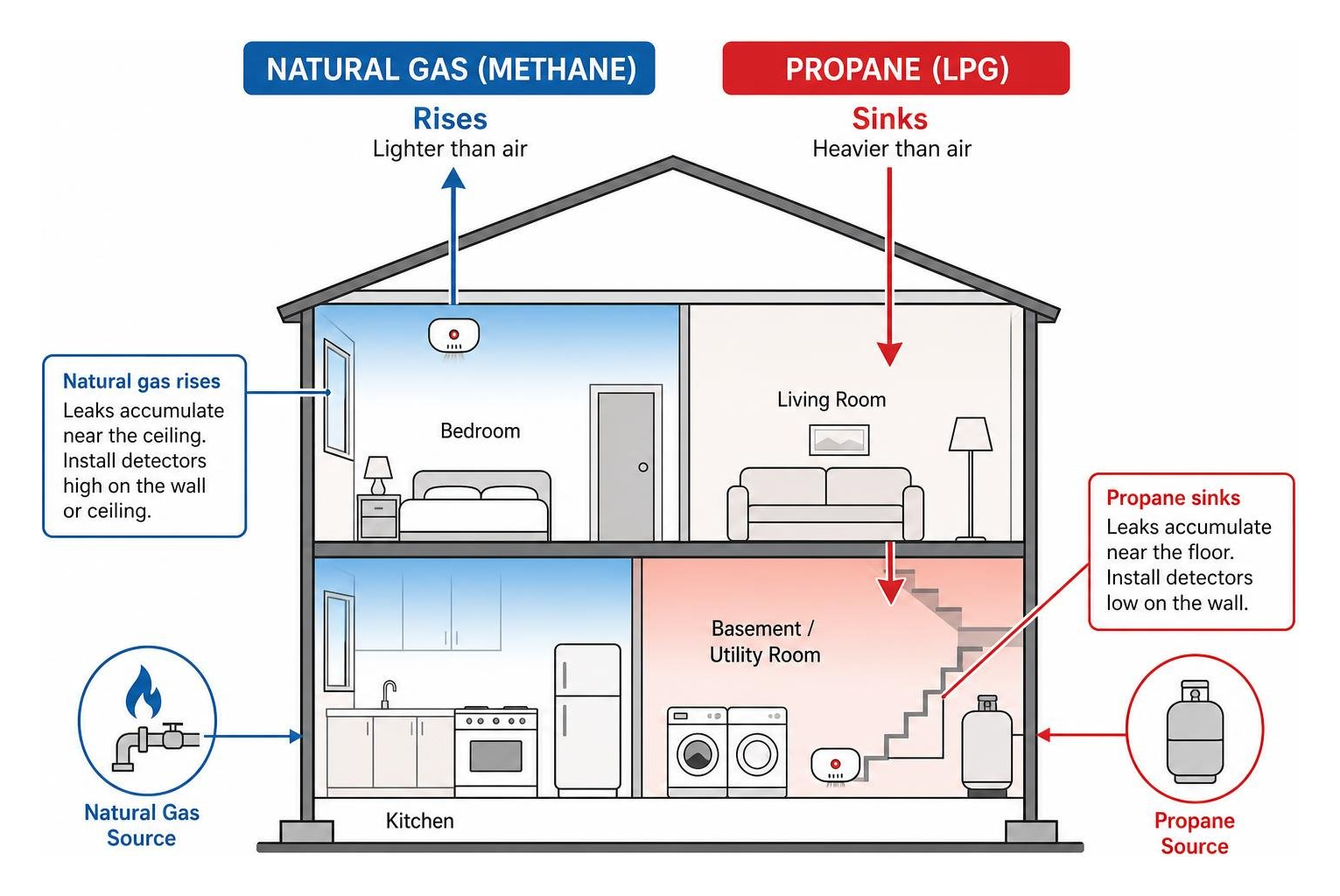
- Natural Gas (Methane / CH4): Natural gas is lighter than air, meaning it rises rapidly toward the ceiling. It is highly explosive when it mixes with air in concentrations between 5% and 15%. Devices like the Qoltec Certified Natural Gas Leak Sensor are specifically engineered to monitor CH4 levels, triggering an alarm when concentrations reach a safe threshold of around 7% LEL.
- Liquefied Petroleum Gas (LPG) & Propane: Unlike natural gas, propane and butane are heavier than air. If you have a leak, these gases will sink and pool along the floor, filling basements, crawlspaces, or lower cabinets first. This makes placement of your detector absolutely critical.
- Carbon Monoxide (CO): Often called the “silent killer,” carbon monoxide is a colorless, odorless, and tasteless gas produced by the incomplete combustion of fuels like gas, oil, wood, or coal. While combustible gas detectors focus on explosion prevention, CO detectors focus on toxicity prevention. Many modern digital units are “2-in-1” or “combo” detectors that monitor both explosive gases and carbon monoxide.
Digital vs. Traditional Analog Detection Methods
For decades, homeowners and technicians relied on manual, analog methods to find gas leaks. The most famous is the classic “bubble test”—spraying a mixture of soap and water onto pipe joints and watching to see if bubbles form. While the bubble test is still a highly effective way to pinpoint the exact physical location of a leak once you know one exists, it is completely useless as an early warning system.
Let’s look at how digital gas detectors stack up against traditional analog methods:
| Feature | Digital Gas Leak Detector | Traditional “Soap Bubble” / Analog Methods |
|---|---|---|
| Operational Mode | Continuous, automatic 24/7 monitoring | Manual, active inspection only |
| Sensitivity | Extremely high (detects down to 1 PPM or 1% LEL) | Low (only works for active, localized bubbles) |
| Response Time | Instantaneous (seconds) | Minutes (requires manual application and observation) |
| Readout Type | Backlit digital screen with real-time PPM/LEL | None (visual observation of physical bubbles) |
| Remote Alerts | Yes (smart models send Wi-Fi push alerts) | No |
| Primary Purpose | Early warning, life safety, and leak tracing | Pinpointing exact joint leaks during repairs |
While analog methods have their place in a plumber’s toolkit for sealing a joint, they cannot protect your family while you sleep. A digital detector provides the continuous, active vigilance required to keep a household safe.
Selecting the Best Device for Your Home or Business
Choosing the right digital gas leak detector depends heavily on where you plan to use it and what appliances you have. A homeowner with a gas range and a gas fireplace has different needs than a commercial facility with a boiler room or a warehouse utilizing propane forklifts.
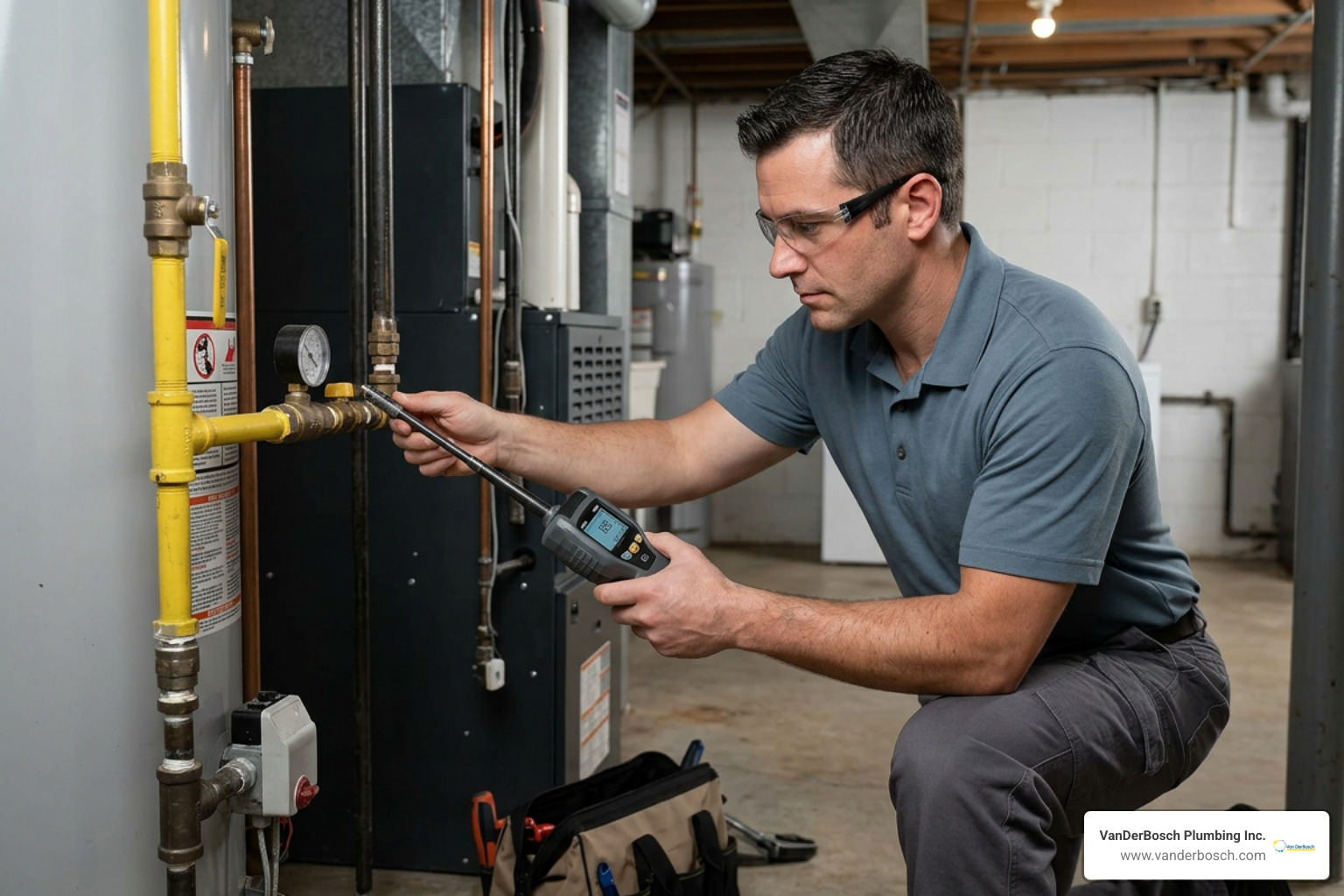
When selecting a device, you also need to decide between a fixed (plug-in/hardwired) monitor and a portable handheld “sniffer.”
- Fixed Monitors: These plug directly into a standard wall outlet (often with a battery backup) or are hardwired into your electrical system. They remain on 24/7 to provide continuous area monitoring.
- Portable Handheld Sniffers: These are battery-powered units with flexible gooseneck probes. They are designed for searching out the exact source of a leak along a pipe, behind an appliance, or around a meter.
For a complete overview of keeping your household secure, you can read our comprehensive article on How to Keep a Household Safe from Gas Leaks.
Key Features of a High-Quality Digital Gas Leak Detector
When shopping for a digital detector, look for these essential features to ensure maximum reliability and ease of use:
- Audible and Visual Alarms: The industry standard for safety is an alarm of at least 85 decibels (dB) at a distance of 10 feet. This is loud enough to wake a heavy sleeper or be heard over loud household appliances. High-quality units also feature bright, flashing red LEDs to provide a visual warning.
- Digital Display: A backlit LCD screen that displays real-time PPM or LEL percentages is incredibly helpful. It allows you to see if gas levels are rising over time, even before the main alarm is triggered, which is invaluable for identifying slow, minor leaks.
- Battery Backup: Power outages can happen, especially during severe Chicago storms. A detector that plugs into the wall but features a battery backup (such as a 9V or rechargeable lithium-ion battery) ensures you remain protected even when the power goes out.
- Self-Diagnostics & Lifespan Indicators: Sensors degrade over time. Look for a unit with a built-in end-of-life warning or a self-diagnostic system that displays an error code (often accompanied by a yellow LED) if the sensor fails.
- Smart Connectivity: For those who want the ultimate peace of mind, smart detectors connect directly to your home’s Wi-Fi network. For example, the Shelly GAS (LPG) is a highly sensitive smart gas sensor that operates without a hub, offering instant sound and light alerts locally while simultaneously pushing notifications to your phone.
Smart Home Integration and Mobile Alerts
One of the greatest advancements in modern gas safety is the integration of digital detectors with smart home ecosystems. Standard alarms are great—but only if you are home to hear them. If a leak develops while you are at work, on vacation, or running errands in Niles or Winnetka, a standard alarm will blare to an empty house while gas continues to accumulate.
Smart digital detectors change the game entirely. By connecting to platforms like Tuya, Smart Life, or proprietary apps via Wi-Fi, these devices can reduce response times to leaks by up to 80%.

When a smart detector identifies a leak, it can:
- Send Instant Push Notifications: You and your family members receive immediate alerts on your smartphones, specifying the exact room and gas concentration.
- Trigger Home Automation Scenes: You can program your smart home system to take immediate, automated action. For example, if gas is detected, your system can automatically turn off the HVAC blower (to prevent circulating gas throughout the house), turn on smart ventilation fans, unlock smart door locks for emergency responders, and turn on emergency lighting.
- Activate Automatic Valve Shutoffs: Some smart systems, like the Shelly GAS line, feature physical accessory ports or wireless relays that can connect to an electronic gas shut-off valve. The moment gas is detected, the system automatically shuts off the main gas supply line before an explosive concentration can even form.
To learn more about how automated systems protect your property, read our guide: Don’t Let Safety Drift Away with a CNG Leakage Detection System.
Installation, Maintenance, and Safety Standards
To ensure your digital gas leak detector performs flawlessly when it matters most, it must be installed correctly and maintained according to strict safety standards.
When purchasing a detector, always look for recognized safety certifications. In North America, look for UL 1484 (the standard for residential gas detectors) or UL 2034 (for carbon monoxide detectors). In Europe, compliance with EN 50194-1 is the benchmark for combustible gas detection. These certifications ensure the device has undergone rigorous testing for accuracy, alarm volume, and environmental resilience.
How to Install Your Digital Gas Leak Detector
Where and how you install your detector depends entirely on the type of gas you are trying to monitor. Because different gases have different densities compared to air, incorrect placement can render a high-quality detector completely useless.
Here are the essential rules for placement:
- For Natural Gas (Methane): Natural gas is lighter than air and rises. Your detector should be mounted on the wall within 12 inches (30 cm) of the ceiling, and ideally between 3 to 10 feet horizontally away from any gas-burning appliance.
- For Propane (LPG): Propane is heavier than air and sinks. Your detector must be mounted low to the ground, within 12 inches (30 cm) of the floor, near the appliance or gas line.
- For Carbon Monoxide (CO): Carbon monoxide has a density very similar to air and distributes relatively evenly. CO detectors are best placed at sleeping height (about 5 feet off the ground) or on the ceiling.
Where NOT to install your detector:
- Directly above or next to a gas appliance (minor, normal gas release during ignition can trigger false alarms).
- Near drafty areas like doors, windows, or ventilation ducts, which can dilute the air and prevent the sensor from getting an accurate sample.
- In damp or humid areas like bathrooms, as high humidity can interfere with sensor accuracy.
If you are located in the Chicago area and want to ensure your home’s gas systems are fully compliant and safely configured, our team can help. Learn more about our regional services in Gas Leak Detection in Edgewater Chicago IL.
Maintenance and Testing Best Practices
A gas detector is not a “set it and forget it” device. Over time, sensors can drift, accumulate dust, or degrade due to exposure to household cleaning chemicals, paint fumes, or cooking oils.
To keep your unit in peak operating condition, follow these best practices:
- Test Weekly: Press the physical “TEST” button on your unit once a week. This verifies that the internal circuitry, visual LEDs, and audible alarm horn are all functioning correctly.
- Keep It Clean: Vacuum or wipe down the exterior of your detector monthly using a dry or slightly damp microfiber cloth. Never spray household cleaners, aerosol sprays, or paints directly on or near the detector, as these chemicals can “poison” the sensor.
- Observe the Pre-Heating Phase: Portable digital detectors require a startup warm-up period—often 60 seconds—to allow the sensor element to reach its operating temperature before you begin testing. Always wait for this countdown to finish in clean air.
- Check the Expiration Date: Most residential metal-oxide semiconductor sensors have a lifespan of 5 years, while some high-end units can last up to 10 years. Mark the replacement date on the side of the device, and replace the unit immediately when it reaches its end-of-life or displays a sensor fault.
For detailed instructions on handling portable digital detection equipment, you can refer to the Si-CD3 User Manual.
Frequently Asked Questions about Gas Detection
Where should I place a natural gas detector versus a propane detector?
Because natural gas is lighter than air, it rises. Therefore, a natural gas detector must be placed high on the wall, within 12 inches of the ceiling. Conversely, propane is heavier than air and pools on the ground. A propane detector must be installed low to the floor—within 12 inches of the ground—to catch a leak before the gas builds up to an explosive level.
How often do digital gas sensors need to be replaced?
Most residential digital gas sensors have an operational lifespan of 5 years. Some premium models or dedicated carbon monoxide detectors can last up to 10 years. Even if the device appears to be working, the internal sensor degrades over time and loses its sensitivity. Most modern digital detectors will chirp or display an end-of-life error code when it is time for a replacement.
What should I do immediately if my gas alarm goes off?
If your digital gas alarm goes off:
- Evacuate immediately. Gather all family members and pets and leave the building.
- Do not touch electrical switches. Do not turn lights on or off, unplug appliances, use a landline phone, or use a garage door opener. Any tiny electrical spark can ignite the gas.
- Leave doors open. As you exit, leave the doors open to help ventilate the space.
- Call for help. Once you are a safe distance away from the property, call 911 and your gas utility company (such as Peoples Gas or Nicor Gas).
- Do not re-enter. Do not go back inside until emergency responders or licensed professionals have declared the building safe.
Conclusion
A digital gas leak detector is one of the smartest safety investments you can make for your home or business. By providing continuous, highly sensitive monitoring, real-time digital readouts, and smart mobile alerts, these devices act as an invisible shield against fire, explosions, and carbon monoxide poisoning.
While installing a digital detector is a fantastic first line of defense, keeping your home safe also requires ensuring your gas lines and appliances are professionally installed, inspected, and maintained. If you suspect a leak, hear a hissing sound, or simply want to schedule a professional gas line safety inspection, our team at VanDerBosch Plumbing Inc. is here to help.
We provide licensed residential and light commercial plumbing and gas services across Chicagoland—including Cook County, Chicago, Roselle, Niles, Winnetka, Melrose Park, Oakbrook Terrace, Hyde Park, Sauganash, West Ridge, Ukrainian Village, Elmhurst, and Mount Prospect. With our 100% satisfaction guarantee, 24/7 emergency availability, transparent pricing, and background-checked technicians, you can rest easy knowing your home is in expert hands.
Protect your home and your loved ones today. Contact us to learn more about our professional Services Gas Leak Detection and gas piping solutions.