
When Your Boiler Stops Delivering Hot Water: What’s Really Going On
Boiler no hot water is one of the most disruptive household problems — especially during a Chicago winter. Before you panic or call anyone, here are the most common causes and what you can do right now:
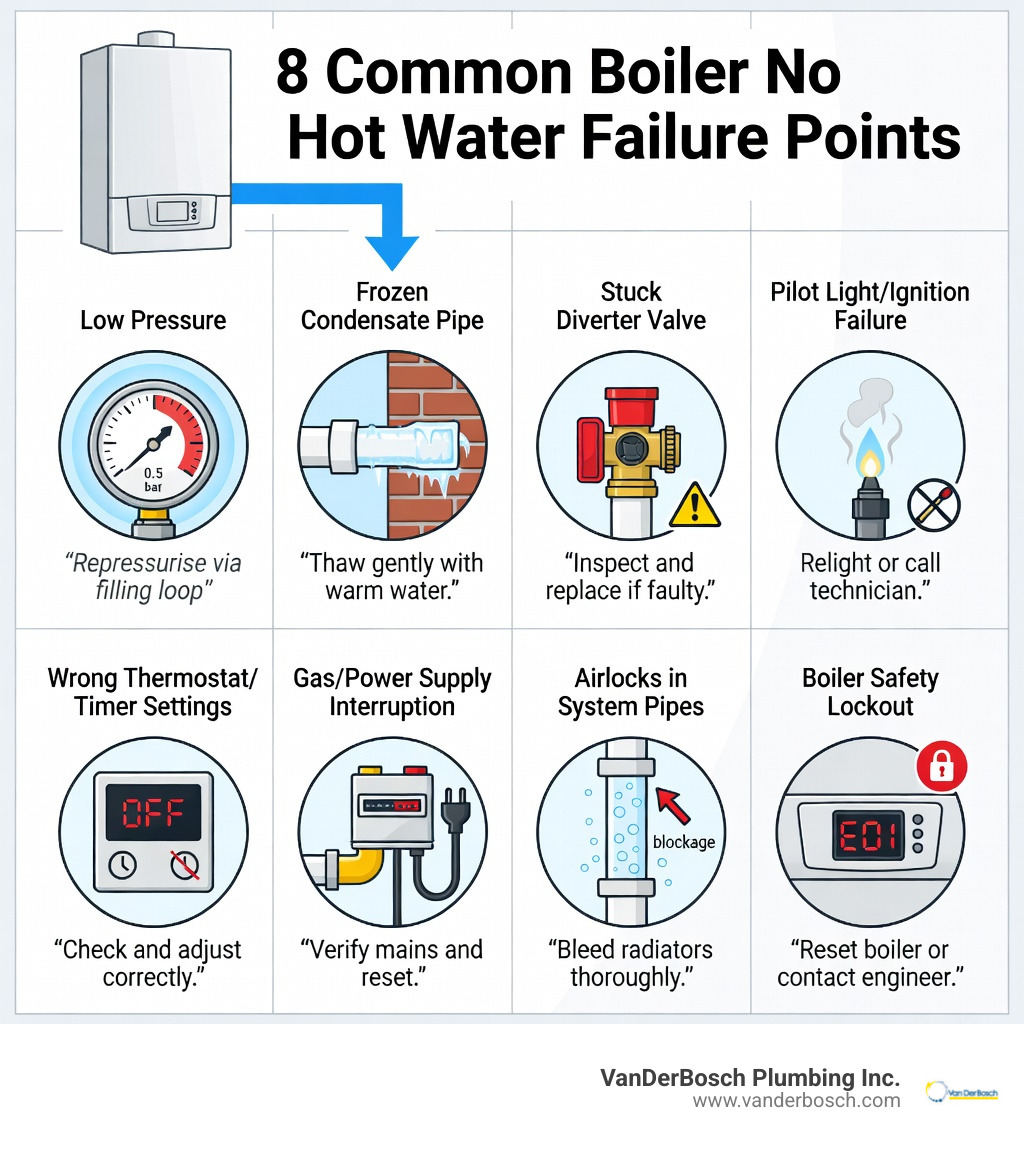
Most common reasons your boiler has no hot water:
- Low boiler pressure — check the gauge; it should read 1–1.5 bar
- Frozen condensate pipe — common in cold weather; listen for gurgling sounds
- Faulty diverter valve — especially if heating works but hot water doesn’t
- Pilot light or ignition failure — the flame that starts it all isn’t lit
- Incorrect thermostat or timer settings — a surprisingly common fix
- Power or gas supply issue — check other appliances to rule this out
- Airlocks or sediment buildup — blocks water flow through the system
- Boiler error/fault code lockout — the system shut itself down for safety
Most of these can be diagnosed at home in minutes. Some you can fix yourself. Others need a licensed technician.
We’ve all been there — you turn on the shower, wait for the warmth, and get nothing but cold water. It’s frustrating, it disrupts your day, and it always seems to happen at the worst possible time.
The good news? Most boiler hot water failures come down to a handful of common, diagnosable causes. This guide walks you through them in plain language — from simple checks you can do in two minutes to knowing when it’s time to call a pro.
I’m Hugh Hodur, President of VanDerBosch Plumbing, and I’ve spent years helping Chicagoland homeowners and businesses resolve exactly these kinds of boiler no hot water emergencies — from frozen condensate pipes in January to worn-out diverter valves in aging systems. Let’s get your hot water back.
Quick Checks: Why is My Boiler No Hot Water?

When the taps run cold, our first instinct is often to assume the worst. “That’s it, the boiler’s dead,” we think, picturing a massive repair bill. But before you start looking for your checkbook, we recommend a “tech support” approach: start with the simplest possibilities.
First, check the power. It sounds obvious, but you’d be surprised how often a tripped circuit breaker or a blown fuse is the culprit. If your boiler display is completely dark, head to your consumer unit (fuse box) and see if any switches have flipped. If you have a pre-payment meter for your gas or electricity, make sure you haven’t run out of credit. It’s a common “oops” moment that can leave you shivering in the shower.
Next, look at your control settings. Did someone bump the timer? Is the boiler actually set to provide hot water, or is it accidentally switched to “central heating only”? On many modern units, there are separate dials or digital settings for the radiators and the domestic hot water. Ensure the hot water dial is turned up (usually to around 140°F or 60°C).
If everything looks powered up but the water is still icy, your boiler might be in a “system lockout.” This is a safety feature where the boiler shuts itself down because it detected an internal issue, like a flame failure or a pressure drop. If you see a flashing red light or a strange code on the screen, your boiler is trying to tell you what’s wrong.
For comprehensive help with these initial diagnostics, our Boiler Services team is always available to guide you through the more technical hurdles.
Checking for Boiler No Hot Water Error Codes
Your boiler’s digital display is its only way of talking to you. When it encounters a problem it can’t fix, it throws up a fault code. These codes vary by manufacturer, but they are your best friend when diagnosing a boiler no hot water situation.
- Worcester Bosch: Often uses codes like “EA” (flame not detected).
- Ideal: Look for “F1” (low water pressure) or “L2” (ignition lockout).
- Vaillant: “F.22” usually points to low pressure.
- Viessmann: Might show “F2” or “Eb” for various burner or circulation faults.
Always keep your manufacturer’s manual handy. If you’ve lost it, most are available online as PDFs. Identifying the code helps us—or you—understand if the fix is a simple reset or if a part needs replacing.
Verifying Utility Supplies
If your boiler is acting up, check your other gas appliances. Can you light the stove? If the stove won’t light, you might have a gas supply issue or a closed gas valve. Similarly, check your water mains. If you have very low flow at the cold tap, the boiler won’t have enough pressure to trigger the heating mechanism.
Electrical overloads are another common issue in older Chicagoland homes. If your boiler fuse keeps blowing, it might be due to too much electrical load on that specific circuit. This is a safety risk and requires a professional look. You can find More info about boiler services on our dedicated service page to see how we handle these complex utility integrations.
Common Mechanical Culprits and DIY Fixes
If the power is on and the gas is flowing, but you still have a boiler no hot water problem, we move into the mechanical territory. Over time, components wear out, air gets trapped in the lines, and sediment (limescale) can build up, especially with the hard water we often see in the Cook County area.
One of the most frequent calls we get involves airlocks. This is essentially a giant bubble of air trapped in your pipes that prevents hot water from reaching your taps. If your hot water is “spluttering” or coming out in weak bursts, an airlock is a likely suspect.
| Issue | DIY Fix | Professional Repair |
|---|---|---|
| Low Pressure | Use filling loop to top up to 1.5 bar | Inspect for hidden leaks in the system |
| Frozen Pipe | Thaw with warm water/hot water bottle | Relocate or insulate pipe for prevention |
| Airlock | Bleed radiators or use “hosepipe trick” | Power flush the entire system |
| Faulty Valve | None (Safety risk) | Replace diverter or motorized valve |
| Sediment | Flush the boiler (if experienced) | Chemical de-scaling or magnetic filter install |
Restoring Low Boiler Pressure
Think of your boiler like a car tire; it needs the right amount of pressure to function. Most boilers operate best between 1.0 and 1.5 bar (or roughly 12 to 22 psi). If the needle on your pressure gauge has slipped into the red zone below 1 bar, the boiler will likely shut down to prevent damage.
To fix this, you’ll need to use the “filling loop”—a silver, flexible pipe with small valves at either end.
- Locate the filling loop (usually underneath the boiler).
- Open the valves slowly. You should hear water entering the system.
- Watch the gauge closely. Once it hits 1.5 bar, close the valves tightly.
- You may need to reset your boiler afterward to clear the low-pressure error.
If you find yourself doing this every week, you likely have a leak. Whether it’s a visible drip from a radiator or a hidden leak behind a wall, it needs professional attention. Residents can look into our Roselle Boiler Services for expert leak detection and pressure stabilization.
Thawing a Frozen Condensate Pipe
In Chicago, “frozen” is a way of life for several months a year. Modern condensing boilers have a plastic pipe that carries acidic water (condensate) away from the unit and usually out of the house. Because this pipe is often exposed to the elements, it can freeze solid during a cold snap.
When the pipe freezes, the water backs up into the boiler, causing it to shut down for safety. You’ll often hear a gurgling sound coming from the unit before it quits.
How to thaw it:
- Locate the plastic pipe outside.
- Pour warm (not boiling!) water over the frozen section. You can also use a hot water bottle or a heat wrap.
- Once the ice melts, reset your boiler.
To prevent this from happening again, we recommend fitting the pipe with foam insulation. For more tips on staying safe during extreme Chicago freezes, check out the NHS cold weather advice which, while UK-based, offers excellent universal tips for protecting your health and home in the cold.
Advanced Troubleshooting: Heating Works but No Hot Water
This is perhaps the most confusing scenario for homeowners: the radiators are toasty warm, but the shower is freezing. This almost always points to a single component: the diverter valve.
In a combi boiler, the diverter valve is the “traffic controller.” Its job is to open and close to direct hot water either to your radiators or to your taps and shower. If the valve gets stuck in the “heating” position, you’ll have plenty of heat but no hot water. Conversely, if it’s stuck the other way, you’ll have hot water but cold radiators.
Because this involves opening the boiler casing and working with internal mechanical parts, this is not a DIY job. If you suspect a diverter valve issue, it’s time to call in the experts. Our Boiler Repair in Chicago page details the signs of valve failure and how we can get it replaced quickly to restore your comfort.
Troubleshooting Boiler No Hot Water Pilot Light Issues
Older boilers use a permanent “pilot light”—a small blue flame that stays lit all the time to ignite the main burner. If this flame goes out, the boiler can’t heat anything.
Safety First: If you see a pilot light that is orange or yellow instead of a crisp blue, turn the boiler off immediately. An orange flame can indicate incomplete combustion and the presence of carbon monoxide, which is odorless and deadly.
If the light is simply out, you can often relight it following the instructions in your manual. However, if it keeps going out, you likely have a faulty thermocouple (a sensor that detects the flame) or a blocked injector. For peace of mind and safety, you can consult the Gas Safe Register safety advice to understand the importance of hiring only licensed, background-checked technicians for gas-related repairs.
Thermostat and Timer Misconfigurations
Sometimes the “boiler” problem isn’t in the boiler at all—it’s on the wall. We’ve seen many cases where a boiler no hot water complaint was solved simply by changing the batteries in a wireless thermostat.
Check your programmer or smart home app. Is the hot water scheduled to be on? If you have a system boiler (one with a separate hot water tank), the timer controls when that tank is heated. If your household has grown or your schedule has changed, you might simply be using up all the stored hot water before the next “on” cycle. Try boosting the hot water manually on your programmer to see if that solves the issue.
Step-by-Step Guide to Safely Resetting Your System
If you’ve checked the pressure, the gas, and the thermostat, and everything seems fine, a system reset is your next move. Think of this as “rebooting” your boiler. It clears temporary electronic glitches and allows the system to perform a fresh diagnostic check.
How to reset your boiler safely:
- Locate the Reset Button: It’s usually on the front control panel. It might be labeled “Reset,” or it might be a flame symbol with a line through it.
- Press and Hold: Most boilers require you to hold the button for about 3 to 5 seconds.
- Wait: The boiler will go through a startup sequence. You might hear fans whirring and clicks as the ignition tries to fire.
- Check for Success: If the flame ignites and the error code disappears, you’re back in business.
Warning: Do not reset your boiler more than two or three times in a row. If it keeps locking out, it’s doing so for a safety reason. Repeatedly resetting a failing boiler can cause further damage or create a hazardous situation.
Frequently Asked Questions about Boiler Failures
Why does my boiler provide heating but no hot water?
As mentioned earlier, this is the classic symptom of a faulty diverter valve. The valve is stuck directing all the heated water to the central heating circuit and won’t “divert” it to the domestic hot water heat exchanger when you turn on a tap. It’s a mechanical failure that requires a professional part replacement.
How do I know if my boiler pressure is too low?
Check the circular gauge on the front of your unit. If the needle is below the 1.0 mark (often in a red section), your pressure is too low. Some digital boilers will display an error code like “F22” or “Low Pressure” and will refuse to fire up until you top up the water using the filling loop.
Is it time to replace my aging boiler?
The average lifespan of a well-maintained boiler is about 15 years. If your unit is older than that and you’re experiencing frequent boiler no hot water issues, it might be more cost-effective to replace it. Modern A-rated boilers are significantly more efficient, which can save you a bundle on those Chicago winter heating bills. Signs it’s time to upgrade include:
- Corrosion on the tank or pipes.
- Strange banging or rumbling noises (kettling).
- Your repair bills are starting to rival the cost of a new unit.
Conclusion
Dealing with a boiler no hot water situation is never fun, but we hope this guide has given you the confidence to perform some basic troubleshooting. From checking your pressure gauge to thawing out a frozen pipe, many common fixes are well within a homeowner’s reach.
However, when DIY isn’t enough, VanDerBosch Plumbing Inc. is here to help. We serve the entire Chicagoland area—from the North Side to the suburbs like Roselle, Niles, and Winnetka. Our licensed technicians are background-checked, experienced, and ready to tackle everything from simple valve repairs to full system installations.
We pride ourselves on transparent pricing with no service charges and a 100% satisfaction guarantee. Whether you’re in Melrose Park, Oakbrook Terrace, or right in the heart of Chicago, we are available 24/7 to ensure you never have to endure a cold shower for long.
Need professional help right now? Explore our Boiler Services and let’s get your home back to the warm, comfortable sanctuary it should be.