
Signs You Need Plumber Water Heater Installation
Recognizing early warning signs of a failing water heater saves you from stepping into a freezing shower or dealing with a flooded utility room. While some issues require quick repairs, severe symptoms indicate that scheduling a plumber water heater installation is the safest, most cost-effective path forward.
Look out for these common warning signs:
- System Age: Most standard tank units have an operational lifespan of 8 to 12 years. If your heater is approaching or past its 10th birthday, internal components are likely wearing down.
- Temperature Fluctuations: Getting hit by a sudden blast of ice water mid-shampoo often indicates failing electrical heating elements, a fractured dip tube, or severe sediment buildup.
- Discolored or Rusty Water: Reddish, brown, or rusty water coming specifically from your hot water taps means the steel inside your tank is corroding.
- Popping or Rumbling Sounds: Loud knocking, popping, or rumbling noises signal heavy mineral sediment sitting at the bottom of the tank. As water gets trapped under this hardened crust and boils, it creates loud popping sounds and stresses the steel base.
- Unexplained Energy Bill Spikes: When sediment insulates the heating element or burner, your unit works twice as hard to heat the water, causing utility bills to jump.
- Visible Leaking: Water pooling near the base of the tank is a red alert.
If you notice moisture around your unit, check our detailed guide on why is my water heater leaking to determine whether it is simple condensation or a structural tank failure. For an exhaustive breakdown of warning signs, review our guide on signs your water heater may need repair or replacement.
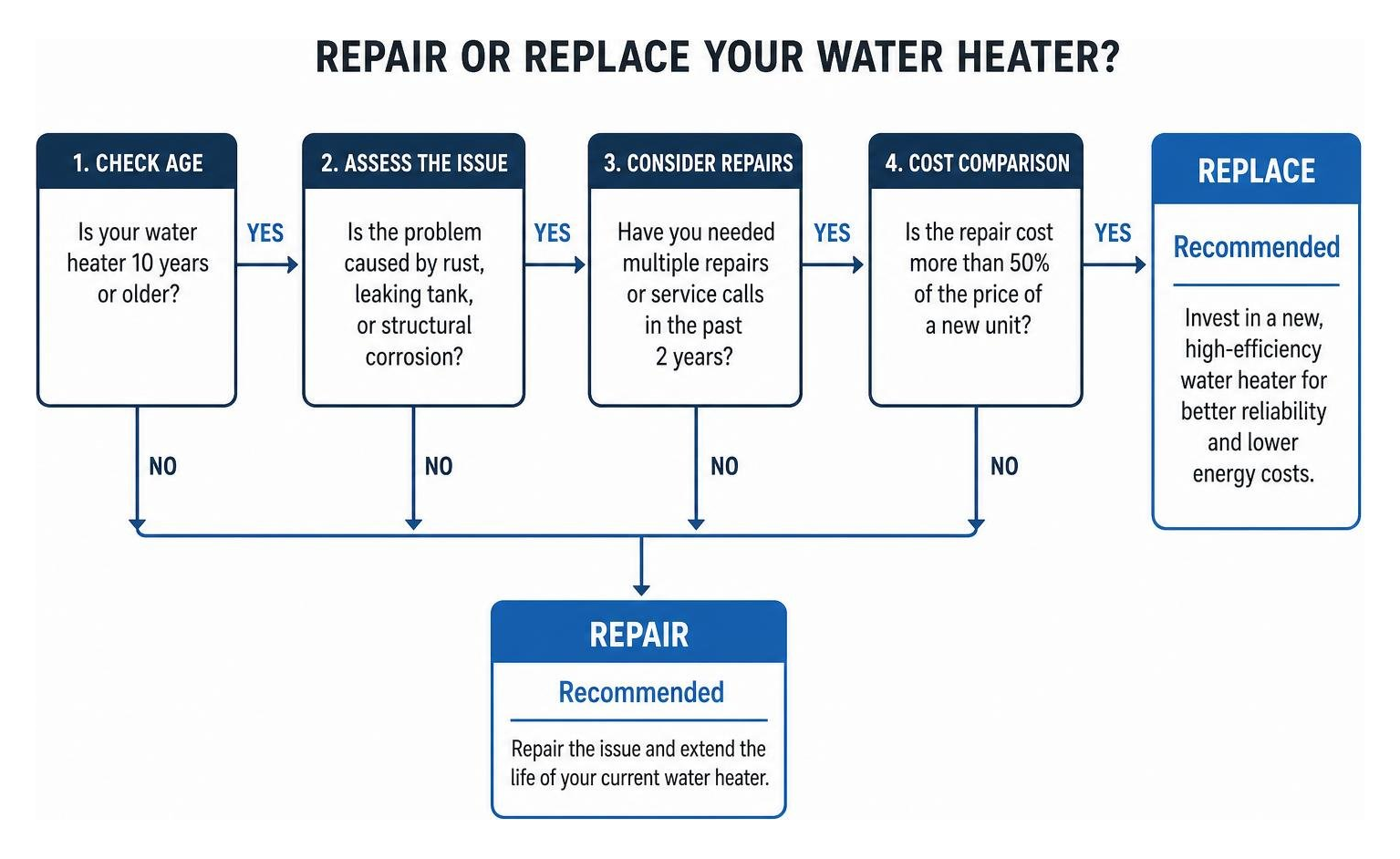
When to Repair vs. Replace Your Water Heater
Deciding whether to call for a quick fix or replace your equipment entirely comes down to unit age, repair frequency, and total cost.
A simple rule of thumb in the plumbing industry is the 50 percent rule: if the cost of a repair exceeds 50% of the price of a brand-new unit—or if you have needed multiple service calls over the past two years—investing in a new, high-efficiency water heater is the smarter financial choice. Modern high-efficiency tank water heaters can reduce ongoing water heating energy expenses by 20% to 30%, which helps offset the initial purchase price over time.
Additionally, location matters. If a component like an upper thermostat fails on a 4-year-old electric heater, repair it. But if water is leaking directly from the bottom of an old tank due to internal rust, repairs are impossible. Once structural corrosion penetrates the steel lining, the tank cannot be patched. Learn more about evaluating your appliance’s health by checking when should homeowners break up with their water heaters.
Gathering Details Before Your Plumber Water Heater Installation
When you contact us to schedule service, having key equipment details ready allows our technicians to bring the exact parts and tools required for your setup on the very first visit.
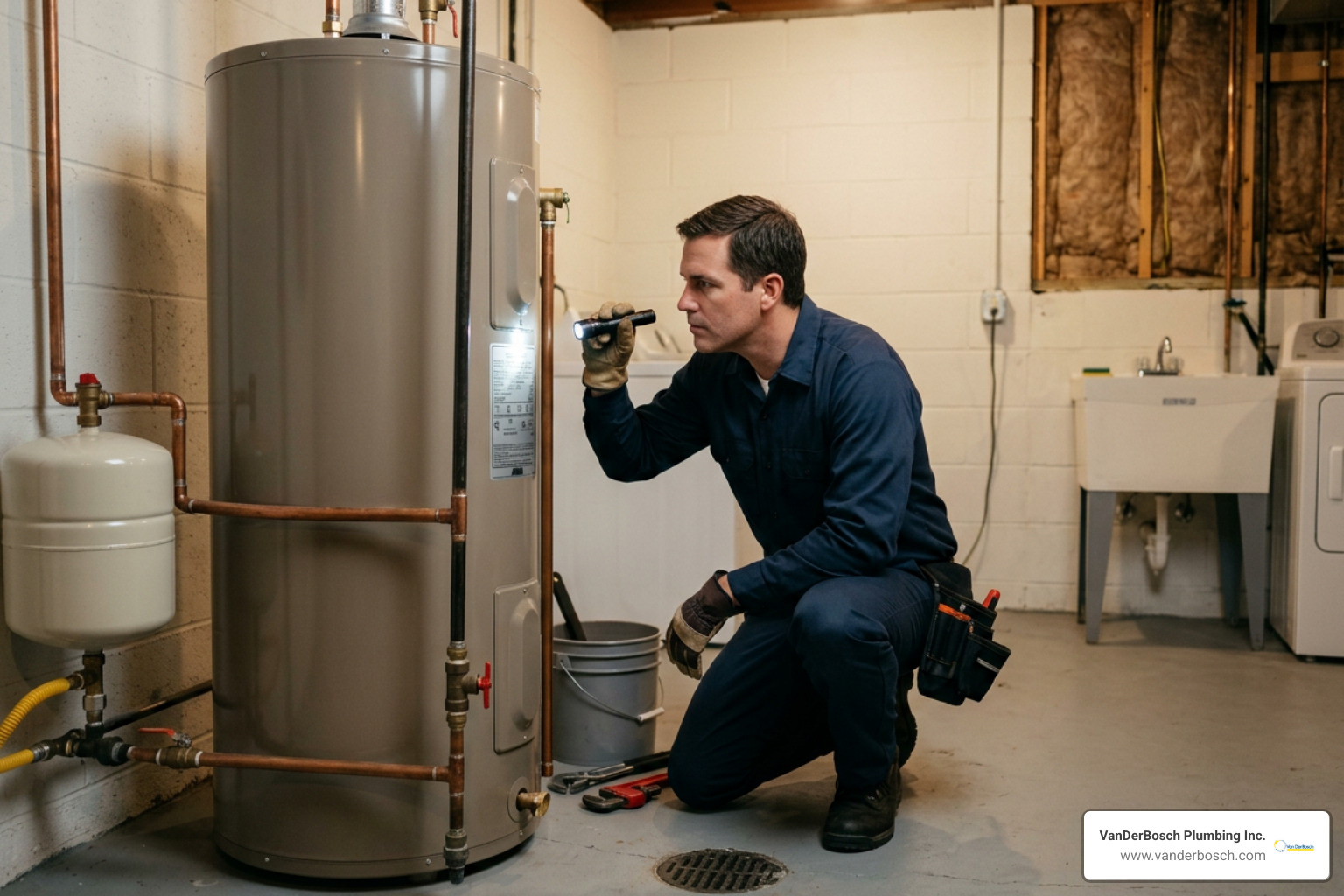
Before calling a professional, locate the manufacturer rating plate glued to the side of your tank and gather the following details:
- Manufacturer Brand: (e.g., Rheem, State, Bradford White)
- Model Number: Helps identify exact dimensions, fuel setup, and heating capacity.
- Serial Number: Allows us to check your remaining manufacturer warranty coverage.
- Safety Verification: Ensure you know where your home’s main water shutoff valve is located in case of active leaks, and locate your main electrical circuit breaker panel or emergency gas shutoff valve.
Having these details on hand streamlines the estimation process, ensures proper physical fitting, and preserves any remaining warranty protection.
Types of Systems and Installation Timelines
The time required to complete a plumber water heater installation depends primarily on the fuel source, equipment style, and whether you are swapping like-for-like or changing system types.
| System Type | Typical Fuel Source | Standard Installation Time | Key Efficiency Factor |
|---|---|---|---|
| Gas Tank Water Heater | Natural Gas / Propane | 2 to 4 Hours | Standard to High Thermal Efficiency |
| Electric Tank Water Heater | Electricity (240V) | 1.5 to 3 Hours | Standard Storage Efficiency |
| Hybrid Heat Pump Water Heater | Electricity (240V / 120V) | 4 to 8 Hours | Up to 5X Energy Efficiency of Standard Electric |
| Tankless Water Heater | Natural Gas / Electricity | 4 to 10 Hours (6-10 hrs for conversions) | On-Demand Heating / Elimination of Standby Loss |
Choosing the best system involves balancing upfront purchase costs against long-term utility savings. Read our in-depth guides on choosing the right type of water heater for installation and the ultimate guide to affordable water heater replacement and installation to explore all available configurations.
Gas and Electric Tank Systems
Standard storage tank replacements represent the fastest, most straightforward installations:
- Electric Tank Replacement (1.5 to 3 Hours): Electric units are generally the quickest to replace because they do not require flue pipes or gas lines. The plumber disconnects the electrical service, drains and removes the old tank, secures the new unit, connects domestic plumbing lines, fills the tank completely, and re-engages the dedicated circuit breaker.
- Gas Tank Replacement (2 to 4 Hours): Gas installations require extra care during fuel line connection and exhaust venting checks. The process involves isolating the gas valve, disconnecting draft hoods and flue piping, draining the tank, securing the unit, testing gas connections for leaks using soapy water solutions, and verifying draft through the chimney or sidewall vent.
Heat Pump and Tankless Options
Upgrading to advanced high-efficiency technology involves additional mechanical and electrical adjustments:
- Heat Pump Water Heater Installation (4 to 8 Hours): Hybrid heat pumps extract thermal energy from surrounding ambient air to heat water. Installing one requires establishing adequate air volume (typically requiring at least 450 to 700 cubic feet of room space or louvered doors), wiring a dedicated 240-volt, 30-amp circuit line, and installing pitch-correct condensate drain lines or condensate removal pumps.
- Tankless Water Heater Conversions (6 to 10 Hours): Converting from a standard tank to a continuous flow tankless unit requires a full-day project. Tankless gas units demand high energy input instantly, which usually requires upsizing gas supply lines from 1/2-inch to 3/4-inch pipe, installing dedicated PVC/CPVC/stainless steel venting through exterior walls or roofs, mounting the unit, and installing system isolation valves. For more detailed insights on on-demand systems, review our complete breakdown on tankless water heaters.
Installation Time Factors and Delays
While simple swaps proceed quickly, site conditions can add time to any job:
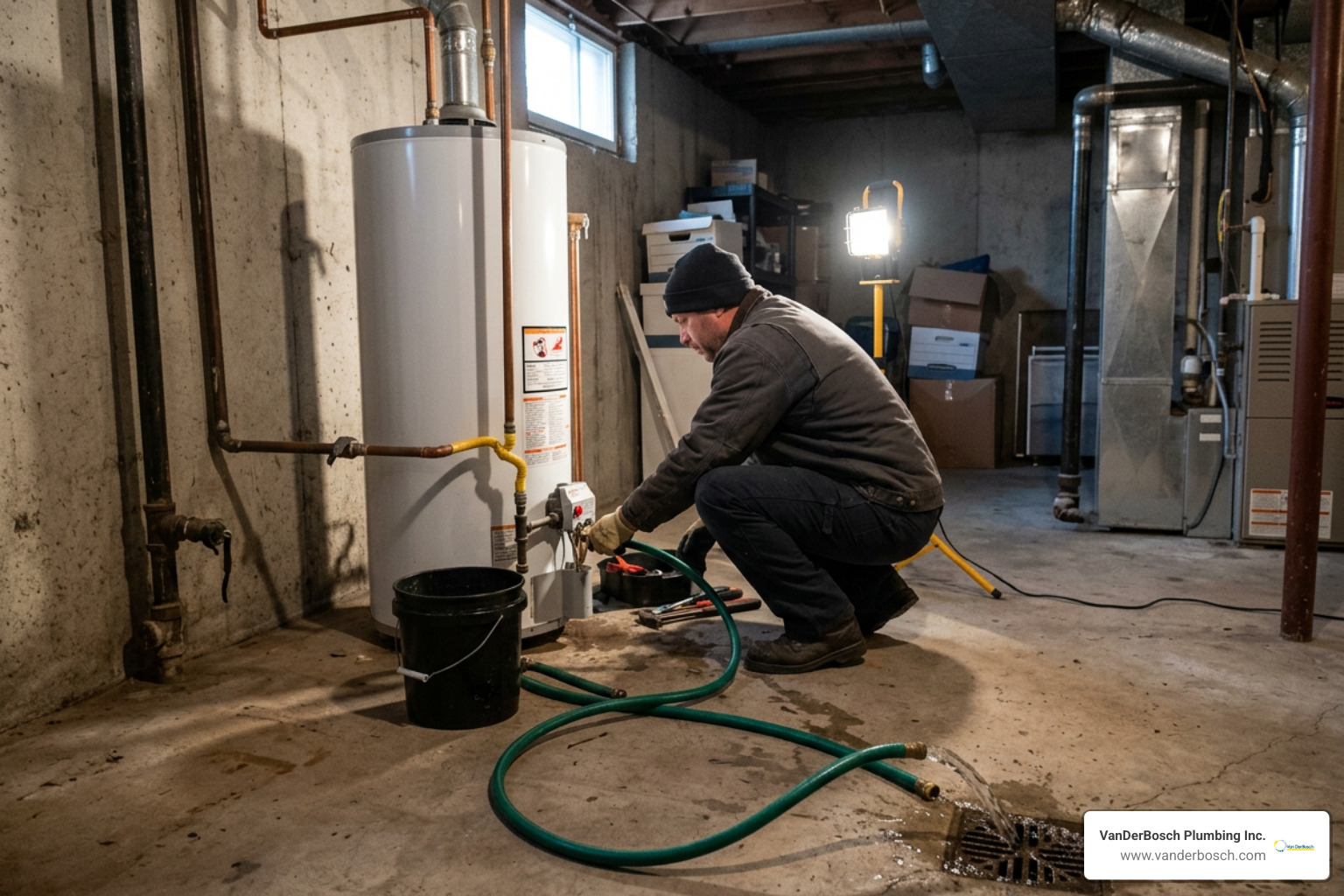
- Tank Draining Delays: A healthy 50-gallon tank takes roughly 20 to 40 minutes to drain completely. However, severe hard-water sediment buildup can clog the lower drain valve, requiring plumbers to flush or pump out sediment manually, adding 30 to 60 minutes.
- Tight Space & Access Challenges: Water heaters installed in cramped crawlspaces, attics, or tiny utility closets require careful maneuvering and extra help to remove safely.
- Mandatory Code Compliance Updates: Installing mandatory thermal expansion tanks, new safety shutoff valves, sediment traps (drip legs), or proper Temperature and Pressure (T&P) discharge lines can add 30 to 90 minutes to the total work time.
Safety Standards and Code Upgrades
A plumber water heater installation involves high-voltage electricity, natural gas lines, and high-pressure hot water. Hiring a professional guarantees that all work complies with current plumbing and mechanical codes, protecting your family and home investment. Review our resource on why you need a licensed plumber for water heater installation to see why professional installation matters. Check out regional safety standards and equipment requirements in this comprehensive Parts Product Manual as well.
Essential Safety Features and Scald Prevention
Safety is paramount during installation. Water heater thermostats are usually set at 120°F at the factory to balance domestic comfort with energy savings and scald safety. Water temperatures over 125°F can cause severe scalding in seconds:
- 120°F (49°C): Over 5 minutes to cause a serious burn
- 130°F (54°C): About 30 seconds to produce a burn
- 140°F (60°C): Less than 5 seconds to produce a severe burn
- 150°F (66°C): Roughly 1.5 seconds to cause a severe burn
To maintain high tank storage temperatures (which prevent waterborne bacterial growth like Legionella) without increasing scalding risks at household taps, plumbers can install thermostatic mixing valves compliant with ASSE standards. These valves blend cold water into the hot output line before it reaches showers or sinks.
Every code-compliant installation must also feature a properly rated Temperature and Pressure (T&P) relief valve set to open if internal tank pressure hits 150 PSI or temperature reaches 210°F. The attached discharge pipe must extend downwards to terminate within 6 inches of the floor or route to an approved drain, ensuring hot water or steam discharges safely toward the ground if triggered. Check specific manufacturer guidelines in this official Water Heaters document.
Mandatory Code Upgrades and Expansion Tanks
Local building codes evolve over time to improve safety. When replacing an older system, licensed plumbers often need to bring surrounding piping up to current building code:
- Thermal Expansion Tanks: Modern municipal water service connections feature backflow preventers or check valves, creating a “closed” plumbing system. When heated, expanding water cannot push back out into the city main. Without a thermal expansion tank, pressure inside your domestic lines spikes dramatically, putting extreme stress on your plumbing, causing premature tank failure, and blowing out safety relief valves. Learn how to safeguard your system by reading our step-by-step guide on how to install a hot water expansion tank and save your pipes.
- Pressure Reducing Valves (PRVs): Plumbing codes mandate incoming water pressure stay below 80 psi (with 50 to 60 psi being ideal). If house pressure exceeds this threshold, a PRV must be installed to prevent equipment damage.
- Drain Pans and Shutoff Valves: If a tank is installed in or above finished living spaces or basements where leaks could cause structural damage, code requires installing a catch pan at least 2 inches wider than the tank, piped directly to a basement drain, along with automatic leak-detection shutoff valves.
Sizing and Preparing Your Home for Installation
Selecting the right water heater size ensures your household never runs out of hot water during busy mornings while preventing unnecessary energy waste.
Sizing Your Unit and Preparing for Plumber Water Heater Installation
Buying a water heater purely based on physical tank gallon capacity is a common mistake. Plumbers calculate system capacity using key sizing metrics:
- First Hour Rating (FHR): For tank units, the FHR measures how many gallons of hot water the appliance can produce in its first hour of operation starting with a fully heated tank. This calculation combines storage capacity with burner/element heating recovery speed.
- Gallons Per Minute (GPM): For tankless continuous-flow units, GPM determines how many hot fixtures can run simultaneously. A shower using a standard head draws about 2.0 to 2.5 GPM, while a dishwasher requires 1.5 GPM.
- Household Occupancy & Peak Demand: A 2-person home typically needs a 30 to 40-gallon tank (FHR ~45-55 gallons). A family of 4 to 5 usually requires a 50 to 66-gallon tank (FHR ~65-80 gallons) or a tankless unit rated for 7 to 9 GPM.
To estimate complete equipment and labor investments for your project, review our detailed guide on how much does a new water heater actually cost.
Before your technician arrives, prepare your home for a smooth installation:
- Clear a wide path from your driveway or alley through entryways, hallways, and basement stairs down to the utility room.
- Move boxes, storage bins, or laundry items away from the existing water heater to leave at least 3 feet of clear workspace around the unit.
- Secure domestic pets in another room for safety while technicians move heavy equipment in and out.
Frequently Asked Questions About Water Heater Installation
How long does a standard water heater installation take?
A standard like-for-like replacement of a gas water heater typically takes between 2 and 4 hours. Swapping an electric tank unit usually takes 1.5 to 3 hours because there are no gas or flue lines to reconnect. Converting a standard tank water heater to a high-efficiency tankless system is a larger project taking roughly 6 to 10 hours due to gas line upsizing and vent rerouting.
How do I choose the right size water heater for my home?
Size storage tank heaters using the First Hour Rating (FHR) listed on the unit’s yellow EnergyGuide label, matching it against your home’s peak-hour water usage (usually mornings when multiple showers, laundry, and kitchen tasks overlap). For tankless systems, add up the Gallons Per Minute (GPM) requirements of all fixtures you plan to run at the same time. A licensed plumber can calculate these metrics precisely during a consultation.
What code upgrades are required during water heater installation?
Common code-mandated updates include adding a thermal expansion tank on closed plumbing systems, installing a Pressure Reducing Valve (PRV) if incoming city pressure exceeds 80 psi, routing a full-sized T&P discharge pipe toward the floor, installing a drain pan with a drain line under elevated units, and adding an gas shutoff valve and sediment trap (drip leg) on gas supply lines.
Conclusion
A reliable supply of hot water is essential for daily household comfort, health, and cleanliness. When your water heater begins showing signs of age, noise, or leaks, scheduling a professional plumber water heater installation protects your property from water damage and ensures your new equipment operates safely and efficiently for years to come.
At VanDerBosch Plumbing Inc., our experienced, licensed, and background-checked technicians deliver top-tier plumbing services throughout Chicago and surrounding Cook County communities. Backed by our 100% satisfaction guarantee, transparent pricing with zero hidden service charges, and 24/7 emergency response, we are ready to restore hot water to your home cleanly and efficiently.
Don’t wait for a complete system breakdown to fix your plumbing issues. Visit our primary water heater services page or call VanDerBosch Plumbing Inc. today to schedule your expert consultation and installation!