
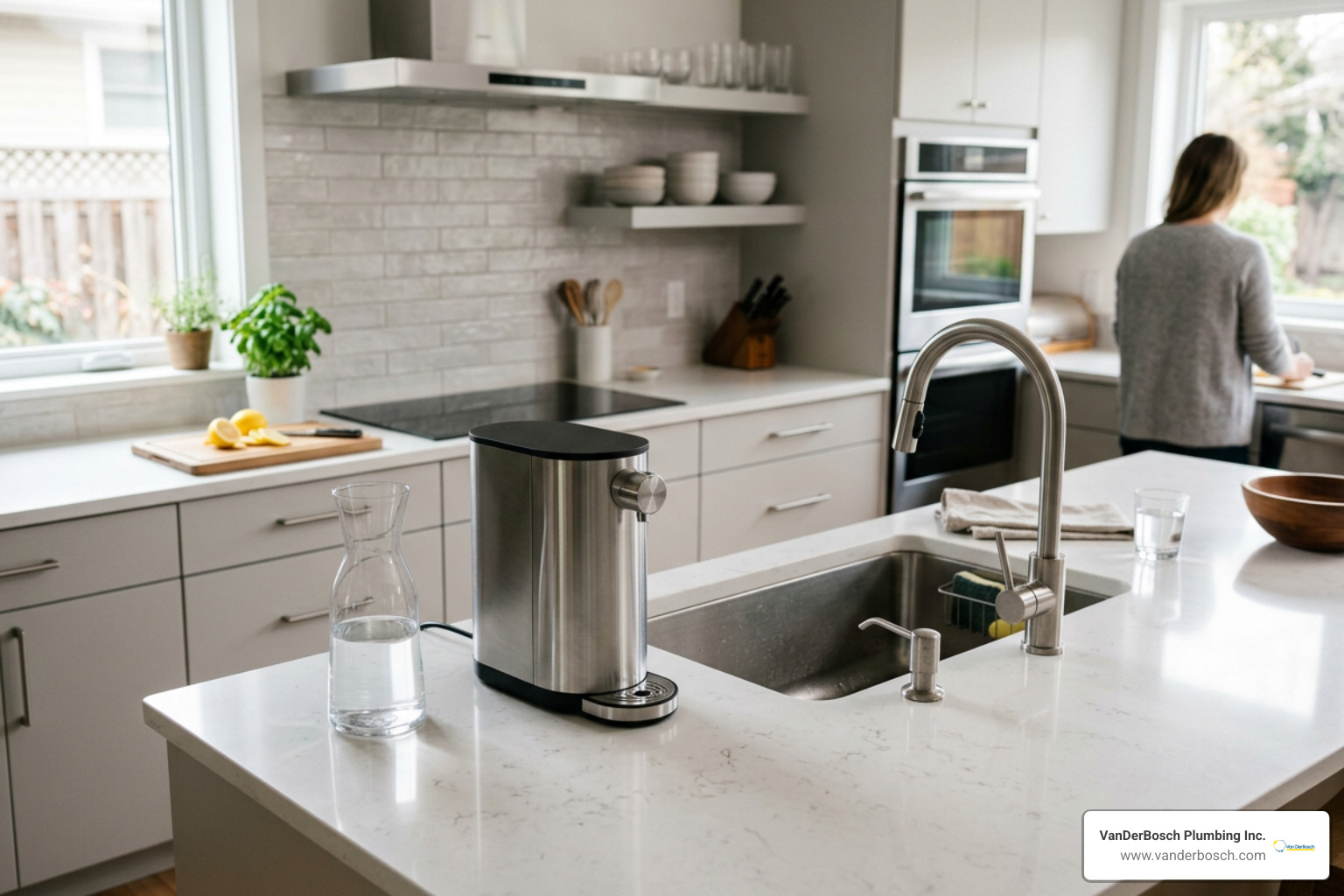
Is a Countertop Water Filter Right for You? Here’s What You Need to Know
If you’re comparing counter top water filters, here’s a quick look at the top-rated options to help you decide fast:
| Filter | Type | Best For | Price Range |
|---|---|---|---|
| AquaTru Carafe | Reverse Osmosis | Best overall performance | $$$ |
| Culligan ZeroWater | Ion Exchange | Zero water waste, nitrate removal | $ |
| British Berkefeld | Gravity-Fed | Off-grid, no electricity needed | $$ |
| Epic Pure Dispenser | Carbon Block | Best budget pick under $100 | $ |
| Waterdrop C1S | Reverse Osmosis | Hot/cold water, compact design | $$$ |
| WaterChef C6500 | Carbon Block | Long filter life, NSF certified | $$ |
| Rorra Countertop | Gravity-Fed | Premium stainless steel, PFAS removal | $$$ |
Tap water in the Chicago area isn’t always as clean as it looks. Even water that meets legal safety standards can still contain lead, PFAS, chlorine byproducts, and other contaminants — many of which have no federal limits at all.
That’s where counter top water filters come in. They sit right on your kitchen counter, need no plumbing changes, and can remove dozens of harmful contaminants. Some use reverse osmosis. Others rely on gravity or carbon block technology. The differences in performance, cost, and convenience are significant — and choosing the wrong one means you might not be filtering out the things that actually matter in your water.
This guide cuts through the noise so you can pick the right system for your home.
I’m Hugh Hodur, President of VanDerBosch Plumbing Inc., and through years of helping Chicagoland homeowners with water quality and plumbing solutions, I’ve seen how much the right counter top water filter can improve daily life. Let’s walk through everything you need to make a confident, informed choice.
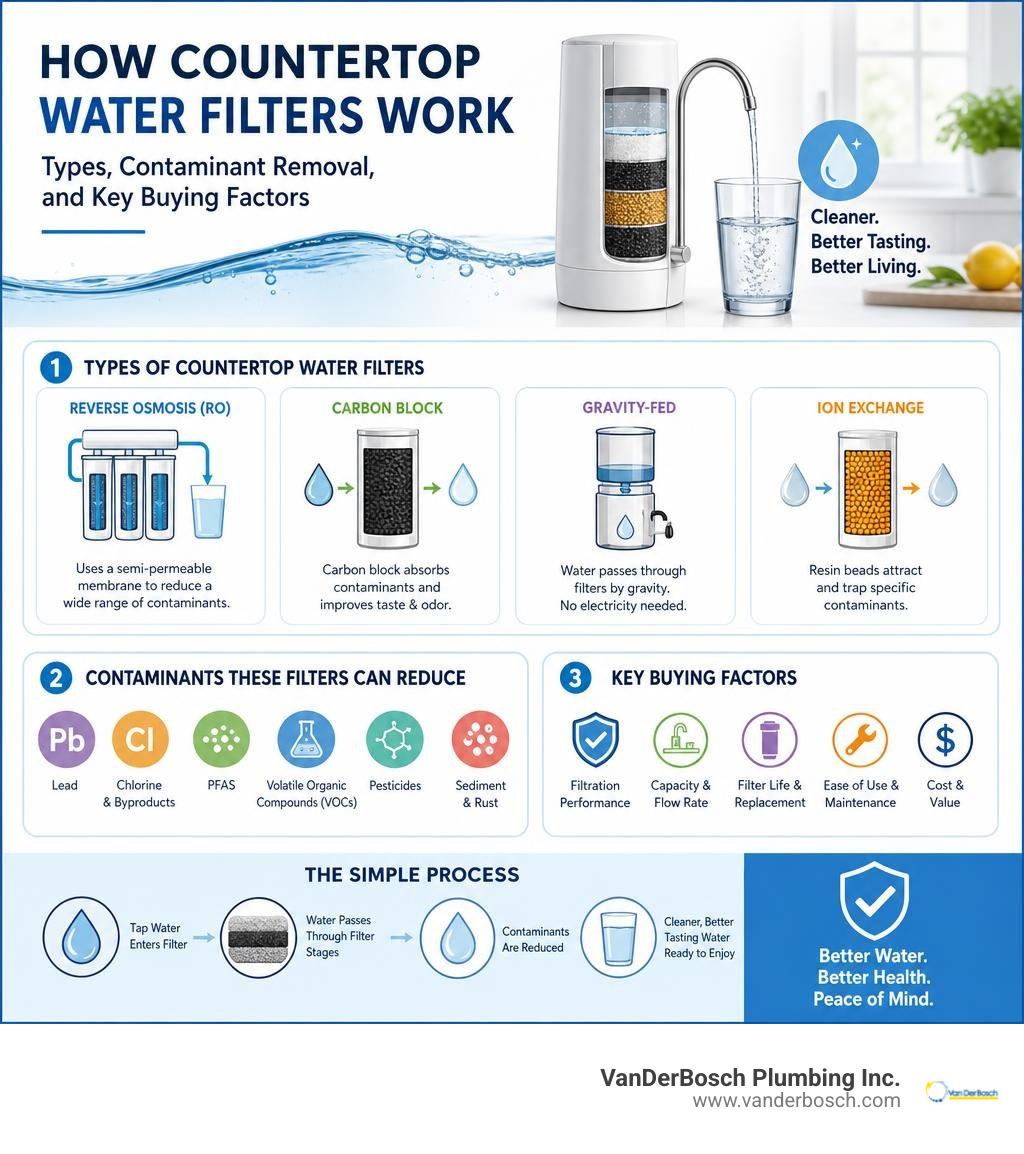
Quick look at counter top water filters:
Main Types of Counter top Water Filters and How They Work

When shopping for counter top water filters, you will quickly notice that while they all sit on your counter, the technology under the hood varies wildly. Selecting the right one depends heavily on what you want to remove and how much patience you have. In our experience servicing homes from Roselle to Winnetka, we’ve found that understanding these core technologies is the best first step.
To learn more about the science behind these processes, check out our comprehensive guide, The Complete Guide to Water Filtration Systems. For a deep dive into performance rankings, you can also explore The Best Countertop Water Filters of 2026 We’ve Tested .
Let’s break down the four primary filtration technologies used in countertop systems:
1. Reverse Osmosis (RO)
Reverse Osmosis is the heavyweight champion of water purification. These systems use an electric pump to force water through a semipermeable membrane with incredibly tiny pores (typically around 0.0001 microns).
- How it works: Water passes through multiple pre-filters, the RO membrane, and a post-carbon filter. It strips out almost everything: dissolved solids, heavy metals, fluoride, and forever chemicals (PFAS).
- The Catch: RO systems produce “wastewater” (though modern countertop units are incredibly efficient compared to under-sink models) and require electricity.
2. Gravity-Fed Systems
If you want something simple, reliable, and completely independent of your electrical grid, gravity-fed filters are the classic choice.
- How it works: You pour water into an upper chamber, and gravity pulls it down through thick filter elements (usually ceramic or carbon-based) into a lower storage chamber.
- The Catch: They are slow. It can take anywhere from 20 minutes to a couple of hours to filter a single gallon. However, this slow “contact time” is exactly why they are so effective at grabbing stubborn contaminants.
3. Carbon Block Filters
Carbon block filters are the most common and user-friendly systems. They typically connect directly to your kitchen faucet via a small diverter valve.
- How it works: When you turn on your tap and flip the diverter switch, water pressure forces tap water through a densely compacted block of activated carbon (often made from coconut shells). The carbon acts like a magnet, trapping chlorine, volatile organic compounds (VOCs), and heavy metals.
- The Catch: They do not remove dissolved solids (TDS) or fluoride unless paired with specialized secondary cartridges.
4. Ultrafiltration (UF)
Ultrafiltration uses hollow fiber membranes with a pore size of about 0.01 microns.
- How it works: It blocks tiny suspended particles, bacteria, and cysts while letting dissolved minerals pass through.
- The Catch: Like carbon blocks, standard UF systems do not lower TDS or remove dissolved chemical salts.
Comparison Table: Countertop Filtration Technologies
| Feature | Reverse Osmosis (RO) | Gravity-Fed | Carbon Block / UF |
|---|---|---|---|
| Electricity Needed | Yes (usually) | No | No |
| Installation | None (Plug & Play) | None (Assemble & Fill) | Simple faucet attachment |
| Filtration Speed | Fast (on demand/pumped) | Slow (20–30 mins/gallon) | Instant (uses tap pressure) |
| TDS Reduction | Excellent (90%+) | Low to Moderate | None to Low |
| Water Waste | Yes (reject water tank) | None | None |
Countertop vs. Under-Sink and Whole-House Systems
As plumbers who install water systems across Cook County, we often get asked: “Should I just buy a countertop filter, or do I need something permanent?”
The answer depends on your living situation, budget, and how you use water. To understand why clean water matters for more than just drinking, read about Why Water Filtration Systems Are Important.
Countertop Filters: The Portable Powerhouses
Countertop systems are perfect for renters in places like Hyde Park or Ukrainian Village, or anyone who wants high-quality filtration without drilling holes in their countertops or renting specialized tools.
- Pros: Zero permanent installation, highly portable, easy to maintain, and generally more affordable upfront.
- Cons: They take up valuable real estate next to your sink. They also have lower flow rates and smaller storage capacities.
Under-Sink Systems: Out of Sight, Out of Mind
Under-sink systems connect directly to your cold water line and dispense water through a dedicated faucet.
- Pros: High flow rates, infinite water on demand, and zero countertop clutter.
- Cons: They require professional installation (or some serious DIY confidence), cabinet space, and are difficult to move if you relocate.
Whole-House Systems: Total Home Protection
If you want to protect your pipes, water heater, and skin, a whole-house system is the ultimate solution. These are installed where your water main enters your home, treating every drop of water before it reaches a single tap. To see how these systems work on a larger scale, read about The Best Whole House Water Filtration and Softener System.
- Pros: Chlorine-free showers, softer skin, and protection for appliances like your water heater.
- Cons: Highest upfront cost and requires professional plumbing installation.
Key Factors: Contaminants, Certifications, and Lifespan
Before pulling the trigger on a new filter, you need to know what you are trying to clean. Municipal water in areas like Niles, Elmhurst, or Mount Prospect can carry different chemical profiles than private well water in outlying rural areas.
If you are dealing with private well water that smells like rotten eggs, you will want to read our specialized guide on How to Choose the Best Sulfur Filter for Well Water Without the Stink. For heavy metals, a targeted system like the Lead Countertop Water Filter | Water Filter System | Crystal Quest – Crystal Quest Water Filters is highly effective.
Contaminants to Watch Out For
- Lead: Often leached from aging service lines or brass household fixtures.
- PFAS (“Forever Chemicals”): Per- and polyfluoroalkyl substances that do not break down in the environment or your body.
- Fluoride: Added to municipal water supplies for dental health, but many homeowners prefer to remove it.
- Nitrates: Common in agricultural runoff and shallow wells, highly toxic to infants.
- Microplastics: Tiny plastic particles now widely found in municipal tap water.
Why NSF/ANSI Certifications Matter
Don’t just trust a manufacturer’s marketing claims. Look for independent testing and certifications from bodies like NSF, IAPMO, or WQA:
- NSF/ANSI 42: Covers aesthetic effects (chlorine, taste, and odor).
- NSF/ANSI 53: Covers health effects (lead, heavy metals, PFAS, VOCs).
- NSF/ANSI 58: The standard specifically for Reverse Osmosis systems.
- NSF/ANSI 401: Covers “emerging compounds” like pharmaceuticals and microplastics.
Lifespan and Cost per Gallon
A cheap filter that needs replacing every 30 days can quickly become more expensive than a premium system with long-lasting cartridges. Always calculate the annual cost of ownership (initial price + replacement filters for one year) rather than just looking at the sticker price.
Top-Rated Countertop Water Filter Models Compared

Let’s explore the top performing countertop systems on the market as of June 2026.
High-Performance Reverse Osmosis counter top water filters
If you want the purest water possible, these RO systems are the gold standard.
AquaTru Classic & Carafe
The AquaTru lineup consistently sweeps performance tests. The AquaTru Carafe earned an outstanding overall score of 9.57/10 in independent testing, reducing 100% of every health-related contaminant detected in baseline samples.
- Performance: Certified to remove 84 harmful contaminants, including lead, PFAS, fluoride, and nitrates.
- Efficiency: Features a 4:1 water recovery rate. This means for every 4 gallons of purified water, only 1 gallon of concentrated waste water is left behind—significantly better than traditional under-sink RO systems that can waste up to 4 gallons for every single gallon purified.
- Lifespan: The filters last between 600 to 1,200 gallons, meaning you won’t be swapping them out every few weeks.
Waterdrop C1S Countertop CoreRO System
The Waterdrop C1S is a highly convenient, plug-and-play 6-stage RO system. You can learn more about its technical specifications directly on the Waterdrop Countertop Water Filter, CoreRO Filter System C1S product page.
- Design: Compact, sleek, and requires zero drilling. It features a smart touch panel with 5 adjustable dispensing volumes.
- Unique Feature: It has a detachable pure water tank that you can slide right into your fridge for chilled water.
- Efficiency: Boasts a 3:1 pure-to-drain ratio and a 12-month (1,100-gallon) filter life.
Premium Carbon Block and Gravity-Fed counter top water filters
For those who want zero water waste, simple maintenance, or plastic-free construction.
WaterChef C6500 Premium Countertop System
The WaterChef C6500 is an exceptional carbon block system that connects directly to your faucet. For pricing and auto-ship options, view the WaterChef C6500 Premium Countertop Water Filtration System .
- Performance: Uses “Big Block” filtration technology to reduce 78 contaminants (including lead, PFAS, and chlorine) while retaining beneficial minerals like calcium and magnesium.
- Capacity: Huge 600-gallon capacity (about once-a-year replacement for average households), resulting in a cost of just 10 cents per gallon.
- Certifications: Independently tested and certified to NSF/ANSI Standards 42, 53, and 401.
Rorra Countertop System
The Rorra Countertop System is a beautiful, medical-grade stainless steel gravity system. You can check it out on the Rorra Countertop System page.
- Performance: Recommended by neuroscientist Dr. Andrew Huberman, it uses dual-layer electrokinetic nanofiber filtration to achieve a 99.6% reduction in PFAS and lead, and a 97.3% reduction in microplastics.
- Design: 17 inches tall to fit under standard kitchen cabinets. It holds 2.5 gallons total and uses a battery-powered performance indicator to tell you exactly when to change the filter.
British Berkefeld & Epic Pure
- British Berkefeld: A historic stainless steel gravity system. In testing, its Ultra Fluoride filters completely eliminated chlorine, fluoride, barium, uranium, and chloroform.
- Epic Pure Dispenser: The best budget countertop filter under $100. It reduced more contaminants than any similarly priced system in independent lab tests, offering a 150-gallon capacity.
Frequently Asked Questions about Countertop Filtration
Do countertop water filters require electricity?
It depends entirely on the technology.
- No Electricity Needed: Gravity-fed systems (like Rorra or British Berkefeld) and faucet-connected carbon block systems (like the WaterChef C6500) rely entirely on physical gravity or water pressure from your tap.
- Electricity Required: Countertop Reverse Osmosis systems (like AquaTru or Waterdrop C1S) require a standard 120V outlet to power the internal pumps that force water through the RO membrane.
How often do I need to replace countertop filter cartridges?
Filter lifespan varies by model and your local water quality:
- Standard pitcher/dispenser filters usually last 2 to 3 months (approx. 40–150 gallons).
- Premium carbon blocks like the WaterChef C6500 last up to 12 months (600 gallons).
- RO systems have multi-stage filters; pre-filters are typically replaced every 6 to 12 months, while the RO membrane itself can last up to 2 years.
Do these systems soften hard water?
Generally, no. Most countertop filters are designed to remove chemical contaminants, heavy metals, and bad tastes.
- Reverse Osmosis will remove the calcium and magnesium that cause hard water, effectively softening it (though this can sometimes make the water taste slightly flat).
- Ion Exchange systems (like ZeroWater) will also remove these minerals.
- Standard Carbon Block and Gravity filters do not soften water, as they deliberately leave healthy minerals intact. If you have severe hard water issues damaging your plumbing fixtures in Oakbrook Terrace or Winnetka, a dedicated water softener is the correct solution.
Conclusion
Investing in a high-quality countertop water filter is one of the easiest, most effective ways to upgrade your daily hydration, protect your family’s health, and say goodbye to plastic bottled water for good. Whether you choose the absolute purity of a Reverse Osmosis system like the AquaTru, the elegant simplicity of the Rorra stainless steel gravity filter, or the long-lasting value of the WaterChef C6500, there is a perfect countertop match for your kitchen.
While countertop systems are fantastic for drinking water, they only treat a single faucet. If you want to experience clean, chlorine-free water throughout your entire home—from your kitchen sink to your morning shower—we can help.
At VanDerBosch Plumbing Inc., we’ve spent decades providing expert water filtration and plumbing services across Chicagoland, including Chicago, Cook County, Roselle, Niles, Winnetka, Melrose Park, Oakbrook Terrace, Elmhurst, and Mount Prospect. We offer a 100% satisfaction guarantee, 24/7 availability, transparent pricing, and fully licensed, background-checked plumbers.
Ready to transform your home’s water quality? Explore our professional water treatment options on our Water Filtration System service page or give us a call today!