
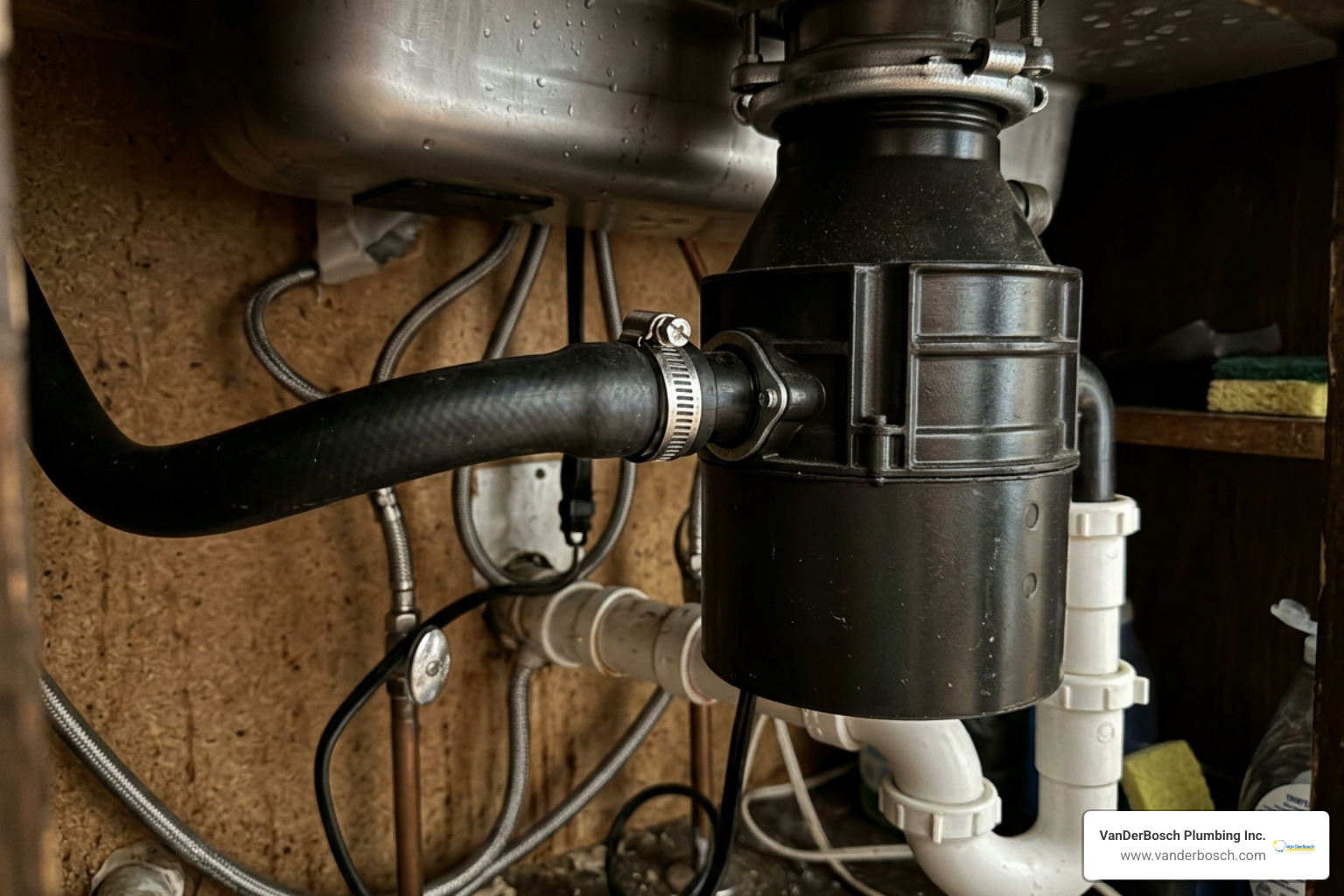
What You Need to Know About a Dishwasher to Garbage Disposal Hookup
A dishwasher to garbage disposal hookup is one of the most common under-sink plumbing tasks homeowners tackle — and one of the most frequently botched.
Here’s the quick answer:
How to connect a dishwasher drain to a garbage disposal:
- Turn off power to the disposal at the circuit breaker.
- Remove the knockout plug inside the disposal’s dishwasher inlet port using a screwdriver and hammer.
- Retrieve the loose plug from inside the grinding chamber.
- Slide the dishwasher drain hose onto the inlet port.
- Secure it with a hose clamp.
- Route the hose in a high loop (or through an air gap) to prevent backflow.
- Restore power and run a test cycle to check for leaks.
That’s the short version. The details — especially steps 2, 3, and 6 — are where most DIY installs go wrong.
If you’ve just installed a new disposal and your dishwasher suddenly won’t drain, you’re likely not alone. Forgetting to knock out the factory-installed plastic plug inside the disposal’s dishwasher inlet is the single most common reason a newly connected dishwasher fails to drain — and it’s often misdiagnosed as a dishwasher pump failure.
This guide walks you through every step of the connection, explains when you need an air gap versus a high loop, and covers what to do when things don’t go as planned.
I’m Hugh Hodur, President of VanDerBosch Plumbing Inc., and I’ve overseen hundreds of residential plumbing installations across Chicagoland — including countless dishwasher to garbage disposal hookup jobs where a missed knockout plug or improper drain routing turned a simple project into an emergency call. If at any point this feels beyond your comfort level, our team is available 24/7 to handle it quickly and correctly.
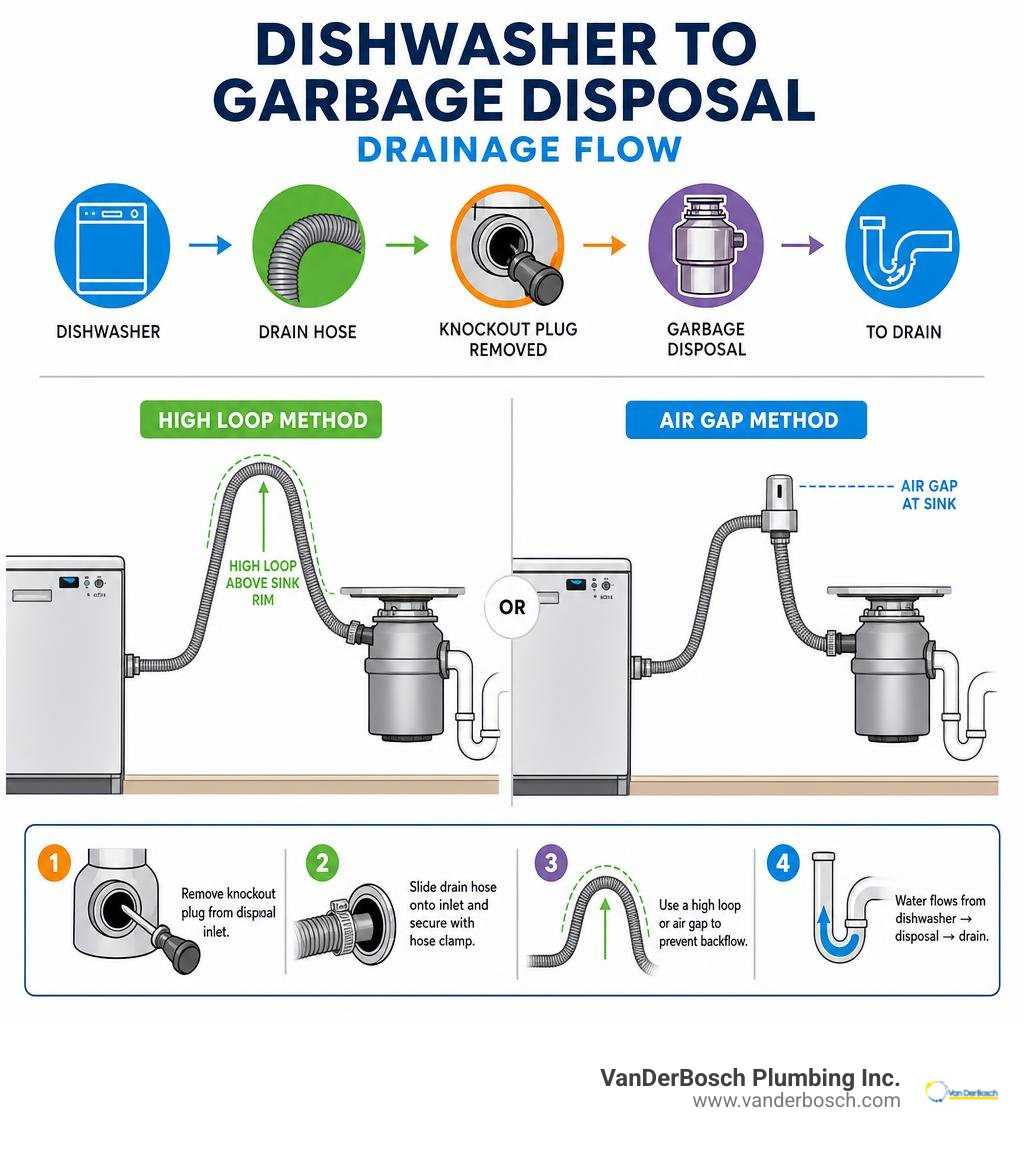
Dishwasher to garbage disposal connection:
Is a Dishwasher to Garbage Disposal Hookup Safe and Recommended?
Yes, connecting your dishwasher drain line directly to your garbage disposal is both safe and highly recommended by appliance manufacturers and plumbing professional standards alike. In fact, most modern garbage disposals are manufactured with a dedicated inlet port specifically designed to receive the dishwasher’s wastewater.
However, while a direct connection is technically feasible and highly efficient, it is not without risks if completed incorrectly. The primary concern with a direct connection is the risk of backflow. If the drain line is not properly routed, wastewater from your kitchen sink and the garbage disposal can siphon backward, carrying food particles, grease, and contaminated water straight into your clean dishwasher. This is not only unsanitary but can also cause foul odor transfer, leaving your freshly washed dishes smelling like yesterday’s garbage disposal waste.
To make this connection safe and compliant with local plumbing codes, you must incorporate a backflow prevention method. This is achieved by either routing the drain hose through a countertop air gap device or creating a physical high loop under the cabinet. When configured with these safeguards, a direct disposal connection becomes the most effective solution for kitchen plumbing management under the sink.
For a deeper dive into the mechanical details of this setup, you can read more about the technical feasibility in this guide on Can I Connect My Dishwasher Directly to the Garbage Disposal?.
Tools, Materials, and Step-by-Step Connection Guide
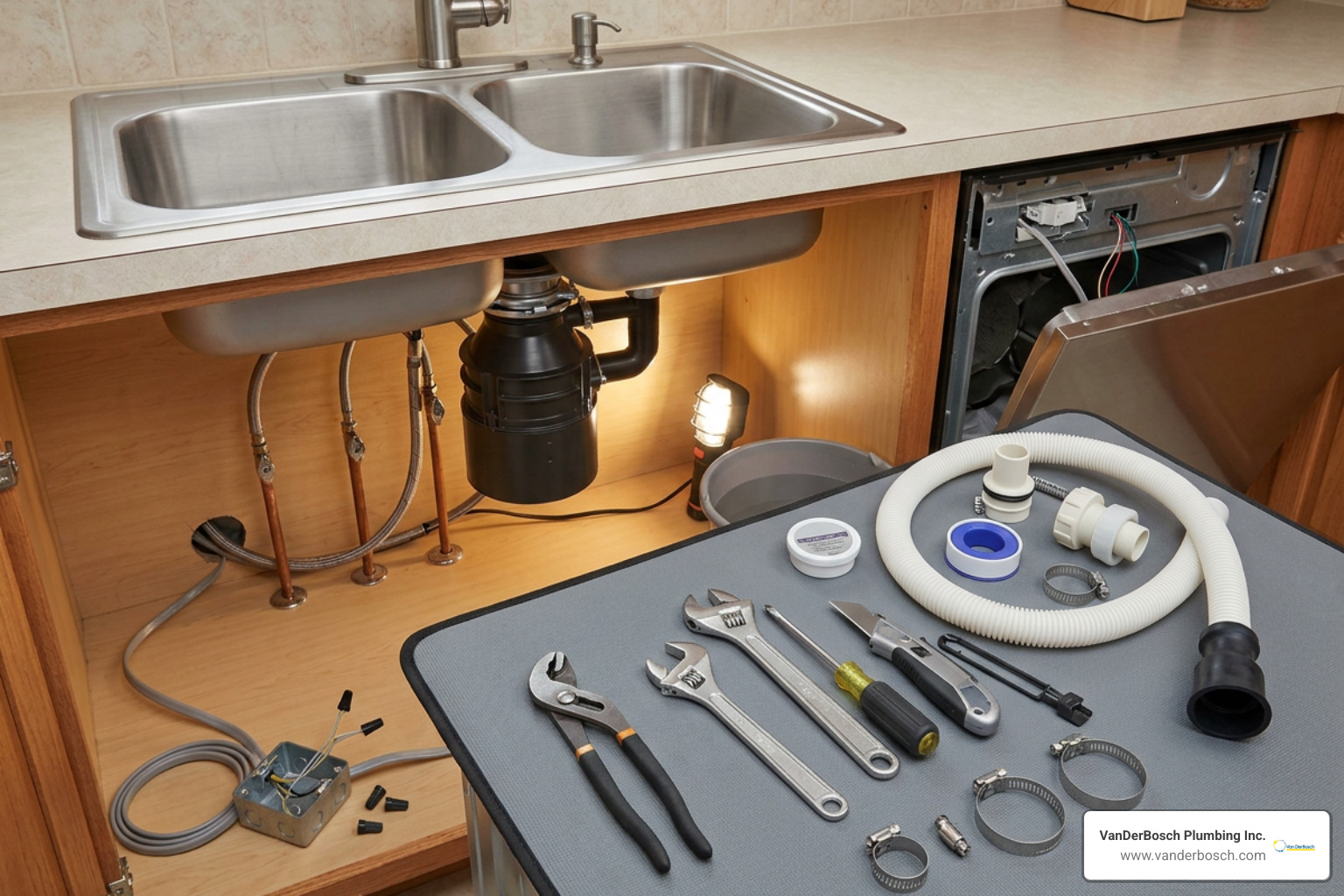
Before you begin crawling under your kitchen sink, it is essential to gather the correct tools and materials. Having everything on hand prevents mid-project trips to the local hardware store in Niles or Elmhurst.
Required Tools and Materials
- Flathead and Phillips screwdrivers
- Hammer
- Needle-nose pliers
- Stainless steel hose clamps (worm gear clamps)
- Utility knife (to trim excess hose if necessary)
- Dishwasher drain connector adapter kit (if hose diameters do not match)
- Bucket and dry towels (to catch residual water)
- Non-contact voltage tester
Comparing Dishwasher Drainage Setups
To help visualize how your under-sink configuration changes with this hookup, review the structural differences below:
| Feature | With a Garbage Disposal | Without a Garbage Disposal |
|---|---|---|
| Primary Connection Point | Disposal dishwasher inlet port | Dedicated Y-branch tailpiece on sink drain |
| Plumbing Trap Setup | P-trap connected downstream of the disposal | P-trap connected directly to sink tailpiece |
| Solid Waste Handling | Disposal grinds down small food particles | Sink strainer basket must catch all solids |
| Key Mechanical Step | Must remove internal knockout plug | Must secure to a direct branch tailpiece |
| Risk of Clogs | Lower (waste is ground up) | Higher (food scraps can settle in P-trap) |
Preparing the Dishwasher to Garbage Disposal Hookup: Removing the Knockout Plug
The absolute most critical step of a new dishwasher to garbage disposal hookup is removing the factory-installed knockout plug. Because garbage disposals are sold to households that may or may not have a dishwasher, manufacturers seal this inlet port with a solid plastic disk to prevent sink water from leaking out of the side of the unit.
If you skip this step, your dishwasher will not be able to pump water out. The appliance will complete its washing cycle, but the dirty water will remain pooled in the bottom of the tub, eventually triggering an error code or flooding your kitchen floor.
To remove the plug safely:
- Turn Off the Power: Ensure the garbage disposal is completely unplugged or the circuit breaker is turned off. Verify there is no electrical current using a non-contact voltage tester.
- Position the Tool: Place the tip of a sturdy flathead screwdriver or a steel punch directly against the plastic knockout plug inside the disposal’s dishwasher inlet port.
- Strike Firmly: Tap the end of the screwdriver handle firmly with a hammer. It may take a couple of sharp blows, but the plastic disk will break free and pop into the disposal’s grinding chamber.
- Retrieve the Plug: This is where many DIYers make a critical error. You must reach inside the disposal grinding chamber (or use needle-nose pliers) to retrieve the dislodged plastic disk. If left inside, the hard plastic plug can jam the grinding blades, damage the motor, or cause an immediate blockage.
For a detailed walkthrough of this specific step, consult the step-by-step instructions on How to connect dishwasher to garbage disposal.
Securing the Dishwasher to Garbage Disposal Hookup: Clamps and Routing
Once the knockout plug is removed and discarded, you are ready to make the physical connection.
- Check Hose Compatibility: Inspect the end of your dishwasher drain hose. Standard dishwasher hoses typically have a 5/8-inch or 7/8-inch inner diameter. The inlet port on most garbage disposals is designed for a 7/8-inch hose. If your hose is too small, you will need a universal rubber dishwasher drain connector adapter kit to bridge the gap.
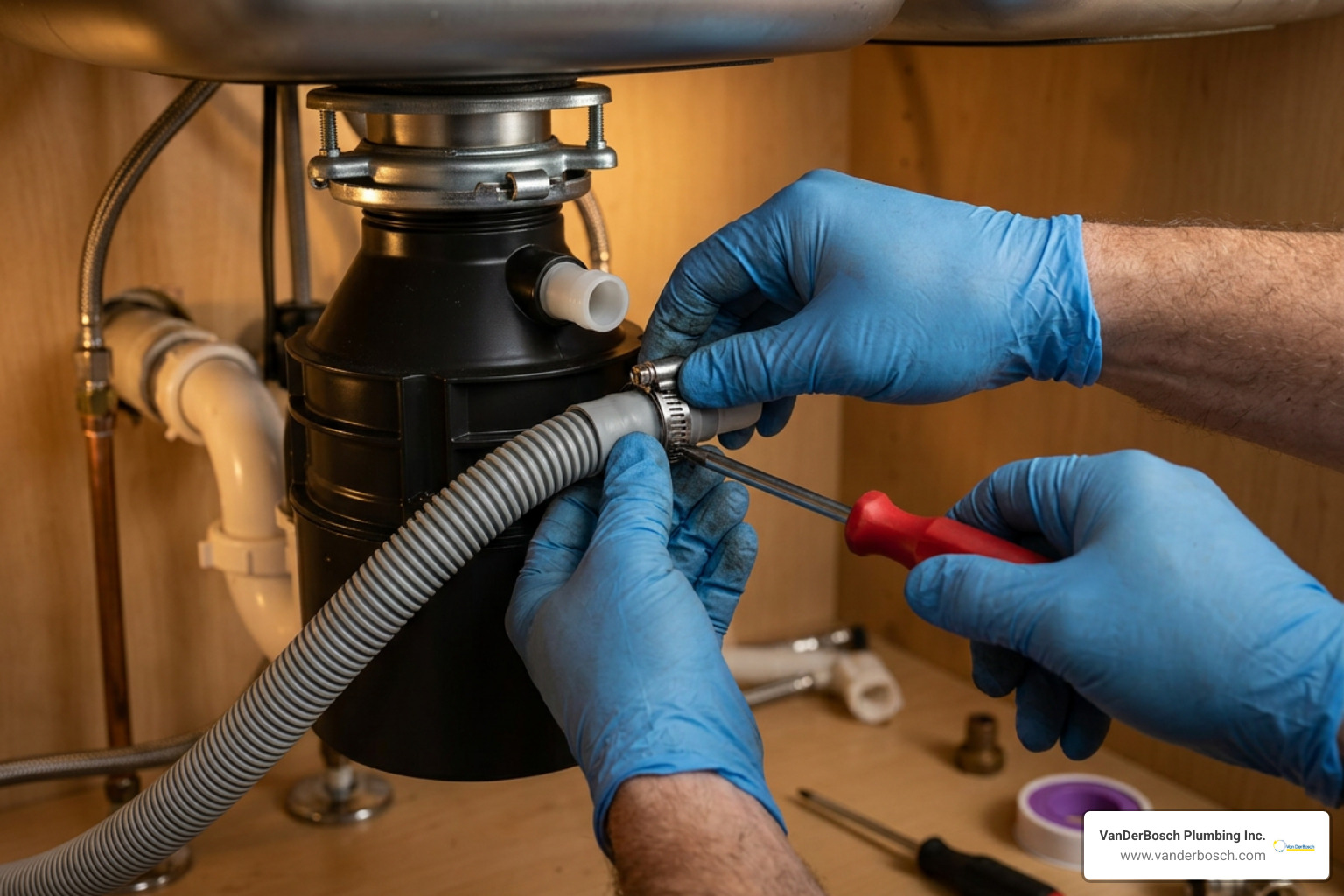
- Slide on the Clamp: Slide a stainless steel worm gear hose clamp over the end of the drain hose before pushing it onto the disposal port.
- Attach the Hose: Push the rubber end of the drain hose firmly onto the disposal’s inlet port. It should fit snugly and slide on at least an inch to ensure a reliable seal.
- Tighten the Clamp: Position the hose clamp directly over the center of the inlet port connection. Use a flathead screwdriver or nut driver to tighten the clamp until snug. Do not overtighten, as this can slice through the rubber hose or crack the plastic inlet port.
- Route the Line: Ensure the hose is routed without any sharp bends or kinks that could restrict water flow.
If you are replacing both appliances, you can find a comprehensive mechanical overview in this guide on How To Install A Garbage Disposal and Dishwasher.
Backflow Prevention: Air Gaps vs. High-Loop Methods
When designing your waste line routing, you must include a reliable backflow prevention mechanism. Without it, dirty sink water and food scraps from the disposal will siphon back into your clean dishwasher. There are two primary methods for preventing this: the Countertop Air Gap and the High-Loop Method.
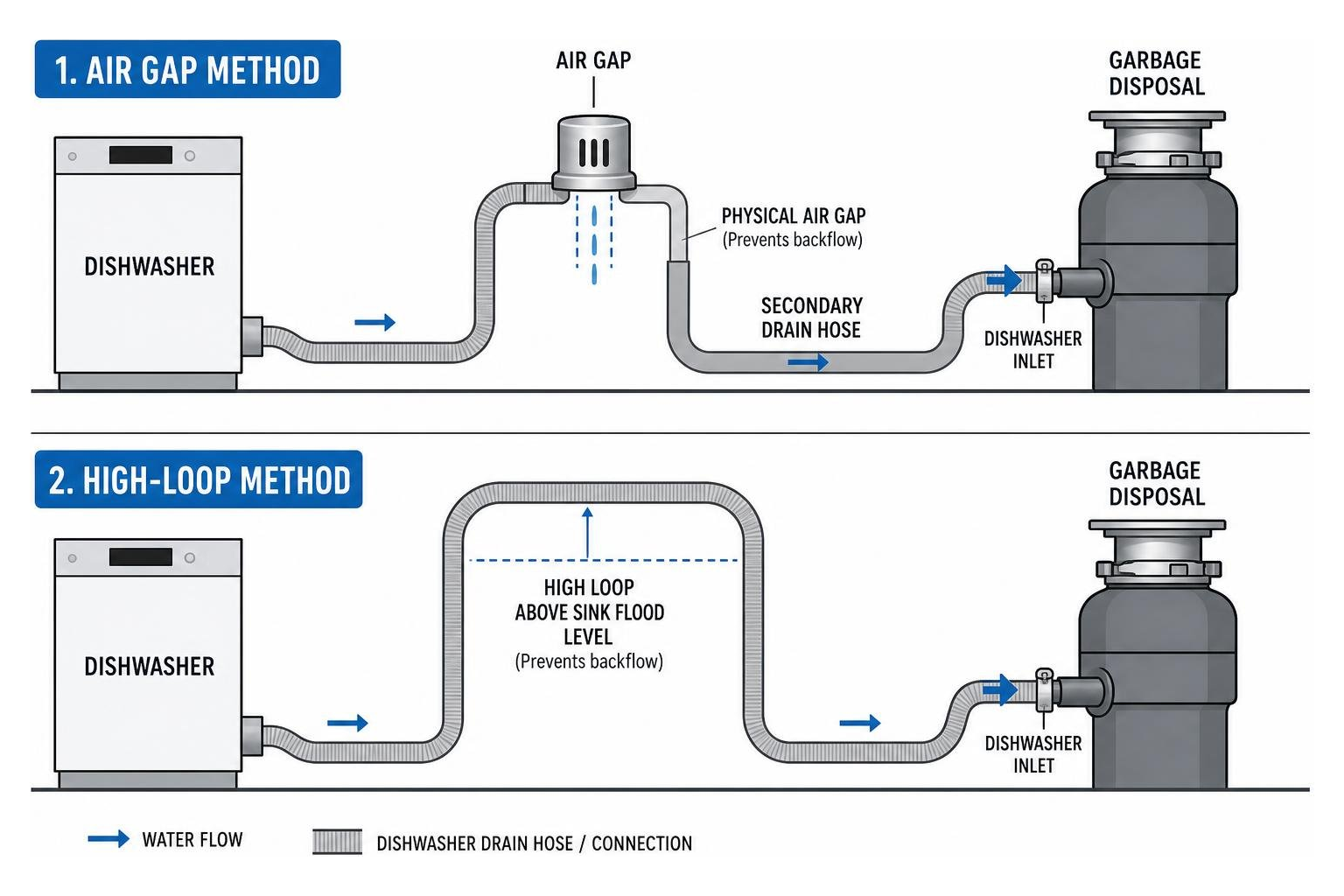
The Countertop Air Gap Method
An air gap is a physical cylindrical fixture mounted on your kitchen sink deck or countertop. The dishwasher drain hose runs from the appliance up to the air gap, where it discharges water across an actual physical gap of air into a secondary hose that runs down to the garbage disposal.
Because there is a literal break in the plumbing line, it is physically impossible for wastewater to siphon backward from the disposal into the dishwasher. If the drain line clogs downstream, the water will simply spill out of the air gap onto your sink deck rather than backing up into your appliance.
The High-Loop Method
The high-loop method is a simpler, under-sink alternative. It involves routing the dishwasher drain hose up to the absolute highest point possible under your cabinet — ideally secured to the underside of the countertop (at least 18 to 20 inches above the floor) — before sloping downward to connect to the disposal.
This loop relies on gravity to prevent backflow. Since the top of the loop is higher than the maximum water level inside the sink basin, wastewater cannot easily climb up and over the loop to flow back into the dishwasher.
Code Compliance and Regional Rules
While the International Residential Code (IRC 2024) and Uniform Plumbing Code (UPC) allow the high-loop method in many jurisdictions, local municipal plumbing codes vary significantly. Some states and strict local municipalities mandate a physical countertop air gap by law.
In Illinois and Cook County, local amendments often dictate specific configurations. For example, in Chicago, Niles, Winnetka, and Ukrainian Village, plumbing inspectors frequently check for proper backflow prevention during home sales or renovations. If you are planning a remodel, it is crucial to understand kitchen sink plumbing: navigating the pipes below to ensure your setup complies with local standards.
To learn more about the national standards governing these installations, review the IRC 2024 Garbage Disposal Installation specifications.
Frequently Asked Questions and Troubleshooting
Once the physical connection is complete, you must test the system under pressure to ensure there are no hidden leaks.
According to the Environmental Protection Agency (EPA), over 10,000 gallons of water are wasted annually in the average U.S. household due to minor leaks, and many of these silent water-wasters originate under the kitchen sink.
How to Properly Test for Leaks
- Clear the cabinet floor and place a dry bucket under the disposal and P-trap.
- Fill both sink basins with 2 to 3 inches of water, then release them simultaneously while running the garbage disposal. This puts maximum pressure on your drain slip-joints and P-trap.
- Take a dry paper towel and wipe down every connection point — including the dishwasher inlet port, hose clamp, and P-trap joints. If the paper towel shows even a tiny spot of moisture, tighten the clamps or slip nuts another quarter-turn.
- Finally, run a short rinse cycle on your dishwasher. Watch the drain hose during the pump-out phase to verify that water flows smoothly into the disposal without spraying or dripping.
If you run into general disposal issues during this process, check out our guide on how to handle a clogged garbage disposal fix in Chicago without the mess.
Why is my dishwasher not draining after connecting it to the disposal?
If your dishwasher is pooling water at the bottom of the tub immediately after installing a new garbage disposal, the culprit is almost always the unremoved knockout plug.
Troubleshooting Steps:
- Disconnect the power to the garbage disposal.
- Loosen the hose clamp and pull the dishwasher drain hose off the disposal inlet.
- Peer inside the inlet port with a flashlight. If you see a solid plastic wall blocking the tube, the plug was not removed.
- Use a screwdriver and hammer to punch the plug out, and thoroughly retrieve the plastic disk from inside the grinding chamber before reconnecting the hose.
If the plug has already been removed and you still experience drainage failure, check the drain hose for physical kinks, inspect the dishwasher’s internal filter for food debris, or consult our comprehensive guide on how to fix a clogged sink.
What is the difference between draining with and without a garbage disposal?
When you connect a dishwasher drain without a garbage disposal, the drain hose must connect directly to a specialized plumbing fitting called a Y-branch tailpiece installed on your sink’s drain pipe above the P-trap.
Key Differences:
- Solid Waste Management: Without a disposal, small bits of food washed out of the dishwasher can easily collect in the sink’s P-trap, leading to frequent blockages. A garbage disposal grinds these solids down so they can pass smoothly through the waste branch.
- Drain Pipe Sizing: Under modern plumbing codes, a horizontal waste branch receiving discharge from both a dishwasher and a disposal is rated at a higher Drainage Fixture Unit (DFU) load, often requiring a 2-inch drain pipe to prevent grease and organic buildup.
If you are experiencing frequent blockages in a non-disposal setup, read our breakdown of the 5 reasons your drain is clogged and how to fix it.
Why does my dishwasher smell like sewage after installation?
If your dishwasher smells like sewer gas or rotting food, it is usually because sewer gases are escaping from your drainage pipes back into the appliance, or organic waste is rotting inside the drain line.
Common Causes:
- Missing or Dry P-Trap: The P-trap under your sink holds a small pool of standing water that acts as a physical barrier, blocking sewer gases from entering your home. If the dishwasher hose bypasses the trap or connects downstream of it, sewer gas will flow freely into your dishwasher.
- Improper Hose Loop: If the drain hose does not have a high loop or air gap, wastewater from the garbage disposal will flow downward into the dishwasher, leaving stagnant, dirty water sitting in the bottom of your appliance.
- Organic Buildup: Food waste can accumulate inside the disposal inlet port. We recommend a monthly maintenance routine: pour half a cup of baking soda down the disposal, follow it with a cup of vinegar, let it sit for ten minutes, and flush with hot water.
For persistent odor issues or deep-seated clogs, a professional drain cleaning may be required. Explore our professional drain cleaning options to restore your kitchen’s hygiene.
Conclusion
A dishwasher to garbage disposal hookup is a highly rewarding kitchen upgrade that keeps your wastewater flowing smoothly and your dishes sparkling clean. While it is a project many homeowners can tackle over a weekend, it requires precise execution — from punching out the knockout plug to routing the drain hose for proper backflow prevention.
If you run into stubborn clogs, complex pipe configurations, or simply want the peace of mind that comes with professional, code-compliant installation, we are here to help. At VanDerBosch Plumbing Inc., we have spent decades serving homeowners across Chicagoland, including Chicago, Niles, Winnetka, Oakbrook Terrace, Hyde Park, Ukrainian Village, and Elmhurst.
We stand by our work with a 100% satisfaction guarantee, 24/7 availability for emergencies, and transparent pricing with no service charges. Our experienced, background-checked technicians will ensure your kitchen plumbing is solid, secure, and completely leak-free.
Ready to upgrade your kitchen waste system? Schedule a professional garbage disposal kitchen installation today, or explore our complete range of expert plumbing solutions on our services page.