
What You Need to Know About Plumbing Installations
Plumbing installations cover the full setup of water supply, drainage, and fixture systems in a home or business. Here’s a quick overview of what’s involved:
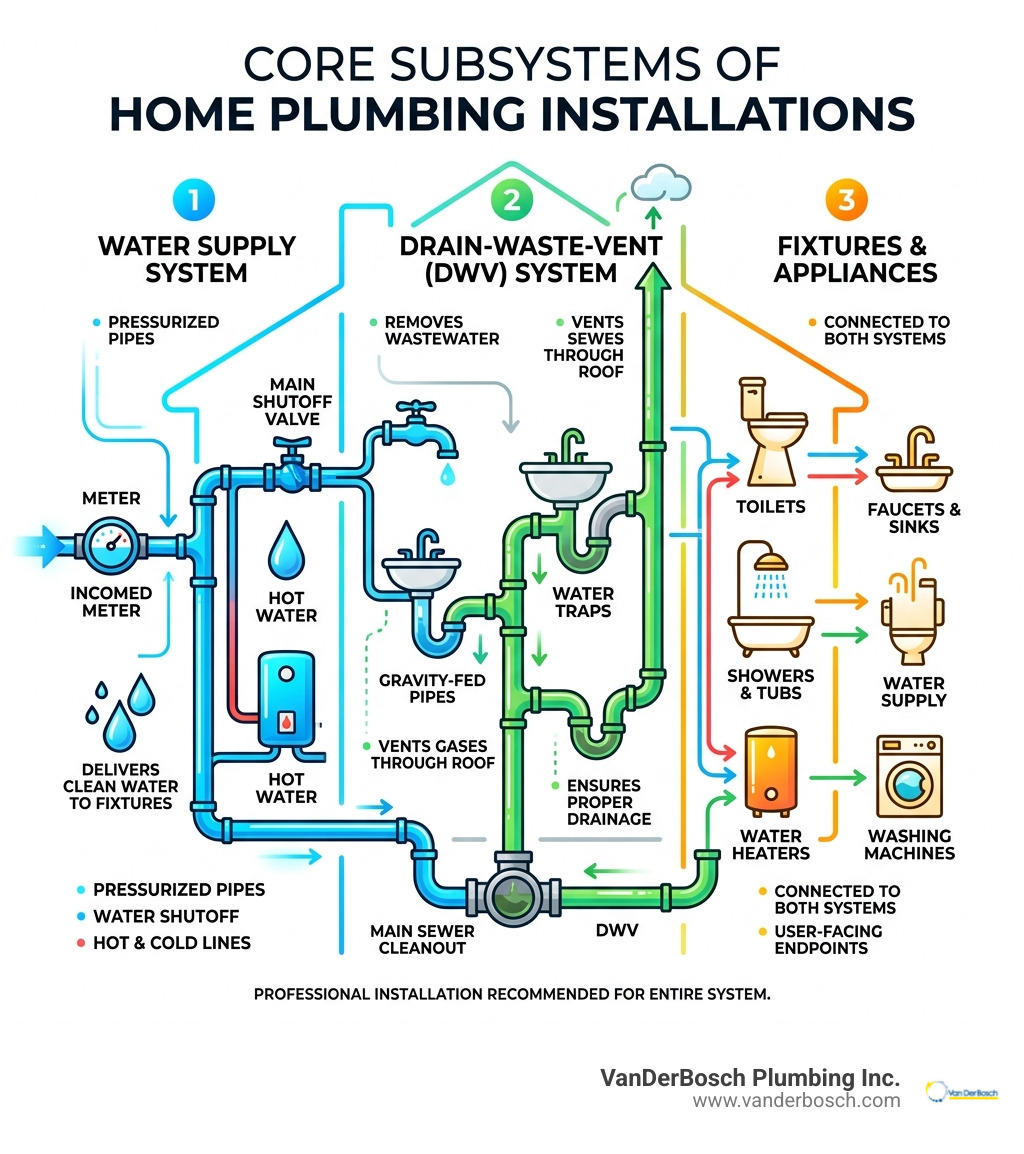
- Water supply system – Pressurized pipes that deliver hot and cold water to fixtures
- Drain-waste-vent (DWV) system – Gravity-fed pipes that remove wastewater and vent sewer gases
- Fixture installation – Toilets, faucets, water heaters, sump pumps, and appliances connected to both systems
Costs typically range from $4 to $15+ per square foot for new construction, depending on home size, materials, and complexity.
Permits are required for most plumbing work in the Chicagoland area. Licensed master plumbers must pull them — homeowners generally cannot self-permit.
Most installations should be handled by a licensed professional. Simple fixture swaps like a faucet replacement can be DIY-friendly, but full system installs carry real risks: leaks, code violations, mold, and costly repairs down the road.
Three out of four U.S. homeowners faced a home repair emergency last year, and plumbing problems ranked among the most common. Whether you’re building new, renovating, or dealing with an aging system, understanding how plumbing installations work puts you in a much stronger position — as a homeowner and as a customer.
I’m Hugh Hodur, President of VanDerBosch Plumbing Inc., where I oversee residential and commercial plumbing installations across the Chicagoland area, including water heater installs, whole-home repiping, sewer solutions, and emergency service. In this guide, I’ll walk you through everything you need to know — from pipe materials and permits to cost ranges and common mistakes.
Understanding the Core Components of Plumbing Installations
To understand plumbing installations, you have to look past the shiny chrome faucets and see the “circulatory system” of your home. In April 2026, modern plumbing is more efficient than ever, but the physics remains the same: water comes in under pressure and leaves via gravity.
A complete installation consists of three primary subsystems:
- Potable Water Supply: This is the pressurized network. In the Chicago area, this water usually comes from municipal sources (like Lake Michigan) and is distributed through your home via copper or PEX piping.
- Drain-Waste-Vent (DWV): This system is the unsung hero. It uses gravity to carry wastewater to the city sewer. The “vent” part is crucial—it allows sewer gases to escape through the roof and maintains air pressure so your drains don’t “glug” or air-lock.
- Natural Gas Lines: About half of U.S. households use natural gas for heating or cooking. Installing these lines requires extreme precision and strict adherence to fire codes.

Choosing the Right Materials
The materials we choose during plumbing installations dictate the system’s longevity. Here is how the most common pipes compare:
| Material | Best Use | Pros | Cons |
|---|---|---|---|
| Copper | Water Supply | Durable, antimicrobial, fire-resistant | Expensive, can corrode in hard water |
| PEX | Water Supply | Flexible, freeze-resistant, fewer joints | Cannot be used outdoors (UV sensitive) |
| PVC / ABS | Drainage (DWV) | Cheap, won’t rust, easy to install | Can be noisy; ABS is better for shifting soil |
Selecting the right pipe is just the start. You also need to consider the equipment that keeps your home comfortable. For example, Choosing the Right Type of Water Heater for Installation is a major decision that affects your monthly utility bills. Additionally, many homeowners in areas like Winnetka or Niles are opting for water filtration systems to ensure the highest water quality directly from the tap.
Residential vs. Commercial Plumbing Installations
While the basics are similar, the scale of plumbing installations changes drastically between a single-family home in Roselle and a commercial space in downtown Chicago.
- Scale and Load: Commercial systems handle much higher “fixture units.” Think of an office building where twenty toilets might flush nearly simultaneously. This requires much larger pipe diameters and sophisticated pressure-regulating valves.
- Complexity: Commercial installations often involve backflow preventers to protect the city’s water supply and grease traps for restaurants.
- Materials: While residential projects use PEX frequently, many commercial codes in Cook County still require cast iron for drainage to reduce noise and increase fire resistance.
Common Fixtures in Modern Plumbing Installations
The fixtures are the parts of the system you actually interact with. In 2026, we are seeing a massive shift toward “smart” and high-efficiency fixtures.
- Faucets and Toilets: Modern low-flow toilets use less than 1.28 gallons per flush, a huge drop from the 3.5 gallons used in older Chicago bungalows.
- Water Heaters: Many of our clients are switching to a Tankless Water Heater to save space and enjoy endless hot water.
- Flood Prevention: In areas prone to heavy rain, Sump Pumps are essential. We often install backup battery systems to ensure they work even during Chicago’s infamous spring storms.
The Professional Step-by-Step Process for Plumbing Installations
Professional plumbing installations aren’t just about “slapping pipes together.” It is a choreographed dance that happens in stages alongside the rest of the home construction or remodel.
1. Design and Planning
Before a single hole is drilled, we create a blueprint. This ensures that the water lines are sized correctly for the home’s demand and that the drain lines have the proper 1/4-inch-per-foot slope.
2. The Underground Rough-In
If you’re building an addition or a new home, this happens before the concrete slab is poured. We lay the heavy-duty drainage pipes and the main water service line. These must be buried below the frost line—in Chicago, that means deep enough to avoid the “Deep Freeze” of January.
3. Aboveground Rough-In (Top-Out)
Once the “skeleton” (studs) of the house is up, we run the supply lines and the drain/vent pipes through the walls and floors. We use nailing plates on the studs to ensure that when the drywallers come in, they don’t accidentally drive a screw into a fresh PEX line.
4. Fixture Setting (Trim-Out)
After the walls are closed and the tiling is done, we install the “jewelry”—the faucets, toilets, and showerheads. This is also when we hook up the Water Heater. If you’re looking for a DIY project, Installing a New Faucet is one of the few areas where a handy homeowner can succeed with a little patience.
5. Pressure Testing and Inspection
This is the most critical step. We cap the system and fill it with air or water to check for leaks. Only after it passes our internal test do we call the city inspector. If you’re ready to start this process, you can Book a Time with our team to discuss your layout.
Essential Tools and Materials for Modern Plumbing Installations
To do the job right, we use a specialized arsenal:
- Basin Wrench: For reaching those impossible nuts behind the kitchen sink.
- PEX Crimpers: For making watertight connections in flexible tubing.
- Soldering Torches: For traditional “sweating” of copper joints.
- PTFE Tape and Pipe Dope: To ensure threaded connections never weep.
- Hydrostatic Pumps: For high-pressure testing of the supply lines.
Project Timelines and Home Preparation
How long does it take? A standard bathroom installation usually takes 1–2 days. A full 2,000 sq ft home in a place like Mount Prospect typically requires 3–5 days for the rough-in and another 2 days for the final trim.
To prepare, we ask homeowners to clear a path to the main shut-off valve and remove personal items from under sinks. If you’re planning a major project, Contact Us for a specific timeline based on your home’s layout.
Navigating Codes, Permits, and Costs in 2026
In 2026, the regulatory landscape for plumbing installations is stricter than ever, but for good reason. Codes like the International Plumbing Code (IPC) ensure that your water is safe to drink and your home is protected from sewer gas.
Understanding Installation Costs and Factors
Budgeting for plumbing can be tricky. For new construction in the Chicagoland area, you can expect to pay between $4 and $8 per square foot for standard builds. However, if you are doing a major remodel or a luxury build with high-end fixtures, that can jump to $15+ per square foot.
Factors that drive up the price include:
- Material Choice: Copper is significantly more expensive than PEX.
- Number of “Wet Walls”: Grouping bathrooms back-to-back saves money on piping.
- Foundation Type: It’s much cheaper to install plumbing in a home with a crawlspace or basement than one built on a concrete slab.
If your home is older and experiencing frequent leaks, a Whole Home Repipe might be more cost-effective than constant piecemeal repairs.
Local Regulations and Permit Requirements
In Chicago and surrounding suburbs like Niles or Oakbrook Terrace, the law is clear: plumbing installations require permits. These permits ensure that a third-party inspector verifies the work. In Cook County, a licensed master plumber must be the one to pull these permits. Attempting unpermitted work can lead to fines of up to $2,000 and can even void your homeowner’s insurance if a leak occurs.
DIY vs. Professional: Avoiding Common Mistakes
We get it—the “Do-It-Yourself” spirit is strong in Illinois. However, there is a reason that master plumbers go through years of apprenticeship. Plumbing installations involve high-pressure water and dangerous gases. One wrong turn of a wrench can lead to thousands of dollars in water damage or mold.
Frequent Installation Errors and Prevention
Even seasoned DIYers make these classic mistakes:
- Improper Venting: If you don’t vent a sink properly, the water draining will suck the water out of the “P-trap,” allowing sewer gas to enter your home. (If your bathroom smells like rotten eggs, this is why!)
- Incorrect Slope: Drains rely on gravity. Too much slope is actually just as bad as too little—the water can outrun the solids, leading to clogs.
- Cross-Connections: This is the most dangerous mistake, where “grey” or waste water accidentally mixes with your clean drinking water.
- Over-tightening: Modern plastic fittings will crack if you go too hard with a wrench.
Before you grab the pipe glue, ask yourself: Do You Need a Plumber for Sump Pump Installation? or is this something you can truly handle? If you see Signs Repiping Services May Be Needed, such as rusty water or low pressure, it’s time to call in the pros. If you’re still wondering Do You Need Repiping?, a professional inspection is the only way to be sure.
Post-Installation Maintenance and Warranties
Once your plumbing installations are complete, the work doesn’t stop. To ensure longevity:
- Annual Inspections: Have a plumber check your shut-off valves and water heater.
- Flush the Water Heater: Sediment buildup can kill a tank in just a few years.
- Check the Sump Pump: Test it every spring before the rains start.
- Service the Boiler: If you have radiant heat, your Boiler needs an annual tune-up to stay efficient.
Professional companies like VanDerBosch Plumbing Inc. offer labor warranties. We stand by our work with a 100% satisfaction guarantee, so if a joint we soldered leaks six months later, we fix it at no cost to you.
Frequently Asked Questions about Plumbing Installations
How long does a standard plumbing installation take?
For a single fixture like a toilet or sink, it usually takes 2–4 hours. A full bathroom remodel takes about 2 days. A complete new home rough-in and trim-out generally takes about a week of total labor spread across the construction phases.
Should I attempt a DIY plumbing installation?
Simple tasks like replacing a showerhead or a kitchen faucet are great DIY projects. However, anything involving the main stack, gas lines, or underground piping should be left to licensed professionals to ensure code compliance and safety.
What are the best pipes for modern homes in 2026?
Currently, PEX (Cross-linked Polyethylene) is the industry standard for water supply because it’s flexible, cheaper than copper, and resists scale buildup. For drainage, PVC or ABS remains the best choice for residential homes.
Conclusion
Plumbing installations are the backbone of a healthy, functional home. From the initial design to the final turn of the faucet, every step requires precision and a deep understanding of local Chicagoland codes. Whether you are in Hyde Park, Ukrainian Village, or Elmhurst, having a reliable system isn’t just a luxury—it’s a necessity.
At VanDerBosch Plumbing Inc., we’ve built our reputation on transparent pricing, background-checked technicians, and a 24/7 commitment to our neighbors. We don’t believe in service charges or hidden fees; we just believe in doing the job right the first time.
Ready to upgrade your home or start a new project? Schedule Appointment today or Explore Our Professional Plumbing Services to see how we can help you build a better, leak-free future.