
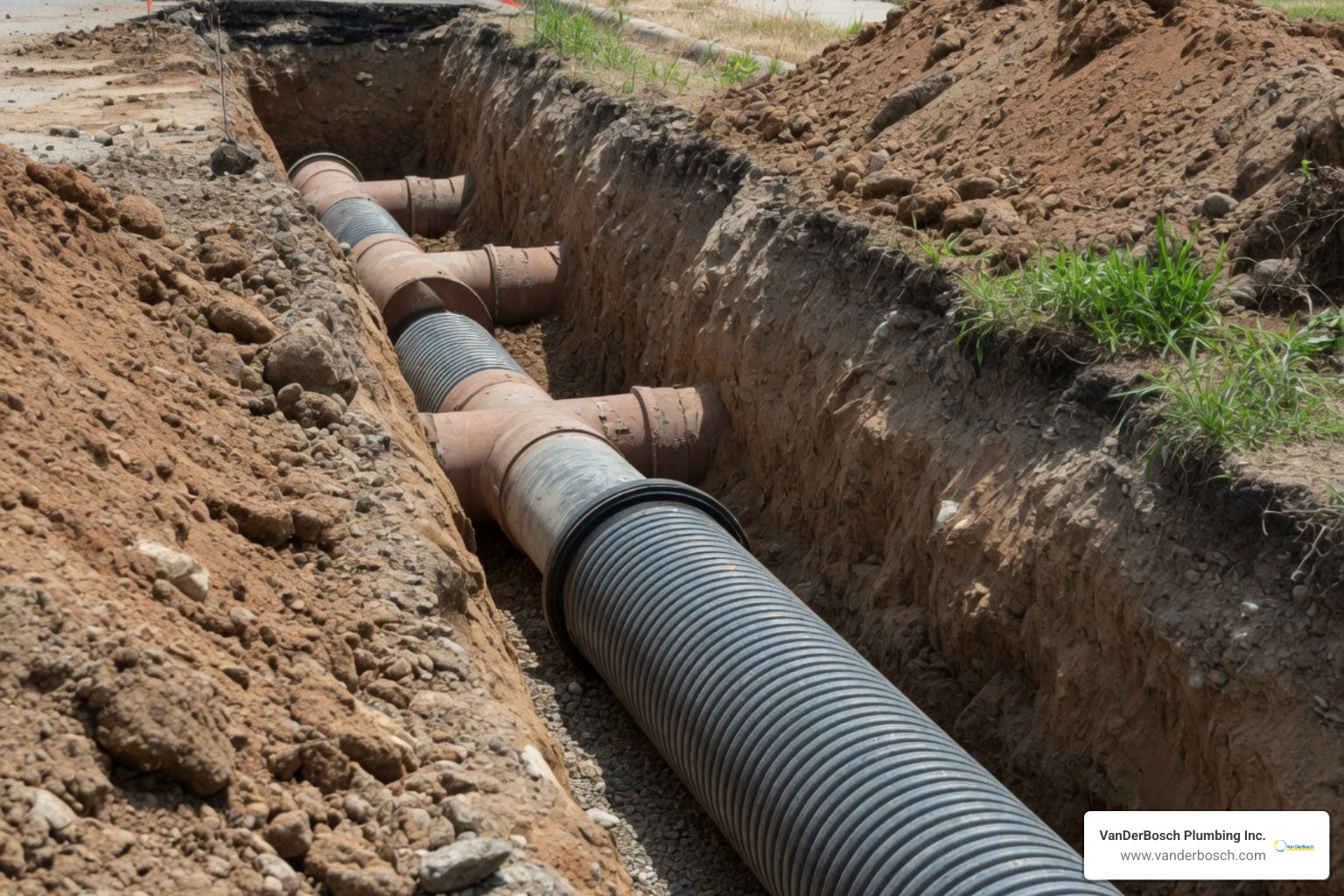
What Does Trenchless Sewer Line Repair Actually Cost?
Trenchless sewer line repair cost typically falls between $80 and $250 per linear foot, with most Chicagoland homeowners paying somewhere in the range of $6,000 to $12,000 for a standard residential project. Complex jobs can reach $20,000.
Here’s a quick snapshot before we dive deeper:
| Project Type | Typical Cost Range |
|---|---|
| CIPP pipe lining (per foot) | $80 – $250 |
| Pipe bursting (per foot) | $60 – $200 |
| Small-scale trenchless repair | $3,000 – $4,000 |
| Average full project | $6,000 – $12,000 |
| Complex or long-run projects | Up to $20,000 |
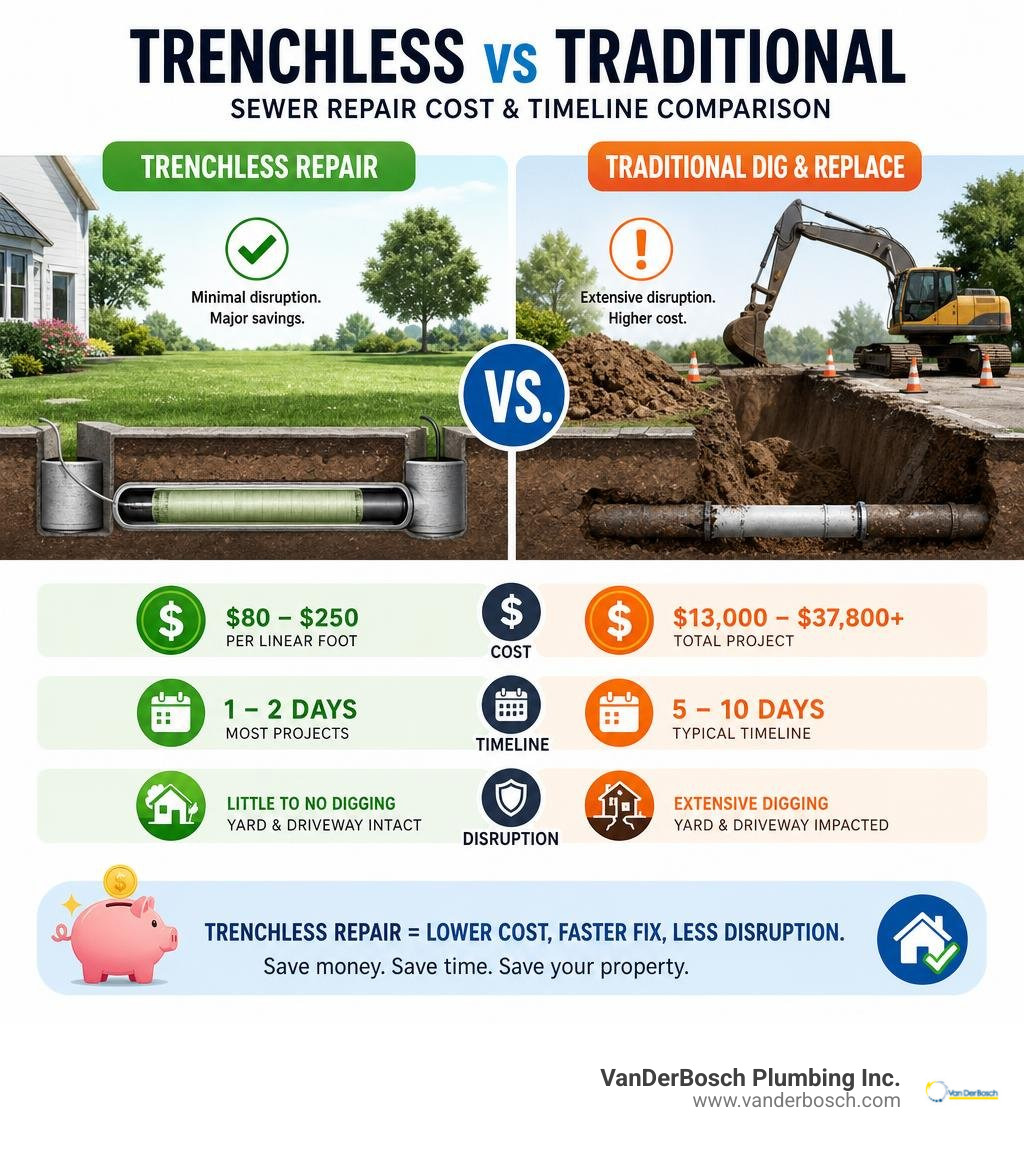
| Traditional dig-and-replace (total) | $13,000 – $37,800+ |
Getting a surprise sewer repair quote is stressful — especially when the numbers seem all over the place. One contractor quotes $4,000. Another says $18,000. What’s actually going on?
The honest answer: sewer repair pricing is complicated, and the method you choose changes everything. Trenchless repair avoids tearing up your yard, driveway, or concrete — and that alone can save thousands compared to traditional excavation.
This guide breaks down exactly what drives the cost, what you’ll likely pay in the Chicagoland area, and how to make sure you’re not overpaying.
I’m Hugh Hodur, President of VanDerBosch Plumbing Inc., and I’ve overseen hundreds of sewer repairs across the Chicagoland area — including both trenchless and traditional methods — so I understand how trenchless sewer line repair cost varies based on pipe condition, access, and local permit requirements. Let’s walk through everything you need to know so you can make a confident, informed decision.
More about trenchless sewer line repair:
What is the Average Trenchless Sewer Line Repair Cost?
When evaluating your options, the first number most homeowners look at is the upfront installation price. Nationally, standard trenchless sewer line repairs range from $3,000 to $30,000 depending on the project’s scale, but the vast majority of standard residential projects land safely between $6,000 and $12,000.
If you are looking at a complete sewer lateral replacement, the national average for trenchless replacement typically sits between $1,900 and $6,000, with a median project cost of around $2,900 for shorter runs. However, for a standard 50-foot residential lateral line in Chicagoland, you should plan for a total project cost of $6,000 to $15,000 depending on the specific trenchless technique used.
To plan your budget effectively, it helps to look at the base cost per linear foot. Trenchless methods generally cost between $80 and $250 per linear foot. While this per-foot rate is often higher than the base installation rate of traditional open-trench digging (which can run $50 to $250 per foot), the trenchless rate is an “all-inclusive” structural solution. It doesn’t require you to rebuild your property afterward.
To see how the numbers shake out, let’s look at the Sewer Line Replacement Cost (2026) | Trenchless & Trench planning ranges for a typical 50-foot residential sewer lateral:
| Repair Method | Base Cost Per Foot | Avg. 50-Ft Project Cost | Post-Project Restoration Cost | Total Expected Out-of-Pocket |
|---|---|---|---|---|
| Traditional Open-Trench | $50 – $250 | $4,000 – $13,000 | $12,000 – $25,000+ | $16,000 – $38,000+ |
| Pipe Bursting (Trenchless) | $60 – $200 | $6,000 – $13,000 | $0 – $2,000 | $6,000 – $15,000 |
| CIPP Pipe Lining (Trenchless) | $80 – $250 | $7,000 – $15,000 | $0 – $1,000 | $7,000 – $16,000 |
As the data shows, traditional excavation seems cheaper on paper when you only look at the plumber’s base pipe-laying fee. However, once you add the cost of rebuilding your lawn, repaving your driveway, or putting your patio back together, the financial advantage swings heavily in favor of trenchless methods.
To better understand your options, check out our guide on What to Know About Trenchless Pipe Repairs and read our breakdown of Say Goodbye to Digging: Understanding No Dig Sewer Line Repair.
Trenchless Sewer Line Repair Cost for Pipe Lining (CIPP)
Cured-in-Place Pipe (CIPP) lining is the most common “no-dig” technology used today. This method involves inserting a flexible felt tube coated with liquid epoxy resin directly into your damaged sewer line. Once positioned, the liner is inflated, pressing the resin against the walls of the old pipe. Over a few hours, the resin cures and hardens, creating a brand-new, structurally sound plastic pipe inside your old, damaged one.
For standard residential CIPP pipe lining, you can expect to pay between $80 and $180 per linear foot nationally, though highly complex residential runs can reach $250 per foot. If you only need a minor sectional repair — often called a “spot repair” or pipe stent — the cost typically ranges from $1,500 to $4,000 depending on the length of the damaged section.
Because CIPP lining relies entirely on the structural integrity of the existing “host” pipe to guide the liner, it is highly cost-effective for pipes that are cracked, leaking, or compromised by tree roots but still retain at least 40% of their original structural integrity. If you want to learn more about how this seamless, jointless barrier keeps tree roots out for good, explore our comprehensive guide on Sewer Pipe Lining: The Ultimate Guide to No Dig Repairs.
Trenchless Sewer Line Repair Cost for Pipe Bursting
When an old sewer line is too deteriorated, collapsed, or misshapen to support a CIPP liner, pipe bursting is the go-to trenchless alternative. Instead of lining the old pipe, pipe bursting completely replaces it.
We pull a heavy, cone-shaped steel bursting head through your existing sewer line. As the bursting head is pulled through, it physically fractures and shatters the old pipe (usually made of clay, cast iron, or concrete) and pushes the fragments into the surrounding soil. Simultaneously, the bursting head pulls a brand-new, seamless High-Density Polyethylene (HDPE) pipe directly behind it.
Pipe bursting typically costs between $60 and $200 per linear foot, with standard residential projects ranging from $6,000 to $12,000. In highly complex situations, such as deep lines beneath structural foundations, costs can reach $20,000.
Because pipe bursting actually replaces the old pipe with a brand-new, full-diameter HDPE line, it is incredibly durable and can even be used to slightly increase the size of your sewer line if your home’s usage patterns require a larger capacity. For a complete analysis of how to budget for these projects, refer to our detailed resource on Budgeting for No Dig: Understanding Trenchless Sewer Replacement Costs.
Trenchless vs. Traditional: The Real Cost Battle
To understand why so many homeowners choose trenchless technology, you have to look beyond the plumbing estimate. The real cost battle isn’t about the price of the pipe itself; it’s about what happens to the property above that pipe.
Traditional sewer repair is a disruptive process. It requires heavy machinery to dig a long, deep trench through your yard, driveway, or sidewalk to expose the damaged line. This excavation destroys everything in its path.
Trenchless sewer repair, on the other hand, only requires one or two small access pits at the ends of the line. Your trees, gardens, walkways, and paved surfaces remain completely untouched.
When you factor in these avoided restoration costs, trenchless sewer repair consistently delivers 30% to 50% total project savings compared to traditional dig-and-replace methods. For a side-by-side comparison of these two approaches, read our detailed breakdown on Trenchless vs Traditional: A Cost Breakdown for Sewer Repair.
The Hidden Costs of Traditional Dig-and-Replace
When a contractor hands you a low-ball estimate for traditional sewer excavation, they are usually quoting you only for the plumbing labor and the pipe materials. They rarely include the cost of putting your property back together. These hidden restoration expenses can quickly double or triple your final bill:
- Landscaping and Sod Restoration: Re-seeding lawns, replacing mature sod, and replanting destroyed flower beds typically costs $4 to $7 per square foot. For a heavily disrupted yard, this can add $1,500 to $5,000 to your total costs.
- Concrete and Driveway Repaving: If your sewer line runs beneath a concrete driveway, patio, or sidewalk, excavation requires cutting and removing that concrete. Replacing concrete costs $11 to $18 per square foot (and even more for stamped or decorative finishes), while asphalt repaving runs $8 to $14 per square foot. Rebuilding a damaged driveway can easily add $3,000 to $5,000+ to your project.
- Trench Shoring and OSHA Safety: For safety reasons, any trench deeper than 5 feet requires professional shoring to prevent cave-ins. This added labor and equipment can increase traditional excavation costs by 25% to 40% for every extra two feet of depth.
- Project Disruption and Extended Labor: Traditional excavation projects often take 3 to 7+ days (or even weeks when waiting for municipal backfill inspections). This extended timeline means paying for multiple days of heavy equipment rentals and operator labor.
For a comprehensive look at these hidden excavation expenses, you can check out our guide on Is Trenchless Sewer Repair Worth the Cost?.
When Traditional Excavation Makes More Financial Sense
While trenchless methods are usually the smartest financial choice, there are certain situations where traditional excavation is actually more practical or cost-effective:
- Completely Collapsed Pipes: If a sewer line has completely collapsed or flat-lined, there is no longer an open pathway to run a CIPP liner or pull a bursting head. In these cases, physical excavation is required to clear the blockage and replace the line.
- Severe Backgrade or “Bellies”: A sewer line relies on gravity to carry waste away from your home. If your pipe has developed a severe sag or “belly” due to ground shifting, trenchless lining will simply follow the existing dip, which won’t fix your drainage issues. Excavation is necessary to re-grade the line and restore proper gravity flow.
- Shallow, Easily Accessible Pipes: If your sewer line is buried only 2 to 3 feet deep in an open, unlandscaped lawn with no trees, driveways, or structures nearby, traditional digging is incredibly fast and cheap. In this scenario, the base cost of traditional excavation will likely be lower than the mobilization costs of specialized trenchless equipment.
- Severe Utility Conflicts: If your sewer line is located dangerously close to other underground utilities (such as high-voltage power lines or main gas lines), the high-force pulling involved in pipe bursting might pose too much risk. Direct excavation allows technicians to carefully hand-dig around sensitive utilities.
Key Factors That Influence Your Total Project Estimate

No two sewer lines are identical, which is why we customize every estimate to your property’s unique layout. When we calculate your trenchless sewer line repair cost, we look at several key physical and environmental factors:
- Pipe Length and Economies of Scale: Longer pipe runs naturally require more material, but they actually offer a lower cost per foot due to equipment mobilization economies of scale. For example, a 100-foot project might average $80 to $180 per foot, whereas a short 25-foot repair often costs $120 to $240 per foot because the fixed setup costs are spread over fewer feet.
- Depth of the Line: The deeper your sewer pipe is buried, the more complex the work becomes. Even for trenchless repairs, we still need to dig small access pits. If your line is buried deep below the frost line, those access pits require extra shoring and labor to excavate safely.
- Soil Conditions and Obstacles: Hard clay soils or rocky ground require more effort to dig through for access pits, which can increase labor hours. Additionally, dense tree root intrusion requires extensive cleaning and hydrojetting before we can install a trenchless liner, adding $500 to $3,000 to the prep work depending on the severity of the blockage.
- Property Layout and Accessibility: If your sewer cleanout is located in an easily accessible basement or outdoor utility area, setup is quick and straightforward. If we have to work in tight crawlspaces or navigate around delicate landscaping, the added labor will be reflected in the final estimate.
To explore these cost drivers in more detail, you can read the Trenchless Sewer Line Replacement Cost: A 2026 Guide.
Why a Sewer Camera Inspection is the Smartest First Dollar
Before you make any decisions about sewer repair, you need to know exactly what is happening inside your pipes. A sewer camera inspection is the single most important diagnostic step you can take.
During an inspection, a technician feeds a high-definition, waterproof video camera down your sewer line. This camera transmits real-time footage of the pipe’s interior, allowing us to see exactly where and why your system is failing. A professional sewer camera inspection typically costs between $200 and $500, though it is often packaged with drain cleaning services.
Investing in a camera inspection helps you avoid several costly mistakes:
- It prevents misdiagnosis: It reveals whether your backup is caused by a simple, easily cleared root clog or a major structural failure like a collapsed pipe.
- It pinpoints the exact location of the damage: If only a 5-foot section of your pipe is damaged, you don’t need to pay for a full 50-foot replacement. A camera inspection allows us to target a cost-effective spot repair.
- It verifies trenchless eligibility: The video footage confirms whether your pipe is strong enough to support a CIPP liner or if it requires pipe bursting.
To learn more about how to spot early warning signs before a major failure occurs, check out our guides on Signs a Sewer Line May Need Repair or Replacement and How to Avoid and Catch Sewer Line Issues.
Regional Labor Rates and Municipal Permit Fees
Your geographic location plays a major role in your final bill. Homeowners in high-cost-of-living areas, like the Northeast and West Coast, typically pay 20% to 50% more than the national average for trenchless sewer repairs. In fact, economic research shows that every $10,000 increase in regional median household income correlates with a $12 to $18 increase in the per-foot cost of sewer repairs.
In the Chicagoland area (including Cook County suburbs like Melrose Park, Niles, Winnetka, and Roselle), local labor rates, strict municipal plumbing codes, and regional permit fees will directly impact your project’s cost:
- Standard Residential Permits: Local plumbing permits for sewer work typically run between $250 and $600.
- Right-of-Way (ROW) Permits: If your sewer line repair extends past your property line and crosses into public property (such as the street or sidewalk), you will need a public right-of-way permit. These permits can cost anywhere from $500 to $3,000 and often require municipal bonds, traffic control planning, and specialized street restoration.
- Chicagoland Weather Factors: Our severe winter freeze-thaw cycles require sewer lines to be buried deeper to prevent freezing. This extra depth can increase the labor and shoring requirements for your access pits.
For more information on local pricing and regulations, you can consult with our team or explore our specialized local plumbing services designed for Chicagoland communities.
Long-Term Value: Is Trenchless Sewer Repair Worth the Cost?

When comparing quotes, it is easy to focus entirely on the immediate out-of-pocket expense. However, the smartest financial decision is the one that delivers the best long-term value.
While trenchless sewer repair can sometimes carry a slightly higher upfront plumbing fee than basic excavation, it is almost always the more cost-effective option over time.
Here is why trenchless technology is a smart investment for your home:
- Incredible Lifespan: Modern CIPP epoxy liners are engineered to last for 40 to 50 years, while seamless HDPE pipes installed via pipe bursting boast a lifespan of 50 to 100 years. These materials are completely immune to rust, corrosion, and chemical degradation.
- Permanent Root Exclusion: Traditional clay and cast iron pipes have joints every few feet. Over time, these joints shift, allowing tree roots to creep inside and cause blockages. Because CIPP liners and HDPE pipes are completely seamless and jointless, they eliminate the entry points that tree roots rely on, saving you thousands in ongoing root maintenance.
- Improved Flow Capacity: The interior of a cured epoxy liner or HDPE pipe is incredibly smooth. This ultra-slick surface reduces friction, which improves your system’s flow capacity and helps prevent future clogs and waste buildup.
- Long-Term Warranties: Because trenchless repairs are so durable, reputable contractors often back their work with long-term warranties. These warranties can last for decades and are often fully transferable to future homeowners, adding real resale value to your property.
To learn more about the long-term return on investment for these modern systems, read our detailed analysis: Is Trenchless Sewer Repair Worth the Cost?.
Frequently Asked Questions about Sewer Repair
Sewer repairs can be confusing. Here are quick, straightforward answers to the most common questions we hear from homeowners:
How long does trenchless sewer line repair take?
Most residential trenchless sewer repairs are completed in just 1 to 2 days. Simple CIPP lining projects often take only 4 to 8 hours of active work, meaning your water service is only offline for a few hours. In contrast, traditional excavation projects typically require 3 to 7+ days of heavy digging, backfilling, and property disruption.
Does homeowners insurance cover trenchless sewer line repair?
Standard homeowners insurance policies generally do not cover sewer line repairs that are caused by gradual wear and tear, age-related deterioration, or tree root intrusion. However, if your sewer line fails suddenly due to a covered peril (such as a sudden earthquake or major utility accident), your policy may assist with the costs.
To protect yourself from unexpected sewer bills, we highly recommend adding a service line endorsement to your homeowners policy. These endorsements typically cost just $30 to $60 per year and can provide up to $10,000 or more in coverage for underground pipe repairs.
Can trenchless methods fix completely collapsed pipes?
No, trenchless methods cannot be used if a pipe has completely collapsed, flattened, or shifted so severely that there is no longer a clear pathway through the line. In these situations, specialized equipment cannot pass through, and traditional excavation is required to dig up and replace the collapsed section.
Conclusion
A failing sewer line is a stressful problem, but resolving it doesn’t have to mean destroying your beautiful lawn, patio, or driveway. By choosing trenchless sewer repair, you can solve your plumbing issues quickly, preserve your property’s landscaping, and invest in a durable, root-resistant solution designed to last for generations.
At VanDerBosch Plumbing Inc., we are proud to provide expert trenchless sewer solutions to homeowners throughout Chicagoland — from Chicago neighborhoods like Hyde Park, West Ridge, Sauganash, and Ukrainian Village, to suburbs like Roselle, Niles, Winnetka, Melrose Park, Oakbrook Terrace, Elmhurst, and Mount Prospect.
When you work with us, you get:
- A 100% satisfaction guarantee on our workmanship
- 24/7 availability for sudden sewer emergencies
- Transparent pricing with absolutely no hidden service charges
- Experienced, background-checked technicians who treat your home with respect
If you are dealing with recurring backups, slow drains, or sewer odors, don’t wait for a costly emergency to happen. Schedule a professional trenchless pipe repair consultation with VanDerBosch Plumbing Inc. today, or explore our Services: Sewer Line Repair page to learn more about how we can help. If you live in the western suburbs, you can also visit our local Roselle: Trenchless Pipe Repair service page to book an inspection. We will help you find the most reliable, cost-effective solution for your home!