
Table of Contents
- When Your Boiler Needs Professional Repair
- Boiler Not Heating: Common Causes and Fixes
- Boiler Leaking Water: Is It Safe to Wait?
- Steam Boiler Repair: What Older Homes Need to Know
- Boiler Repair or Replacement: Making the Right Decision
- What to Expect During a Professional Boiler Service Call
- Finding a Licensed Boiler Technician You Can Trust
- Frequently Asked Questions
Last Updated: October 13, 2026
When Your Boiler Needs Professional Repair
A boiler that won’t heat your home or is leaking water is a safety and comfort issue. The right response depends on what’s happening inside the system.
Most boiler problems fall into a few categories: no heat, water leaks, strange noises, or pressure issues. Some you can investigate safely; others involve pressurized systems, gas, or electrical components that are dangerous to troubleshoot yourself.
Knowing when to call for boiler repair near me service helps you get heat back faster and avoid a middle-of-the-night emergency.
Boiler Not Heating: Common Causes and Fixes
No heat is the most common reason people search for boiler repair, and it has the widest range of causes, from simple settings issues to gas valves, control boards, or internal components only a licensed technician should diagnose.
Start with the safe, obvious checks
Before assuming the boiler has failed, confirm:
- Thermostat mode and setpoint. Confirm it’s set to Heat with a target above room temperature. Dead batteries or a tripped schedule can mimic a boiler failure.
- Power to the boiler. Check the service switch and breaker.
- Fuel supply. For a gas boiler, confirm the shutoff valve at the boiler is open. If other gas appliances are also out, that’s a utility issue.
- Condensate (high-efficiency units). Condensing boilers drain acidic condensate through a trap and line. If it freezes or clogs, many units lock out and won’t fire, a common winter failure in homes with unheated basements or crawl spaces.
If those check out and the boiler still won’t fire, stop and call for service. Do not open the burner compartment, clean the flame sensor, or bypass a safety switch.
Match the symptom to the likely cause
Different no-heat patterns point to different problems. Knowing them helps you describe symptoms accurately to a technician.
No heat anywhere, boiler is silent. The boiler isn’t firing.
No heat anywhere, boiler runs but shuts off quickly (short cycling). The boiler fires briefly, shuts down, and repeats.
Some rooms heat, others don’t. This usually points to circulation, not the boiler: a stuck zone valve, a failed circulator, trapped air, or a balancing issue.
Boiler fires, then locks out after a few minutes. Lockouts are the boiler protecting itself.
What the pressure gauge is actually telling you
Most hot-water boilers run at low pressure when cold, with the target set by system design and the height of the highest radiator above the boiler. A needle in the red zone, or well below the normal cold reading, is a real symptom.
- Pressure too low. Often a slow leak, a recently bled radiator, or a failed pressure-reducing valve. Overfilling can trigger the relief valve, so if you don’t know your system’s target pressure, let a technician handle it.
- Pressure too high. Usually a failed expansion tank, a stuck pressure-reducing valve, or thermal expansion with nowhere to go. High pressure can force the relief valve to discharge water, a warning sign, not a normal event.
- Pressure swings wildly during a cycle. Often a waterlogged or failed expansion tank. Diagnosing it requires checking charge pressure, which is a technician task.
If you smell gas, hear hissing near the boiler or gas line, or your carbon monoxide alarm sounds, do not troubleshoot. Leave the building, get to fresh air, and call your gas utility’s emergency line or 911 from outside. Do not flip switches, use a phone indoors, or relight anything.
Noises that mean stop and call
A healthy boiler makes a low, steady rumble when the burner is on. Problem sounds include:
- Banging or hammering. Often steam or water hammer, sometimes a failing circulator or trapped air. On steam systems, it can mean the boiler is surging from dirty water.
- Kettling (a rumbling, kettle-like sound). Usually mineral scale or sludge on the heat exchanger, which reduces efficiency and can eventually crack the metal.
- Whistling or screeching. Often a failing circulator bearing or a piping restriction.
- Rumbling that gets louder over weeks. Typically scale accumulation. It won’t fix itself.
None of these are DIY repairs. They require opening the system, and on a gas-fired boiler that means working around combustion components.
When to call for boiler repair
Call a licensed technician if any of the following is true:
- The boiler won’t fire after the basic checks above.
- You see a lockout code, a flashing fault light, or repeated shutdowns.
- The pressure gauge is in the red zone or the relief valve is discharging.
- You hear banging, kettling, or grinding.
- You smell gas, see soot, or the carbon monoxide alarm has sounded.
- The boiler is leaking water from anywhere other than the relief valve discharge.
A technician can test the ignition sequence, check combustion with a gas analyzer, verify the circulator and zone valves, and confirm the system is operating within safe parameters. If you’re not sure whether your situation is urgent, it’s reasonable to call and describe the symptoms; a reputable company can help you decide whether it can wait until morning or needs attention now. You can schedule boiler repair service or call to talk through what you’re seeing.
Boiler Leaking Water: Is It Safe to Wait?
Water pooling around your boiler means something inside the system is failing. The question is whether it’s a minor slow leak or a sign of imminent failure.
A small drip from the pressure relief valve (the pipe hanging down from the boiler) is often normal, it’s how the boiler releases excess pressure.
Leaks from the boiler body, pipe connections, or pump usually get worse over time.
If water is actively dripping or pooling, turn off the boiler and call for boiler repair near me service.
While you wait for service, place towels or a bucket under the leak to limit water damage.
Steam Boiler Repair: What Older Homes Need to Know
If you live in an older Chicagoland home, you may have a steam boiler rather than a hot-water system.
A steam boiler heats water to boiling, pushes steam through pipes to radiators, then the steam condenses back to water and returns to the boiler.
Common steam boiler problems include leaking steam valves, failed condensate return pumps, and water level issues. Many general plumbers and heating contractors won’t work on steam systems because they require specific knowledge.
VanDerBosch Plumbing Inc. specializes in steam boiler repair and maintenance for vintage systems. Our technicians understand older boilers and can often repair them rather than pushing replacement.
Boiler Repair or Replacement: Making the Right Decision
When a technician says your boiler needs work, the next question is whether to fix it or replace it. The answer isn’t always replacement.
Start with age. Most boilers have a typical lifespan.
Look at what’s broken. A failed pump or leaking valve can often be replaced without replacing the boiler.
Consider efficiency too. Older boilers use more energy than modern ones.
Ask the technician what happens if you defer the repair. Some problems worsen quickly; others are slow-moving. Understanding the timeline helps you decide.
What to Expect During a Professional Boiler Service Call
Here’s what usually happens during a professional boiler service call.
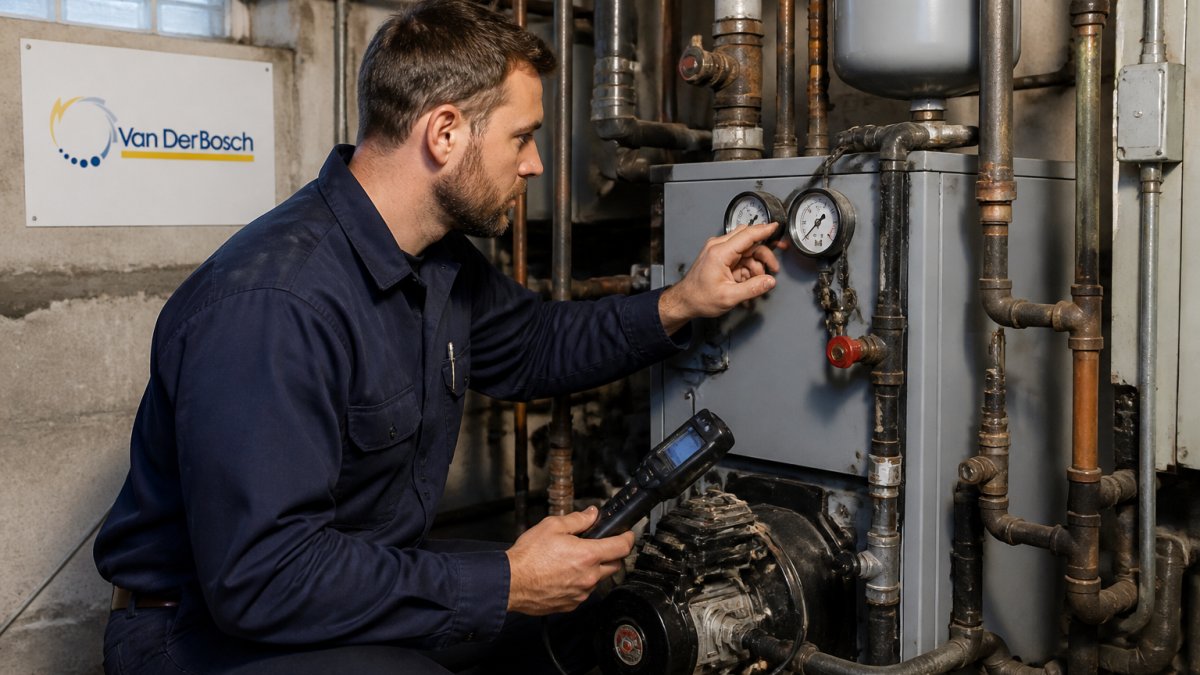
The technician will ask about symptoms, when the problem started, what you’ve noticed, and whether anything unusual preceded it.
They’ll test the controls and may use a combustion analyzer to check flame quality and burn efficiency.
Once diagnosis is complete, the technician will explain what they found, your options, and what the repair involves.
Repair time varies widely. Replacing a valve might take a certain amount of time; repairing a pump or cleaning the heat exchanger might take longer.
Finding a Licensed Boiler Technician You Can Trust
Boiler work isn’t the same as general plumbing. A technician who’s excellent at clearing drains or replacing water heaters may not have the training or tools to safely diagnose a gas-fired boiler, and the difference matters when combustion, pressurized water or steam, and electrical controls are involved.
Questions worth asking before you book
“Do you work on both hot-water and steam boilers?” These are different systems with different controls, failure modes, and service procedures.
“Who will do the diagnostic work?” Some companies send a sales-focused estimator first.
“How do you test combustion?” A serious boiler technician uses a combustion analyzer to measure flue gases and confirm the burner is set up correctly.
“What’s your policy on emergency calls?” Boiler failures cluster in cold weather, and a January no-heat call is different from a September tune-up.
How to evaluate the diagnosis and estimate
A trustworthy diagnosis has recognizable features:
- It names the failed component and how it was tested. “The flame sensor is reading below spec” is a diagnosis. “Your boiler is old” is not.
- It separates the immediate repair from optional recommendations. You should know which items restore safe operation and which are maintenance suggestions.
- It explains what happens if you defer. Some issues are safe to monitor; a leaking relief valve or cracked heat exchanger is not.
- It gives you a written estimate before work begins. Verbal-only estimates leave you exposed if scope changes mid-job.
Be cautious of a diagnosis that jumps to full replacement without explaining why the failed component can’t be repaired, or one that pressures you to decide on the spot. A second opinion is reasonable for any major recommendation.
What factors affect the cost of boiler repair
Boiler repair pricing varies widely. The main factors that drive the estimate are:
- The type of boiler. Steam and hot-water systems use different parts and diagnostic procedures.
- The failed component. A thermocouple or igniter is a small job; a circulator, zone valve, or control board is more involved; a heat exchanger or cracked section is major and often shifts the conversation toward replacement.
- Access. A boiler in a tight basement corner or behind finished walls takes longer to service.
- Age and parts availability. Older boilers may need specialty parts that take longer to source.
- Routine vs. emergency. After-hours and weekend calls typically carry a different rate structure than scheduled visits.
- Additional issues found during diagnosis. Low water cutoff problems, expansion tank failures, and relief valve issues often appear together on an aging system.
A written estimate should break these out. If a company won’t itemize, ask why.
Red flags during the visit
- The technician won’t show credentials or confirm licensing when asked.
- The diagnosis changes significantly between the phone call and the visit without explanation.
- You’re told the boiler is “unsafe” without being shown the specific condition or test result.
- The estimate is verbal and the technician wants to start immediately.
- You’re pressured to sign a maintenance contract as a condition of the repair.
A note on maintenance plans
Regular boiler maintenance, typically an annual tune-up before heating season, reliably extends boiler life and catches problems before they become no-heat emergencies. A tune-up generally includes cleaning the burner and heat exchanger, checking the flame signal, testing safety controls, verifying pressure and temperature settings, and on steam systems, checking the low-water cutoff and skimming the boiler if needed.
If you’re comparing providers or want to talk through what your boiler is doing before you commit to a service call, contact VanDerBosch Plumbing Inc. to discuss your system and schedule a visit.
Frequently Asked Questions
What are the warning signs that my boiler needs repair?
Common warning signs include strange noises (rumbling, banging, or whistling), inconsistent heat, water leaks around the unit, discolored pilot light, or a burning smell. If your boiler is not heating properly or you notice water pooling beneath it, contact a licensed technician promptly. Some warning signs indicate safety risks that require immediate professional attention.
Should I repair or replace my boiler?
The decision depends on the boiler’s age, the cost of repair, and how often problems occur. Boilers have a typical lifespan. If your boiler is nearing the end of its lifespan, has frequent repairs, or is inefficient, replacement may be more cost-effective long-term. A professional technician can assess the damage and help you weigh repair versus replacement options.
Is a boiler problem an emergency?
Boiler problems can become emergencies quickly, especially in cold weather when heating is essential. Gas leaks, significant water leaks, or complete loss of heat require immediate professional attention. Do not attempt to repair gas lines or pressurized systems yourself. If you suspect a gas leak, leave the area and call emergency services. Licensed technicians are available to diagnose and repair boiler emergencies safely.
Can a plumber fix my boiler, or do I need a specialist?
Licensed plumbers trained in boiler repair can diagnose and fix most boiler problems. Some older steam boilers or complex heating systems may require a technician with specialized experience. When calling for service, ask whether the technician has experience with your boiler type, especially if you have a vintage steam system common in older homes.