
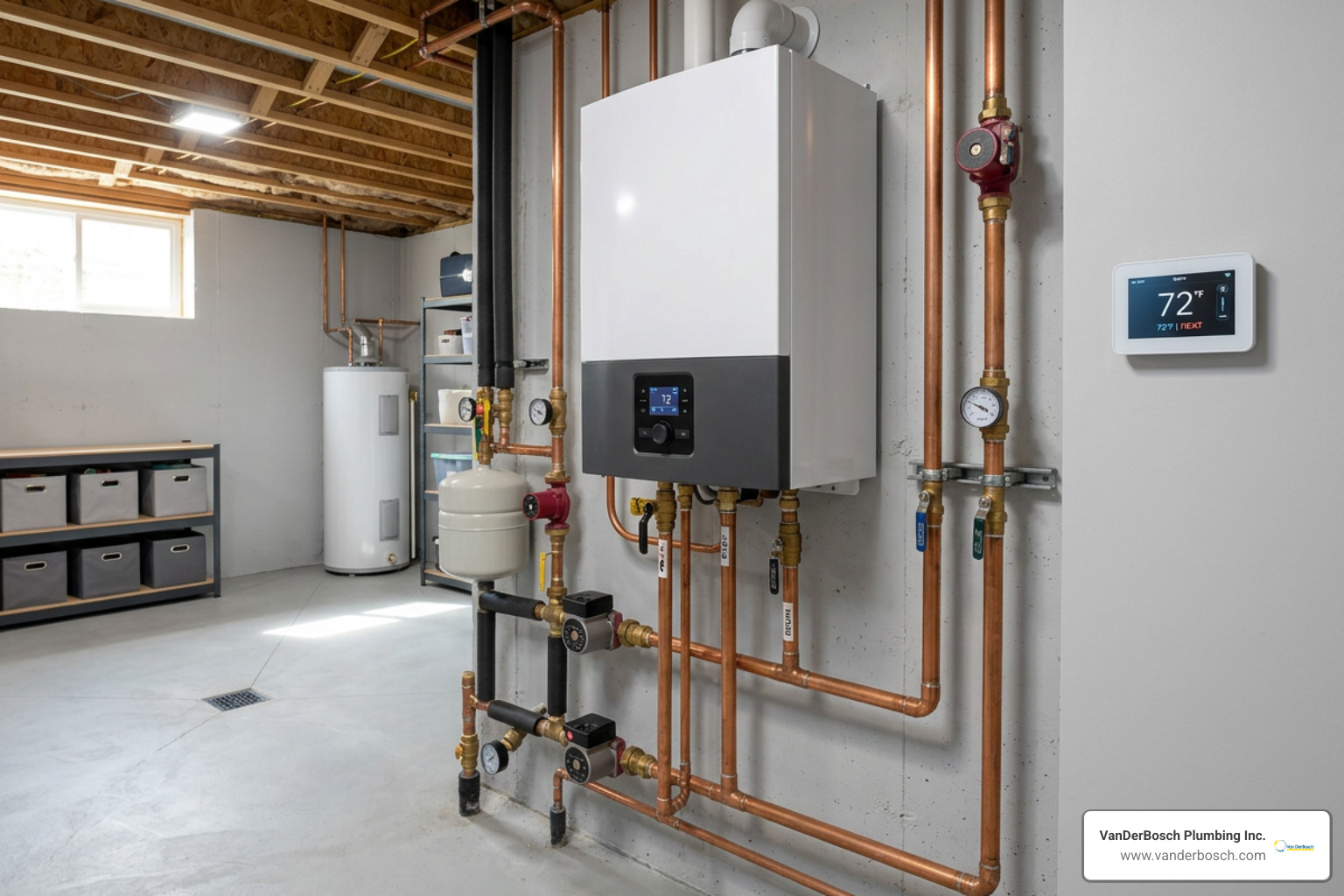
Why Boiler Services Matter for Your Home’s Heating System
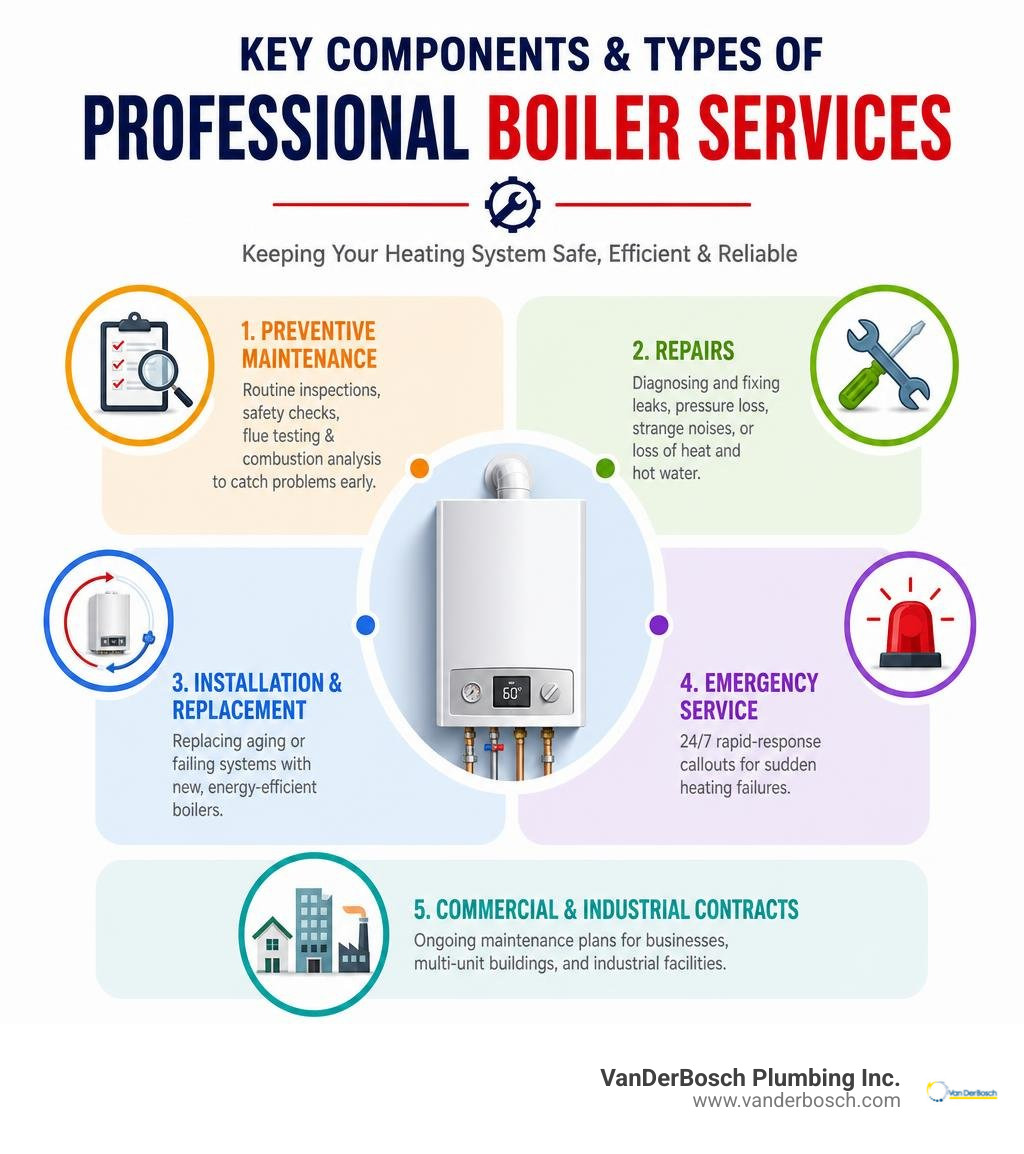
Boiler services are professional inspections, repairs, installations, and maintenance checks that keep your heating system running safely and efficiently. Here’s a quick overview of what’s covered:
- Preventive Maintenance — Annual safety checks, flue testing, and combustion analysis to catch problems early
- Repairs — Diagnosing and fixing leaks, pressure loss, strange noises, or loss of heat and hot water
- Installation & Replacement — Swapping out aging or failing systems for new, energy-efficient boilers
- Emergency Service — 24/7 rapid-response callouts for sudden heating failures
- Commercial & Industrial Contracts — Ongoing maintenance plans for businesses, multi-unit buildings, and industrial facilities
Your boiler is one of the hardest-working systems in your home — especially during a Chicago winter. When it fails, it rarely gives much warning. A boiler that’s quietly losing efficiency can drive up your energy bills for months before it breaks down completely. And when it does break down, the timing is almost never convenient.
The good news: most boiler problems are entirely preventable with the right service plan. A well-maintained boiler can last up to 20 years, and switching to a new high-efficiency unit can cut your annual gas bill by as much as 35%.
I’m Hugh Hodur, President of VanDerBosch Plumbing Inc., where I’ve spent years overseeing residential and commercial boiler services across the Chicagoland area — from emergency repairs to full system installations. In the sections below, I’ll walk you through everything you need to know to make smart, confident decisions about your boiler.
Core Types of Professional Boiler Services
When you call for professional boiler services, you are tapping into a full spectrum of mechanical solutions designed to ensure comfort, safety, and operational performance. Whether you own a single-family bungalow in Sauganash, a multi-unit property in Ukrainian Village, or a light commercial facility in Elmhurst, understanding the main categories of boiler care helps you request exactly what your building requires.
Primary offerings provided by professional heating contractors include:
- Comprehensive System Diagnostics: Utilizing digital analyzers and leak detection tools to find hidden flaws before they cause total system failure.
- Precision Repairs: Resolving zone valve failures, circulating pump lockups, scale buildup, corroded piping, and burner ignition faults.
- Routine Servicing & Tune-ups: Cleaning internal heat exchangers, checking expansion tanks, testing relief valves, and optimizing air-to-fuel combustion ratios.
- System Upgrades & Replacement: Removing outdated cast-iron or steam boilers and sizing modern high-efficiency condensing units tailored to your space.
- Gas Line & Combustion Safety Inspection: Testing tightness across domestic gas lines, monitoring draft conditions, and checking for silent carbon monoxide leaks.
Preventive Boiler Maintenance and Servicing
Preventive maintenance is the single most valuable service you can schedule for your hydronic heating system. Think of annual boiler maintenance as an inspection and tune-up for your heating setup — a comprehensive physical that verifies every valve, burner, seal, and electronic control is operating safely.
During a standard maintenance visit, a licensed technician performs a thorough visual and mechanical inspection. We check for hidden signs of rust, corrosion, and water weeping on pressure vessels and manifolds. Crucially, preventive care includes flue gas analysis. By inserting a specialized probe into the flue vent, we measure carbon monoxide (CO) and carbon dioxide (CO2) ratios on both high and low flame settings. This ensures fuel burns cleanly and zero carbon monoxide leaks into your indoor living spaces.
Beyond safety, routine servicing is a mandatory condition for preserving your manufacturer’s warranty. If a primary component like a heat exchanger or electronic board fails within its 5- or 10-year warranty period, manufacturers almost always require proof of documented annual servicing before honoring replacement claims.
Emergency Boiler Services and Rapid Response Callouts
When sub-zero Arctic cold sweeps through Cook County, a sudden boiler breakdown is more than an inconvenience — it is a genuine home emergency. Frozen pipes can burst within hours of a total heat outage, causing thousands of dollars in water damage.
Emergency boiler services provide 24/7 rapid response callouts when disaster strikes outside standard business hours. Common emergency triggers include complete loss of heat during freeze warnings, active water leaking from the boiler unit, strong odors of gas or fuel, and red-flag digital error codes that shut the system down completely.
When technicians arrive for an emergency callout, our immediate goal is fast, accurate fault diagnosis with zero guesswork. Whether your issue stems from a seized circulator pump, an extinguished pilot light, an air-locked radiator zone, or a failed thermocouple, immediate triage gets your heat restored quickly. If you are currently dealing with a sudden drop in water temperature or cold radiators, check out our guide on Causes of No Hot Water to understand what might be causing the freeze.
Commercial Boiler Services and Industrial Maintenance Contracts
Commercial buildings, multi-family apartment complexes, churches, and industrial facilities in Chicagoland rely on heavy-duty hydronic and steam systems to maintain occupied temperatures. Commercial boiler services demand specialized expertise far beyond standard residential units.
Commercial systems often involve low- or high-pressure steam boilers, complex manifold piping, deaerators, economizers, and large gas burners. Servicing these units requires compliance with ASME (American Society of Mechanical Engineers) code standards and strict local building regulations.
Many facility managers choose structured maintenance contracts or service plans. These customized agreements provide scheduled shut-down inspections, combustion tuning, burner retrofits, and priority emergency service. Establishing a formal maintenance contract ensures continuous operation, minimizes costly downtime, and keeps energy bills predictable across peak winter months.
Boiler Diagnostics: Signs Your Heating System Needs Service or Replacement
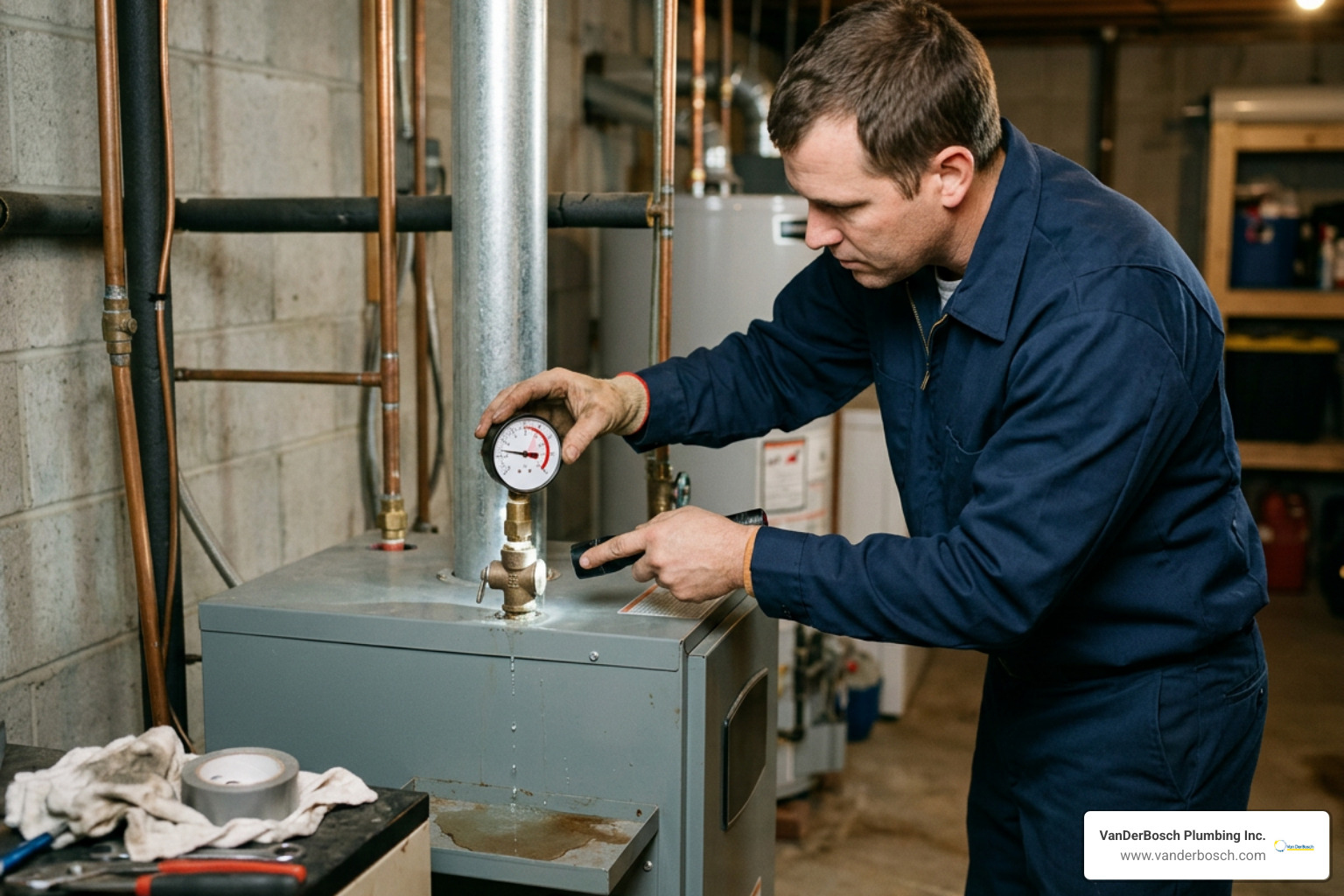
Boilers are generally quiet, sturdy systems, but they rarely fail without sending early warning signals. Paying attention to subtle changes in system behavior allows you to schedule repairs before you are left huddling next to a space heater.
Here are the primary signs that your boiler requires urgent professional attention:
- Unusual Noises (Kettling, Banging, or Whistling): Loud rumbling or metallic clanking inside the boiler — often called “kettling” — occurs when mineral deposits and scale build up on the heat exchanger. Water gets trapped and boils rapidly, creating localized steam pockets.
- Frequent Pressure Loss: Hydronic systems require stable water pressure (typically 12 to 15 PSI when cold). If you constantly have to refill or repressurize your boiler, water is escaping somewhere through a hidden leak or a failing expansion tank.
- Dripping or Weeping Relief Valves: Water pooling around the base of the unit often points to a weeping temperature-and-pressure relief valve, indicating severe pressure spikes or internal component degradation. To diagnose hidden water issues early, read our breakdown on How to Diagnose Boiler Leaks.
- Spiking Energy Bills: If your gas usage jumps dramatically without a corresponding drop in outdoor temperatures, your boiler’s heat exchanger may be coated in soot or scale, forcing it to burn far more fuel to produce the same heat output.
- Uneven Heating and Cold Spots: If upper floors or specific rooms remain freezing while others overheat, air locks, sludge accumulation, or failing zone valves are likely throttling proper circulation.
The $5,000 Rule: Deciding to Repair or Replace
When an aging boiler suffers a major breakdown, homeowners face a classic dilemma: Should you invest in another repair or put that money toward a full replacement?
To make an objective decision, professional heating contractors use a simple formula known as The $5,000 Rule:
$$\text{Age of Boiler (in years)} \times \text{Quoted Repair Cost (\$)} = \text{Decision Index}$$
If the resulting number exceeds $5,000, replacement is almost always the smarter, more economical financial choice.
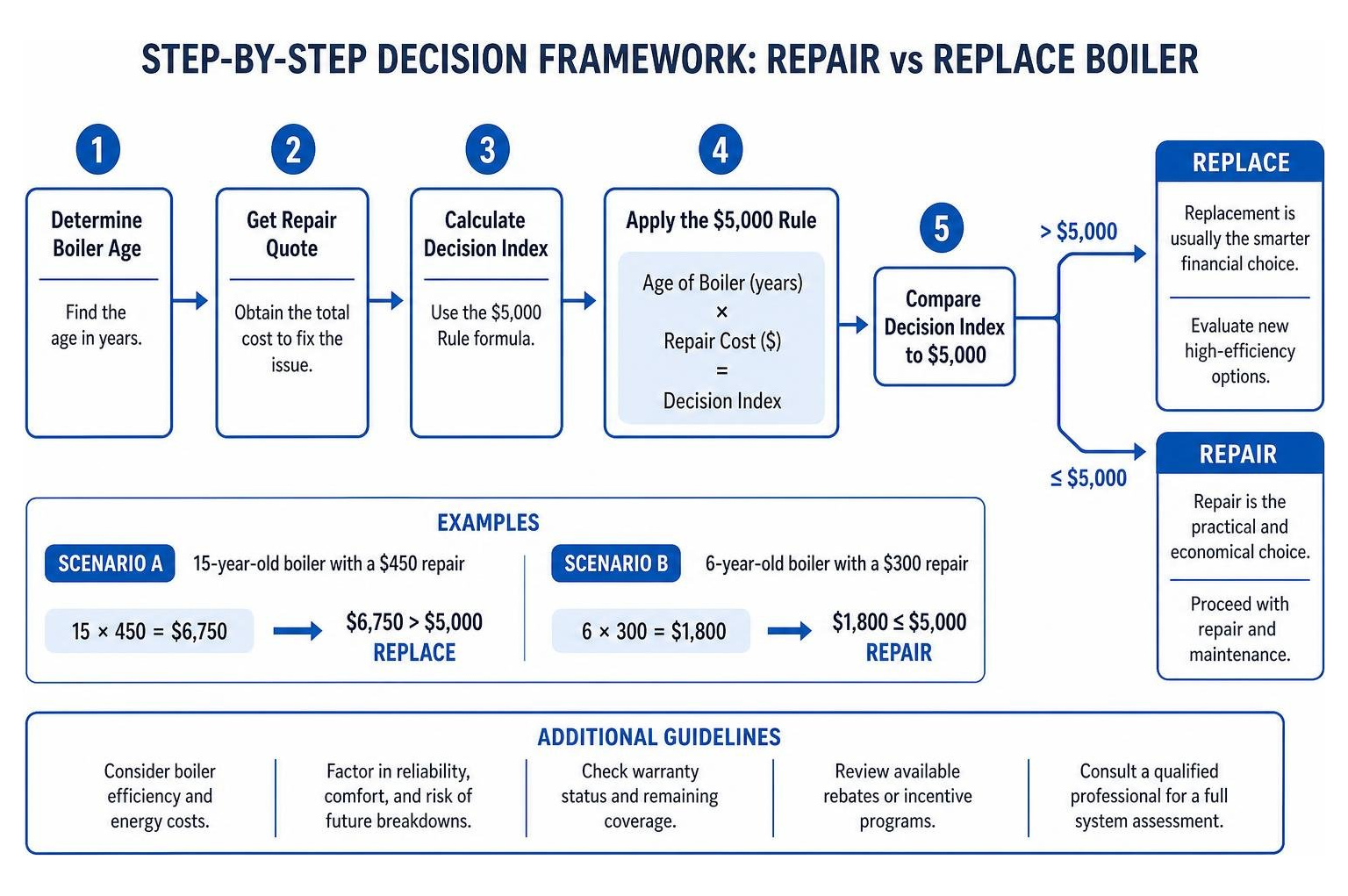
For example:
- Scenario A: A 15-year-old boiler requires a $450 circulator pump replacement. $15 \times 450 = \$6,750$. Because $6,750 is greater than $5,000, investing $450 into a unit nearing the end of its typical lifespan is risky; replacement should be strongly evaluated.
- Scenario B: A 6-year-old boiler needs a $300 pressure valve fix. $6 \times 300 = \$1,800$. Since $1,800 is far below $5,000, repairing the unit makes complete sense.
Additional guidelines to consider:
- The 12-Month Repair Frequency Rule: If your boiler requires more than one expensive repair within a single 12-month period, it is entering systemic failure. Stop patching it up and start planning a replacement.
- System Lifespan: A well-maintained residential boiler can last up to 20 years. However, once a system reaches 15 to 20 years of age, its core heat exchanger is at higher risk of cracking, and internal efficiency has dropped compared to modern units.
- Efficiency Gains: Upgrading an ancient 65% AFUE cast-iron boiler to a modern 95%+ condensing model can reduce your annual gas heating bill by up to 35%, helping offset the installation cost over time. For a full breakdown of expected costs, explore our comprehensive Gas Boiler Installation Cost Guide.
What Is Included in an Annual Boiler Maintenance Check?
A thorough annual boiler service is far more involved than a simple glance at the burner flame. It is an exhaustive diagnostic tune-up covering mechanical, electrical, and gas safety parameters.
During a standard professional visit, our technicians systematically complete the following technical tasks:
- Combustion Analysis & Flue Testing: Analyzing exhaust gases with a specialized digital meter to verify complete fuel combustion and confirm zero carbon monoxide spillage.
- Gas Pressure & Tightness Checks: Testing line pressure at the gas valve and checking all local gas joints for micro-leaks.
- Burner & Heat Exchanger Cleaning: Removing carbon deposits, dust, and debris from combustion chambers to maximize heat transfer efficiency.
- Condensate Trap Flushing: Clearing sludge and acidic condensation buildup from the condensate line to prevent winter freezing and backups.
- Safety Device Verification: Testing high-limit aquastats, low-water cut-offs, flame safeguards, and pressure relief valves to ensure emergency shut-offs function instantly.
- System Hydronic Inspection: Checking expansion tank air bladders, venting trapped air from radiators, and checking zone pumps.
| Feature / Metric | Routine Annual Maintenance | Emergency Repair Visit |
|---|---|---|
| Primary Objective | Preventive care, safety verification, & peak efficiency | Restoring lost heat or fixing active system leaks |
| Combustion & Flue Test | Included as standard procedure | Conducted if combustion fault is suspected |
| Timing | Scheduled conveniently before winter | 24/7 immediate callout response |
| Impact on Lifespan | Extends system life up to 20 years | Resolves localized component failure |
| Warranty Status | Keeps manufacturer warranty valid | Fixes breakdown but doesn’t substitute routine care |
| Average Operational Impact | Reduces annual fuel usage up to 35% | Restores baseline function |
Key Benefits of Regular Boiler Maintenance
Investing in routine annual care delivers tangible long-term benefits for your home and budget:
- Lower Fuel Bills: Cleaning internal heating surfaces and optimizing gas-to-air combustion ensures every therm of natural gas translates directly into home warmth, trimming fuel consumption by up to 35%.
- Extended Lifespan: Catching small issues — like minor weeping valves or air pockets — prevents major secondary damage to heat exchangers and pumps, allowing your system to reach its full 20-year potential.
- Carbon Monoxide Safety: Gas boilers produce carbon monoxide as a byproduct of combustion. Routine flue checks guarantee exhaust gases vent safely outside your home, protecting your family from dangerous indoor gas accumulation.
- Uninterrupted Winter Comfort: Over 80% of unexpected winter heating breakdowns stem from lack of routine maintenance. Servicing your unit in autumn prevents freezing mid-winter wake-up calls.
Comparing Boiler Types, Fuel Sources, and System Designs
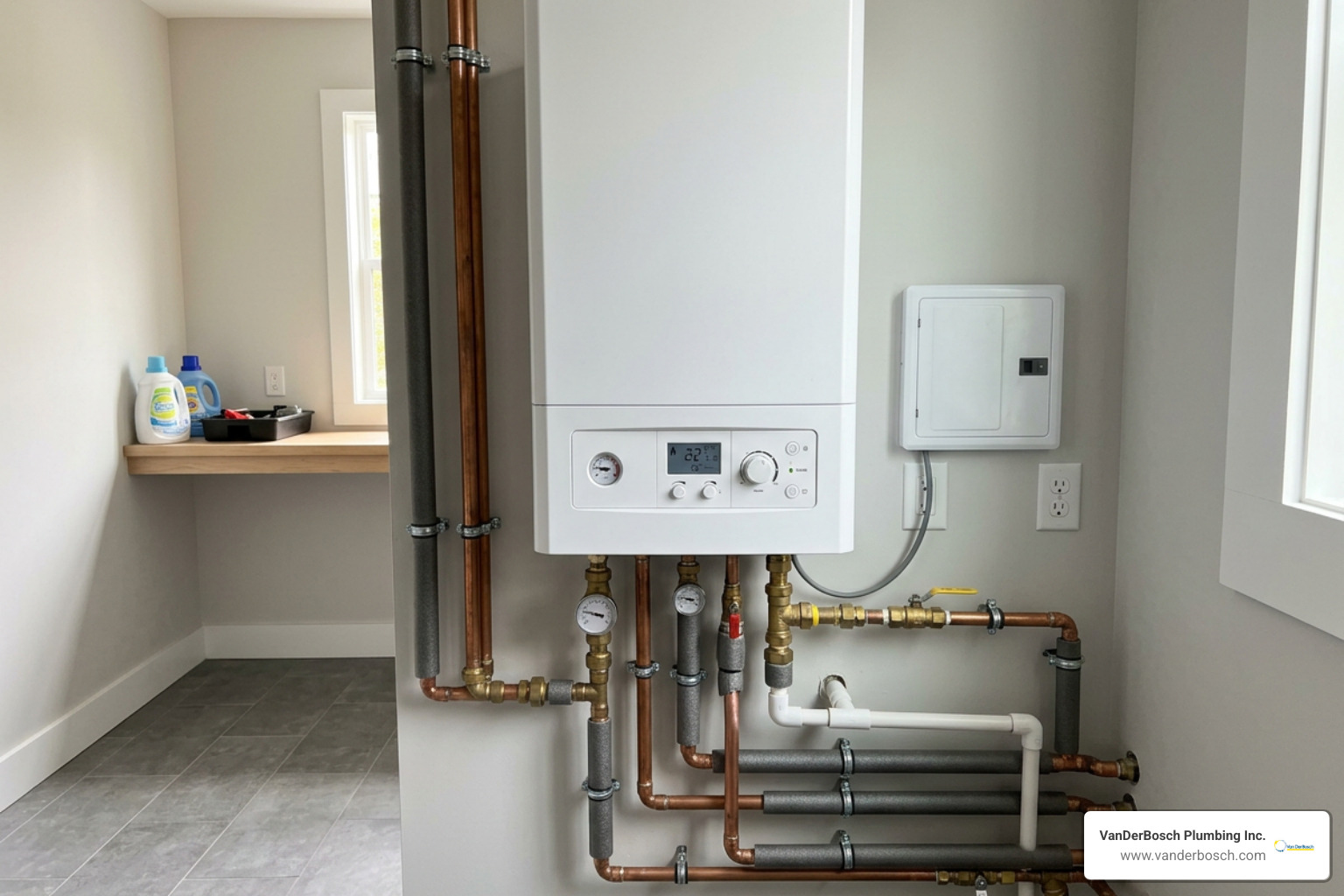
Understanding your boiler’s underlying architecture helps you communicate effectively with your service technician and select the right equipment when upgrading.
Residential and commercial boilers come in three core configurations:
- Combination (“Combi”) Boilers: Highly popular in modern retrofits, combi boilers serve as both a high-efficiency space heating unit and an on-demand domestic water heater in a single compact, wall-mounted cabinet. They eliminate the need for a separate hot water tank, saving valuable floor space.
- System Boilers: These units feature integrated pumps and expansion vessels built directly into the boiler casing. They work alongside a separate hot water storage cylinder, making them an excellent option for homes with multiple bathrooms and high simultaneous hot water demands.
- Conventional (Standard) Boilers: Common in older homes throughout Chicagoland, standard boilers utilize separate feed-and-expansion tanks along with traditional hot water storage tanks and circulating pumps. They are ideal replacements when existing heavy cast-iron piping is being retained.
In terms of heating mediums, systems operate via hot water (hydronic) or steam:
- Hot Water Systems: Water is heated to approximately 140°F–180°F and circulated through baseboard heaters, radiant floor tubing, or cast-iron radiators using electric circulating pumps. They offer gentle, steady, continuous heat.
- Steam Systems: Water is boiled into low-pressure steam, which rises naturally through piping into radiators where it condenses back into liquid water and drains back to the boiler. Steam systems provide intense heat but require careful water-level monitoring and skimmer valve maintenance.
Fuel sources across Illinois include Natural Gas, Propane, and Electricity:
- Natural Gas: The predominant fuel source across Cook County, providing cost-effective, high-BTU heating power.
- Propane (LPG): Used primarily in rural settings without municipal gas main access.
- Electric Boilers: Highly efficient at point of use with zero direct emissions, though operating costs depend heavily on local electric rates.
How to Select a Qualified Boiler Repair and Installation Contractor
Boilers operate under heat, high water pressure, and natural gas combustion. Because safety is paramount, boiler work should never be treated as a DIY project or handed off to an unlicensed handyman.
When selecting a heating contractor in Chicagoland, insist on the following qualifications:
- Licensing and Insurance: Verify that the contractor holds active municipal plumbing and heating licenses along with comprehensive liability and worker’s compensation coverage.
- ASME Code Knowledge: Professional boiler technicians should understand ASME boiler and pressure vessel codes, ensuring every pipe joint, weld, and relief valve meets rigorous safety guidelines.
- Background-Checked and Drug-Tested Staff: You deserve complete peace of mind when technicians enter your home. Look for established companies that mandate background checks and ongoing professional training.
- 24/7 Emergency Capabilities: Heating systems don’t wait for business hours to break down. Choose a contractor offering true round-the-clock emergency service with fully stocked service trucks.
- Transparent Pricing with Guarantees: Reliable contractors provide clear, upfront estimates before work begins — with no hidden service charges or unexpected fees — and back their workmanship with robust satisfaction guarantees.
If winter is approaching and you haven’t had your system checked, review our checklist on Top Signs You Need Boiler Repair Before Winter.
Frequently Asked Questions About Boiler Services
How often should my boiler be serviced?
You should schedule a professional boiler service at least once per year. The ideal time for maintenance is during early autumn before the heavy heating season kicks off. Annual servicing ensures safe operation, preserves high energy efficiency, catches minor component wear before it causes winter outages, and maintains active manufacturer warranty coverage.
What is the average lifespan of a well-maintained boiler?
A well-maintained residential boiler has an average lifespan of 15 to 20 years. In contrast, units that suffer from lack of maintenance, scale accumulation, or unaddressed water leaks often experience catastrophic heat exchanger failure in as little as 8 to 10 years. Annual servicing is the single most critical factor in achieving a full two-decade operational lifespan.
What should I do if my boiler loses pressure or shows an error code?
If your boiler’s water pressure gauge drops below 10 PSI, or if a digital error code flashes on the control screen, follow these steps:
- Note the Error Code: Write down or photograph the exact digital code displayed on the interface.
- Check for Visible Leaks: Inspect visible piping, radiator valves, and the relief discharge pipe for dripping water.
- Avoid Over-Pressurizing: If your system includes a manual fill loop, you can carefully re-introduce water until the cold pressure reads between 12 and 15 PSI. If pressure drops again quickly, turn off the fill valve immediately.
- Call a Professional: Repeated pressure loss indicates an internal leak, a failed expansion vessel bladder, or a faulty relief valve. For detailed step-by-step guidance on identifying system pressure drops, follow our Boiler Losing Pressure Troubleshooting Guide.
Conclusion
Proactive heating care is the secret to a warm home, low utility bills, and long-term peace of mind throughout cold winters. By scheduling annual maintenance checks, addressing minor leaks promptly, and understanding when to transition from old repairs to high-efficiency replacement units, you protect both your family’s comfort and your home’s equity.
At VanDerBosch Plumbing Inc., our licensed, background-checked technicians bring decades of dedicated hydronic experience to every service call across Chicago and surrounding communities, including Roselle, Winnetka, Melrose Park, Oakbrook Terrace, and Niles. We pride ourselves on transparent pricing with no hidden charges, 24/7 emergency availability, and a 100% satisfaction guarantee on every job.
Ready to schedule your pre-winter maintenance tune-up or request an estimate on a high-efficiency boiler upgrade? Explore our full range of Comprehensive VanDerBosch Boiler Services or call our friendly team today to book your appointment!