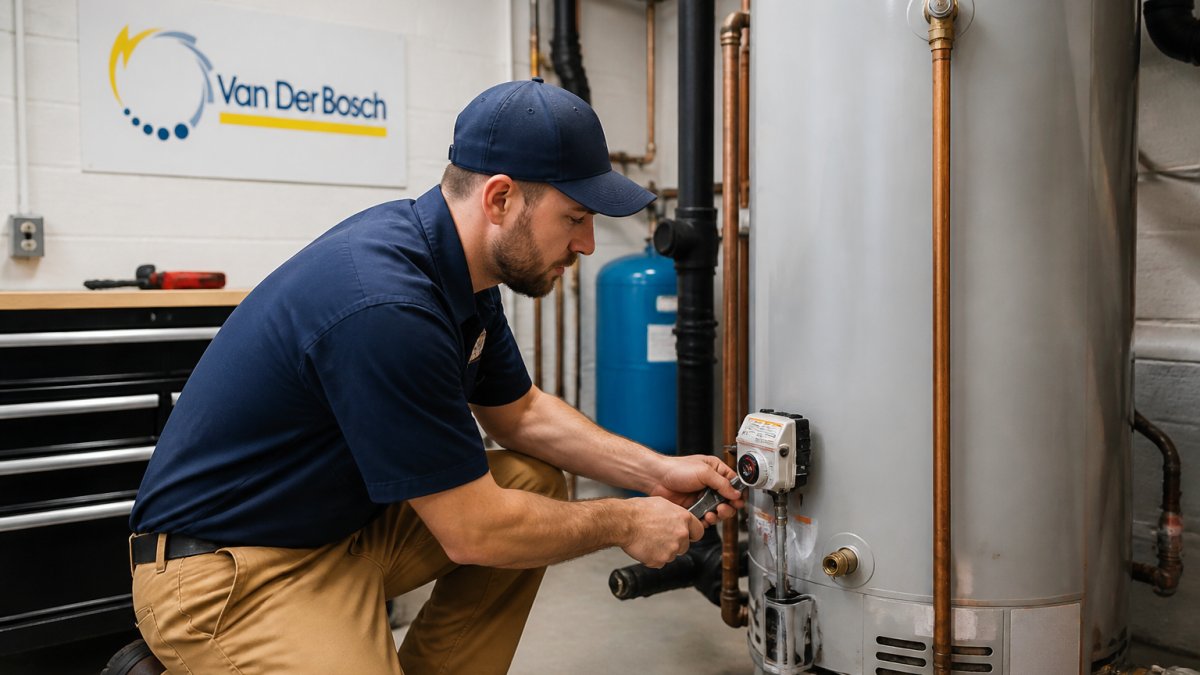
Water Heater Repair or Replace: How to Decide

Table of Contents

Last Updated: October 8, 2026

Water Heater Repair or Replace: How to Decide

At VanDerBosch Plumbing Inc., we’ve walked Chicago-area homeowners through this exact call for decades, and the pattern rarely changes. Age plus leak location tells most of the story before a wrench ever comes out.

Below, we’ll show you how to weigh repair against replacement using a simple rule of thumb, a symptom-to-part map, and the factors that actually drive the numbers.

Quick Comparison: Repair vs. Replace at a Glance

Repair makes sense when the problem is a single, accessible component and the tank itself is sound. Replacement makes sense when the tank, the surrounding plumbing, or the unit’s age points to more failures ahead.

Factor

Favor Repair

Favor Replace

Age of unit

Under 6 years

Over 10 years

Leak location

Fittings, valve, element

Tank body or base

Repair cost vs. age

Well under half of replacement

Half or more of replacement

Repair history

First issue

Third or fourth issue

Water quality

Clear, no rust

Rusty or metallic-tasting

Use this as a starting filter, not a verdict. A licensed plumber still needs to confirm what’s actually failing.

Key TakeawayLeaks from the tank body itself are the clearest replacement signal. Leaks from a fitting, valve, or drain are usually repairable.

Water Heater Lifespan: How Long Tanks and Tankless Units Last

A traditional tank water heater typically lasts about 8 to 12 years, while a tankless unit often runs 20 years or longer with regular maintenance. That gap matters when you’re weighing a repair bill against the years you’d get from a new unit.

Does Age Alone Decide It?

No. Age is one factor, not the whole case. A 12-year-old tank with a failed heating element may still have usable life left, while a 7-year-old tank with a corroded base is on borrowed time.

Here’s how we think about it:

  • Under 6 years: repair is usually the clear choice
  • 6 to 10 years: weigh the repair cost against remaining useful life
  • Over 10 years: replacement starts to make more sense, especially with a second or third failure

Sediment buildup is the quiet killer in older tanks. It forces the burner or element to work harder, shortens the unit’s life, and shows up as rumbling or popping noises.

Common Water Heater Problems and What They Usually Mean

Most water heater complaints fall into a handful of categories: no hot water, reduced hot water, inconsistent temperature, strange noises, or a leak. Each points to a different part, and each has a different repair outlook.
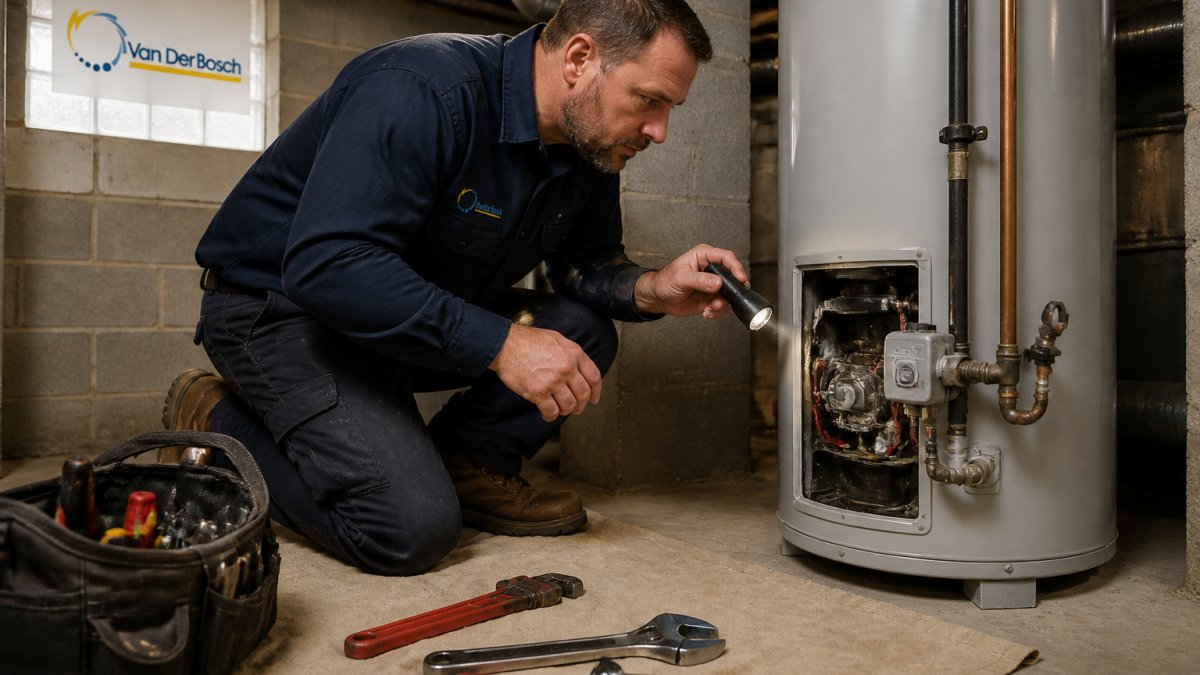
Article image

Repairable by Component: A Symptom-to-Part Map

  • No hot water (gas): pilot light, thermocouple, or gas control valve
  • No hot water (electric): heating element or upper thermostat
  • Reduced hot water: sediment buildup or a failing lower element

The last one is the fork in the road. If the tank shell is cracked, no repair fixes it.

Repair or Replace by Symptom

A failed element or thermostat is a straightforward repair. A leaking tank is not. That’s the line most homeowners need help finding, and it’s the reason a professional diagnosis matters more than a guess.

Watch OutIf you smell gas near a gas water heater, do not try to relight it or troubleshoot it yourself. Leave the area, avoid switches and open flames, and call your gas utility or a licensed plumber from a safe location.

The 50% Repair-Cost Rule and What Drives the Numbers

The 50% rule is a starting filter: if a repair costs half or more of what a comparable new unit would cost, replacement usually deserves serious consideration. It is a guideline, not a verdict. A repair that costs 40% of replacement on a two-year-old tank is a very different decision than the same ratio on a twelve-year-old tank.

Factors That Affect Water Heater Repair Cost

What we can tell you is what moves the number up or down:

  • Type and location of the problem, an accessible heating element is a different job than a fitting buried behind the tank
  • Accessibility, basement, closet, attic, or a tight mechanical room changes labor and time
  • Materials and parts required for the fix

Two identical symptoms can produce very different bills. That is why a real diagnosis comes before any number.

Total Cost of Ownership: The Math Most Guides Skip

Upfront repair cost is only one line in the ledger. A more useful comparison looks at what you will spend over the next several years, not just this month.

If you repair:

  • You pay the repair bill now.
  • You keep the existing efficiency rating, which on an older tank is lower than a new unit’s.
  • You accept the risk of another failure, often a related component, within the remaining service life.

If you replace:

  • You pay more upfront.
  • You reset the clock on the unit’s expected service life.
  • You gain the efficiency of a current model, which can lower monthly gas or electric use.

A common pattern: a repair on a unit with several years of life left pays for itself quickly, while a repair on a unit near the end of its service life rarely does.

When the Rule of Thumb Breaks Down

Three situations override the 50% math:

  • Tank shell leak. No repair fixes a cracked or corroded tank. Replacement is the only option regardless of cost ratio.
  • Safety issues. A failed pressure relief valve, scorched wiring, or a gas control problem that cannot be corrected safely points to replacement.
  • Code or venting problems. If the existing install no longer meets current code, a repair may not be permitted without bringing the rest of the system up to standard, which changes the math entirely.

Use the 50% rule as a first pass, then compare total cost of ownership over the next several years. The cheapest repair today is not always the cheapest decision.

Book a Visit →

Tankless vs Tank Water Heater: Which Replacement Makes Sense

If replacement is the call, the next question is what to replace it with. Three options dominate the residential market: traditional tank, tankless, and heat pump. Each has a different footprint, fuel requirement, and cost profile.

Traditional Tank Water Heaters

A tank unit stores a set volume of hot water and reheats as it is used. It is the most common type in older housing stock because it fits existing gas, venting, and electrical setups with minimal modification.

  • Strengths: lower upfront cost, simple installation, steady stored supply, works with standard venting
  • Tradeoffs: shorter service life than tankless, standby heat loss, larger physical footprint
  • Best fit: rental properties, tight budgets, homes where the existing venting and gas supply are already sized for a tank

Tankless Water Heaters

Tankless units heat water on demand and do not store it. They take up far less space and typically last longer than tanks with regular maintenance.

  • Strengths: long service life, endless hot water within capacity, small footprint, no standby loss
  • Tradeoffs: higher upfront cost, requires adequate gas supply and proper venting, may need electrical upgrades for the ignition and controls, flow rate limits how many fixtures can run at once
  • Best fit: households with steady demand and limited mechanical space, or owners planning to stay long enough to benefit from the longer service life

Tankless is not a drop-in swap. Gas line sizing, venting material and routing, condensate management on condensing models, and sometimes electrical capacity all have to be evaluated before installation. A unit that is undersized for the home’s demand will disappoint, and one that is oversized wastes money.

Heat Pump Water Heaters

Heat pump (hybrid) water heaters pull heat from the surrounding air to warm the water instead of generating heat directly (Heat Pump Water Heaters Achieve Significant Peak Reduction and Energy Savings). They use noticeably less electricity than a standard electric resistance tank.

  • Strengths: lower operating cost than a standard electric tank, qualifies for some utility and federal efficiency incentives, uses the same tank-style footprint
  • Tradeoffs: needs a large, unconditioned space with adequate airflow, typically a basement or garage, produces cooler air and some condensate, recovery is slower than a gas tank, and the compressor adds noise
  • Best fit: homes with an electric setup, a suitable basement or garage, and enough space around the unit for airflow

Heat pump units are a poor fit for a closet or a finished living space. They also are not a match for every household’s hot water demand pattern.

How to Choose

The right replacement depends on more than preference:

  • Fuel available: gas, electric, or both at the install location
  • Venting: existing flue type and whether it can be reused or must be modified
  • Space and airflow: closet, basement, garage, or utility room

Our team installs tank, tankless, and heat pump units and can walk you through tankless options if you want to compare. The right answer is the one that fits your fuel, space, and demand, not the one with the best marketing.

Before committing to any new unit, ask about the condition of the surrounding plumbing. A new water heater tied to a failing shutoff valve or corroded fittings just moves the next problem a few months down the road.

Safety First: Gas, Leaks, and When to Shut It Down

Any gas smell, scorched wiring, or active leak around a water heater is a stop-and-call situation. Your first move is to shut off the gas or power and the water supply, then get a licensed professional on site.

What to do right now:

  • Smell gas? Leave the area, don’t touch switches, and call your gas utility or a licensed plumber from outside
  • Active water leak? Shut off the water supply and, if safe, the power or gas to the unit
  • Scorched or burnt smell? Cut power at the breaker and keep clear of the unit

Do not attempt to repair gas lines, burners, or electrical components yourself. If a leak has already spread to the piping around the unit, that’s a separate repair, our burst pipe repair team handles damaged supply lines, and gas work around the heater falls under gas line repair and installation.

Permits, Code, and What Replacement Involves

A water heater replacement typically requires a permit and an inspection in most jurisdictions, and the work has to meet current plumbing and gas codes.

Skipping the permit can create real problems later: failed home inspections, insurance questions after a leak, and code violations you inherit at resale.

If you’re weighing repair against replacement, the water heater service team at VanDerBosch Plumbing Inc. can diagnose the unit, explain your options in plain terms, and handle the permit and install if replacement is the answer.

When a water heater fails, the pressure to decide fast can push you toward the wrong call. VanDerBosch Plumbing Inc. takes the guesswork out of it: licensed and insured technicians, honest and fair pricing, a 100% satisfaction guarantee, and availability seven days a week. Whether you need a repair or a full replacement, get started with VanDerBosch Plumbing Inc. and get your hot water back the right way.

Frequently Asked Questions

Is it worth it to repair a hot water heater?

It depends on the unit’s age and the repair involved. If the tank is still within its expected lifespan and the problem is a single component like a heating element, thermostat, or pilot assembly, repair is often the cost-effective choice. If the tank itself is leaking, corroded, or the unit is near the end of its water heater lifespan, replacement usually makes more sense because tank leaks cannot be repaired.

What is the average lifespan of a hot water heater?

Tank water heaters generally last about 8 to 12 years, while tankless units often run 15 to 20 years with regular maintenance. Actual water heater lifespan depends on water quality, sediment buildup, how hard the unit works, and whether it has been serviced. In areas with hard water, tanks can fail sooner because sediment collects on the bottom and overheats the steel.

Is it cheaper to repair or replace a water heater?

A single repair is almost always cheaper upfront than a full replacement. The useful comparison is the 50% repair-cost rule: if the repair costs more than half the price of a new unit and the heater is already past middle age, replacement is usually the better long-term value. Pricing depends on the unit type, the failed part, accessibility, and local code requirements.

How can I tell if my water heater needs to be replaced?

The clearest replacement signals are a leaking tank, a leak around the base, rust-colored water, corrosion on the tank fittings, or repeated repairs on a unit that is already 10 years or older. Erratic operation, reduced hot water, and strange noises point to repairable problems like sediment buildup or a failing heating element. A licensed plumber can diagnose the unit and confirm whether repair is still reasonable.
Commercial Plumbing Maintenance Contract Benefits

Table of Contents

Last Updated: October 7, 2026

Why Commercial Plumbing Maintenance Contracts Pay Off

A commercial plumbing maintenance contract puts a property’s plumbing on a recurring inspection and service cycle instead of waiting for something to fail. For property managers and building owners, the appeal is simple: predictable service beats emergency calls. VanDerBosch Plumbing Inc. has over 30 years of experience working on commercial plumbing systems across the Chicagoland area.

The Real Cost of Reactive Repairs

Reactive plumbing is expensive in ways that don’t show up on a single invoice. A failed water heater in a multi-unit building can mean tenant complaints, water damage, and after-hours labor all at once.

There’s also the diagnostic scramble. When a problem appears suddenly, technicians spend time tracing the source rather than fixing a known issue. On a maintenance contract, that groundwork is already done.

How Preventive Maintenance Changes the Equation

Preventive maintenance shifts the work from emergency response to planned service calls. A technician inspects the system on a set schedule, catches worn components before they fail, and documents what’s aging. That turns a surprise emergency into a scheduled repair.

The benefits compound:

  • Fewer emergency repairs and less downtime
  • Longer equipment lifespan for water heaters, boilers, and pumps
  • Lower energy use when equipment runs at spec
Key Takeaway
The core value of a commercial plumbing maintenance contract isn’t the discount on repairs. It’s the shift from unpredictable emergencies to scheduled, budgetable service.

Commercial Plumbing Maintenance Checklist: What Gets Inspected

A commercial plumbing maintenance checklist covers the systems most likely to fail and the ones most expensive to fix after a failure. Most plans include:

  • Water supply lines: checking for leaks, corrosion, and pressure issues
  • Drain lines and sewer lines: testing flow and looking for slow drains or recurring clogs
  • Water heaters: inspecting the tank, anode rod, valves, and connections

The checklist matters less than the record it produces. A written history of each inspection shows which components are trending toward failure, which is what actually prevents emergencies.

Building a Commercial Plumbing Maintenance Schedule That Works

A commercial plumbing maintenance schedule sets how often each system gets inspected, and the right frequency depends on the building. High-traffic commercial kitchens and multi-unit residential buildings need more frequent visits than a low-occupancy office.

A common approach is quarterly inspections for the full system, with monthly checks on high-use equipment like grease-prone drain lines or commercial water heaters.

System Typical Inspection Frequency Why It Matters
Drain and sewer lines Quarterly Catches clogs before backups
Water heaters Quarterly to semi-annual Prevents sudden failure and leaks
Boilers Annual, before heating season Avoids mid-winter breakdowns
Sump pumps and lift stations Semi-annual Confirms operation before storms
Valve and backflow testing Annual Keeps shutoffs and devices reliable
Full system walkthrough Quarterly Tracks overall condition over time

Seasonal Adjustments for Cold-Climate Properties

Winter changes the schedule. In cold-climate buildings, exposed pipes in basements, crawl spaces, and unheated areas are at risk of freezing (Essential Tasks After it Warms Up).

Boilers deserve special attention before heating season. A steam or hot-water boiler that hasn’t been serviced since spring can fail on the first cold week, when every plumber in the area is booked.

What a Commercial Plumbing Service Agreement Includes

A commercial plumbing service agreement defines what the maintenance plan covers, how often technicians visit, and what happens when something breaks. It’s the part most buyers skim past, a mistake, because two agreements with the same headline frequency can cover very different amounts of work.

Most agreements spell out:

  • The systems covered and the inspection frequency for each
  • What is included in a routine visit versus billed separately
  • Response commitments for emergencies, including after-hours terms

Scope: What Is Actually Covered

Scope is where agreements diverge. One contract may cover a full walkthrough of supply lines, drains, water heaters, boilers, pumps, and valves; another may cover only drain lines and call everything else a billable service call.

Read the scope with your building in mind. A restaurant with grease-prone kitchen drains has different priorities than an office building with a few restrooms.

Exclusions and Billable Work

Every maintenance agreement has exclusions, and they are usually reasonable. Common ones include:

  • Major repairs and equipment replacement
  • Work caused by tenant misuse, such as foreign objects flushed into drains
  • Damage from freezing, storms, or other events outside normal wear

The question is not whether exclusions exist, but whether they are written clearly enough that you can predict what a given call will cost. Vague language like “major repairs excluded” leaves the boundary open to interpretation. A contract that names the categories of billable work is easier to budget against.

Service-Level Agreements and Response Commitments

The service-level agreement, or SLA, is the part property managers should read most carefully. It states how fast the provider responds, whether after-hours service is included, and what priority a contract client gets over a one-off caller. Response language should be measurable: “priority service” means little on its own, while terms like “respond within a set number of hours during business hours” or “after-hours calls routed to an on-call technician” tell you what actually happens when a pipe fails at 2 a.m.

Documentation and Reporting

A maintenance contract should produce a paper trail. Each visit should generate a written report listing what was inspected, what condition it was found in, and what needs attention.

Ask to see a sample report before you sign. If the provider cannot show you what a completed visit looks like, you have no way to judge the documentation until after the contract starts.

Watch Out
Do not sign a service agreement that lists covered systems vaguely. If the contract does not name the equipment, the inspection frequency, and the exclusions, you have no way to hold the provider to it later.

How to Compare Two Agreements Side by Side

When you have more than one proposal, compare them on the same points rather than the bottom line alone:

  • Which systems are named, and which are left out
  • Visit frequency per system, not just an overall number
  • What counts as included work versus a billable service call

An agreement that looks cheaper on the summary page can cost more over a year if it excludes the systems your building relies on most. The comparison is about coverage and predictability, not just the recurring figure.

The Commercial Plumbing Inspection: What to Expect During a Visit

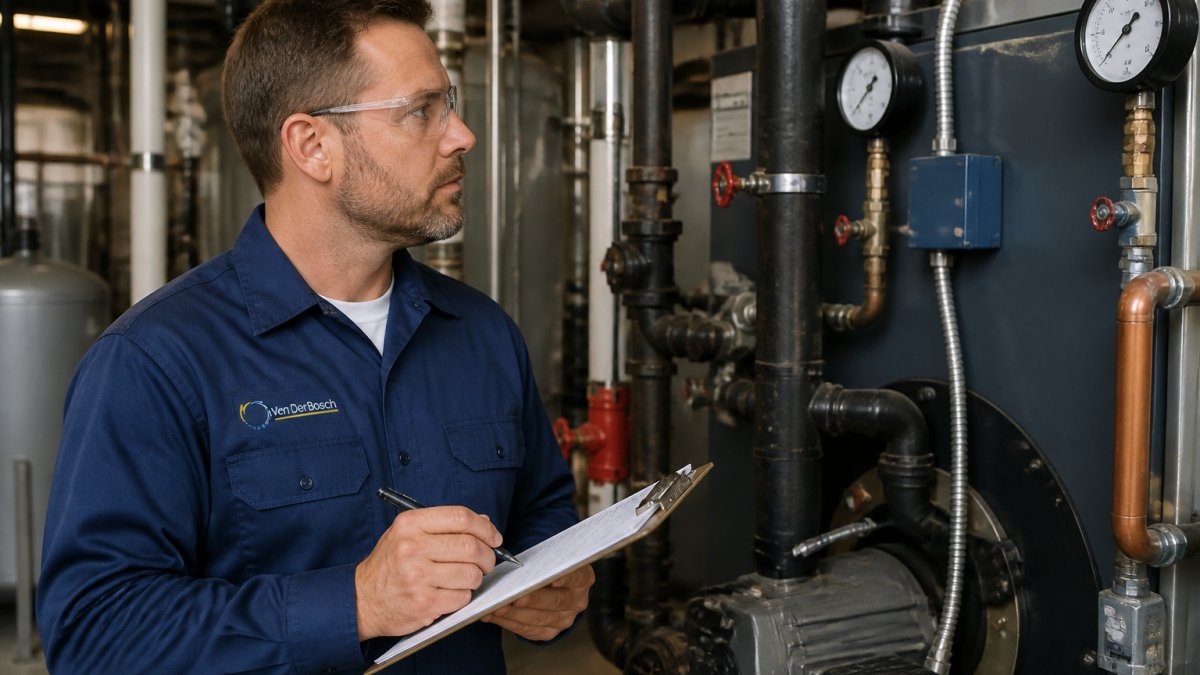
A commercial plumbing inspection is a scheduled walkthrough where a technician checks each covered system, documents its condition, and flags anything that needs attention.

Book a Visit →

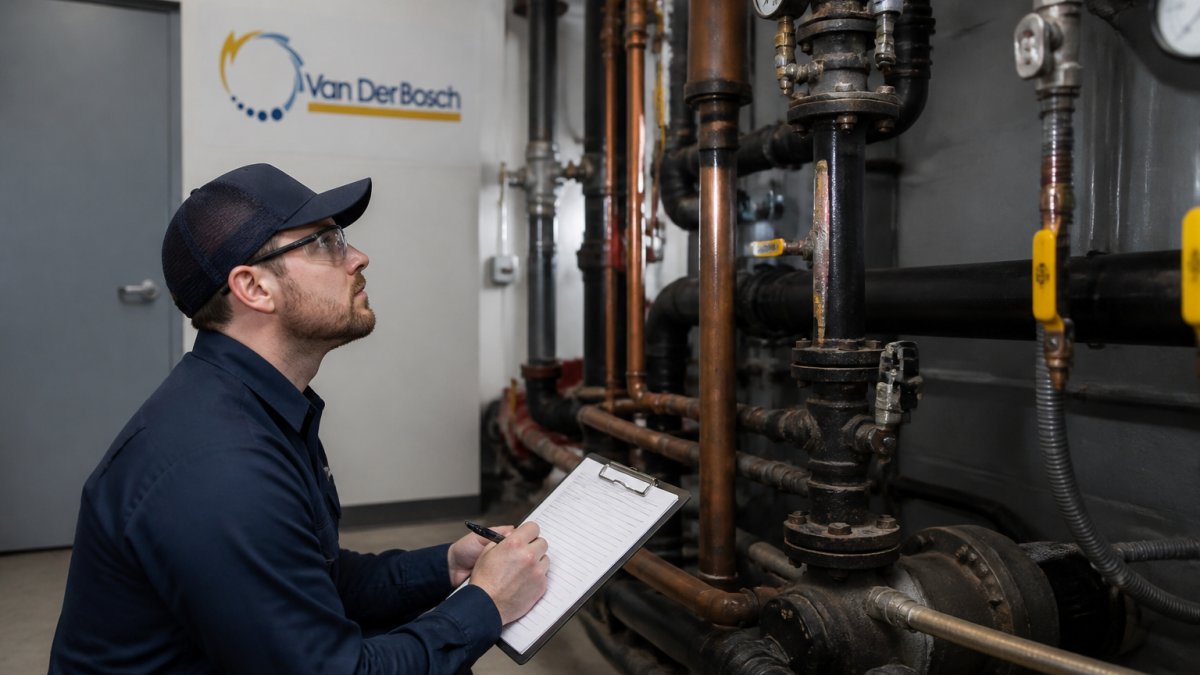
Licensed plumber with a checklist inspecting a boiler room during commercial plumbing maintenance

The report matters as much as the visit. A running record of each inspection shows how equipment is aging and gives you evidence when it’s time to plan a replacement rather than another repair.

How to Evaluate and Select a Commercial Plumbing Provider

Choosing a commercial plumbing provider comes down to response capability, coverage, and transparency, not just price. A provider who cannot reach your building quickly during a failure is not much help, no matter how competitive the routine rate looks. Evaluate before you sign, not after the first emergency call.

Start With Licensing and Insurance

Commercial plumbing work in most jurisdictions requires a licensed plumber, and certain tasks carry additional requirements. Gas line work, boiler service, and backflow testing are common examples where credentials matter as much as the work itself.

Ask for:

  • The license number and the name it is issued to
  • Proof of general liability insurance and workers’ compensation coverage
  • Confirmation that the technicians who will work in your building are covered under those policies

Verify the license through the issuing authority rather than accepting a number on a business card.

Confirm Commercial Experience

Residential and commercial plumbing overlap, but they are not the same job. Commercial buildings have larger pipe sizes, different code requirements, higher-demand water heating and boiler systems, and often more complex drain layouts.

Ask what share of their work is commercial, what types of buildings they typically service, and whether they have experience with the specific systems in your property.

Check References and Service-Area Coverage

References are most useful when they come from buildings similar to yours. Ask for two or three commercial clients with comparable systems and call them.

Service-area coverage matters too. A provider who lists your area but has no technicians nearby may not meet the response terms in the agreement. Ask where the nearest technicians are based and how they route calls to your building.

Evaluate Response Capability

Response capability is more than a phone number. Ask:

  • Who answers after hours, and how calls are routed
  • Whether the same technicians handle routine visits and emergency calls
  • How the provider communicates status while you wait

A provider with a clear after-hours process is easier to rely on than one who promises “24/7 service” without explaining how it works.

Review Pricing Structure and Transparency

Pricing for commercial maintenance agreements varies with the building, the systems covered, and the visit frequency. Rather than comparing a single figure, ask how the provider builds the number: what is included in the recurring fee, what is billed separately, and how out-of-scope work is quoted.

A transparent provider will explain the factors that affect the agreement cost: the number of systems covered, the size and age of the building, the visit frequency, and the response terms.

Questions to Ask Before Signing

  • Can you service multiple properties under one agreement?
  • What are your response commitments for emergencies, and are they in writing?
  • How do you document each inspection, and can I see a sample report?

For gas lines, boilers, and other hazardous systems, confirm the provider’s technicians are properly licensed and insured for that work. Never attempt gas line or boiler repairs yourself; those require a licensed professional.

Pro Tip
Ask for a sample inspection report and a copy of the proposed agreement before you sign. The quality of the documentation and the clarity of the scope tell you more about a provider’s process than any sales pitch.

Red Flags to Watch For

A few patterns suggest an agreement will be hard to manage:

  • Scope language that names categories of work but not specific systems
  • Response terms described only as “priority” or “prompt” without measurable commitments
  • No sample report or documentation example available

None of these is automatically disqualifying, but each is worth a direct question before you commit.

Conclusion

A commercial plumbing maintenance contract only pays off if the provider shows up, documents the work, and responds when something fails. The right agreement turns plumbing from a recurring emergency into a managed expense.

VanDerBosch Plumbing Inc. offers commercial plumbing service with no service charges, same-day service, and availability seven days a week.

Frequently Asked Questions

What are the benefits of a commercial plumbing maintenance contract?

A commercial plumbing maintenance contract shifts your property from reactive repairs to planned care. Regular inspections catch small issues like slow drains, worn valves, or early leaks before they become emergencies. That reduces downtime, extends the life of water heaters, boilers, and pumps, and helps control repair costs over time. Scheduled visits also keep maintenance records organized, which matters for property managers who need documentation. Many contracts include priority response for urgent problems, so a burst pipe or sewer backup gets attention faster than a cold call to an unfamiliar plumber.

What should a commercial plumbing maintenance agreement include?

A solid commercial plumbing service agreement should spell out the scope of work, inspection frequency, and which systems are covered: water supply lines, drain lines, sewer lines, water heaters, boilers, sump pumps, and valves. Look for details on priority response times, how after-hours emergencies are handled, and whether repairs are billed separately or bundled. The agreement should also state what documentation you receive after each visit and how the provider handles findings that need follow-up work. Ask for the terms in writing before signing.

How often should commercial plumbing systems be inspected?

Most commercial properties benefit from at least annual inspections, but high-traffic buildings, restaurants, and multi-unit residential properties often need quarterly or semi-annual visits. A commercial plumbing maintenance schedule should account for your building’s age, water usage, and equipment. Older buildings with original pipework or steam boilers may need more frequent checks. In cold climates, adding a pre-winter inspection helps catch vulnerable pipes before freezing temperatures arrive. Your provider can recommend an inspection frequency based on your specific systems and usage patterns.

Can preventive plumbing maintenance reduce emergency repairs?

Yes. Preventive maintenance targets the conditions that lead to emergencies: corrosion, mineral buildup, worn seals, failing valves, and slow drains that signal a developing blockage. When these are addressed during a scheduled commercial plumbing inspection, the likelihood of a sudden failure drops. That means fewer after-hours calls, less water damage risk, and more predictable operating costs. It also gives property managers time to budget for planned repairs instead of absorbing unexpected emergency expenses.

Tankless Water Heater Installation Cost: What to Expect

Table of Contents

Last Updated: October 6, 2026

What Drives Tankless Water Heater Installation Cost

The tankless water heater installation cost you’re quoted reflects equipment, labor, and site conditions, not a flat rate. Two homes on the same street can receive very different figures because the work behind the wall rarely matches.

At VanDerBosch Plumbing Inc., the unit itself is only part of the equation. The rest is what it takes to connect it safely. Below, we’ll break down each factor so you can read an estimate with confidence.

Key TakeawayThe tankless water heater installation cost is driven less by the unit’s sticker price and more by what your home’s existing gas, venting, and electrical systems can support.

Unit Capacity and BTU Rating

BTU rating measures how much heat a tankless unit can produce in an hour. Higher capacity costs more but serves more fixtures at once. Undersize the unit and you’ll get temperature swings every time someone runs a second shower, so capacity should follow your household’s actual demand, not the biggest number on the spec sheet.

Labor Hours and Installation Complexity

Labor is where estimates diverge most. A straightforward swap with a short, accessible vent run takes far fewer hours than a retrofit requiring new gas piping and a relocated exhaust. Complexity shows up in predictable places:

  • Distance from the unit to an exterior wall for venting
  • Whether the gas line needs upsizing
  • Accessibility of the mounting location

Each adds time, and time is the largest variable in most quotes.

Tankless Water Heater Installation Requirements

Tankless water heater installation requirements center on three systems: gas supply, venting, and electrical. These dictate what’s physically possible, so a unit that fits one home may be wrong for the next.

Article image

Gas Supply, Venting, and Electrical Needs

Gas-fired units need a supply line sized to match the unit’s BTU rating.

Venting matters just as much. Exhaust must route outdoors through approved materials, and run length and termination must meet local code.

Electric tankless models sidestep venting but typically require a dedicated circuit and often an electrical upgrade. That work belongs with a licensed electrician, not a homeowner.

Watch OutNever attempt to modify a gas line, venting run, or electrical circuit yourself. Gas and exhaust work carries serious safety risks and must be performed by a licensed professional.

Sizing for Household Demand and Flow Rate

Sizing is where most tankless regrets start. The unit must heat water fast enough to serve every fixture running at once, and that number, not square footage, sets required capacity. Three inputs drive the calculation:

  • Peak flow rate, the combined gallons per minute (GPM) of every fixture likely to run at once. A standard shower head runs roughly 2.0-2.5 GPM, a bathroom faucet about 1.0-1.5 GPM, a kitchen faucet around 1.5-2.2 GPM, and a dishwasher or washing machine draws in bursts.
  • Temperature rise, the gap between incoming ground water and your target output. Incoming water runs warmer in summer and colder in winter, so the same unit produces less hot water in January than in July.
  • Ground water temperature, in northern climates, winter incoming water can sit in the low 40s°F, while summer water may reach the low 60s°F. That swing can cut a unit’s effective output by a meaningful margin, which is why sizing calculators built for warm climates steer homeowners toward undersized equipment.

A practical example: two showers, a kitchen faucet, and a dishwasher running together can demand 6-8 GPM at a 60-70°F rise. A unit rated for that flow at a 40°F rise won’t keep up in winter, showing up as temperature swings whenever a second fixture opens.

What to Check Before You Commit to a Unit

Before choosing a model, confirm:

  • The gas meter and service line can deliver the unit’s rated BTU input alongside the furnace, range, and dryer.
  • There is a code-compliant vent path to an exterior wall within the manufacturer’s allowed run length.
  • The electrical panel has capacity for the controls, igniter, and any recirculation pump.

If any are in question, a licensed plumber should evaluate the site before a unit is ordered. Replacing a tank heater with a tankless model is not a like-for-like swap.

Tankless Water Heater Conversion Cost: What Changes From a Tank System

Tankless water heater conversion cost is usually higher than a like-for-like replacement because you’re changing the system, not just the box. A tank heater stores hot water; a tankless unit heats on demand, and that difference ripples through the installation.

What typically changes:

  • Gas line sizing to match higher demand
  • New venting routed to an exterior wall
  • Electrical work for controls or a dedicated circuit

A conversion also means removing and disposing of the old tank. If you’re weighing whether the switch makes sense, our water heater repair and installation team can walk through your setup.

Tankless Water Heater Installation Cost Factors: Permits, Code, and Site Conditions

Permits, code compliance, and site conditions are the factors homeowners most often overlook when budgeting. They’re also the ones most likely to change a quote after work begins.

Permits and Inspections

Most jurisdictions require a permit for water heater replacement and gas work, followed by an inspection. Permit fees vary by municipality, and the inspection must pass before the job is complete, so the permit is a scheduled project step, not just a fee. A few things to know:

  • Permit fees are usually set by the local building department and scale with the scope of work, not the equipment cost.
  • Gas work and venting changes typically trigger a separate inspection from the plumbing rough-in.
  • Some jurisdictions require the permit to be pulled by the licensed contractor performing the work, not the homeowner.

Ask any contractor to list permit and inspection costs as separate line items on the estimate. Bundled fees make it impossible to compare quotes fairly.

Code Requirements That Shape the Scope

Code requirements are not uniform, but a few themes show up across most jurisdictions:

Book a Visit →

  • Venting, material, slope, run length, and termination point are specified. A vent exiting too close to a window, door, or air intake will fail inspection.
  • Combustion air, gas-fired units need adequate air supply, which can require added openings or ducting in tight mechanical rooms.
  • Gas line sizing, the line must deliver the unit’s rated BTU input at the required pressure, often meaning upsizing from the tank heater’s line.

Because these rules vary by jurisdiction, verify with the local authority having jurisdiction (AHJ) before work begins. A contractor who has pulled permits in your area will already know the local interpretation.

Site Conditions That Add Labor

Site conditions add their own layer. Older homes may have undersized gas lines, corroded fittings, or a vent path blocked by finished walls. Common examples:

  • A finished basement ceiling that must be opened to run a new vent or gas line.
  • A gas meter on the opposite side of the house from the water heater.
  • A mechanical room too tight to meet combustion air or clearance requirements.

Each is a known cost driver, and a good estimate will call them out before work starts rather than after.

Rebates, Tax Incentives, and Financing

Upfront cost is not the same as net cost. Federal tax credits, utility rebates, and manufacturer promotions can offset part of a qualifying tankless installation.

  • Federal incentives for high-efficiency water heating have changed over time; verify current rules and efficiency thresholds at purchase.
  • Utility rebates are often tied to specific efficiency ratings and may require the installing contractor to submit paperwork.
  • Manufacturer promotions typically have expiration dates and may require registration.
Pro TipAsk any contractor to list permit and inspection costs as separate line items on the estimate, and ask whether they handle rebate paperwork. Bundled fees and unclaimed rebates both make it harder to compare the real net cost of a quote.

VanDerBosch Plumbing Inc. can walk through your setup, explain what permits and inspections your project requires, and help you understand which cost factors apply before work begins.

Tankless Water Heater Installation Time: What the Project Timeline Looks Like

Tankless water heater installation time ranges from a few hours for a simple swap to a full day or more when gas, venting, or electrical work is involved. The timeline follows the scope, not a fixed schedule.

U.S. Department of Energy guidance on water heating notes that proper sizing and installation affect both performance and operating efficiency, which is why rushing the setup rarely pays off.

Step-by-Step Overview of a Typical Install

Here’s how a professional install generally unfolds:

  1. Assessment and permit – Confirm sizing, gas capacity, and vent path; pull required permits.
  2. Shutdown and removal – Isolate gas and water, drain and remove the old tank.
  3. System modifications – Upsize gas lines, run new venting, or add electrical circuits as needed.
  4. Mounting and connection – Secure the unit, connect gas, water, and condensate drain lines.
  5. Testing and inspection – Check for leaks, verify flow and temperature, pass inspection.
  6. Cleanup and walkthrough – Restore the area and review operation with you.

Expected result: consistent hot water at the fixtures you specified, with the installation signed off by inspection.

Phase

Typical Duration

What Happens

Assessment and permit

Same day to a few days

Sizing, gas check, permit filing

Removal and modification

2-5 hours

Old tank out, gas and vent work

Mounting and connection

2-4 hours

Unit set, lines connected

Testing and inspection

1-2 hours

Leak check, code sign-off

Repair or Replace? Deciding When a Tankless Unit Is Worth Keeping

Repair usually makes sense when a tankless unit is relatively new, the problem is isolated, and parts are available. Replacement tends to win when failures repeat or the unit no longer meets household demand. Work through these factors:

  • Age and repair history – A unit with recurring issues may cost more over time than a replacement.
  • Severity of the fault – A failed control board differs from a cracked heat exchanger.
  • Efficiency and capacity – If your household has outgrown the unit, repairs won’t fix the shortfall.

We don’t push replacement when a repair is the reasonable call. Sometimes a descaling service or a replaced part is all a unit needs.

How to Evaluate a Tankless Water Heater Installation Estimate

A useful estimate separates equipment, labor, and materials so you can see where the money goes. A lump sum with no breakdown makes it impossible to compare like with like. Ask for these line items:

  • Unit price and model number
  • Labor hours and rate
  • Materials – copper pipe, pipe fittings, ball valves, shutoff valve, pressure relief valve, condensate drain

Federal Trade Commission guidance on home improvement contracts advises getting written estimates and understanding what’s included before signing. That applies directly to plumbing work.

Watch OutBe cautious of any quote that omits permits or lists a suspiciously low labor figure. Those gaps often reappear as change orders once work starts.

VanDerBosch Plumbing Inc. provides transparent pricing with no service charges. Our technicians are licensed and insured, and we back new equipment with a 90-day warranty.

Comparing tankless water heater installation cost estimates can feel like reading three different languages. The right approach is to compare scope, not just totals. VanDerBosch Plumbing Inc. offers same-day service, seven-day availability, and a 100% satisfaction guarantee, with no service charges to come take a look. Explore our tankless water heater installation service or call today to schedule your assessment.

Frequently Asked Questions

What factors affect the cost of installing a tankless water heater?

The biggest drivers are the unit’s BTU rating and heating capacity, whether your home has natural gas or propane, and how much modification the existing gas line, venting, and electrical system need. Labor hours, permit fees, and whether the install is a replacement or a first-time conversion from a tank system also affect the total. Because every home’s plumbing layout is different, the only reliable number comes from an on-site assessment and a written quote.

Does installing a tankless water heater require changes to gas lines or venting?

Often, yes. Many tankless units need a larger gas line than a tank water heater used, and they require a dedicated vent, either concentric PVC or stainless steel, rather than the atmospheric vent a tank unit typically uses. Electric models may need a dedicated circuit or panel upgrade. A plumber should confirm your existing connections, gas meter capacity, and vent path before quoting the job.

How long does tankless water heater installation take?

A straightforward swap where gas, venting, and water connections already meet code can often be completed in a few hours. A conversion from a tank system, or a job that requires new gas piping, venting runs, or an electrical upgrade, usually takes longer and may span more than one visit. Your plumber can give a realistic timeline after inspecting the installation site.

Is it worth converting from a tank water heater to a tankless model?

It depends on your hot water demand, available space, and how long you plan to stay in the home. Tankless units free up floor space and heat water on demand rather than storing it, which some homeowners prefer. The trade-off is a higher upfront installation cost, especially if gas line or venting work is needed. A plumber can help you weigh the conversion against simply replacing your existing tank.

Questions to Ask Before Hiring a Plumber

Table of Contents

Last Updated: October 5, 2026

Questions to Ask About Credentials and Licensing

The most important questions to ask plumber should start with verifying credentials and licensing first.

Ask directly: “Are you licensed to perform plumbing work in this area?” A licensed plumber has passed exams on plumbing codes, safety, and best practices.

Insurance matters too. Ask: “Do you carry liability insurance and workers’ compensation?” Liability insurance protects you if something goes wrong; workers’ comp covers the plumber if injured on your property.

How to Verify a Plumber’s License and Insurance

Don’t just take the plumber’s word for it.

For insurance, ask for a certificate of insurance and call the insurer to confirm the policy is active.

Finally, ask: “Have you had any complaints filed against you?” You can also check the Better Business Bureau or local consumer protection agencies.

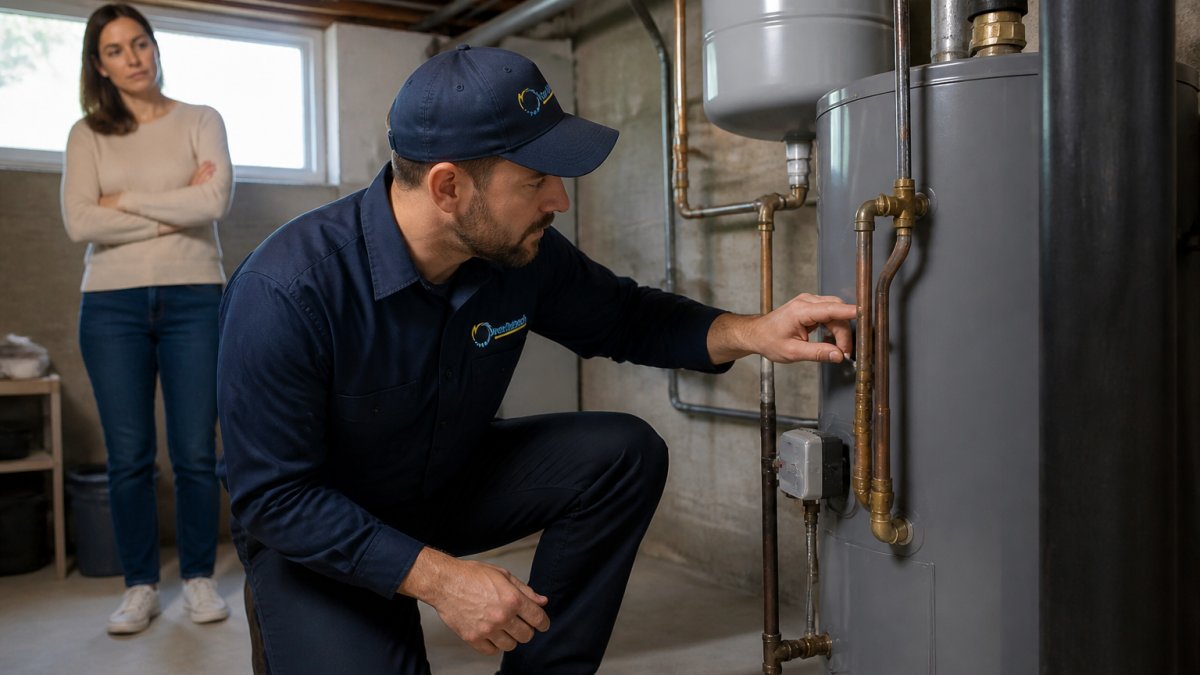
Professional plumber in uniform examining water heater system in residential basement with homeowner observing in background, natural lighting from basement window

Plumber Estimate Questions and Pricing Factors

When you call for an estimate, the goal is to understand what the job costs and why, so you can compare quotes fairly.

Ask how labor is calculated, hourly or flat rate, and whether there’s a service call fee just to diagnose.

Ask what’s included: materials, permits, cleanup, disposal, travel time?

What Should Be Included in a Written Estimate

A good written estimate is specific. It should list:

  • The exact work to be performed (not vague language like “fix plumbing”)
  • Materials needed and their cost
  • Labor hours or flat rate
  • Any service call or diagnostic fees
  • Permits or inspections required

The estimate should also specify what happens if additional problems are found.

Ask about warranties on the work and any equipment installed. VanDerBosch Plumbing Inc. offers a 90-day warranty on new equipment.

Compare estimates from at least two plumbers. Don’t automatically choose the cheapest, a much lower estimate might mean cut corners or an underestimated scope.

Ask if the estimate includes a timeline. When can work start, and how long will it take?

Experience and References: The Right Questions to Ask

Experience is easy to claim and harder to verify. The right questions to ask plumber force a specific answer you can check.

Questions That Reveal Real Experience

  • “How many jobs like mine have you completed in the past year?”, A plumber who does sewer line work weekly will answer quickly. A generalist will hedge.
  • “What’s the most common failure point you see on systems like mine?”, For a steam boiler, a knowledgeable answer might mention low-water cutoff issues, faulty pressuretrols, or radiator vents. For a tankless water heater, scale buildup or undersized gas supply. Vague answers signal inexperience.
  • “Who on your team will actually be doing the work?”, Some companies send a licensed master to sell the job and an apprentice to do it. Not automatically a problem, but you should know who is on site.
  • “Do you handle permits yourself, or do I need to pull them?”, In most jurisdictions, the licensed contractor pulls the permit. If a plumber asks you to pull it as the homeowner, that’s a warning sign.

How to Check References Without Wasting Time

Ask for the right references.

  • Request two or three references from jobs completed in the last six months, not years ago. Recent references reflect current staff and standards.
  • Ask for at least one reference matching your job type, a water heater replacement, sewer repair, or boiler service. A faucet swap reference tells you little about a repiping job.
  • When you call, ask: Did the plumber show up when scheduled? Did the final bill match the estimate? Was the work area left clean? Would you hire them again?

Reading Reviews the Right Way

Read reviews as a pattern, not a verdict.

  • One bad review is noise. Three describing the same problem, missed appointments, surprise charges, no callbacks, is a pattern.
  • Look at how the company responds to negative reviews. A business that replies professionally and offers to make it right signals something different from one that argues or ignores.
  • Check the Better Business Bureau for complaint history and whether complaints were resolved. Your state or local consumer protection agency is a second source.

Matching Experience to Your Job

Different problems require different skill sets. A plumber excellent at drain cleaning may not be right for a boiler replacement, and vice versa.

  • Drain and sewer work: Ask whether they use sewer video inspection to confirm the cause before recommending repair, and whether they offer hydro jetting for grease or root intrusion versus snaking for simple clogs.
  • Water heaters: Ask whether they install both tank and tankless units, and whether they handle venting and gas line sizing for a tankless conversion.
  • Boilers: Ask specifically about steam versus hot-water systems. These are different systems with different controls, and not every plumber services both.
  • Gas lines: Ask whether they perform gas leak detection and gas line installation, and confirm they hold the credentials required for gas work in your area.

If a plumber can’t explain their diagnostic approach for your problem, that’s your answer. A qualified plumber describes how they’d confirm the cause before quoting, not guess over the phone.

Pro Tip
Before you call, write down three details: when the problem started, what you’ve already tried, and any recent work on the system. Plumbers who ask follow-up questions about those details are usually the ones who diagnose carefully.

For recurring drain backups, a sewer video inspection can confirm whether the issue is root intrusion, a bellied line, or a collapsed section, three different problems with three different repairs. For water heater or boiler questions, the right first step is often a service call to diagnose rather than a phone quote.

What to Expect During a Plumbing Service Call

Knowing what happens during the service call helps you prepare.

The plumber should explain the problem, why it happened, and outline repair options in plain terms.

Book a Visit →

For water heater repair or replacement, ask about the process.

Ask about cleanup: “Will you clean up debris and dispose of old materials?” This matters for jobs like drain cleaning or pipe replacement.

During the work, the plumber should keep you informed.

Questions to Ask Before Replacing a Water Heater

Water heater replacement is a major decision. Ask the right questions to choose the best option.

Ask about tank versus tankless.

Ask about energy efficiency.

Ask about warranty coverage. How long is it? What does it cover, labor or just parts?

Ask about installation requirements. Will the new unit fit where the old one was?

Ask about maintenance. Tank systems typically need annual flushing; tankless systems need descaling.

Red Flags and Warranty Protection

Most plumbing companies are legitimate. The ones that aren’t follow recognizable patterns, and knowing them ahead of time is the best protection.

Red Flags That Should End the Conversation

  • Large upfront cash payment required. A deposit for materials is normal on larger jobs. Demanding most or all payment before work begins is not. Never pay in full before the work is done and inspected.
  • No written estimate, or a verbal-only quote. If a plumber won’t put scope and terms in writing, you have no way to hold them to it.
  • Pressure to decide immediately. “This price is only good today” or “we have a crew in the area right now” are sales tactics, not scheduling realities. Legitimate plumbers schedule work without a countdown clock.
  • Recommendation to replace without diagnosis. If a plumber recommends replacing a water heater or boiler without checking obvious failure points first, thermocouple, heating element, pressuretrol, expansion tank, ask why. Sometimes replacement is correct; sometimes it’s the faster sale.
  • No physical business address or verifiable license number. A plumber who won’t provide a license number you can look up is a risk you don’t need.

Contract and Scope Red Flags

Read the estimate or contract before you sign. Watch for:

  • Vague scope language like “repair plumbing as needed” instead of a specific description.
  • No stated process for change orders, what happens if the plumber finds something unexpected after opening a wall or floor.
  • No completion timeline or start date.
  • No mention of who pulls permits and who pays for inspections.
  • Blank spaces in the contract that could be filled in later.

A legitimate estimate describes the work, lists materials, notes permits required, and explains how additional findings will be handled. If the plumber finds a corroded pipe behind a wall that wasn’t in the original scope, they should stop, explain, and get your approval before proceeding, not add it to the bill afterward.

Warranty Questions to Ask Before You Sign

Warranty terms vary widely, and the differences matter when something fails.

  • What does the workmanship warranty cover, and for how long? Workmanship coverage applies to the installation itself, a leak at a fitting, a poorly soldered joint, a water heater installed with the wrong venting. This is separate from the manufacturer’s warranty on the equipment.
  • What does the manufacturer’s warranty cover? Most water heater and boiler manufacturers cover parts for a set period. Labor is often not included. Ask who handles labor if a covered part fails.
  • Does the warranty transfer if you sell the home? Some do, some don’t. If you might sell within the warranty period, this matters.
  • What’s the process for a callback? If something fails a week after the job, who do you call, and how quickly will they respond? Get this in writing.
  • Are there conditions that void the warranty? Some warranties require annual maintenance or prohibit homeowner repairs. Know the rules before you need them.
Watch Out
If you smell gas, hear hissing near a gas line, or see a boiler leaking water or showing error codes, don’t wait to compare quotes. Leave the area if you suspect a gas leak, avoid operating switches or open flames, and call your gas utility’s emergency line or 911 from a safe location. Gas and boiler issues are not DIY territory.

How to Compare Two Estimates Fairly

Once you have written estimates from two or more plumbers, compare line by line:

  • Are they quoting the same scope, or is one excluding something the other includes?
  • Are materials specified by brand and model, or left generic?
  • Are permits and inspections included?
  • Is the warranty stated in writing?
  • Does the timeline match your needs?

If you’re ready to move forward, VanDerBosch Plumbing Inc. can walk you through the scope, timeline, and warranty terms for your job before any work begins.

Conclusion

Asking the right questions before hiring a plumber puts you in control. Verify credentials and licensing, get a detailed written estimate, check references and experience, and understand what happens during the service call and what warranties cover.

When you’re ready to hire, VanDerBosch Plumbing Inc. is here to help. Our licensed and insured technicians have over 30 years of experience with residential and light commercial plumbing.

Frequently Asked Questions

What should I ask a plumber before hiring them?

Ask about their license, insurance, and experience with your specific problem. Request a written estimate that includes labor, materials, and any additional fees. Inquire about their response time, availability, and warranty on their work. Ask for references from recent jobs and find out whether they charge a service call fee just to diagnose the problem. These questions help you understand what you’re paying for and whether they’re qualified to handle your plumbing issue.

How can I verify that a plumber is licensed and insured?

Request their license number and insurance documentation before work begins. You can verify licensing through your state’s licensing board or contractor database. Ask to see proof of general liability insurance and workers’ compensation coverage. A legitimate plumber should provide this information without hesitation. Licensed and insured plumbers protect both you and themselves, if something goes wrong, you’re covered.

What should a plumbing estimate include?

A clear estimate should list the specific work to be performed, labor costs, materials needed, any diagnostic or permit fees, and travel charges if applicable. It should specify the scope of work so you understand exactly what’s included and what’s not. Ask whether the estimate is binding or if additional charges might appear once work begins. Request the estimate in writing so you have documentation for comparison and reference.

What questions should I ask before replacing a water heater?

Ask about the age of your current unit and whether repair or replacement makes more sense. Inquire about efficiency ratings and long-term cost savings of different models. Ask about installation timeline, whether permits are required, and what warranty comes with the new unit. Discuss whether you want a traditional tank water heater or a tankless system, as each has different benefits and costs. Understanding these factors helps you make the right choice for your home and budget.

Why Professional Plumbing Estimates Vary

Table of Contents

Last Updated: October 4, 2026

Why Professional Plumbing Estimates Vary So Much

When you call a plumber for a repair, you might get quotes that differ dramatically. This confusion is normal. Professional plumbing estimates vary because the work itself is rarely straightforward.

A clogged drain in one home might take 30 minutes and minimal equipment. In another, the same symptom could signal a deeper sewer line problem requiring video inspection and specialized equipment.

Key Plumbing Repair Cost Factors That Drive Price Differences

Several concrete factors determine the final bill. None of them is arbitrary.

Scope of Work and Job Complexity

Replacing a faucet washer is straightforward. Complexity increases when the plumber discovers the valve body is corroded, the supply line needs rerouting, or the sink cabinet requires partial removal for access.

Factors that increase job complexity:

  • Multiple problems discovered during diagnosis
  • Hard-to-reach locations (crawl spaces, walls, underground)
  • Existing damage or deterioration requiring additional repairs
  • Code compliance work or permit requirements
  • Need for specialized tools or equipment
  • Coordination with other trades (electricians, contractors)

Age and Condition of Your Plumbing Infrastructure

Older homes present different challenges than newer construction.

Homes built before the 1970s often have galvanized steel pipes, cast iron drains, or corroded copper lines. Working on these systems requires different techniques and parts that cost more than modern equivalents.

How plumbing age affects pricing:

  • Older materials need specialized knowledge and tools
  • Corrosion or buildup may make repairs more time-intensive
  • Finding matching parts for vintage systems costs more
  • Risk of additional problems increases, requiring more diagnostic work
  • Replacement may be more cost-effective than repair on very old systems

Material Costs and Equipment Selection

A drain cleaning job offers several options: a hand snake, a motorized auger, or hydro jetting equipment. Hydro jetting is more thorough and prevents future clogs, but costs more upfront.

Material and equipment considerations:

  • Type of pipe material required (PVC, copper, PEX, galvanized)
  • Quality grade of fixtures or equipment
  • Specialty tools needed for the specific job
  • Whether replacement parts must be ordered
  • Disposal costs for old materials or debris

A water heater replacement estimate depends on whether you choose a traditional tank model or a tankless system, which requires different venting, gas line work, and electrical considerations.

Labor Expenses and Technician Experience

Labor is typically the largest component of a plumbing estimate. Labor cost depends on how long the job takes and the plumber’s hourly rate. Experienced technicians may charge higher hourly rates but finish faster.

Labor factors:

  • Technician’s experience and specialization
  • Complexity of the diagnosis and repair
  • Time required for the specific job type
  • Whether the job requires multiple visits
  • Availability and scheduling urgency

Flat-Rate Billing vs. Time-and-Materials Pricing

Two common pricing models create different estimates for the same work.

Flat-rate billing means you pay a set price for a specific job, regardless of how long it takes. Time-and-materials pricing charges an hourly labor rate plus the actual cost of materials used. Ask the plumber which model they use and what it includes.

The Hidden Cost of Diagnostics and Service Calls

One of the biggest sources of confusion in plumbing estimates is the diagnostic fee or service call charge. Understanding why diagnostics are separate helps you evaluate whether a quote is fair.

Why Diagnostics Cost Separately

A diagnostic visit is fundamentally different from repair work. For simple, visible problems, a leaking faucet, a running toilet, a clogged sink, diagnosis is quick. For hidden or complex problems, a plumber may use specialized equipment like a sewer camera, run water pressure tests, or disassemble fixtures.

Common Diagnostic Fee Models

Plumbers use different approaches to charge for diagnostics:

Flat diagnostic fee. The plumber charges a set amount for the service call and inspection. Ask whether the fee is waived if you proceed with repairs, many companies do this.

Hourly diagnostic rate. Some plumbers charge their standard hourly rate for diagnostic time. This is transparent but can feel expensive if the problem requires extensive investigation.

No diagnostic fee. Some companies, including VanDerBosch Plumbing Inc., charge no service call fee. The diagnostic visit is included at no charge.

When Diagnostics Justify Their Cost

Sewer line inspection. A sewer video inspection uses a camera to examine the interior of your sewer line, pinpointing the exact location and nature of a problem, clog, crack, root intrusion, or collapsed section.

Water leak detection. Finding a hidden leak requires systematic investigation using acoustic listening devices, thermal imaging, or water pressure tests.

Complex system diagnosis. Older homes with steam boilers or vintage plumbing configurations require extended diagnosis to identify which component is failing.

Red Flags in Diagnostic Charges

Red flags include: a diagnostic fee for a simple, visible problem; a fee unusually high relative to typical repair costs; a cursory inspection that doesn’t deliver value; or a fee not credited toward repair work if you hire the plumber.

How to Evaluate Diagnostic Costs

When a plumber quotes a diagnostic fee, ask what it includes, how long diagnosis typically takes, whether the fee is credited toward repair, and what you’ll understand about the problem afterward. If you’re getting multiple estimates, use the first plumber’s diagnosis to get quotes from others without re-diagnosing.

How Overhead and Market Conditions Affect Pricing

A company with multiple service vehicles, office staff, insurance, licensing, and equipment maintenance has higher overhead than a solo operator. These costs get factored into hourly rates. During peak seasons, demand for emergency plumbing increases, and some companies adjust rates accordingly.

A professional company with strong insurance, licensed technicians, and reliable equipment typically charges more than an unlicensed operator. That premium reflects lower risk and accountability.

Book a Visit →

Questions to Ask a Plumber Before Hiring

Ask about the pricing model: Is this a flat rate or time-and-materials? What does the estimate include? What exactly will be done? What happens if additional problems are found?

Key questions to ask:

  • Is there a diagnostic or service call fee? Will it be waived if I hire you?
  • What’s included in this estimate?
  • How long will the job typically take?
  • What’s your warranty or guarantee on the work?
  • What happens if you find additional problems during the repair?
  • Are you licensed and insured?
  • Do you charge extra for emergency or after-hours service?
  • Can you provide references or recent project examples? Understanding these nuances helps clarify why varying service quotes are common across different home maintenance trades, including those that explain why AC repair quotes vary.

Ask about guarantees and warranties. A reputable company stands behind their work.

What to Expect During a Plumbing Service Call

Understanding the process reduces confusion about why estimates vary.

Article image

The plumber arrives and listens to your description of the problem. They ask clarifying questions: When did it start? What have you noticed? Have you tried anything already?

Next, they inspect the problem area. For some issues, this is quick.

Once they understand the issue, the plumber explains what needs to be done and provides an estimate. If you approve, they perform the repair.

What happens during a service call:

  • Problem description and inspection
  • Use of diagnostic tools if needed
  • Explanation of the problem and repair options
  • Estimate for the work
  • Repair work and any necessary adjustments

How to Compare Estimates Fairly

Getting multiple estimates is smart, but comparing them requires discipline to avoid comparing apples to oranges.

Step 1: Verify the Diagnosis Is the Same

Before comparing any numbers, confirm that each plumber has diagnosed the same problem. If one plumber says you have a clogged drain and another says you have a sewer line issue, the estimates aren’t comparable. Write down the diagnosis from each plumber and ask follow-up questions if they differ significantly.

Step 2: Create a Detailed Estimate Comparison Sheet

For each estimate, document: the specific work to be performed, materials included, labor hours or flat rate, permits and inspections, disposal and cleanup, warranty or guarantee, payment terms, and any exclusions or caveats.

Example comparison:

Item

Plumber A

Plumber B

Plumber C

Work

Motorized auger drain cleaning, kitchen sink only

Motorized auger + sewer video inspection

Hydro jetting, full line from sink to street

Materials

Included

Included

Included

Labor

Flat rate

Flat rate

Flat rate

Permits

Not needed

Not needed

Not needed

Warranty

30 days

30 days

1 year

Exclusions

None stated

“If video shows damage, repair estimate separate”

None stated

Now you can see that these aren’t three quotes for the same job. Plumber A is doing basic drain cleaning. Plumber B is doing the same plus diagnostics. Plumber C is doing a more aggressive cleaning method on a larger scope.

Step 3: Identify What’s Actually Different

Look for real differences: Scope. Hydro jetting costs more than a standard auger but is more effective at removing buildup. Material quality. Are replacement parts the same grade? Labor time. One plumber may estimate 2 hours while another estimates 4 hours. Warranty. A shorter warranty is less protective than a longer one. Company overhead. A large company may charge more per hour than a solo operator, but you have recourse if something goes wrong.

Step 4: Watch for Red Flags

Watch for red flags: One estimate is dramatically lower. Ask why, the plumber may be less experienced, using lower-quality materials, underestimating the job, or not licensed or insured. One estimate is dramatically higher. They may recommend a more thorough solution or identify additional problems, but ask them to explain clearly. Vague or incomplete estimates. An estimate that says “drain cleaning” without specifying the method or scope is hard to compare. Estimates heavily hedged with caveats. Some variation is normal if additional damage is found, but excessive hedging suggests the plumber isn’t confident in their diagnosis.

Step 5: Consider the Whole Package, Not Just Price

Once you’ve compared the actual work, consider factors beyond the estimate number:

Licensing and insurance. Is the plumber licensed and insured? This protects you if something goes wrong.

Availability and responsiveness. How quickly can they schedule the work? Did they return your call promptly?

Communication and clarity. Did the plumber explain the problem clearly and answer your questions?

Warranty and guarantees. What stands behind the work?

References and reputation. Can the plumber provide references or online reviews?

What Not to Do

Avoid these mistakes: comparing prices without understanding the work, assuming the lowest price is best value, assuming the highest price is best quality, ignoring the warranty, or skipping the reference check.

Making Your Decision

After comparing estimates fairly, you should see which plumber offers the best value for your situation. That’s not always the lowest price, it’s the plumber who will solve your problem correctly, on time, and with accountability.

VanDerBosch Plumbing Inc. provides detailed, transparent estimates with no hidden fees or surprise charges. Our licensed technicians diagnose problems accurately and explain your options clearly. We stand behind our work with a 100% satisfaction guarantee.

Frequently Asked Questions

Do plumbers usually charge for estimates?

Many plumbers charge a diagnostic fee to inspect your plumbing system and identify the problem. However, some companies, like VanDerBosch Plumbing Inc., offer free service calls with no charge to evaluate your plumbing repair needs. When you call for an estimate, ask whether a diagnostic fee applies. If one does, confirm whether it will be credited toward the final repair cost if you move forward with that contractor.

Why do plumbing estimates vary so much between companies?

Estimates differ because contractors assess job complexity, material costs, labor rates, and overhead differently. One plumber may quote a flat rate while another uses time-and-materials pricing. The age of your home, accessibility of the problem area, required permits, and the contractor’s experience level all influence the final price. Getting multiple estimates helps you understand the range and identify which contractor offers fair value for the scope of work.

How does the age of a home affect plumbing repair estimates?

Older homes often have corroded pipes, outdated materials, or non-standard plumbing layouts that complicate repairs. Contractors may need to spend extra time diagnosing issues, replacing sections of pipe, or updating work to meet current code compliance. Homes with vintage steam boilers or cast-iron drain lines typically cost more to repair because fewer technicians have experience with these systems and materials are harder to source.

What is the difference between a plumbing estimate and a final invoice?

An estimate is a quote based on the contractor’s assessment of the work required. A final invoice reflects the actual work performed and may differ if unexpected problems arise during the job. Ask contractors to explain what could cause the final cost to exceed the estimate, such as discovering hidden damage once work begins. Request a written estimate that details the scope of work, materials, labor, and any conditions that might change the price.

Urgent Sewer Line Repair Help: What to Do Now

Table of Contents

Last Updated: October 2, 2026

Signs You Have a Sewer Line Emergency

A sewer line emergency means sewage is backing up into your home or pooling in your yard, and getting sewer line repair help from a licensed professional is essential. This is one of the most serious plumbing problems you can face, and it requires professional attention quickly.

The most obvious sign is raw sewage appearing in your basement, lower-level bathrooms, or yard. You might notice foul odors near drains, toilets, or the foundation. Multiple drains backing up at the same time, toilets, showers, and sinks all draining slowly or not at all, usually points to a problem deeper in the main sewer line rather than a single clogged fixture.

Main sewer line clog symptoms to watch for

Watch for these warning signs that your main sewer line may be failing:

  • Gurgling sounds from drains or toilets when you flush or run water
  • Slow drainage in multiple fixtures simultaneously
  • Raw sewage or foul odors coming from drains, basement floors, or yard areas
  • Patches of unusually lush grass or soft ground in your yard (sewage acts as fertilizer)
  • Visible cracks, sinkholes, or sunken areas in your lawn
  • Repeated backups in the lowest drains of your home

If you see any of these signs, the problem likely extends beyond a simple drain clog. The issue may be a collapsed pipe, tree root intrusion, or buildup of grease and debris far down the line where you cannot reach it with a plunger or standard drain snake.

Immediate Steps to Take During a Sewer Backup

When sewage backs up into your home, your first priority is safety and preventing further damage.

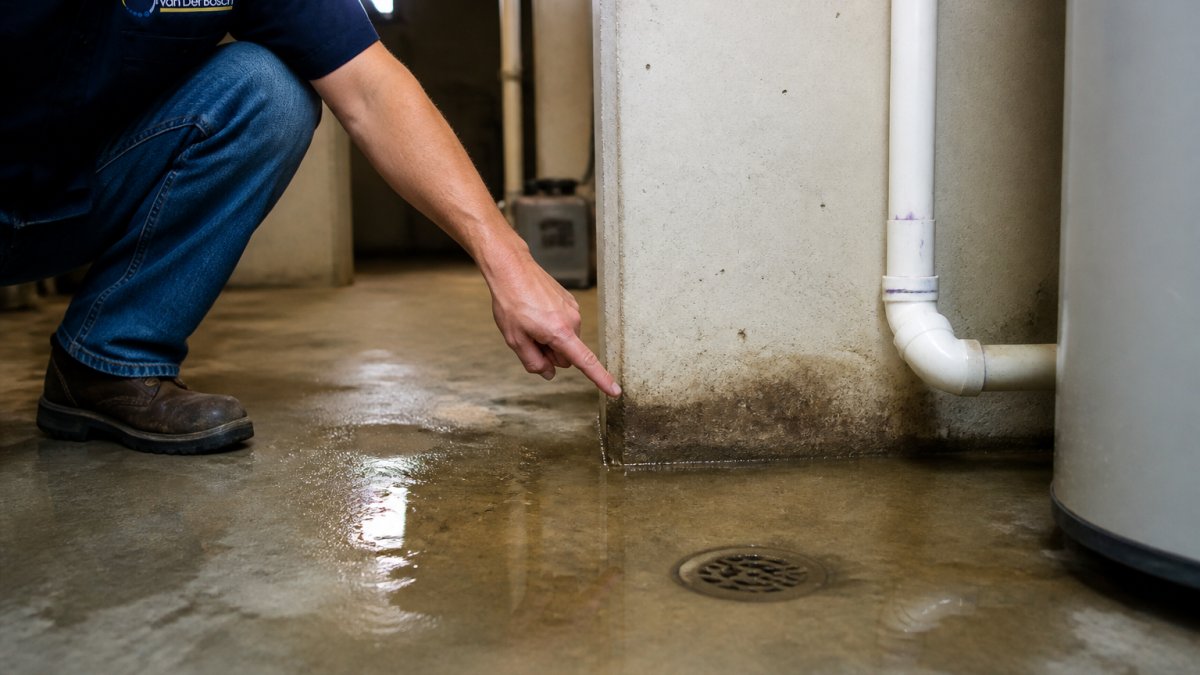
Close-up of a basement floor showing water pooling near a drain with a homeowner pointing to the problem area

Stop using water immediately. Do not flush toilets, run showers, use sinks, or run washing machines.

Locate your main water shut-off valve. This is usually near the street, at the foundation wall in your basement, or in a utility closet.

Identify and protect low-lying areas. Sewage flows to the lowest point in your home. If your basement has floor drains, a sump pump, or a laundry area, move valuables, electronics, and important documents away from these areas.

Contain the mess if it has already started. If sewage has begun backing up into your basement, place towels or absorbent materials around the affected area. Do not use your regular household vacuum or mop.

Keep people and pets away from affected areas. Sewage contains harmful pathogens (the CDC). Do not let children or pets play in yards where you suspect a sewer problem or touch contaminated water or materials.

Document what you see for insurance and diagnosis. Take photos or video of the backup, location, odors, and visible damage.

Call a licensed plumber immediately. A sewer line emergency requires professional diagnosis and cannot wait. Do not attempt to clear a main sewer line yourself with a plunger, drain snake, or chemical drain cleaner. VanDerBosch Plumbing Inc. provides emergency service to assess whether the problem is in your line or the municipal system, and to begin mitigation or repair.

What Causes Sewer Line Failure

Sewer line problems develop over time or occur suddenly. Understanding the cause helps determine whether you need repair or replacement.

Tree root intrusion is one of the most common causes. Tree roots seek moisture and can penetrate small cracks in older pipes, growing inside the line and blocking flow (Tree root intrusion in sewer systems: A review of extent and costs). Homes with mature trees near the sewer line are especially vulnerable.

Pipe collapse happens when cast iron, clay, or concrete pipes deteriorate from age or ground movement. Older homes often have cast iron or clay pipes that can crack or collapse.

Grease and debris buildup occurs when fats, oils, and non-flushable items accumulate in the line. Over time, this restricts flow and can cause backups. Drain cleaning and hydro jetting services can remove buildup before it causes a major blockage.

Ground movement or settling can shift pipes out of alignment, creating low spots where sewage pools instead of flowing. This is common in older neighborhoods where the soil has settled unevenly.

Bellied pipes (sagging sections) trap sewage and debris, leading to recurring clogs and backups.

Municipal system issues occasionally cause backups that originate outside your property. Heavy rains can overwhelm the city system, pushing sewage back into homes. A licensed plumber can determine whether the problem is on your side of the meter or the city’s responsibility.

Sewer Video Inspection: Diagnosing the Problem

Before deciding on repair or replacement, you need to know exactly what is wrong with your sewer line. A sewer camera inspection shows the condition of the pipe from inside.

A technician inserts a small camera on a flexible cable into your cleanout or drain, revealing cracks, collapses, root intrusion, debris, and misalignment. This diagnostic step determines your options: a small crack may be repairable with trenchless technology, while a severely collapsed section may require full replacement.

VanDerBosch Plumbing Inc. uses sewer line camera inspection services to give you a clear picture before recommending treatment and provides documentation for repairs or insurance claims.

Repair vs. Replacement: Understanding Your Options

Once you know what is wrong, you face a choice: repair the damaged section or replace the entire line.

Repair is appropriate when:

  • The damage is localized to a small section
  • The pipe material is still structurally sound elsewhere
  • The cost of repair is significantly lower than replacement
  • The pipe has many years of life remaining

Replacement is appropriate when:

Book a Visit →

  • The pipe is severely collapsed or has multiple breaks
  • The pipe material is at the end of its service life (cast iron over 75 years, clay over 60 years)
  • You are experiencing recurring problems
  • Repairs have failed to solve the problem permanently
  • The entire line shows signs of deterioration

Do not let a contractor automatically recommend replacement if repair will solve your immediate problem. A localized crack can often be repaired affordably. However, if your pipe is 80 years old and showing multiple problem areas, replacement may be the better long-term choice even if only one section is currently failing.

Trenchless pipe repair as an alternative to excavation

Trenchless repair technology has changed sewer line treatment. Instead of excavating your yard, a technician can repair pipes from the inside using one of two methods.

Pipe bursting pulls a new pipe through the old one, breaking the damaged pipe apart as it goes. This works well for collapsed pipes and requires only small access holes at each end.

Cured-in-place pipe (CIPP) uses a resin-saturated liner inserted into the damaged pipe and hardened in place, sealing cracks and small breaks without removing the old pipe.

Both methods avoid digging up your yard, eliminating landscape damage, heavy equipment, and reducing completion time. A sewer video inspection determines whether trenchless repair is possible for your situation.

Sewer Line Replacement Cost Factors

Pipe material and age. Older homes often have cast iron or clay sewer pipes that deteriorate and become brittle, crack, or collapse.

Depth and accessibility. Sewer lines typically run 4-8 feet below ground. Deeper lines require more excavation and equipment, increasing labor and time.

Length of the damaged section. If damage is isolated to a small section, repair of just that section may be appropriate.

Soil conditions and water table. Clay and rocky soil are harder to excavate than sandy soil.

Whether you choose traditional excavation or trenchless repair. Trenchless methods avoid digging and can be a more efficient option than full excavation in many cases.

Permits, inspections, and municipal requirements. Your city or county requires permits for sewer work and inspections at various stages.

Whether additional plumbing components need attention. If the inspection reveals that your cleanout is damaged, corroded, or missing, it may need repair or replacement.

Restoration and site conditions after excavation. If traditional excavation is necessary, the contractor must restore the area afterward.

Get a professional assessment rather than guessing at scope or cost.

When to Call a Professional

Do not wait to call a plumber if you suspect a sewer line problem. Early diagnosis prevents sewage from backing into your home and damaging your foundation or personal property.

Call immediately if you see raw sewage, smell foul odors from drains, or notice multiple fixtures draining slowly. These are signs the problem is beyond what you can fix yourself.

Call within 24 hours if you notice one or two drains backing up slowly, gurgling sounds from toilets, or patches of unusually green grass in your yard.

A licensed plumber can run a camera inspection, identify the problem, and explain your options. Many sewer issues are easier and less expensive to fix early than after they cause major damage.

VanDerBosch Plumbing Inc. is available seven days a week for emergency plumbing service. When a sewer line backup threatens your home, we respond quickly to diagnose the problem and discuss repair or replacement options.


A sewer line emergency can feel overwhelming, but you do not have to navigate it alone.

Frequently Asked Questions

What are the warning signs of a failing sewer line?

Multiple drains backing up simultaneously is the clearest sign. You may also notice sewage odors in the yard or basement, patches of unusually green grass (from sewage nutrients), persistent slow drains that don’t respond to plunging, or gurgling sounds from toilets and drains. If you see any of these, a sewer video inspection can confirm whether the main sewer line is damaged or clogged.

Can I fix a sewer line backup myself?

No. Sewer backups involve pressurized systems, hazardous wastewater, and underground infrastructure that requires professional diagnosis and repair. What you can do immediately is stop using water, locate your cleanout, and document the problem with photos for insurance. A licensed plumber should handle the actual repair work.

What’s the difference between trenchless pipe repair and traditional excavation?

Traditional excavation involves digging up your yard to access and replace the damaged pipe. Trenchless pipe repair uses camera inspection and specialized equipment to repair or reline the pipe from inside without major digging. Trenchless methods are faster and less disruptive, but not all damage qualifies. A professional inspection determines which option applies to your situation.

How much does sewer line repair or replacement cost?

Cost depends on the severity of damage, how deep the line is, whether you need repair or full replacement, accessibility, and whether trenchless methods can be used. A professional inspection and estimate are the only way to know your actual cost. Contact a licensed plumber for an evaluation of your specific situation.

Best Plumbing Companies in Chicago Suburbs

Table of Contents

Last Updated: October 1, 2026

What Makes a Reliable Plumbing Company in the Suburbs

When a pipe bursts at 2 AM or your toilet won’t stop running, you need more than just someone with a wrench. Finding the right plumbing companies Chicago suburbs requires understanding what separates a trustworthy contractor from one that leaves you frustrated and overcharged. A reliable plumbing company combines technical expertise, proper credentials, transparent pricing, and genuine availability when you need them most.

Article image

Licensed and Insured Credentials

The first thing to verify is licensing and insurance. A licensed plumber has completed apprenticeship requirements and passed exams demonstrating competency in local plumbing codes. Insurance protects you if something goes wrong during the repair. Ask for proof of both before work begins. Many homeowners skip this step and end up liable for injuries or property damage that a licensed, insured contractor would have covered.

VanDerBosch Plumbing Inc. operates with full licensing and insurance.

Emergency Availability and Response Times

Plumbing emergencies don’t follow business hours. The best plumbing companies Chicago suburbs offer seven-day availability and respond quickly. Ask directly about response time expectations, a company that answers at 2 AM and actually arrives is worth remembering.

VanDerBosch Plumbing Inc. provides same-day service and is available seven days a week.

Common Plumbing Problems That Require Professional Help

Not every drip needs a plumber, but certain problems absolutely do. Understanding which issues demand professional attention helps you avoid costly DIY mistakes and prevents minor problems from becoming emergencies.

Burst Pipes and Major Water Leaks

A burst pipe floods your home in minutes. If you see water spraying from a pipe, flowing from walls, or pooling under your home, turn off the main water shut-off valve immediately and call a professional, water pressure is too high for DIY repair.

Location affects repair difficulty: a burst under a sink is easier and less costly than one inside a wall or under the foundation. Professional plumbers can locate hidden leaks and repair them without unnecessary demolition.

Recurring Drain Backups and Clogged Toilets

If multiple drains back up simultaneously, kitchen sink, bathroom sinks, showers, the problem is in the main drain or sewer line, not individual fixtures. A professional sewer video inspection pinpoints the blockage and determines the best repair approach.

Recurring clogs in the same drain signal a deeper problem, partial blockage, tree roots, or structural damage. Over-the-counter drain cleaners provide only temporary relief.

Sewer Video Inspection: When and Why You Need It

A sewer video inspection uses a camera on a flexible rod to see inside your sewer line without digging, revealing tree roots, cracks, sagging sections, and blockages. It’s invaluable for recurring backups, slow drains, or older homes.

If the camera reveals roots or cracks, you’ll know exactly what repair method makes sense: hydro jetting for roots, or excavation for severe damage. Without inspection, you’re guessing and risking expensive mistakes.

Boiler Repair Services for Older Homes

Chicago suburbs have thousands of older homes with steam or hot-water boiler systems. These are reliable when maintained but need specialized knowledge, most modern plumbers won’t confidently work on vintage steam boilers.

Steam Boilers in Vintage Properties

Steam boilers convert water to steam and distribute it through radiators. They require specific maintenance: checking water levels, bleeding air, and inspecting the safety relief valve. A leaking radiator or boiler that won’t fire needs someone trained in steam systems.

Older steam boilers have cast iron components that can’t be replaced with modern parts. A plumber familiar with vintage systems can repair properly instead of recommending replacement.

Seasonal Maintenance and Winter Concerns

Winter creates specific challenges: a boiler idle all summer may not fire reliably in October, and frozen pipes risk uninsulated basements or exterior walls. Preventative maintenance, flushing sediment, insulating pipes, checking the relief valve, prevents winter emergencies.

Plumbing Maintenance Tips to Prevent Emergencies

Regular maintenance catches small problems before they become expensive. You don’t need a plumber for everything, but a few habits and seasonal checks make a real difference, especially in older homes where plumbing systems are under more stress.

Year-Round Drain Care and Prevention

Avoid grease, food scraps, and non-flushable items down drains. Grease solidifies and builds up over months; flushable wipes, dental floss, and hygiene products cause blockages. Use drain screens to catch hair. Monthly boiling water flushes minor buildup and grease.

Run cold water while the garbage disposal operates and for 15 seconds after. Avoid fibrous foods (celery, potato peels), bones, coffee grounds, and starchy foods, they jam blades or accumulate deeper in the line.

Book a Visit →

Water Heater and Fixture Inspection

Check under sinks and around the water heater monthly for leaks or rust. Corrosion often precedes failure by months. If you see rust, sediment, or discolored hot water, a professional inspection prevents sudden rupture and water damage.

Inspect toilet tanks for cracks or leaks. A slow leak wastes water silently until your bill spikes or the toilet refills periodically. A leaking fill valve or flapper can be replaced inexpensively if caught early.

Seasonal Preparation: Fall and Winter

Fall is the critical maintenance window for older homes. Before temperatures drop, have your boiler inspected and serviced. Professional maintenance includes flushing sediment and checking the relief valve.

Insulate exposed pipes in unheated areas before winter.

Spring and Summer Checks

After winter, inspect for water stains on basement walls or ceilings, indicating slow leaks from burst pipes inside walls. Early detection prevents mold and structural damage.

When to Call a Professional for Maintenance

If slow drains don’t respond to boiling water or a plunger, or if you see recurring backups, don’t wait for an emergency. A professional can use a drain camera or hydro jetting to clear buildup. In older homes, preventative hydro jetting every few years removes tree roots and mineral buildup.

Questions to Ask Before Hiring a Plumber

Before you call, knowing what to ask helps you compare companies fairly, understand what to expect, and avoid surprises on your bill. The right questions also help you determine whether a problem is truly an emergency or can wait for business hours.

Questions About Credentials and Availability

Are you licensed and insured? This is non-negotiable. A licensed plumber has completed apprenticeship requirements and passed exams. Insurance protects you if something goes wrong, ask for proof before work begins.

Questions About Diagnosis and Pricing

Do you charge a service call fee just to diagnose the problem? Some companies charge a diagnostic fee that gets credited toward repairs if you hire them; others don’t charge for the initial visit.

Questions About Repair Versus Replacement

Can this be repaired, or does it need to be replaced? Don’t let a plumber pressure you into replacement when repair is reasonable. A good plumber will explain the trade-offs: repair cost now versus replacement cost later.

Questions About Warranties and Follow-Up

Do you offer any warranty on repairs or new equipment? Warranties vary. Equipment manufacturers often provide warranties separate from the plumber’s labor warranty. Understand what’s covered and for how long.

Questions to Determine If It’s Really an Emergency

Is water actively leaking or flooding? A burst pipe, major leak, or sewer backup is an emergency. Turn off the main water shut-off valve and call immediately. Water damage spreads quickly and becomes expensive.

Residential vs. Commercial Plumbing Needs

Residential plumbing, homes, townhouses, small rental properties, focuses on individual fixtures and household systems. Commercial plumbing serves businesses, office buildings, and multi-unit residential properties with higher-capacity systems, stricter code requirements, and more complex layouts.

Schedule Your Plumbing Service Today

Plumbing problems don’t resolve themselves. A small leak becomes water damage. A slow drain becomes a backup. When you need professional help, you need someone reliable who shows up, diagnoses the problem honestly, and explains your options clearly.

When a plumbing emergency strikes, waiting for the next business day isn’t an option. VanDerBosch Plumbing Inc. offers same-day service seven days a week, backed by a 100% satisfaction guarantee and no service charges. Our licensed, insured technicians bring expertise in everything from burst pipes and clogged toilets to vintage steam boiler maintenance. Get the reliable, honest plumbing service your home deserves, call VanDerBosch Plumbing Inc. today.

Frequently Asked Questions

How do I know if a plumbing company is licensed and insured?

Ask to see their license and insurance certificates before work begins. Licensed plumbers have completed required training and passed exams in your state. Insurance protects you if damage occurs during the repair. Reputable plumbing companies are happy to provide proof of both. You can also verify licensing through your state’s licensing board. Never hire someone who refuses to show credentials or claims licensing isn’t necessary.

What should I look for when hiring a plumber in the suburbs?

Look for licensed and insured technicians with experience in your type of problem. Check whether they offer same-day or emergency service if you need urgent help. Ask about their warranty on repairs and whether they charge a service call fee just to diagnose the problem. Read customer reviews that mention response time, professionalism, and honest pricing. A good plumbing company should provide a clear estimate before starting work and explain what they found and why the repair is needed.

When should I call a professional for a clogged drain instead of trying to fix it myself?

Call a professional if a plunger or drain snake doesn’t clear the clog, if multiple drains are backing up at once, or if you suspect a problem deeper in the sewer line. Avoid chemical drain cleaners, which can damage pipes and create safety hazards. If the clog keeps returning in the same spot, a professional can inspect the line with a camera to find the real cause. For stubborn clogs, hydro-jetting or sewer video inspection can identify blockages that simple tools won’t reach.

What are the signs of a failing sewer line in older homes?

Watch for multiple drains backing up at the same time, slow drainage throughout the house, sewage odors in the yard or basement, unusually lush patches of grass (from nutrient-rich sewage), or cracks in the foundation. Older homes are more prone to sewer line problems because clay and cast iron pipes deteriorate over time. If you notice these signs, a sewer video inspection can confirm whether the line needs repair or replacement. Professional diagnosis is essential because some symptoms can point to other issues, and guessing wrong wastes time and money.

Emergency Drain Cleaning: What to Do Now

Table of Contents

Last Updated: September 30, 2026

Plumbing Emergency Signs That Require Drain Cleaning

A backed-up drain is one of the most common plumbing emergencies homeowners face. Unlike a slow drain that develops over weeks, a true emergency drain situation demands immediate attention because water can’t flow out of your home, creating potential damage and sanitation hazards.

The first step is recognizing whether you’re dealing with a localized clog or a sign of a deeper problem in your plumbing system. Not every slow drain requires professional emergency drain cleaning, but some situations absolutely do. Understanding the difference between a minor inconvenience and a genuine emergency will help you decide whether to try a temporary fix or call for help right away.

Single Drain vs. Multiple Drains Backing Up

When only one sink, shower, or toilet is draining slowly or backing up, the clog is likely isolated to that fixture or its branch line. You might be able to handle this yourself with a plunger or a drain snake.

But when multiple drains in different areas of your home back up at the same time, the problem is farther down your plumbing system. If your kitchen sink, bathroom sink, and shower all drain slowly or back up together, the blockage may be in your main sewer line or a shared drain line. This is a red flag that requires professional diagnosis and emergency drain cleaning services.

Water Pooling and Slow Drainage

Water pooling around floor drains, in your basement, or near your foundation is a serious sign. This often indicates a sewer backup or a main line clog that’s preventing water from leaving your property entirely. Slow drainage that worsens over hours rather than days also suggests an urgent blockage.

If you notice sewage smell coming from drains, toilets, or your yard, stop using water immediately and contact a professional. This is a health and safety issue that demands same-day attention.

What to Do Right Now if Your Drain Is Backed Up

When you discover a backed-up drain, your first priority is preventing water damage and further complications. Take these steps immediately while waiting for professional help.

Article image

Stop Using Water Immediately

The moment you realize you have a backed-up drain, stop using water. This includes toilets, sinks, showers, and washing machines. Every time you use water, you’re sending more liquid into a system that can’t drain it out. This increases the risk of sewage backing up into your home through the lowest drains, typically in basements or lower-level bathrooms.

If you have a basement floor drain and you see water beginning to pool there, this is an urgent sign. Turn off water use and contact an emergency plumber immediately.

Check Your Main Water Shut-Off Valve

Know where your main water shut-off valve is located before an emergency happens. It’s typically found near your water meter in a basement, crawl space, or utility room. In some homes, it’s outside near the street.

If water is backing up into your home or you see significant pooling, you may need to shut off the main water supply to prevent additional water from entering your system. Turn the valve clockwise to close it. This is a temporary measure only, you’ll still need professional help to clear the blockage and restore normal drainage.

Temporary Steps While Waiting for Help

While waiting for emergency drain cleaning services, avoid using the affected drains. If you must use water, use only the drains that are working normally and are in a different part of your home.

Don’t attempt to use a chemical drain cleaner on a backed-up drain. These products can make the situation worse and create safety hazards for the professional who arrives to help. Similarly, avoid using a plunger on multiple drains at once, as this can force sewage into other areas of your plumbing system.

If water is actively backing up into your home, place towels or a wet vacuum near the affected area to catch overflow. Document the problem with photos if possible, this helps your plumber understand what happened and how to address it.

Why Chemical Drain Cleaners Can Make Things Worse

Chemical drain cleaners are one of the most common mistakes homeowners make during a plumbing emergency, and they frequently turn a manageable problem into a costly one.

These products work by generating an exothermic reaction, they produce heat and caustic chemical action inside your pipes. When a drain is completely blocked, this pressure and heat have nowhere to escape. In older cast iron, clay, or galvanized steel pipes common in homes, the combination of heat and chemical corrosion can cause the pipe walls to weaken, crack, or even rupture. Plastic PVC pipes can soften or warp. If the blockage is severe, the buildup of pressure may force sewage backward into other parts of your plumbing system or cause a pipe joint to separate. Avoiding these destructive chemical reactions is essential when you are attempting professional blocked drain clearing to restore normal flow without compromising the integrity of your home plumbing.

Beyond structural damage, chemical cleaners create serious hazards for the professional who arrives to help. Residual chemicals can splash or react unpredictably when a plumber introduces water, tools, or diagnostic equipment into the drain. Some chemical products are incompatible with the high-pressure water used in hydro jetting, creating a safety risk. If a plumber must perform a sewer video inspection, chemical residue can coat the camera lens and make diagnosis impossible.

Book a Visit →

Chemical cleaners also leave a toxic residue inside your pipes that can persist for days or weeks. This makes it harder to determine the actual cause of the blockage, was it grease, tree roots, mineral buildup, or a structural failure? Without knowing the real problem, a plumber may recommend an incomplete solution, and the clog will return.

If you’ve already used a chemical drain cleaner before calling for professional help, inform your plumber immediately. They need to know what product was used, how much, and when. This allows them to take appropriate safety precautions and choose the right cleaning method.

For a true emergency drain situation, skip the chemicals entirely. A licensed plumber has the tools, training, and diagnostic equipment to clear the blockage safely without risking additional damage to your plumbing system or creating hazards during the repair process.

How Sewer Video Inspection Identifies the Real Problem

When a drain backs up, the cause might be a simple clog, tree roots invading your sewer line, a collapsed pipe section, or buildup inside your pipes. Without knowing what’s actually blocking the line, it’s impossible to choose the right solution.

Sewer video inspection uses a small camera on a flexible cable to look directly inside your drain and sewer lines. The plumber can see exactly where the blockage is, what’s causing it, and how severe the damage is.

Hydro Jetting Services for Stubborn Clogs and Buildup

Hydro jetting is a powerful drain cleaning method that uses high-pressure water to blast away clogs, grease buildup, and debris inside your pipes. Unlike a traditional drain snake, which punches a hole through a blockage, hydro jetting cleans the entire interior wall of the pipe.

When to Call a Licensed Plumber for Emergency Drain Cleaning

If your drain is backing up, multiple drains are slow at once, you see sewage or foul water, or water is pooling in your home, you need professional help immediately. These situations pose health risks and can cause significant property damage if not addressed quickly.

24-Hour Emergency Response and Same-Day Service

Drain emergencies don’t happen during business hours. When a pipe backs up at midnight or on a weekend, you need a plumber who’s actually available.

What to Expect During an Emergency Service Call

When your plumber arrives, they’ll start by asking about when the problem began, which drains are affected, and what you’ve already tried. This information helps them narrow down the cause.

Preventing Future Drain Emergencies

The best response to a drain emergency is preventing one in the first place. But if you’ve already experienced a backup, understanding what caused it and taking steps to prevent recurrence is equally important.

Addressing the Aftermath of a Sewer Backup

If sewage has backed up into your home, whether into a basement, crawl space, or lower-level bathroom, the cleanup involves more than just removing standing water. Sewage contains harmful bacteria, viruses, and pathogens that pose serious health risks to you and your family.

Routine Maintenance to Prevent Recurring Clogs

Once you know what caused your emergency, you can take targeted steps to prevent recurrence.

Frequently Asked Questions

What are the main signs I need emergency drain cleaning?

Multiple drains backing up at once, water pooling around floor drains, sewage odors, or gurgling sounds from toilets and sinks all indicate a clog deeper in your drain line or sewer system. A single slow sink may just need a plunger, but when several fixtures fail simultaneously, professional emergency drain cleaning is needed. Stop using water and call a licensed plumber right away.

Why shouldn’t I use chemical drain cleaners during an emergency?

Chemical cleaners can corrode older pipes, create toxic fumes, and may not reach the actual clog if it’s deep in the sewer line. If the clog is severe, the chemical can pool and cause pressure buildup. Professional drain cleaning methods like hydro jetting or drain snakes are safer and more effective for true emergencies.

How does sewer video inspection help with emergency drain cleaning?

A sewer video inspection camera shows exactly where the clog is located and what caused it—roots, grease buildup, broken pipe sections, or debris. This diagnostic step prevents unnecessary digging and helps the plumber choose the right cleaning method. For emergency situations, it confirms whether you need standard drain cleaning, hydro jetting services, or sewer line repair.

What should I do if my drain backs up at 2 AM?

Stop using all water immediately to prevent overflow and water damage. Locate your main water shut-off valve and know where it is. Do not use chemical drain cleaners. Place towels around affected drains to contain water. Call a licensed plumber who offers 24-hour emergency response. Many clogs worsen overnight, so immediate professional help prevents costly damage to your home or business.

How to Find Emergency Plumbers in Chicago Suburbs

Table of Contents

Last Updated: September 28, 2026

What Qualifies as a Plumbing Emergency

A plumbing emergency is any situation where water damage, health hazards, or system failure pose an immediate threat to your home or safety. The key difference between an emergency and a routine repair is urgency and risk.

True emergencies include burst pipes flooding your basement, sewage backing up into your home, active gas leaks, or complete loss of water supply. These situations demand immediate professional attention because they can cause structural damage, contaminate your water supply, or create dangerous conditions.

Not every plumbing problem requires emergency service. A slow drain, a dripping faucet, or a running toilet are annoying but not urgent. You can schedule these repairs during regular business hours. The challenge is knowing which problems fall into each category, especially when you’re stressed and water is actively damaging your home.

When you call about a potential emergency, describe what’s happening clearly: “Water is actively leaking from under my sink” gets a faster response than “I think I might have a leak somewhere.” Professionals can then assess whether your situation truly requires immediate dispatch or can wait for a scheduled appointment.

How to Find Emergency Plumbers When You Need Them

To find emergency plumbers when you need them, start your search before an actual emergency occurs. The time to research isn’t when water is pouring into your basement at midnight. Build a short list of licensed professionals in your area during calmer moments, then you’ll know exactly who to call when crisis hits.

Distinguish Emergency from Non-Emergency to Avoid Unnecessary Costs

Not every plumbing problem that happens outside business hours qualifies as an emergency. Understanding the difference can save you hundreds of dollars in after-hours surcharges.

True emergencies demand immediate dispatch:

  • Active water leaks flooding your home or basement
  • Burst pipes with water actively spraying or pooling
  • Sewage backing up into your home or yard
  • Complete loss of water supply
  • Gas leaks (call your utility company first, then a licensed professional)
  • Boiler failures in winter when heating is at risk

Problems that can wait until business hours:

  • Slow or clogged drains (unless multiple drains are backing up simultaneously)
  • Dripping faucets or running toilets
  • Low water pressure in a single fixture
  • Minor leaks under sinks that you can contain with a bucket
  • Water heater producing less hot water than usual

The key distinction is whether the problem is actively causing damage or creating a safety hazard right now. A slow leak under your sink is annoying, but if you’ve placed a bucket underneath and the water isn’t spreading, it can wait for a daytime appointment. A burst pipe flooding your basement cannot.

When you call, describe the situation clearly and let the professional determine urgency. “Water is actively leaking from my burst pipe and pooling on my basement floor” gets a faster response than “I think I might have a leak.” Professionals hear dozens of calls daily and can quickly assess whether your situation truly requires immediate dispatch.

Check Availability and Response Time

Ask any plumbing company directly: “Do you offer 24/7 emergency service?” Many plumbers advertise emergency availability but may operate limited hours or have varying response times.

Follow up with: “If I have an emergency at 2 AM on a Saturday, how long until someone arrives?” A realistic answer depends on your location and time of year, but professionals can often provide a general timeframe. Be skeptical of promises that sound too good to be true.

Also ask whether the company charges an additional fee just to dispatch someone for an emergency call. Understanding these cost structures upfront helps you decide whether to call immediately or wait a few hours.

Verify Licensing and Insurance

This is non-negotiable. Every plumber who enters your home should be licensed by your state and carry liability insurance. Licensing means they’ve passed exams and met training requirements. Insurance protects you if something goes wrong during the repair, for example, if a technician accidentally damages your wall while accessing a pipe.

Ask to see proof of both licenses and insurance before work begins. A legitimate company will provide this information without hesitation or defensiveness. If a plumber gets evasive about credentials, move on to someone else.

Licensed professionals also carry the right tools and knowledge to handle complex emergencies safely. Gas line work, boiler repairs, and sewer line issues require specific certifications beyond general plumbing licenses. You want someone who knows what they’re doing, especially when safety is at stake.

Book a Visit →

Build Your Pre-Emergency Contact List

During normal business hours, call 2-3 plumbers in your area and ask these questions:

  1. Do you offer 24/7 emergency service?
  2. What is your typical response time for emergencies?
  3. Do you charge an additional fee for after-hours or emergency dispatch?
  4. Can you provide proof of state licensing and liability insurance?
  5. Do you provide written estimates before starting work?
  6. What happens if the repair costs more than the initial estimate?
  7. What warranty or guarantee covers your repairs?

Write down their answers. When an actual emergency hits, you’ll already know who to call and what to expect. This preparation removes decision-making stress when you’re in crisis mode and helps you avoid calling the first plumber you find online, who may not be the best fit for your situation.

Signs of a Sewer Line Emergency

A sewer line emergency develops when your main sewer line backs up or breaks. Multiple drains in your home may back up simultaneously, or you might notice raw sewage in your yard. These situations create serious health hazards and require professional intervention immediately.

Common warning signs include toilets that gurgle when you run the sink, frequent backups in your lowest-level fixtures (usually the basement toilet or shower), or soft spots in your yard. If you notice a sewage smell in your yard or basement, don’t ignore it.

Older homes in the area sometimes have cast iron or clay sewer lines that deteriorate over decades. Tree roots can also penetrate sewer pipes and cause blockages (the EPA).

Burst Pipe Repair Services and When to Call

A burst pipe is an immediate emergency. Frozen pipes in winter are the most common cause, but pipes can also burst from age, corrosion, or high water pressure. Water floods out rapidly, causing damage to walls, ceilings, and belongings.

Gas Leak Detection and Safety

A gas leak is a life-threatening emergency. If you smell gas (a rotten egg odor that gas companies add for safety), leave your home immediately and call your gas utility company from outside. Don’t use your phone indoors, don’t flip light switches, and don’t light matches or candles.

What to Expect During an Emergency Plumbing Visit

When an emergency plumber arrives, they’ll assess the situation and explain what they found and what needs to happen next. A good professional takes time to answer your questions, even during an emergency.

What to Do Before the Plumber Arrives

Your immediate actions in the first minutes of a plumbing emergency can prevent thousands of dollars in damage.

Article image

Building Your Vetting Checklist for Emergency Plumbers

Before an emergency happens, create a simple checklist of questions to ask plumbers in your area. This preparation lets you make a confident decision quickly when stress is high.

When a pipe bursts or sewage backs up into your home, you need professional help fast. VanDerBosch Plumbing Inc. provides emergency plumbing services seven days a week with no service call fees, so you pay only for the actual repair. Our licensed and insured technicians arrive promptly and explain exactly what needs to happen next. Call today to discuss your emergency or to add our number to your contact list before you need it.

Vetting Criteria

What to Ask

Why It Matters

Availability

Do you offer 24/7 emergency service?

Ensures help is available when you need it

Response Time

How long until dispatch in emergencies?

Sets realistic expectations for when help arrives

Licensing

Can you provide proof of state license?

Confirms training and legal authority to work

Insurance

Do you carry liability insurance?

Protects you if something goes wrong during repair

Service Fees

Do you charge a service call fee?

Removes hidden costs from the estimate

Pricing Transparency

Do you provide written estimates before work?

Prevents surprise charges when the bill comes

Warranty

What warranty covers your repairs?

Gives you recourse if the repair fails soon after

Experience

What is your experience in the plumbing industry?

Indicates stability and experience with complex issues

Frequently Asked Questions

What qualifies as a plumbing emergency that requires immediate professional attention?

A plumbing emergency requires immediate professional attention when there is active water damage, gas leak, sewage backup, burst pipes, or complete loss of water service. Situations involving multiple drains backing up simultaneously, water pooling in the basement, or visible gas leak symptoms (rotten egg smell, hissing sounds) should be treated as emergencies. Contact a licensed plumber immediately or call emergency services if you suspect a gas leak.

How do I verify that an emergency plumber is actually licensed and insured?

Ask for the plumber’s license number and verify it with your state’s licensing board before work begins. Request a copy of their insurance certificate covering both liability and workers’ compensation. A reputable emergency plumbing company will provide this information immediately without hesitation. Licensed and insured technicians protect you from liability if someone is injured or property is damaged during the repair.

What should I do while waiting for an emergency plumber to arrive?

Locate and shut off your main water supply valve immediately to minimize water damage. Move valuables and furniture away from the affected area. If the emergency involves sewage, avoid contact and keep family members and pets away. For gas leaks, evacuate the building and call emergency services. Document the damage with photos for insurance purposes. Keep the area accessible so the plumber can work quickly when they arrive.

How can I find an emergency plumber who charges fair prices and is transparent about costs?

Call several emergency plumbing companies and ask about their service call fees, hourly rates, and whether they charge for diagnosis. Reputable companies will explain their pricing structure upfront and won’t hide charges in fine print. Always ask what the initial quote includes and whether additional costs may apply if the problem is more complex than first assessed.

Commercial Plumbing Maintenance Checklist 2026

Table of Contents

Last Updated: September 27, 2026

Why Commercial Plumbing Maintenance Matters

A single burst pipe or sewer backup can shut down operations, damage inventory, and create liability issues that cost far more than preventive maintenance ever would. That’s why a structured commercial plumbing maintenance program isn’t optional, it’s essential infrastructure management.

Most property managers and facility directors know maintenance matters, but many treat plumbing as a “call when something breaks” system. The problem with that approach is simple: you don’t see the slow corrosion, the pressure buildup, or the blockage forming until it becomes an emergency. By then, you’re paying for emergency service, potential water damage, and lost business hours.

At VanDerBosch Plumbing Inc., we work with commercial property owners and managers across the region to build maintenance schedules that catch problems early. The goal isn’t to add cost, it’s to prevent the expensive failures that disrupt operations and damage your reputation.

This guide covers the essential elements of a commercial plumbing maintenance checklist for 2026, including daily monitoring, seasonal inspections, regulatory compliance, and modern technologies that help you stay ahead of problems.

Preventive Plumbing Maintenance Schedule

A structured maintenance schedule divides tasks by frequency. Daily and weekly checks catch emerging issues quickly. Monthly inspections verify system performance. Quarterly and annual reviews assess long-term asset condition and plan for capital expenditures.

Daily and Weekly Tasks

Daily monitoring doesn’t require a licensed plumber, it requires someone on-site to notice what’s normal and what isn’t.

Check for visible leaks under sinks, around toilets, and beneath water heaters. Look at the floor around equipment for pooling water or dampness. Listen for unusual sounds: hissing, dripping, or grinding noises often signal pressure problems, loose connections, or debris in lines.

Monitor water pressure at the main shut-off valve. Pressure that drops without explanation may indicate a leak in the wall or underground. Pressure that spikes can damage fixtures and seals. A pressure reducing valve should keep supply pressure between 40-80 PSI in most commercial buildings.

Test the emergency shut-off valve weekly to confirm it operates smoothly. A valve that’s corroded or stuck won’t help during an actual emergency. Turn it off and back on slowly, don’t force it.

Check backflow prevention devices for leaks or visible corrosion. These devices protect your water supply from contamination and are required by code in most jurisdictions. If you see water pooling beneath one, call a licensed technician immediately.

Monthly Inspections

Monthly checks should be documented and performed by someone familiar with your building’s plumbing system.

Inspect all exposed piping for corrosion, especially copper and galvanized steel. Green or white buildup on copper indicates oxidation. Rust stains or pitting on steel mean the pipe wall is thinning. Take photos and note the location, this informs future replacement planning.

Test all shut-off valves (main line, fixtures, equipment) to ensure they operate smoothly. A corroded or stuck valve is useless when you need it. Slow operation or grinding sounds mean the valve needs professional service.

Flush drains in low-use areas. Drains that don’t flow regularly can develop biofilm buildup and odors. Running water through them monthly helps keep them clear.

Check water heater and boiler pressure gauges and temperature readings. Record these numbers in a maintenance log. Trending data shows whether equipment is operating normally or drifting toward failure.

Inspect the floor around the water heater, boiler, and main shut-off for dampness or pooling water. Small leaks are easier to address than major failures.

Quarterly and Annual Reviews

Quarterly reviews combine visual inspection with testing. Annual reviews should include a professional assessment of system condition and planning for replacement or major repair.

Inspect the interior of pipes using a sewer camera if any drains are slow or backing up. Early detection of blockages, tree root intrusion, or pipe collapse prevents emergency service calls. Many facilities schedule sewer line video inspection annually as preventive maintenance rather than waiting for a problem.

Test water pressure throughout the building. Pressure should be consistent at all fixtures. Drops at certain locations may indicate a developing leak or blockage.

Assess the condition of gaskets and seals on all fixtures. Worn seals cause slow leaks that waste water and damage surrounding materials. Replacing seals is inexpensive compared to repairing water damage.

Review your maintenance log for patterns. Are certain drains clogging repeatedly? Is pressure unstable? Is equipment aging? These trends guide replacement decisions and capital budgeting.

Commercial Boiler Maintenance Checklist

Boilers are high-pressure systems that require careful attention. Neglected boilers fail suddenly and create safety risks.

Inspect the boiler exterior monthly for leaks, corrosion, or visible damage. Check the water level gauge and pressure gauge. Record readings in a maintenance log.

Flush the boiler annually to remove sediment and mineral buildup. Sediment reduces efficiency and can cause overheating and failure. A professional technician performs this using hot water circulation.

Book a Visit →

Test the pressure relief valve quarterly. This valve protects the system from dangerous pressure buildup. If it doesn’t discharge properly, the boiler is at risk.

Inspect the combustion chamber and heat exchanger annually for cracks or corrosion. These components are expensive to replace and critical to safe operation.

Check all piping connections for leaks. Tighten any loose connections. Corroded connections should be replaced before they fail.

Test the automatic shut-off controls monthly. These safety devices must function reliably. If the boiler doesn’t shut off when it should, call a technician immediately.

For steam boilers specifically, inspect the condensate return line and steam trap operation. Malfunctioning traps waste energy and can damage the system.

Commercial Drain Cleaning Services and Sewer Inspection

Drains are the system you don’t think about until they fail. Regular cleaning prevents backups and extends asset life.

Routine Drain Maintenance

Clear drain screens and strainers monthly. Debris accumulates quickly in commercial kitchens, bathrooms, and laundry areas. Clogged screens force water to back up into pipes.

Run hot water through drains weekly to dissolve grease and soap buildup. In kitchens, this is especially important. Grease solidifies as it cools and creates blockages.

Use drain cleaners sparingly and only if recommended by a professional. Chemical cleaners can damage older pipes and harm the environment. Mechanical cleaning is usually safer and more effective.

For buildings with grease traps, schedule professional cleaning on a regular schedule, typically every 30-90 days depending on usage. Overflowed grease traps create health code violations and expensive cleanup.

Sewer Line Video Inspection Protocol

A sewer line video inspection uses a camera to examine the interior of pipes without excavation. It reveals blockages, cracks, root intrusion, and structural damage.

Schedule a sewer line video inspection if drains are slow, backing up, or if you’re planning a major renovation. Many commercial properties benefit from an initial inspection to establish baseline condition, then periodic inspections every 3-5 years.

The inspection identifies the exact location and nature of any problem.

Pipe Inspection, Corrosion Detection, and Leak Prevention

Pipe corrosion is the silent failure mode in older buildings. It happens slowly and invisibly until the pipe fails.

Plumber using a video inspection camera for commercial plumbing maintenance on basement pipes

Water Heater and Pressure System Maintenance

Water heaters and pressurized systems require regular flushing and inspection to operate efficiently and safely.

Smart Monitoring and Sustainability Considerations

Modern facilities increasingly use IoT sensors and smart monitoring to track plumbing system performance in real time.

Building Code Compliance and Emergency Preparedness

Commercial plumbing must meet local codes and regulations. Non-compliance creates liability and can result in fines or forced closure.


Frequently Asked Questions

How often should commercial plumbing systems be inspected?

Most commercial properties benefit from professional plumbing inspections at least annually, with quarterly reviews for high-traffic facilities or older buildings. Properties with significant water usage, multiple fixtures, or aging infrastructure may need more frequent checks. A licensed plumber can assess your specific system and recommend an appropriate inspection schedule based on building age, usage patterns, and maintenance history.

What should be included in a commercial plumbing maintenance checklist?

A comprehensive commercial plumbing maintenance checklist covers daily fixture checks, monthly pressure and leak assessments, quarterly drain cleaning, annual boiler servicing, pipe corrosion inspection, backflow prevention device testing, shut-off valve operation, water heater flushing, and sewer line video inspection. The checklist should also address regulatory compliance requirements specific to your facility type and local building codes. VanDerBosch can help develop a customized maintenance plan for your property.

What are the most common commercial plumbing issues to monitor?

Common issues include recurring drain clogs, grease accumulation in kitchen lines, low water pressure from mineral buildup, pipe corrosion in older systems, thermal expansion damage, backflow prevention failures, and sewer line blockages. Early detection through preventive maintenance can prevent costly emergency repairs and system failures. Regular inspections help identify problems before they disrupt operations or create safety hazards.

Why is preventive plumbing maintenance important for businesses?

Preventive maintenance reduces unexpected downtime, extends the life of plumbing infrastructure, prevents water damage and contamination, ensures regulatory compliance, and lowers long-term repair costs. A well-maintained system operates more efficiently, uses less water and energy, and protects your facility from emergency situations that could interrupt business operations. Proactive maintenance also provides documentation for facility audits and insurance purposes.

When should a professional plumber be called for commercial maintenance?

Schedule professional service for annual boiler inspections, sewer line camera inspections, backflow device testing, water heater flushing, and pressure system diagnostics. Call immediately if you notice multiple drains backing up, visible pipe corrosion, water leaks, low pressure, or unusual noises in the plumbing system. VanDerBosch provides same-day service and can respond to both routine maintenance and emergency situations.

How does commercial sewer line inspection work?

Sewer line video inspection uses a small camera attached to a flexible line that travels through your drain pipes to identify blockages, cracks, root intrusion, or buildup. The technician views real-time footage and can pinpoint problem areas without excavation. This diagnostic tool helps determine whether hydro-jetting, repairs, or replacement is needed. VanDerBosch offers sewer video inspection services to help property managers make informed maintenance decisions.

What is the difference between drain cleaning and hydro-jetting?

Standard drain cleaning uses mechanical tools or chemical treatments to clear clogs. Hydro-jetting uses high-pressure water to scour pipe walls, removing buildup, grease, mineral deposits, and debris more thoroughly. Hydro-jetting is often recommended for commercial properties with heavy usage or recurring clogs because it cleans the entire pipe rather than just creating a temporary opening. Your plumber can recommend the best method based on the type and severity of the blockage.